
Unleashing the Potential of Marketing Automation: Real-World Examples
This listicle provides seven marketing automation examples to inspire your own automation strategy. Discover how businesses use automation to improve efficiency and boost their bottom line. Learn practical tactics you can implement immediately, no matter your business size.
This article delivers actionable insights into how real-world companies are using marketing automation tools. We'll dissect successful strategies using platforms like HubSpot and Salesforce. You'll discover how to achieve similar results through replicable methods. We’ll explore the “why” behind each success, providing specific takeaways you can use.
We'll cover these key marketing automation examples:
- Email Drip Campaigns
- Lead Scoring and Nurturing
- Behavioral Trigger Campaigns
- Social Media Automation
- Personalized Website Content
- Customer Onboarding Sequences
- Retargeting and Remarketing Campaigns
Stop wasting time on repetitive marketing tasks. This in-depth exploration of marketing automation examples will empower you to scale your marketing efforts and maximize your ROI.
1. Email Drip Campaigns
Email drip campaigns are a cornerstone of marketing automation, enabling businesses to nurture leads and customers through automated email sequences. These sequences are triggered by specific timelines or user actions, delivering relevant content at pre-defined intervals. This automated approach allows for consistent communication without manual intervention, freeing up marketers to focus on strategy and analysis. This fundamental approach makes email drip campaigns a crucial element in any marketing automation strategy. Want to learn more about the advantages of email marketing? Learn more about…
Examples of Effective Email Drip Campaigns
Several successful companies leverage email drip campaigns to enhance customer engagement and drive conversions. HubSpot, for example, uses a welcome series for new subscribers, providing valuable resources and introducing key features. Airbnb sends post-booking travel tips, enhancing the customer experience and fostering loyalty. Dropbox utilizes an onboarding email series to guide new users through the platform, maximizing product adoption. Amazon's abandoned cart recovery campaigns remind customers of items left in their cart, recovering potentially lost sales. These diverse examples highlight the versatility and effectiveness of email drip campaigns across various industries.
Actionable Tips for Implementing Email Drip Campaigns
To maximize the impact of your email drip campaigns, consider these key tips:
- Segmentation: Divide your audience into specific segments to deliver highly targeted messages, increasing relevance and engagement.
- Testing: Experiment with different send times and frequencies to optimize open and click-through rates.
- Call to Action: Include clear and compelling calls to action in each email, guiding recipients towards desired actions.
- Monitoring: Track unsubscribe rates and adjust your strategy accordingly to maintain a healthy subscriber list.
- Progressive Profiling: Gradually gather more data about your subscribers over time to further personalize their experience.
Why and When to Use Email Drip Campaigns
Email drip campaigns are particularly effective for:
- Lead Nurturing: Guiding potential customers through the sales funnel with targeted content.
- Onboarding: Educating new users about your product or service and encouraging adoption.
- Customer Retention: Maintaining engagement with existing customers and fostering loyalty.
- Promotional Campaigns: Delivering targeted promotions and offers to specific segments.
The following infographic visualizes the three key stages of a successful email drip campaign: the initial automated trigger, the delivery of personalized content, and the analysis of performance and ROI.
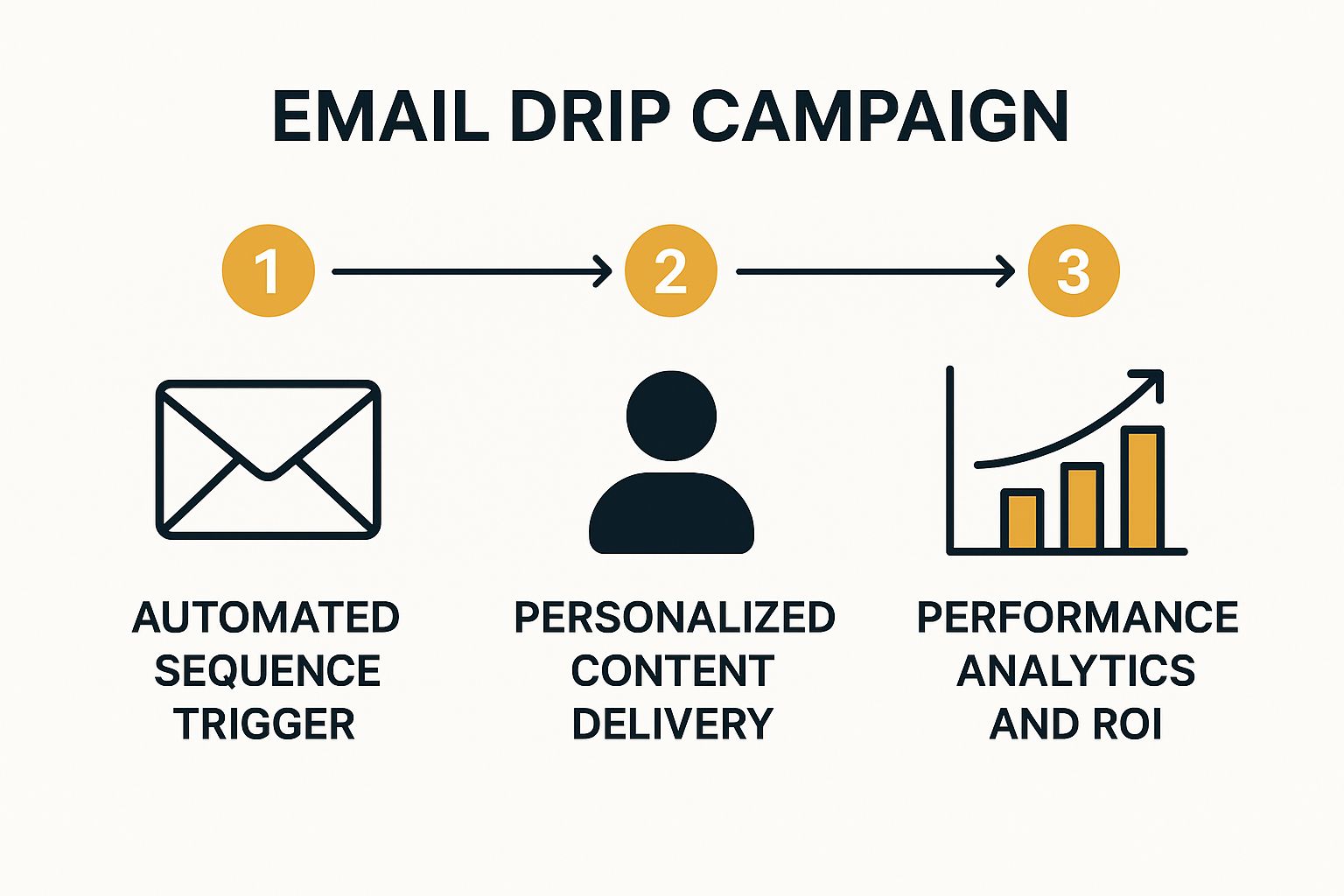
The infographic illustrates the cyclical nature of email drip campaigns, where analysis informs optimization, leading to improved triggers and content, and ultimately, a higher ROI. By understanding and implementing these key stages, businesses can leverage the power of email drip campaigns as a potent marketing automation example.
2. Lead Scoring and Nurturing
Lead scoring and nurturing is a powerful marketing automation example that combines two key processes. Lead scoring assigns numerical values to leads based on their demographics, behavior, and engagement. This allows businesses to identify high-potential prospects. Lead nurturing then uses automated workflows to deliver targeted content to these leads, guiding them through the sales funnel. This combined approach enables sales teams to prioritize effectively and build stronger relationships with qualified leads.
Examples of Effective Lead Scoring and Nurturing
Several companies have successfully implemented lead scoring and nurturing to enhance their sales processes. Salesforce's Einstein Lead Scoring uses AI to predict lead conversion potential, allowing sales teams to focus on the most promising opportunities. Marketo's predictive lead scoring, implemented by Microsoft, analyzes behavioral data to identify and prioritize high-value leads. HubSpot's lead scoring implementation at Nextiva facilitated personalized communications, resulting in increased engagement and conversions. These examples showcase the effectiveness of lead scoring and nurturing across various industries.
Actionable Tips for Implementing Lead Scoring and Nurturing
Implementing an effective lead scoring and nurturing system requires a strategic approach. Start with a simple scoring model and gradually refine it based on performance and sales team feedback. Align your scoring criteria with your ideal customer profile and sales objectives. Include both positive and negative scoring factors to accurately assess lead quality. Regularly review and adjust scoring thresholds to maintain accuracy. Combine implicit behavioral data with explicit demographic information for a more holistic view of each lead.
Why and When to Use Lead Scoring and Nurturing
Lead scoring and nurturing are particularly effective for businesses with complex sales cycles or a large volume of leads. This approach allows sales teams to efficiently manage their pipeline, prioritize high-potential leads, and deliver personalized content that resonates with each individual. This targeted approach increases conversion rates and shortens the sales cycle. It's beneficial for lead nurturing, sales qualification, personalized messaging, and improving sales efficiency.
Lead scoring and nurturing is particularly effective for:
- Prioritizing Leads: Identifying high-potential leads for sales follow-up.
- Personalizing Content: Delivering targeted messages based on lead score and behavior.
- Improving Sales Efficiency: Focusing sales efforts on the most qualified prospects.
- Increasing Conversions: Moving leads through the sales funnel more effectively.
By implementing lead scoring and nurturing, businesses can automate key aspects of their sales process, leading to improved efficiency, increased conversions, and stronger customer relationships. This makes it a crucial marketing automation example for businesses looking to optimize their sales and marketing efforts.
3. Behavioral Trigger Campaigns
Behavioral trigger campaigns are automated marketing messages activated by specific user actions or behaviors. These actions can occur on websites, apps, or even through email interactions. These campaigns deliver highly relevant, timely content based on real-time user behavior. This personalized approach significantly improves engagement and conversion rates, making it a powerful marketing automation example.
Examples of Effective Behavioral Trigger Campaigns
Several companies successfully utilize behavioral triggers. Netflix, for instance, uses viewing history to recommend personalized content, increasing user engagement and retention. Spotify creates personalized playlists based on listening habits, enhancing user experience. Sephora sends browse abandonment emails, reminding customers of products they viewed, recovering potentially lost sales. Uber uses location-based triggers to offer promotional discounts, driving app usage and conversions. These diverse examples showcase the effectiveness of behavioral triggers across different industries.
Actionable Tips for Implementing Behavioral Trigger Campaigns
Consider these key tips for maximizing the impact of your behavioral trigger campaigns:
- Set Frequency Caps: Avoid overwhelming users with too many messages by setting appropriate frequency limits.
- Progressive Delays: Implement delays for multiple trigger events to provide a natural flow of communication.
- Test Trigger Thresholds: Experiment with different thresholds to determine the optimal timing for triggering messages.
- Mobile Optimization: Ensure all triggered content is optimized for mobile devices to reach users on the go.
- Data Privacy: Implement appropriate data privacy measures to protect user information and maintain trust.
Why and When to Use Behavioral Trigger Campaigns
Behavioral trigger campaigns are particularly effective for:
- Personalized Recommendations: Suggesting products or content based on individual user preferences and behavior.
- Re-engagement Campaigns: Reconnecting with inactive users or customers who have abandoned their carts.
- Upselling and Cross-selling: Offering relevant product upgrades or complementary items based on purchase history.
- Improving Customer Experience: Providing timely support and guidance based on user interactions within your app or website.
Behavioral triggers provide a highly effective way to deliver the right message to the right person at the right time. By leveraging real-time user behavior, businesses can personalize the customer journey and drive significant improvements in engagement and conversions. This makes them a key component of any effective marketing automation strategy.
4. Social Media Automation
Social media automation involves using tools and software to schedule, publish, and manage social media content across multiple platforms automatically. This streamlines tasks like posting schedules, social listening, and automated responses, ensuring a consistent brand presence without constant manual intervention. It also facilitates cross-platform content distribution, maximizing reach and engagement. This automation frees up marketers to focus on strategy, content creation, and community engagement rather than repetitive tasks.

Examples of Effective Social Media Automation
Several brands effectively leverage social media automation. Starbucks uses Instagram story automation to showcase daily specials and promote limited-time offers, driving foot traffic. Nike utilizes Twitter engagement campaigns with automated polls and Q&A sessions to foster community and gather customer insights. Wendy's stands out with automated yet personalized Twitter responses, creating a witty and engaging brand persona. National Geographic excels at cross-platform content distribution, automatically sharing stunning visuals and articles across Instagram, Facebook, and Twitter, maximizing their reach and impact.
Actionable Tips for Implementing Social Media Automation
Consider these tips to optimize your social media automation strategy:
- Balance Automation and Authenticity: Maintain a balance between automated and manual posts to preserve a genuine connection with your audience.
- Monitor Brand Mentions: Set up monitoring alerts for brand mentions to respond promptly to customer inquiries and feedback.
- Content Calendars: Create content calendars aligned with your marketing campaigns for cohesive messaging and timely promotions.
- Platform Optimization: Use platform-specific optimization techniques for image sizes, hashtags, and posting times to maximize visibility on each channel.
- Review Automated Responses: Regularly review and update automated responses to ensure relevance and accuracy.
Why and When to Use Social Media Automation
Social media automation is particularly effective for:
- Consistency: Maintaining a regular posting schedule across multiple platforms.
- Efficiency: Streamlining repetitive tasks and freeing up time for strategic activities.
- Engagement: Automating responses to comments and messages to enhance customer service and community building.
- Reach: Expanding reach and visibility through automated cross-platform content distribution.
- Analysis: Tracking social media performance and gathering insights for campaign optimization. Want to learn more about social media automation? Learn more about…
By strategically implementing these tips, businesses can leverage social media automation to enhance their online presence, engage their target audience, and drive meaningful results. This makes it a vital component of any modern marketing automation example.
5. Personalized Website Content
Personalized website content uses visitor data, behaviour, and preferences to dynamically display customized content, product recommendations, and messaging in real-time. This creates unique website experiences for each visitor, improving engagement and conversion rates through relevant, targeted content delivery. Instead of a generic, one-size-fits-all approach, personalized content speaks directly to individual interests, making the website experience more compelling and effective. This targeted approach transforms a static website into a dynamic platform that caters to individual needs, boosting user satisfaction and business outcomes.
Examples of Effective Personalized Website Content
Several successful companies leverage personalized website content to enhance user experience and drive conversions. Amazon, a pioneer in this area, uses browsing history and purchase patterns to deliver highly accurate product recommendations. This personalized approach has significantly contributed to their sales growth. Netflix tailors its homepage and content suggestions based on viewing history, ensuring users quickly find shows and movies they'll enjoy. Spotify's Discover Weekly playlists offer personalized music recommendations, driving user engagement and platform loyalty. LinkedIn personalizes news feeds and job recommendations based on professional profiles and connections, making the platform more valuable for career development. These diverse examples demonstrate the power of personalization across various industries.
Actionable Tips for Implementing Personalized Website Content
To maximize the impact of personalized website content, consider these key tips:
- Start Simple: Begin with basic personalization, such as greeting users by name or location, and gradually increase complexity as you gather more data.
- Progressive Profiling: Implement strategies to collect visitor data over time, allowing for increasingly refined personalization.
- Fallback Content: Prepare default content for new or unknown visitors to ensure a positive experience for everyone.
- A/B Testing: Test the effectiveness of your personalization strategies by comparing personalized content against generic control groups.
- Page Speed: Ensure your website loads quickly even with dynamic content to avoid frustrating users.
Why and When to Use Personalized Website Content
Personalized website content is particularly effective for:
- E-commerce: Boosting sales by recommending relevant products based on browsing history and purchase patterns.
- Content Marketing: Increasing engagement by displaying content tailored to individual interests and preferences.
- Lead Generation: Improving conversion rates by presenting targeted offers and calls to action.
- Customer Retention: Fostering loyalty by creating a more personalized and engaging customer experience.
Personalized website content represents a powerful marketing automation example. By dynamically adapting to each visitor, businesses can enhance engagement, improve conversion rates, and foster stronger customer relationships. This approach moves beyond static web pages and creates a dynamic, interactive experience that resonates with individual needs, contributing to a more effective and personalized online journey for every user. By implementing these tips and understanding the best applications, businesses can unlock the full potential of personalized website content as a key marketing automation tool.
6. Customer Onboarding Sequences
Customer onboarding sequences are automated workflows designed to guide new customers through their initial experience with a product or service. These sequences combine emails, in-app messages, tutorials, and resources to ensure customers understand the product's value, achieve early success, and become long-term users. Effectively implemented onboarding nurtures customer relationships from the outset, reducing churn and maximizing lifetime value. This makes onboarding a powerful marketing automation example for businesses seeking sustainable growth.
Examples of Effective Customer Onboarding Sequences
Several companies demonstrate successful customer onboarding. Slack's interactive onboarding seamlessly integrates new team members, showcasing key features through guided tours. Canva's design tutorial sequence empowers new users to create visuals quickly, demonstrating the platform's ease of use. Dropbox's file organization onboarding flow helps users understand the core functionality, promoting immediate product adoption. Duolingo's language learning goal-setting sequence personalizes the learning path, increasing user engagement and motivation. These examples highlight the strategic use of onboarding across diverse platforms.
Actionable Tips for Implementing Customer Onboarding Sequences
To optimize your customer onboarding sequences, consider these actionable tips:
- Focus on Early Wins: Design your onboarding to deliver quick “aha moments” that showcase the product's value proposition.
- Segmentation: Tailor the onboarding experience based on user goals or use cases, ensuring relevance and personalization.
- Progress Indicators: Use progress bars or checklists to visually represent user advancement, encouraging completion.
- Support Access: Provide multiple avenues for accessing help and support, addressing user questions and concerns promptly.
- Analyze and Optimize: Regularly track drop-off points in the onboarding sequence and identify areas for improvement.
Why and When to Use Customer Onboarding Sequences
Customer onboarding sequences are particularly effective for:
- Product Adoption: Guiding new users through key features and functionalities, encouraging active usage.
- Customer Retention: Building strong customer relationships from the start, reducing early churn and fostering loyalty.
- Value Demonstration: Showcasing the product's benefits and helping users achieve desired outcomes quickly.
- Feature Discovery: Introducing users to lesser-known features that enhance their experience and deepen engagement.
This video further illustrates the importance of customer onboarding in driving user engagement and achieving business objectives. By implementing these strategies, businesses can leverage customer onboarding sequences as a crucial element in their marketing automation efforts.
7. Retargeting and Remarketing Campaigns
Retargeting and remarketing campaigns automatically serve targeted ads or messages to users who have previously interacted with a brand but haven't converted. These campaigns leverage cookies, pixel tracking, and customer data to re-engage potential customers across various digital channels. Personalized messaging tailored to previous interactions makes these campaigns highly effective in recapturing lost interest and driving conversions. This automation allows marketers to stay top-of-mind with potential customers without constant manual effort.
Examples of Effective Retargeting and Remarketing Campaigns
Several companies demonstrate the power of retargeting and remarketing. Amazon excels at product retargeting across the Google Display Network, reminding users of previously viewed items. Booking.com uses hotel reminder campaigns, encouraging users to complete their bookings. Wayfair implements furniture retargeting with discount offers, incentivizing hesitant buyers. Expedia’s travel deal remarketing campaigns entice users with personalized travel packages based on their past searches. These diverse examples illustrate the versatility of retargeting and remarketing across various e-commerce and service industries.
Actionable Tips for Implementing Retargeting and Remarketing Campaigns
Consider these tips to maximize the impact of your campaigns:
- Segmentation: Create different ad sets for different stages of the funnel, tailoring messaging to user intent.
- Dynamic Product Ads: Use dynamic product ads for e-commerce retargeting, showcasing previously viewed items.
- Frequency Caps: Implement frequency caps to avoid ad fatigue and maintain a positive user experience.
- Exclusion Lists: Exclude recent customers from ongoing campaigns to prevent redundant advertising.
- Creative Testing: Test different creative formats and messaging to optimize click-through and conversion rates.
Why and When to Use Retargeting and Remarketing Campaigns
Retargeting and remarketing are particularly effective for:
- Abandoned Cart Recovery: Recapturing lost sales by reminding users of items left in their online shopping carts.
- Lead Nurturing: Re-engaging leads who have interacted with your website or content but haven't converted.
- Cross-selling and Upselling: Promoting related products or higher-tier services to existing customers.
- Brand Awareness: Keeping your brand top-of-mind with users who have shown interest in your products or services.
Want to learn more about Retargeting and Remarketing Campaigns? This strategy is a valuable component of any marketing automation plan, allowing you to efficiently re-engage potential customers and maximize your return on ad spend. By strategically segmenting audiences and personalizing messaging, you can effectively nudge users towards conversion and boost overall sales. This approach is a powerful marketing automation example due to its ability to automate personalized outreach and drive measurable results.
7 Marketing Automation Examples Compared
| Marketing Automation Type | Implementation Complexity 🔄 | Resource Requirements ⚡ | Expected Outcomes 📊 | Ideal Use Cases 💡 | Key Advantages ⭐ |
|---|---|---|---|---|---|
| Email Drip Campaigns | Medium – setup of sequences and triggers | Moderate – requires email platform and CRM integration | Improved lead nurturing and conversion (15-25% open rates) | Lead nurturing, onboarding, cart recovery | Scalable automation, measurable ROI, personalized content |
| Lead Scoring and Nurturing | High – calibration and data integration | High – behavioral data tracking and CRM integration | Better lead qualification, up to 77% lift in ROI | Prioritizing leads, sales & marketing alignment | Focus on high-quality leads, data-driven optimization |
| Behavioral Trigger Campaigns | High – requires real-time tracking system | High – multi-channel tracking and data infrastructure | Higher engagement, 15-30% uplift in conversion rates | Timely, behavior-based messaging, cart abandonment | Real-time relevance, personalized timely interactions |
| Social Media Automation | Medium – scheduling and chatbot setup | Moderate – social tools and platforms required | Consistent posting, improved engagement | Social media management, brand presence | Saves time, enables 24/7 engagement, cross-platform |
| Personalized Website Content | High – technical setup and dynamic systems | High – personalization engines and data integration | 10-30% conversion increase, better engagement | Website experience optimization, product recommendations | Enhances UX, competitive advantage, data-rich insights |
| Customer Onboarding Sequences | Medium to High – multi-channel workflows | Moderate to High – content creation & tech integration | Reduced churn, accelerated time-to-value | SaaS and product adoption, new customer success | Scalable onboarding, improved retention and adoption |
| Retargeting and Remarketing | Medium – ad platform setups and pixel tracking | Moderate to High – ad spend and tracking tools | 2-5% conversion rate, lower CPA than cold traffic | Recovering abandoned prospects, increasing brand recall | Highly targeted ads, cost-effective conversions |
Elevating Your Marketing Game with Automation
This exploration of marketing automation examples has revealed the potential to revolutionize how businesses connect with their audience. From email drip campaigns and lead nurturing to personalized website content and retargeting, automation empowers you to achieve more with less, scaling your efforts while maintaining a personal touch. These strategies enable you to streamline repetitive tasks, personalize the customer journey at every touchpoint, and ultimately drive better results. Remember, effective marketing automation isn't about replacing human interaction but enhancing it. It's about working smarter, not harder.
Key Takeaways for Implementing Marketing Automation
Let's recap the key takeaways to consider when implementing marketing automation in your own strategy:
- Data-Driven Decisions: Leverage the data gathered through automation to understand customer behavior, preferences, and pain points. This insight allows for more targeted and effective campaigns.
- Personalization is Paramount: Customers value personalized experiences. Use automation to tailor your messaging and offers to individual needs and preferences, fostering stronger relationships and driving conversions.
- Strategic Segmentation: Don't treat all your customers the same. Segment your audience based on demographics, behavior, and other relevant factors to deliver the right message to the right people at the right time.
- Test and Optimize: Marketing automation isn't a set-it-and-forget-it solution. Continuously analyze your campaigns, A/B test different approaches, and refine your strategies based on performance data.
The Power of Integrated Marketing Automation
These marketing automation examples – email drip campaigns, lead scoring and nurturing, behavioral trigger campaigns, social media automation, personalized website content, customer onboarding sequences, and retargeting/remarketing campaigns – demonstrate the power of an integrated approach. By connecting these different automation elements, you can create a seamless and cohesive customer journey that nurtures leads, builds loyalty, and drives revenue. This interconnectedness is critical for maximizing the impact of your automation efforts.
Prioritizing Data Privacy and the Human Element
As you embrace automation, remember to prioritize data privacy and maintain a balance between automated interactions and genuine human connection. Transparency with your audience about how their data is being used is crucial for building trust. While automation streamlines many tasks, it’s essential to retain the human touch in your marketing efforts to build authentic relationships.
Unlocking Future Growth with Marketing Automation
Mastering marketing automation isn't just about staying ahead of the curve; it's about unlocking future growth. By strategically implementing these examples and continuously optimizing your approach, you can achieve greater efficiency, improved customer engagement, and ultimately, a stronger bottom line. Embracing these principles will set your business up for long-term success in today's dynamic digital landscape. The potential of marketing automation is vast, offering a significant competitive advantage for businesses of all sizes in the UK and beyond.
Ready to supercharge your marketing efforts and implement these powerful strategies? Explore The Digital Marketing Toolbox for a comprehensive suite of tools designed to streamline your automation workflows, from email marketing and lead management to social media scheduling and analytics. The Digital Marketing Toolbox offers practical resources and templates inspired by the marketing automation examples discussed, helping you implement these tactics effectively.


