
In a competitive market, scaling your business effectively means working smarter, not just harder. The key lies in strategic automation, a powerful approach that streamlines repetitive tasks, personalises customer interactions, and frees up your team to focus on high-impact activities like strategy and creative development. Moving beyond simple, scheduled emails, modern marketing automation strategies allow you to build sophisticated, responsive systems that nurture leads, engage customers, and drive revenue with remarkable efficiency.
This guide is designed to be a practical toolkit, not a theoretical overview. We will move directly into actionable frameworks you can implement immediately. Forget generic advice; we are delving into specific, proven methods that deliver measurable results. You will discover how to create dynamic systems that adapt to customer behaviour in real-time, ensuring your marketing messages are always timely, relevant, and effective.
Here, we will explore a curated collection of ten powerful marketing automation strategies, complete with step-by-step implementation guidance, real-world examples, and tool recommendations. Whether you are a small business owner aiming for cost-effective growth, an e-commerce manager focused on boosting conversions, or a marketing professional exploring AI-driven analytics, this listicle provides the practical insights you need. Prepare to learn how to:
- Automate lead scoring and nurturing to prioritise your sales efforts.
- Personalise content and customer journeys at scale.
- Leverage behavioural triggers for timely and relevant communication.
- Implement multi-channel campaigns that provide a seamless customer experience.
By the end of this article, you will have a clear roadmap for transforming your marketing efforts from manual and time-consuming to automated, intelligent, and growth-oriented. Let’s get started.
1. Lead Scoring and Nurturing Automation
Lead scoring and nurturing automation is a powerful combination that systematically qualifies prospects and guides them towards a purchase. This strategy involves assigning points to leads based on their attributes (like job title or company size) and behaviours (such as website visits or email opens). Once a lead reaches a predefined score, they are identified as sales-ready, allowing your sales team to focus their efforts on the most promising opportunities.

Simultaneously, automated nurturing workflows deliver personalised content to leads at different stages of the funnel, keeping them engaged until they are ready to buy. This is one of the most fundamental marketing automation strategies because it directly bridges the gap between marketing efforts and sales results, ensuring a steady flow of high-quality leads. For instance, tech giant Lenovo successfully used Salesforce Pardot to implement this approach, resulting in a remarkable 150% increase in marketing-qualified leads.
How to Implement This Strategy
To effectively deploy lead scoring and nurturing, start by defining what an ideal customer looks like for your business. Collaborate closely with your sales department to establish the criteria for a “sales-qualified lead” (SQL).
- Develop a Scoring Model: Assign positive scores for desirable attributes (e.g., +10 for a C-level executive) and actions (+5 for downloading a whitepaper). Implement negative scoring to penalise signs of disengagement, such as unsubscribing from emails (-20) or long periods of inactivity (-5).
- Create Nurturing Sequences: Design automated email workflows tailored to different lead segments. A new subscriber might receive a welcome series, while a lead who downloaded a case study could get more product-focused content.
- Set Scoring Thresholds: Determine the point value at which a lead is considered a marketing-qualified lead (MQL) and automatically passed to the sales team for follow-up.
- Refine and Optimise: Regularly review the performance of your scoring model. Analyse which leads convert to customers and adjust your scoring criteria to improve accuracy over time. This continuous feedback loop is crucial for long-term success.
2. Email Marketing Automation
Email marketing automation is the cornerstone of many digital communication strategies, enabling businesses to send timely, personalised, and relevant messages to subscribers. This approach involves setting up triggered email sequences based on user behaviour, preferences, or their specific stage in the customer lifecycle. Instead of manual batch-and-blast campaigns, automation delivers the right message at the right moment, enhancing user experience and driving conversions.
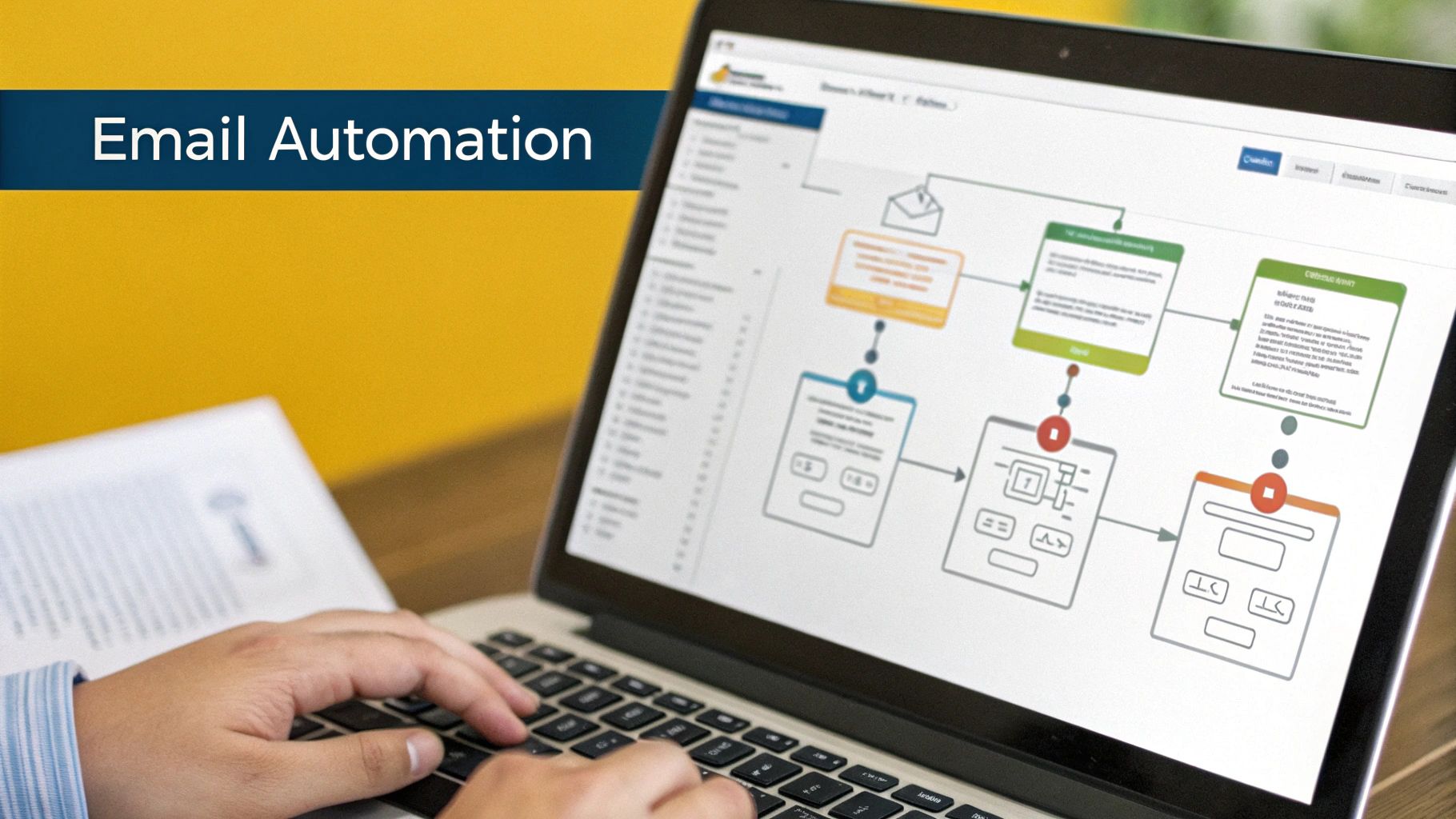
From welcome series for new subscribers to abandoned cart reminders for e-commerce shoppers, this is one of the most effective marketing automation strategies for nurturing relationships at scale. For instance, Airbnb leverages browsing history to send personalised travel recommendations, while Amazon’s highly effective abandoned cart emails are known to recover a significant percentage of would-be lost sales. Realising the numerous benefits this approach offers is key to modern marketing success. You can explore the advantages of email marketing to understand its full potential.
How to Implement This Strategy
To successfully implement email marketing automation, you must move beyond generic messaging and focus on delivering personalised value through segmentation and triggers. Start by mapping out key customer journey touchpoints where an automated email could be beneficial.
- Segment Your Audience: Group subscribers based on demographics, purchase history, and engagement level. Create distinct segments for new leads, loyal customers, and inactive users to tailor your messaging accordingly.
- Design Trigger-Based Workflows: Develop automated sequences for specific actions. Common examples include a welcome series for new sign-ups, post-purchase follow-ups to gather reviews, and re-engagement campaigns for dormant subscribers.
- Personalise Your Content: Use dynamic content to insert subscriber names, mention previously viewed products, or recommend items based on past purchases. Compelling, personalised subject lines are crucial for boosting open rates.
- Test and Optimise: Continuously monitor key metrics like open rates, click-through rates, and conversions. A/B test different subject lines, send times, and content to refine your campaigns for optimal engagement and performance.
3. Customer Journey Mapping and Automation
Customer journey mapping and automation is a holistic strategy that visualises every interaction a customer has with your brand, from initial awareness to post-purchase loyalty. This approach allows you to create automated workflows that deliver a seamless and personalised experience at each stage. By mapping the entire journey, you can identify critical touchpoints, moments of friction, and opportunities to deliver the right message at the right time, ensuring consistency across all channels.
This is one of the most sophisticated marketing automation strategies because it moves beyond single campaigns to orchestrate the entire customer lifecycle. It ensures that marketing, sales, and service efforts are perfectly aligned with the customer's needs and context. For example, Nike optimised its digital customer journey by personalising recommendations and follow-up communications, leading to a reported 30% increase in digital sales. Similarly, Starbucks uses its mobile app to automate rewards and personalised offers, which helped increase customer lifetime value by 25%.
How to Implement This Strategy
To effectively implement journey automation, you must first gain a deep, empathetic understanding of your customer's experience from their perspective. This involves gathering data and insights from across your organisation.
- Map Current Customer Touchpoints: Begin by outlining every possible interaction a customer might have with your brand, from seeing a social media advert to contacting customer support. Use tools like flowcharts to visualise this path.
- Use Customer Feedback to Validate: Don't rely on assumptions. Use surveys, interviews, and reviews to understand what customers are actually thinking and feeling at each stage. This qualitative data is invaluable for identifying pain points.
- Implement Cross-Channel Tracking: To automate effectively, you need a unified view of the customer. Use marketing automation platforms like Salesforce Journey Builder or Adobe Experience Cloud to track interactions online, in-store, on mobile, and via email.
- Focus on High-Impact Stages First: Instead of trying to automate the entire journey at once, prioritise the stages that have the biggest impact on conversion or retention, such as onboarding new customers or re-engaging at-risk users.
- Regularly Review and Update: Customer behaviours and expectations change. Revisit and refine your journey maps at least once or twice a year to ensure they remain accurate and your automated workflows are still effective.
4. Social Media Automation
Social media automation involves using tools to schedule content, monitor conversations, and manage engagement across various platforms. This strategy frees up valuable time by handling repetitive tasks, allowing your team to focus on creating quality content and fostering genuine community interaction. It automates the distribution of posts at optimal times, listens for brand mentions, and can even handle initial responses to common queries, ensuring a consistent and active brand presence.
By streamlining workflows, social media automation helps maintain brand voice and responsiveness without constant manual oversight. This is one of the most accessible marketing automation strategies, offering immediate benefits in efficiency and audience reach. For example, Hootsuite, a key player in this space, used its own platform to automate social media management and reportedly saw a 150% increase in engagement. Similarly, Netflix excels at scheduling promotional content for its vast library across global platforms, keeping audiences consistently informed and excited. This approach is fundamental for any modern digital marketing effort. If you're building your online presence, you can explore a beginner's guide to digital marketing on grow-your-biz.com to understand its core components.
How to Implement This Strategy
To successfully implement social media automation without sounding robotic, focus on creating a balanced system that blends automated efficiency with authentic human touch.
- Schedule Content Strategically: Use tools like Buffer or Sprout Social to plan and schedule posts for times when your audience is most active. Mix promotional content with valuable, engaging posts to keep your feed interesting.
- Set Up Social Listening: Configure alerts for keywords, hashtags, and mentions of your brand. This allows you to track conversations, identify customer service issues, and discover user-generated content in real-time.
- Balance Automation and Human Interaction: Automate evergreen content and initial responses, but ensure a human team member steps in for complex queries or to engage in meaningful conversations. Wendy's Twitter account is a masterclass in this, using automation for consistency while maintaining a distinct, human-led brand personality.
- Review and Refine: Regularly analyse the performance of your automated posts and responses. Use the insights to refine your content calendar, update automated replies, and adjust your overall strategy for better results.
5. Behavioral Trigger Marketing
Behavioral trigger marketing is a highly targeted approach that automatically delivers personalised marketing messages based on specific user actions or behaviours. This strategy leverages real-time data to trigger immediate, relevant communications that align with the user's current intent and stage in the customer journey, moving beyond simple demographics to focus on what users actually do.
When a user abandons a shopping cart, watches a specific product video, or visits your pricing page multiple times, these actions can trigger a predefined automated response, such as a reminder email or a special offer. These timely interventions are powerful marketing automation strategies because they capitalise on moments of high intent, significantly increasing engagement and conversion rates. For example, music streaming giant Spotify uses listening behaviour to trigger personalised “Discover Weekly” playlists, keeping users engaged and demonstrating a deep understanding of their individual tastes.
How to Implement This Strategy
To implement behavioral trigger marketing, you must first identify the key user actions that signal important shifts in their journey. This requires robust data tracking and a clear understanding of your customer lifecycle.
- Identify High-Value Triggers: Start by mapping your customer journey and pinpointing critical actions. High-value triggers often include cart abandonment, browsing a specific product category several times, or downloading a high-intent resource like a pricing guide.
- Create Triggered Campaigns: For each identified behaviour, design a corresponding automated campaign. This could be a single email, a multi-touch sequence, an in-app message, or a push notification designed to re-engage the user based on their specific action.
- Set Clear Conditions and Timing: Define the exact conditions that must be met to activate a trigger. Test the timing of your messages carefully; an abandoned cart reminder sent after one hour is often more effective than one sent 24 hours later. Implement frequency caps to avoid overwhelming your audience.
- Monitor and Refine: Continuously analyse the performance of your triggered campaigns. Track open rates, click-through rates, and conversion rates for each trigger. Use this data to adjust your messaging, timing, and the trigger conditions themselves to optimise results over time.
6. Retargeting and Remarketing Automation
Retargeting and remarketing automation is a strategic approach to re-engage users who have previously interacted with your brand but have not yet converted. This method uses tracking technologies like cookies and pixels to follow your audience across the web and social media, serving them personalised adverts designed to bring them back to your site. By reminding potential customers of their initial interest, you can significantly increase conversion rates and recover otherwise lost sales.
This is one of the most cost-effective marketing automation strategies as it targets a warm audience already familiar with your brand. For instance, dynamic retargeting platform Criteo has helped e-commerce brands recover an average of 13% of lost sales through its automated campaigns. Similarly, Volkswagen used Google’s remarketing capabilities to increase brand-related searches by a significant 41%, demonstrating its power in maintaining brand presence.
How to Implement This Strategy
Effective retargeting relies on delivering the right message to the right user segment at the right time. Start by installing tracking pixels from platforms like Google Ads and Facebook Ads on your website to begin collecting audience data.
- Segment Your Audience: Group users based on their on-site behaviour. For example, create separate audiences for users who visited your homepage, viewed a specific product category, or abandoned their shopping cart.
- Develop Tailored Creative: Design different ad creatives for each stage of the funnel. A user who only visited the homepage might see a general brand awareness advert, while someone who abandoned a cart could be shown the exact product they left behind with a special offer.
- Set Frequency Caps: To prevent ad fatigue and maintain a positive brand image, set a limit on how many times a single user will see your advert within a specific period. This ensures your campaign remains helpful rather than intrusive.
- Exclude Recent Converters: Continuously update your retargeting lists to automatically exclude users who have already made a purchase or completed the desired action. This prevents wasting your budget and annoying new customers with irrelevant ads.
7. Content Personalisation Automation
Content personalisation automation involves the dynamic customisation of website content, emails, and marketing materials based on user data, behaviour, and preferences. This strategy leverages AI and machine learning to automatically serve the most relevant content to each individual visitor, significantly improving engagement and conversion rates. It moves beyond simple name tokening to create truly unique user experiences.
By tailoring messaging in real-time, you make each customer feel understood and valued. This is one of the most sophisticated marketing automation strategies, as it directly addresses the modern consumer's expectation for relevance. For instance, Amazon's legendary recommendation engine drives an estimated 35% of its total sales, while Spotify’s AI-curated “Discover Weekly” playlist has become a core feature, generating billions of listening hours and fostering intense user loyalty. These examples prove that personalisation isn't just a gimmick; it's a powerful revenue driver.
How to Implement This Strategy
To begin with content personalisation, you need to collect and analyse user data to understand their needs and intent. Start small and expand your efforts as you gather more insights and see positive results.
- Gather User Data: Collect both explicit data (information users provide, like preferences in a form) and implicit data (behavioural information, like pages viewed or items clicked). Use tools like Adobe Target or Optimizely to track these interactions.
- Segment Your Audience: Group users based on shared characteristics, such as demographics, purchase history, or on-site behaviour. You could create segments for new visitors, repeat customers, or users interested in a specific product category.
- Create Dynamic Content Rules: Set up rules in your personalisation platform to display specific content to certain segments. For example, show a “Welcome Back” banner to returning visitors or feature blog posts related to a category a user has recently browsed.
- Test and Refine: Continuously A/B test your personalisation efforts to measure their impact on key metrics like click-through rates, time on page, and conversions. Monitor algorithms for any potential bias and provide users with options to control their personalised experience, which builds trust and improves accuracy.
8. Customer Lifecycle Automation
Customer lifecycle automation is a holistic approach that uses automated workflows to manage and nurture relationships across every stage of the customer journey, from initial awareness to long-term advocacy. This strategy ensures that every interaction is timely, relevant, and context-aware, creating a seamless experience that guides individuals from prospect to loyal brand champion. By personalising communications based on a customer's current stage, you can significantly enhance engagement, reduce churn, and maximise lifetime value.
This is one of the most impactful marketing automation strategies because it shifts the focus from one-off campaigns to building enduring, profitable customer relationships. For example, using platforms like HubSpot, companies have automated their lifecycle stages to increase customer retention by as much as 40%. Similarly, businesses using Intercom's lifecycle messaging have seen product adoption rates climb by over 60% by delivering the right message at the right moment in the user’s journey.
How to Implement This Strategy
Successfully implementing customer lifecycle automation requires a deep understanding of your customer’s journey and the key milestones within it. A well-defined framework is essential for delivering value at every touchpoint.
- Define Your Lifecycle Stages: Map out the distinct phases a customer goes through with your brand, such as Subscriber, Lead, Marketing Qualified Lead (MQL), Customer, and Advocate. Establish clear, data-driven criteria for entering and exiting each stage.
- Create Stage-Specific Content: Develop automated communication workflows with content and offers tailored to each lifecycle stage. A new customer might receive an onboarding series, while a long-time advocate could get exclusive previews or referral incentives.
- Use Predictive Analytics: Leverage automation tools to identify customers at risk of churn. Trigger automated retention campaigns, such as offering a special discount or a feedback survey, when a customer shows signs of disengagement.
- Track Progression and Refine: Monitor how customers move between stages. Analyse progression rates and identify bottlenecks in the journey. Use this data to continuously refine your lifecycle definitions and the automated workflows associated with them.
9. Multi-Channel Campaign Automation
Multi-channel campaign automation involves orchestrating your marketing efforts across various platforms simultaneously to deliver a cohesive and unified brand message. This strategy ensures that whether a customer interacts with your brand via email, social media, SMS, or an in-app notification, they receive consistent and contextually relevant communication. By synchronising these touchpoints, you create a seamless customer journey that maximises engagement and reinforces brand identity.
This approach is one of the most impactful marketing automation strategies because it meets customers where they are, leveraging their preferred channels to deliver timely messages. For example, Starbucks masterfully integrates its seasonal campaigns across its mobile app, email marketing, and in-store promotions to create an immersive experience. Similarly, Nike synchronises its high-profile product launches across social media, its website, and its mobile apps to generate massive, coordinated buzz.
How to Implement This Strategy
To successfully execute multi-channel campaigns, you need a centralised platform and a clear plan that aligns all your channels towards a common goal. This requires deep customer understanding and careful coordination.
- Develop a Master Content Calendar: Create a single, unified calendar that outlines all campaign activities across every channel. This ensures messaging is aligned and timing is optimised, preventing customer fatigue from overlapping communications.
- Use Data to Define Channel Mix: Analyse customer data to understand which channels your audience prefers. Use this insight to tailor your channel mix for different segments, focusing your budget and efforts where they will have the greatest impact.
- Test and Personalise Messages: While the core message should be consistent, adapt the format and tone for each channel. Test different variations of copy, creative, and calls-to-action to see what resonates best on platforms like Instagram versus email.
- Implement Cross-Channel Attribution: Use tracking tools to understand how different channels contribute to conversions. This allows you to measure the true ROI of your integrated campaigns and make data-driven decisions to reallocate your budget for future efforts. For businesses looking to build a foundational plan, exploring a comprehensive marketing strategy for small business can provide crucial insights.
10. Predictive Analytics and AI-Driven Automation
Predictive analytics and AI-driven automation represent the cutting edge of marketing, using machine learning algorithms to forecast customer behaviour and automate sophisticated decisions. This advanced strategy leverages big data and predictive modelling to anticipate customer needs, identify high-value opportunities, and prevent churn before it happens. By analysing past patterns, AI can determine the next best action for each individual customer, delivering hyper-personalised experiences at scale.
This is one of the most transformative marketing automation strategies as it shifts the focus from reactive to proactive engagement. Instead of simply responding to user actions, you can anticipate them. For example, Amazon’s recommendation engine, driven by predictive analytics, is famously responsible for a significant portion of its sales. Similarly, Netflix's AI-driven content recommendations are credited with dramatically increasing user engagement and retention by personalising the viewing experience for each subscriber.
How to Implement This Strategy
Integrating predictive analytics requires a solid data foundation and a clear objective. Start small and scale your efforts as you gain confidence and see results.
- Ensure Data Quality: Begin by consolidating and cleaning your customer data. Accurate, consistent, and comprehensive data from various touchpoints (CRM, website, social media) is the fuel for any predictive model. Inaccurate data will lead to flawed predictions.
- Start with a Simple Model: You don't need a complex AI from day one. Start with a straightforward predictive goal, such as identifying customers at risk of churning or predicting which leads are most likely to convert. Use this initial model to prove the concept's value.
- Combine AI with Human Insight: Use AI-generated insights to empower your marketing team, not replace them. Human expertise is crucial for interpreting the “why” behind the data and making strategic decisions based on the model's predictions.
- Validate and Retrain Models: Customer behaviour changes over time, so your predictive models must evolve too. Regularly validate their accuracy against real-world outcomes and retrain them with new data to ensure they remain effective and relevant.
- Monitor for Bias: Be vigilant about monitoring your algorithms for unintentional bias. Ensure your models make fair and equitable decisions, avoiding discriminatory outcomes that could damage your brand's reputation and alienate customer segments.
Marketing Automation Strategies Comparison
| Automation Type | Implementation Complexity 🔄 | Resource Requirements ⚡ | Expected Outcomes 📊 | Ideal Use Cases 💡 | Key Advantages ⭐ |
|---|---|---|---|---|---|
| Lead Scoring and Nurturing Automation | High (complex multi-channel setup) | Moderate to High (data & system integration) | Improved lead prioritization and higher conversion rates | B2B sales teams, complex sales funnels | Prioritizes high-quality leads; clear ROI; personalized nurturing |
| Email Marketing Automation | Moderate (sequence setup & segmentation) | Low to Moderate (content creation, tools) | High ROI and measurable email engagement | Broad audience engagement; lifecycle communication | Scalable, cost-effective, highly measurable |
| Customer Journey Mapping and Automation | High (multi-system integration) | High (data integration & analytics) | Holistic customer experience and improved retention | Omnichannel brands seeking consistent messaging | Identifies funnel gaps; cross-channel consistency |
| Social Media Automation | Moderate (scheduling + monitoring) | Moderate (tools + monitoring team) | Consistent social presence and time savings | Brands with active social media engagement | Saves time; supports 24/7 monitoring; maintains brand voice |
| Behavioral Trigger Marketing | High (real-time triggers & tracking) | High (tracking infrastructure & analytics) | Highly relevant, timely communications; increased conversions | E-commerce, apps needing instant user response | Increases conversion; reduces waste; enhances relevance |
| Retargeting and Remarketing Automation | Moderate to High (cross-platform setup) | Moderate to High (ad spend + tech) | Higher conversion from previous prospects | Brands re-engaging website visitors or cart abandoners | Cost-effective recovery; detailed attribution data |
| Content Personalization Automation | High (AI-powered dynamic content) | High (technical infrastructure + data) | Increased engagement and conversion rates | Personalized web and email experiences | AI-driven relevance; improves user experience |
| Customer Lifecycle Automation | High (multi-stage lifecycle setup) | Moderate to High (data integration + content) | Maximized lifetime value and improved retention | Businesses focusing on long-term customer engagement | Reduces churn; clear ROI; consistent nurturing |
| Multi-Channel Campaign Automation | High (coordination across platforms) | High (integration + campaign management) | Increased reach and engagement via coordinated messaging | Large-scale campaigns across email, social, SMS, etc. | Consistent messaging; optimized channel use |
| Predictive Analytics and AI-Driven Automation | Very High (AI models and ML integration) | Very High (expertise, infrastructure, data) | Proactive marketing with improved targeting accuracy | Advanced marketers using big data for optimization | Proactive insights; reduces manual workload; adaptive models |
Bringing It All Together: Your Next Steps in Automation
We have navigated through a comprehensive landscape of ten powerful marketing automation strategies, from foundational lead scoring to the advanced frontier of AI-driven analytics. Each strategy represents a significant lever you can pull to drive efficiency, enhance personalisation, and ultimately, grow your business. The common thread weaving through all these approaches is a shift from manual, time-intensive tasks to intelligent, scalable systems that work for you around the clock.
By now, it should be clear that marketing automation is not merely about sending scheduled emails. It is a holistic business philosophy centred on understanding and responding to customer behaviour in real-time, across multiple channels. It’s about creating a cohesive, intelligent, and deeply personal customer experience at a scale that would be impossible to manage manually. The true power of these strategies is unlocked when they are integrated, creating a synergistic effect where the whole is far greater than the sum of its parts.
Recapping the Core Pillars of Automation Success
Let's distill our exploration into a few core takeaways. Effective marketing automation strategies are built on three fundamental pillars:
- Data-Driven Decisions: Every strategy we've discussed, from behavioural triggers to predictive analytics, relies on clean, well-organised customer data. Your ability to collect, segment, and interpret this data is the bedrock of your automation success. Without it, even the most sophisticated tools are simply guessing.
- Customer-Centric Journeys: The goal is not to automate for automation's sake, but to create smoother, more relevant, and more valuable experiences for your audience. Mapping the customer journey and aligning your automated touchpoints with their needs and lifecycle stage is non-negotiable.
- Strategic Integration: The most impactful results come from seeing these strategies not as isolated tactics but as interconnected components of a larger engine. Your social media automation should feed your lead nurturing sequences, which in turn are optimised by predictive scoring, creating a seamless flow for both your team and your customers.
Your Action Plan: Moving from Theory to Implementation
Reading about these concepts is the first step; taking action is what separates thriving businesses from the rest. Here is a practical roadmap to get you started on implementing these powerful marketing automation strategies:
- Conduct an Automation Audit: Before you add anything new, assess what you're already doing. Identify manual, repetitive tasks that consume significant time. Are you manually segmenting email lists? Are you posting to social media one by one? These are your low-hanging fruit for initial automation.
- Start with One Key Journey: Don't try to boil the ocean. Select one critical customer journey to automate first. This could be a welcome sequence for new subscribers, an abandoned cart recovery flow, or a lead nurturing campaign for a specific high-value service. Master this before expanding.
- Choose the Right Tools for the Job: Refer back to the tools mentioned throughout this article. Evaluate your specific needs. Do you need a simple email autoresponder or a comprehensive platform that integrates CRM, social media, and advanced analytics? Select a tool that can grow with you.
- Set, Measure, and Optimise: For the journey you choose to automate, establish clear Key Performance Indicators (KPIs). This could be open rates, conversion rates, or customer lifetime value. Continuously monitor these metrics and be prepared to test and refine your workflows. An automated system is not a “set and forget” machine; it's a dynamic engine that requires regular tuning.
Mastering these marketing automation strategies is no longer a luxury reserved for enterprise-level corporations. It is an essential capability for any business, small or large, looking to build meaningful customer relationships, optimise resources, and achieve sustainable growth in a competitive digital world. The journey begins with a single, well-chosen, and thoughtfully automated step.
Feeling overwhelmed by the sheer number of tools and platforms? We've curated the best-in-class solutions for you in The Digital Marketing Toolbox. It’s your all-in-one resource for finding, comparing, and selecting the perfect automation software to bring these strategies to life. Find the right tools to power your growth at The Digital Marketing Toolbox.


