
Think of a marketing campaign planning template as your strategic blueprint. It’s the tool that takes all those brilliant, scattered ideas and organises them into a coherent, actionable strategy. Before a single penny is spent, this framework makes sure every piece of the puzzle—from your core objectives and audience to your channels and budget—is perfectly aligned for success.
Why a Template is Your Campaign's Unsung Hero
Ever launched a campaign that felt more like guesswork than a strategy? We've all been there. Diving in without a solid plan is a fast track to a drained budget and disappointing results. A good template, however, is what separates hoping for a good outcome from intentionally building one.
I've seen it time and time again in real marketing teams: these documents are crucial for getting everyone on the same page. When the creative, sales, and content teams are all working from a single source of truth, there’s no room for confusion. Everyone understands the goals, who we're talking to, and the key messages. This alignment isn't just nice to have; it creates clarity and accountability right from the start.
Turning Ideas into Organised Action
A template prompts you to answer the tough questions that often get skipped in the rush to get started. It has dedicated spaces that push you to:
- Define sharp objectives: Instead of a vague goal like "boost awareness," you're forced to get specific. What does success actually look like?
- Zero in on your audience: Moving beyond basic demographics to build out detailed personas that make your messaging hit home.
- Set a realistic budget: You can allocate funds with purpose, ensuring every pound works as hard as possible.
- Map out a practical timeline: This means setting key milestones and clarifying who owns what, and when.
This structured thinking prevents critical details from falling through the cracks. For campaigns leaning heavily on digital platforms, a more specialised social media marketing plan template can be invaluable, offering an even more granular blueprint for channel-specific tactics.
The real magic of a template isn't just about filling in boxes. It’s about the strategic conversations it starts. It forces you and your team to justify every decision and tie every action back to a measurable goal.
Ultimately, a well-thought-out template is far more than a simple checklist. It’s a living document that lays a rock-solid foundation for your entire campaign. By sorting out the details beforehand, you give your team the confidence to execute flawlessly, the agility to adapt when things change, and the clarity to measure what truly matters. It’s how you build a campaign to win before it even begins.
Setting Objectives That Actually Drive Growth
What does success really look like for your next campaign? It's a simple question, but one that trips up a lot of marketers. A fuzzy goal like ‘more website traffic’ might sound good in a meeting, but it doesn’t give you a roadmap. You end up just doing stuff, with no real way to know if it's working.
Effective campaigns are built on something far more solid: specific, measurable outcomes that tie directly back to your business's bottom line. The objectives section of your marketing campaign planning template is where this happens. Think of it as giving your campaign a clear job description. Is its job to generate sales this quarter, build a pipeline of qualified leads, or simply get your brand name recognised in a new market?
Without this clarity, you're just flying blind.
From Vague Ideas to SMART Goals
The best way I’ve found to give a campaign a proper job description is by using the SMART framework. It’s a classic for a reason—it forces you to move from wishful thinking to a concrete plan.
Here’s how it works in practice:
- Specific: Don't just say "increase engagement." Get granular. "Increase comments and shares on our LinkedIn posts by 15%."
- Measurable: You have to be able to track it. "Grow our email list" is nice, but "add 500 new, qualified subscribers" is a target you can measure.
- Achievable: Be ambitious, but realistic. A goal to double company revenue in one month with a single campaign is probably setting yourself up for disappointment.
- Relevant: Does this actually help the business? If the priority is lead generation, a campaign focused purely on gaining Twitter followers might not be the most relevant use of your budget.
- Time-bound: Every goal needs a deadline to create urgency. For example, "generate 75 MQLs from our webinar series by the end of Q3."
This process is what transforms your marketing strategy for a small business from a list of nice-to-haves into an actionable, no-nonsense plan.
Focusing on What Truly Matters
It’s incredibly easy to get sidetracked by vanity metrics. These are the numbers that look impressive on a report—like page views or social media likes—but don't necessarily signal real business impact. The trick is to anchor everything to Key Performance Indicators (KPIs) that directly reflect your SMART objectives.
A KPI tells a story about your performance against a key objective. If your objective is to increase sales, your primary KPI is revenue. If it’s lead generation, your KPI is the number of qualified leads captured.
For instance, many UK businesses I've worked with take a balanced approach. While recent data shows 54% of them prioritise increasing sales revenue above all else, a very significant 42% also focus heavily on building brand awareness and improving customer engagement. It’s not always about the immediate sale.
The image below gives a great visual breakdown of how objectives are often prioritised.
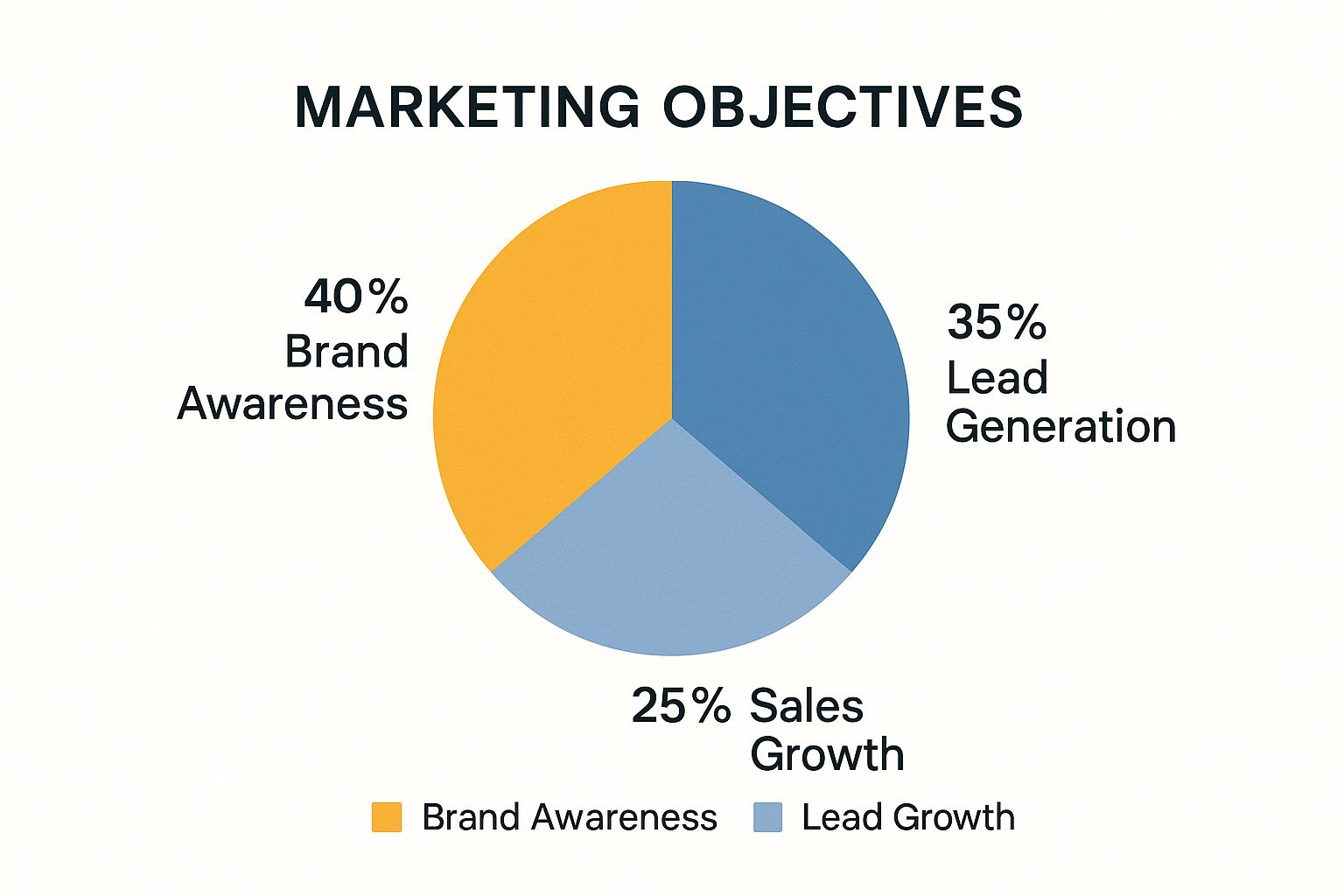
This data shows a healthy mix, confirming that while sales are king, building a strong brand and a pipeline of future customers are also critical for long-term, sustainable growth.
How to Map Campaign Objectives to KPIs
To make this crystal clear, you need to draw a straight line from your high-level business goals to the specific metrics you’ll track. Here’s a simple table to show how that connection works in the real world.
| Business Goal | Campaign Objective Example | Primary KPI |
|---|---|---|
| Increase Market Share | Boost brand awareness in the 25-35 female demographic. | Social Media Reach, Share of Voice |
| Improve Profitability | Increase customer lifetime value (CLV). | Repeat Purchase Rate, Average Order Value (AOV) |
| Generate More Leads | Capture 200 qualified leads for the sales team this quarter. | Marketing Qualified Leads (MQLs), Cost Per Lead (CPL) |
| Drive Direct Sales | Sell 500 units of the new product via the e-commerce site. | Conversion Rate, Revenue, Return on Ad Spend (ROAS) |
By mapping your goals like this, you ensure every activity and every pound spent is pushing you toward a meaningful outcome. This simple alignment is the difference between a campaign that feels busy and one that actually builds the business.
Identifying Your Audience and Best Channels

A brilliant message is completely wasted if it doesn't reach the right people. This is the point where your marketing campaign planning template pivots from high-level objectives to the actual humans you want to connect with. Before you can figure out where or how to talk to your audience, you first need to know exactly who they are.
This goes much deeper than just scratching the surface of demographics. A truly useful buyer persona is the bedrock of any solid campaign, capturing not just age and location but the real, human stuff that influences their decisions. What are their biggest frustrations? What truly motivates them, personally and professionally?
Answering these questions is how you turn a vague target market into a relatable person. For instance, instead of aiming for "small business owners," you might flesh out a persona for "Startup Steve". He's a 32-year-old tech founder in Manchester, completely overwhelmed by financial admin and looking for a simple, time-saving fix. See how much easier it is to make decisions with that level of clarity?
Pinpointing Your Ideal Customer
To build a persona that feels less like a document and more like a real person, you need to get your hands dirty with both qualitative and quantitative data. Your template should have a dedicated space to pull together insights from a few key places.
- Customer Interviews: Nothing beats a direct conversation. Talk to your best customers and ask them about their daily headaches, why they chose you, and what other tools are indispensable to them.
- Sales Team Feedback: Your sales reps are a goldmine of information. They're on the front lines every day, hearing directly about the pain points and priorities that drive prospects.
- Analytics Data: Dive into tools like Google Analytics. Look at the demographics and online behaviour of your website visitors. Which blog posts or pages are they spending the most time on?
When you weave these different threads together, you create a rich, multi-dimensional picture of who you’re trying to reach. This persona then becomes your North Star for crafting messages that don't just get seen, but actually land with meaning.
Choosing Channels with Purpose
Once you have that crystal-clear persona, picking your marketing channels stops being a guessing game and starts being a strategic exercise. The whole point is to show up where your audience already spends their time. Don’t just throw your budget at a platform because it’s trendy; choose it because it's the right place for your audience.
The most common mistake I see is teams spreading themselves too thin across too many channels. It’s far more effective to dominate one or two relevant platforms than to have a weak presence on ten.
Let’s go back to 'Startup Steve'. He’s almost certainly active on LinkedIn for networking and probably skims industry-specific subreddits for unfiltered advice. It's safe to say he isn’t spending his workday scrolling through Facebook or TikTok. Right there, that insight tells you where to focus your time, energy, and budget for the best possible return.
A good marketing campaign planning template will push you to justify your channel choices based on audience fit, not just raw reach numbers. If you're new to this and need a primer, exploring a beginner's guide to digital marketing can give you a fantastic overview of the main platforms and what they’re good for. Your final plan should clearly list your primary channels, along with a simple sentence explaining why you chose each one. This simple step ensures every bit of content you create is perfectly placed to make a real impact.
Developing a Compelling Message and Content Plan

Alright, you’ve set your objectives and you know who you’re talking to. Now comes the creative part: crafting a message that actually sticks. This is where many campaigns fall flat. It's not about listing your product's features; it's about articulating what your audience truly needs to hear.
Think of your core message as the single, powerful idea that cuts through the noise. It should connect directly with the pain points of the persona you’ve defined in your marketing campaign planning template.
Let’s say you’re targeting time-poor freelance creatives. A message like “Our software has advanced features” is going to get ignored. Instead, try something like, “Spend less time on admin and more time creating.” See the difference? You’re reframing the value around their specific problem, making it instantly relevant. This central idea is the North Star for all your campaign content.
Building Your Content Strategy
With your core message locked in, you can start mapping out the actual content. A huge mistake I see people make is putting all their eggs in one basket—like relying only on blog posts. A really effective campaign uses a smart mix of content to meet people wherever they are in their buying journey.
Think of it in terms of the classic marketing funnel. You need different types of content for each stage.
- Attracting Attention (Top of Funnel): This is where you grab eyeballs. Think engaging videos, eye-catching infographics, and genuinely helpful blog posts that introduce your solution without a hard sell.
- Building Trust (Middle of Funnel): Now they know you exist, you need to prove your worth. This is the perfect spot for in-depth case studies, expert-led webinars, or detailed buyer’s guides that position you as the authority.
- Driving Action (Bottom of Funnel): Time to close the loop. Content here should make the final decision easy. Offer a free trial, a live product demo, or compelling customer testimonials to give them that final nudge.
The key is to create a journey, not just a collection of assets. Each piece of content should feel like a natural next step, reinforcing your core message and guiding them towards a decision without being pushy.
This is where you can be really strategic. For instance, highly personalised content, like that used in email marketing, is brilliant for nurturing those leads in the middle and bottom of the funnel. You can learn more about the advantages of email marketing to see how it fits in.
For more on creating pieces that truly connect, check out these essential content marketing best practices. It’s a great resource for making sure your content doesn't just get seen, but actually drives results. Ultimately, a solid content plan is what keeps your brand's voice consistent and powerful across every touchpoint.
How to Budget and Allocate Your Resources

A brilliant campaign idea is just that—an idea—until you put a realistic budget behind it. This is the point in your marketing campaign planning template where creative ambition meets financial reality. It’s not just about plucking a number out of thin air; it’s about strategically assigning every pound to get the best possible return.
I’ve seen too many marketers stumble here. They either underestimate costs and run out of steam halfway through, or they fail to track their spending and can't explain where the money went. Think of a well-structured budget as your financial roadmap. It gives you the control to make smart, agile decisions as the campaign unfolds.
Breaking Down Your Campaign Costs
Before you can decide where the money goes, you need a crystal-clear picture of what you’ll actually be paying for. Your costs typically fall into a few main buckets, and it’s vital to think through all of them to avoid nasty surprises later.
Here are the usual suspects when it comes to campaign expenses:
- Ad Spend: This is often the biggest ticket item. It’s the money you pay to platforms like Google, LinkedIn, Instagram, or TikTok to get your message in front of people.
- Content Creation: Don't forget the cost of making the 'stuff' of your campaign. This could be anything from hiring freelance writers and videographers to paying for a graphic designer’s time or a photographer’s day rate.
- Influencer & Creator Fees: If you're bringing influencers on board, their collaboration fees need a line item. These can vary wildly from a few hundred pounds to tens of thousands.
- Software & Tools: Your marketing stack costs money. This includes your email marketing platform, social media schedulers, analytics software, and any other subscriptions that make the magic happen.
- Team & Agency Costs: If you’re outsourcing to an agency or even just allocating your internal team's time to the project, that has a real cost that needs to be factored in.
Laying all this out gives you a comprehensive view of the required investment. It’s also crucial for getting the green light from management or clients.
Your budget isn’t just a spending limit; it’s a strategic tool. It forces you to prioritise, make trade-offs, and focus your resources on the activities most likely to drive your key objectives.
Choosing the Right Budgeting Model
So, how do you decide on that big total number? There are a few tried-and-tested ways to approach it.
One straightforward method is the percentage of revenue model. You simply allocate a set percentage—often somewhere between 5-10%—of your company's total or projected revenue to marketing. This is a great way to ensure your spending scales with the business's performance.
Another popular approach is objective-based budgeting. With this model, you start with the end in mind. First, you define your campaign goals (e.g., "we need to generate 500 new leads this quarter"), and then you work backwards to calculate the investment required to hit that target. This method is brilliant because it directly ties every pound spent to a specific outcome.
It's important to be realistic about what things cost. For instance, the average cost per action (CPA) can be surprisingly high—around $49 for paid search and $75 for display ads, according to some industry benchmarks. These figures show why modern UK campaign planning templates stress the need for data to make every pound count. Digging into more digital marketing statistics can help you set realistic expectations.
Ultimately, the best model for you will depend on your business maturity and specific campaign goals. The trick is to pick a method, document it clearly in your template, and be disciplined about sticking to it. That financial rigour is what empowers you to confidently shift funds from an underperforming channel to a high-impact one, ensuring your campaign stays on track to deliver real results.
Building Your Campaign Timeline and Action Plan
Right, this is where the rubber really meets the road. All that brilliant strategy needs a concrete plan to bring it to life. A detailed campaign timeline isn't just a fancy calendar; it's your operational bible, the very thing that stops your launch from descending into chaos and missed deadlines.
I've seen it happen too many times – great ideas fall apart because of poor execution. The best way I’ve found to prevent this is by using a Gantt chart. It forces you to think through every single task, from the first creative brief to the moment you hit ‘publish’, and map it all out visually. You assign owners and set realistic deadlines, which instantly creates a culture of accountability.
Mapping Dependencies and Key Milestones
One of the biggest wins from building a proper timeline is identifying critical dependencies early on. It sounds simple, but it's a game-changer. For instance, your paid media specialist can't build the ad campaigns until the copywriter has delivered the final ad copy, and the copy can't be finalised until the core messaging is signed off. Mapping these relationships visually stops a small delay from snowballing into a major roadblock.
You'll also want to flag your major milestones. These aren't just tasks; they're the big checkpoints that show you're on track.
- Creative Assets Finalised: All images, videos, and copy have been approved and are ready to go.
- Ad Campaigns Built: All your paid search and social ads are set up in their respective platforms, just waiting for you to press the button.
- Final Pre-Launch Review: The whole team does one last check and gives the final sign-off before anything goes live.
Considering the UK social media advertising market is expected to reach £9.95 billion by 2025, having your digital assets locked and loaded on time is essential. You can’t afford delays. If you want to dig deeper, it's worth exploring some of the latest UK social media trends to fine-tune your channel-specific plans.
A timeline isn't just about listing what needs to get done. It’s about understanding the when and the why of the sequence. It brings order to complexity and gets everyone marching in the same direction.
Finally, don't forget the checklists within your marketing campaign planning template. You absolutely need a pre-launch checklist to catch any last-minute errors, like a broken link or a typo in a headline. Equally important is a post-launch plan that details who is monitoring performance from the second it goes live, so you’re ready to analyse the data and start optimising immediately.
What If My Campaign Goes Off-Track? Answering Your Top Planning Questions
Even with the most meticulously crafted plan, marketing campaigns rarely go exactly as you predict. That's just the nature of the beast. So, what do you do when the unexpected happens? I get asked this a lot, so let's tackle a couple of the most common worries that pop up.
One of the biggest anxieties for marketers is a campaign veering off course midway through. The secret isn't to panic; it's to have planned for unpredictability from the very beginning. I always recommend building a contingency fund right into your budget—think of it as your safety net. Setting aside 5-10% gives you the wiggle room you need.
This little buffer means you can react smartly. Did a social channel suddenly take off? You've got the funds to double down on what's working. Is an ad set completely failing to connect? You can afford to pause it and test a new creative without derailing your entire financial plan.
The same logic applies to your timeline. Don't pack it so tightly that a single missed deadline causes a domino effect. Sprinkle in a few buffer days around your most critical milestones. It’s a simple trick that can save you a world of stress.
How Do I Prove a Campaign's Value Months Later?
Another question I hear all the time is about tracking success beyond the initial flurry of activity. It’s great to see those immediate conversions and leads roll in, but the real test of a campaign's power is its long-term impact.
To get a true picture, you need to look at what we call lagging indicators, usually a few months after the campaign has wrapped up. These tell the real story of its value.
A few key things I always track are:
- Customer Lifetime Value (CLV): Take a look at the customers you brought in through the campaign. Are they spending more with you over time compared to customers from other channels or periods? That's a huge win.
- Brand Recall: A simple post-campaign survey can be incredibly revealing. Ask your target audience about brand awareness and how they feel about you. You're looking for a noticeable lift.
- Organic Search Lift: Keep an eye on your branded search volume. When a campaign really resonates, you'll see more people searching for your brand by name. That's a fantastic sign of growing brand equity.
Remember, a campaign's impact doesn't stop when the ads do. True success is measured by the lasting impression and sustained business growth it generates long after the initial push is over.
Adopting this long-term view doesn't just help you calculate the full return on your investment; it gives you a goldmine of insights for making your next campaign even better.
Ready to build your next successful campaign? Discover a universe of powerful marketing solutions with The Digital Marketing Toolbox. Find, compare, and implement the best tools for your business.


