
Driving Growth with Data-Driven Marketing KPIs in 2025
This listicle provides eight essential marketing KPI examples to drive growth and achieve your business objectives. Learn how to measure crucial metrics like Customer Acquisition Cost (CAC), Return on Marketing Investment (ROMI), Customer Lifetime Value (CLV/LTV), Conversion Rate, Marketing Qualified Leads (MQLs), Brand Awareness, Email Marketing performance, and Social Media Engagement. Understanding these marketing KPI examples empowers data-driven decisions, optimized strategies, and maximized ROI. This knowledge is crucial for success in 2025.
1. Customer Acquisition Cost (CAC)
Customer Acquisition Cost (CAC) is a crucial marketing KPI that measures the total cost of acquiring a new customer. It's a fundamental metric for any business, especially for those operating in the competitive UK market, because it provides a clear picture of how efficiently your marketing budget is being spent and whether your growth strategies are sustainable. Essentially, CAC answers the question: “How much does it cost us to gain a new customer?” This is calculated by dividing the total marketing and sales expenses incurred during a specific period by the number of new customers acquired within that same period. Understanding your CAC is essential for making informed decisions about marketing investments and projecting future profitability. This KPI deserves its place on this list because it provides a direct link between marketing spend and business growth, enabling data-driven decision-making.
CAC encompasses all costs associated with attracting and converting new customers. This includes advertising spend (both online and offline), salaries of marketing and sales teams, the cost of marketing software and tools, and even a portion of overhead costs allocated to marketing and sales activities. The calculation should be performed over specific timeframes (e.g., monthly, quarterly, annually) for accurate analysis and to identify trends. Importantly, CAC can be segmented by channel (e.g., social media, email, paid search), campaign, or even specific customer segments, allowing for a granular understanding of acquisition costs. For instance, you can calculate the CAC for customers acquired through a Facebook ad campaign versus those acquired through organic search, giving you valuable insights into channel effectiveness.
This granular analysis is one of the key benefits of tracking CAC. By understanding the cost-effectiveness of different channels, you can optimise your budget allocation. For example, if you find that your CAC for paid search is significantly higher than for email marketing, you might consider shifting more resources towards email campaigns. Furthermore, CAC directly correlates with Customer Lifetime Value (CLTV), another crucial metric. A healthy business model typically aims for a CLTV:CAC ratio of at least 3:1, meaning the value a customer brings over their lifetime is at least three times the cost of acquiring them. Analyzing CAC alongside CLTV provides a comprehensive view of profitability and long-term sustainability. Learn more about Customer Acquisition Cost (CAC)
There are several compelling examples of companies leveraging CAC to drive growth. Spotify famously reduced their CAC by 23% through personalised ad targeting, demonstrating the power of data-driven marketing. Dropbox achieved a remarkably low CAC of $388 (compared to a CLTV of over $1,000) through a successful referral program. HubSpot, a leader in inbound marketing, segments CAC by channel and has found that content marketing yields the lowest CAC in the long term, highlighting the effectiveness of this strategy for sustainable growth.
While CAC is a powerful metric, it's important to be aware of its limitations. If attribution windows (the timeframe in which a conversion is attributed to a specific marketing touchpoint) are too short, CAC can be misleading. It also doesn't account for the long-term brand building effects of some marketing activities. Additionally, CAC can vary significantly between customer segments, requiring careful segmentation for accurate interpretation. Finally, accurate CAC calculations depend on meticulous tracking of all associated costs.
Here are some practical tips for effectively utilizing CAC:
- Calculate CAC by channel: Identify your best-performing acquisition sources.
- Include hidden costs: Factor in expenses like tools, training, and overhead.
- Compare CAC to CLTV: Aim for a healthy 3:1 LTV:CAC ratio.
- Track trends: Monitor CAC over time to identify changes and patterns.
- Consider payback period: How long does it take to recoup the CAC for each customer?
The concept of CAC has been popularized by SaaS companies like Salesforce and HubSpot, growth hacking pioneers like Sean Ellis, and venture capital firms emphasizing unit economics.
The following bar chart visualizes Customer Acquisition Cost benchmarks across different business segments, providing a context for comparing your own CAC performance.
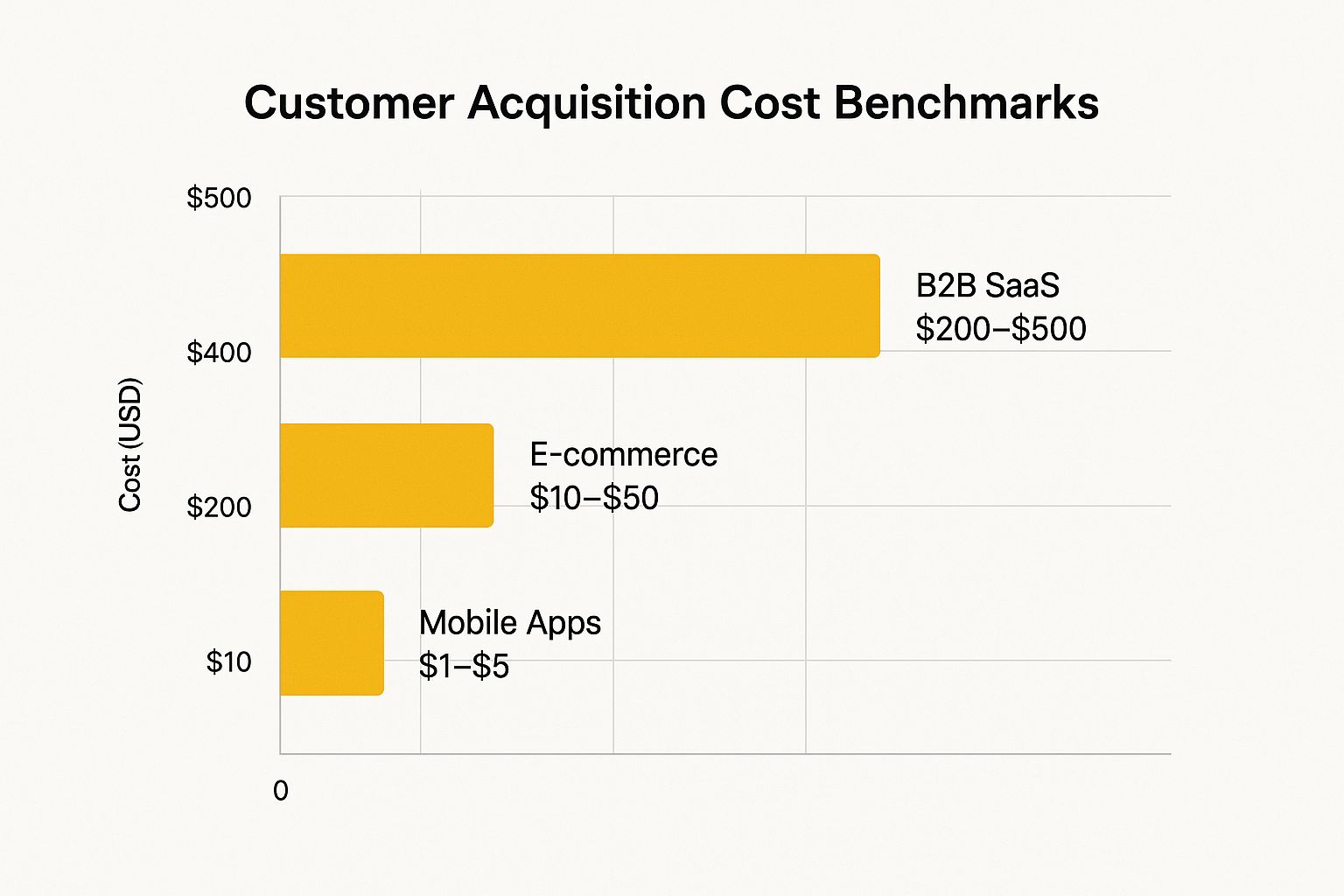
This bar chart clearly illustrates the significant variations in typical CAC across different business models. B2B SaaS companies often have a higher CAC (between $200 and $500) compared to E-commerce businesses ($10–$50) and Mobile Apps ($1–$5), reflecting differences in customer lifetime value, sales cycles, and marketing strategies. Understanding these benchmarks allows businesses to assess their own CAC performance relative to their industry and identify potential areas for improvement. By implementing the strategies and tips outlined above, businesses in the UK can effectively leverage CAC as a key driver of profitable and sustainable growth.
2. Return on Marketing Investment (ROMI)
Return on Marketing Investment (ROMI) is a crucial marketing KPI example for any business, particularly in the competitive UK market. It measures the revenue generated specifically from your marketing activities relative to the amount spent on those activities. Unlike general Return on Investment (ROI), which considers the return on all investments, ROMI focuses solely on marketing-attributed revenue, offering actionable insights for optimising your marketing budget and making strategic decisions. Its inclusion in any marketing KPI dashboard is essential for understanding the effectiveness and profitability of your marketing efforts.
How ROMI Works and Why It Matters
ROMI helps you understand the financial impact of your marketing campaigns. It answers the fundamental question: “For every pound spent on marketing, how much revenue did we generate?” This metric provides a clear, quantifiable measure of marketing success, allowing you to justify marketing spend to stakeholders and demonstrate its contribution to the bottom line. By tracking ROMI, you can identify high-performing campaigns and channels, optimise underperforming ones, and make informed decisions about future marketing investments.
Calculating ROMI involves subtracting your marketing costs from the revenue generated by your marketing activities, then dividing the result by your marketing costs. The result is often expressed as a percentage. A simple formula is:
(Revenue Generated by Marketing – Marketing Costs) / Marketing Costs x 100 = ROMI (%)
For instance, if you spend £5,000 on a campaign and generate £15,000 in revenue directly attributable to that campaign, your ROMI is 200% (£10,000 / £5,000 x 100). This indicates that for every pound invested, you generated two pounds in return.
Features and Benefits of Tracking ROMI
ROMI offers several key features that make it a valuable marketing KPI:
- Marketing-Specific Focus: It isolates marketing-driven revenue, providing a more accurate picture of marketing performance than broader ROI calculations.
- Granular Analysis: ROMI can be calculated for individual campaigns, specific channels (like social media or email), or across your entire marketing mix, offering granular insights.
- Holistic Revenue Attribution: It can incorporate both direct revenue (e.g., sales from a specific ad) and influenced revenue (e.g., sales influenced by multiple touchpoints).
- Comparative Measurement: ROMI provides a percentage-based metric, making it easy to compare the performance of different marketing initiatives and allocate budget effectively.
Pros and Cons of Using ROMI
Pros:
- Directly links marketing activities to business revenue, demonstrating clear value.
- Enables data-driven budget allocation decisions, optimising resource allocation.
- Facilitates comparison between different marketing initiatives, identifying top performers.
- Provides clear justification for marketing investments to stakeholders, increasing transparency.
Cons:
- Attribution Complexity: Accurately attributing revenue to specific marketing activities can be challenging, especially with complex customer journeys. Perfect attribution models are elusive.
- Long-Term Brand Impact: ROMI may not fully capture the long-term benefits of brand-building activities, which can be difficult to quantify immediately.
- Tracking and Analytics: Implementing robust tracking and analytics systems is crucial for accurate ROMI calculation, which can require investment in tools and expertise.
- External Factors: ROMI can be influenced by external factors beyond your control, such as economic downturns or competitor activity.
Successful ROMI Implementation Examples
Several global brands have demonstrated impressive ROMI results. Coca-Cola's “Share a Coke” personalisation campaign achieved a staggering 2300% ROMI, demonstrating the power of targeted marketing. Airbnb's referral program generated a 25% ROMI within its first year, highlighting the effectiveness of word-of-mouth marketing. These examples, while for large companies, showcase the potential of focusing on ROMI.
Actionable Tips for Improving Your ROMI
- Multi-Touch Attribution: Implement multi-touch attribution models to gain a more accurate understanding of how different touchpoints contribute to conversions.
- Benchmarking: Set realistic ROMI benchmarks for different marketing objectives. These benchmarks should be tailored to your industry and specific business goals.
- Holistic Attribution: Consider assisted conversions, not just last-click attribution, to acknowledge the influence of all marketing touchpoints.
- Customer Lifetime Value (CLTV): Factor in CLTV when calculating ROMI to understand the long-term value generated by your marketing efforts.
- Regular Reporting: Establish regular reporting cycles to identify trends, optimise campaigns quickly, and adapt your marketing strategy based on performance data.
When and Why to Use ROMI
ROMI is a valuable metric for any business looking to understand the effectiveness of its marketing investments. It’s especially crucial for:
- Small Business Owners: Demonstrating the value of limited marketing budgets.
- Digital Marketing Agencies: Proving the effectiveness of their services to clients.
- E-commerce Managers: Optimising online advertising and promotional campaigns.
- Content Creators and Bloggers: Tracking the ROI of content marketing efforts.
- Marketing Professionals: Evaluating the performance of different marketing channels and campaigns.
By incorporating ROMI as a key marketing KPI, businesses can gain a clear understanding of marketing performance, optimise campaigns for profitability, and make data-driven decisions to drive growth in the UK market and beyond.
3. Customer Lifetime Value (CLV/LTV)
Customer Lifetime Value (CLV or LTV) is a crucial marketing KPI example that quantifies the total revenue a business can expect from a single customer throughout their entire relationship. Instead of focusing on short-term gains, CLV takes a long-term perspective, predicting the overall profitability of acquiring and retaining a customer. Understanding this metric allows businesses to make data-driven decisions about sales, marketing, product development, and customer support. It shifts the focus from individual transactions to the overall value a customer brings over time, leading to more sustainable and profitable growth. This makes CLV a vital metric for businesses of all sizes, particularly in the competitive UK market.

CLV incorporates key factors like purchase frequency, average order value, and customer retention rates to arrive at a comprehensive figure. For example, a customer who regularly purchases high-value items and remains loyal to a brand for years will have a significantly higher CLV than a customer who makes only a single small purchase. This information is invaluable for determining how much to invest in acquiring new customers and retaining existing ones. Moreover, CLV can be segmented by customer demographics, acquisition channels, or behaviour, providing granular insights into which customer segments are most valuable. This allows for targeted marketing efforts and resource allocation towards the most profitable customer groups.
Successful Implementations of CLV:
- Amazon Prime: Amazon leverages CLV data to justify the cost of Prime membership benefits. They understand that Prime members, with their higher purchase frequency and order values, have a significantly higher LTV than non-Prime members. This justifies the investment in free shipping, streaming services, and other perks that encourage Prime membership.
- Starbucks: Starbucks utilises CLV to personalise marketing spend. By identifying high-value customers, they can justify investing in personalized offers, loyalty programs, and targeted promotions, even if the individual cost per customer seems high. The higher CLV of these customers ensures a positive return on this investment.
- Netflix: Netflix uses CLV based on viewing habits to inform content investment decisions. By analyzing viewing patterns, they can determine which genres and formats are most appealing to high-CLV subscribers, enabling them to make strategic decisions about which shows and films to commission.
Actionable Tips for Using CLV:
- Segment for Accuracy: Calculate CLV for different customer segments to get a more precise understanding of your customer base. For instance, segmenting by demographics, purchasing behaviour, or acquisition source can reveal significant variations in CLV.
- Regular Updates: Regularly update your CLV calculations as business dynamics and customer behaviour change. Market trends, seasonality, and economic conditions can all impact CLV.
- Customer Service Investment: Use CLV to determine appropriate customer service investment levels. High-CLV customers warrant a higher level of personalized service to maximize retention.
- Historical and Predictive Models: Consider both historical CLV (based on past data) and predictive CLV (forecasting future value) to get a holistic view.
- Indirect Revenue: Factor in referral value and other indirect revenue contributions to get a more comprehensive understanding of customer value.
Pros and Cons of Using CLV:
Pros:
- Guides customer acquisition budget allocation effectively.
- Identifies most valuable customer segments for targeted marketing.
- Supports pricing and product development decisions.
- Enables long-term strategic planning and forecasting.
Cons:
- Requires historical data and may not accurately predict future behaviour.
- Complex calculation involving multiple variables and assumptions.
- Can be skewed by outlier customers or changing market conditions.
- Difficult to calculate for new businesses without sufficient data.
CLV deserves a prominent place in any marketing KPI list because it shifts the focus from short-term transactions to long-term customer relationships. By understanding the lifetime value of your customers, you can make more informed decisions about acquisition, retention, and overall business strategy. In the dynamic UK market, prioritizing CLV can provide a significant competitive advantage, enabling businesses to optimize marketing spend, personalize customer experiences, and drive sustainable growth.
4. Conversion Rate
Conversion Rate is a crucial marketing KPI that measures the percentage of visitors or leads who complete a desired action. This “desired action” could be anything from making a purchase on an e-commerce site to signing up for a newsletter, downloading a piece of content, filling out a contact form, or clicking a specific link. It provides a clear picture of how effective your marketing campaigns, website optimisation, and overall customer journey design are in driving meaningful business outcomes. By understanding your conversion rate, you gain insight into what resonates with your audience and what needs improvement in your marketing strategy. This makes Conversion Rate a critical KPI for any business looking to maximize its marketing ROI.

Conversion rate is calculated by dividing the number of conversions by the total number of visitors and multiplying by 100. For example, if your website had 10,000 visitors and 200 of them made a purchase, your conversion rate would be 2% (200 / 10,000 * 100 = 2%). This seemingly simple metric offers profound insights into the effectiveness of your marketing efforts. It helps pinpoint areas of strength and weakness within specific marketing funnels and touchpoints, enabling data-driven decision-making for optimisation and improvement. Whether you're running paid advertising campaigns, focusing on organic search traffic, or building an email list, conversion rate provides a quantifiable measure of success.
One of the most powerful features of conversion rate as a KPI is its versatility. It can be applied to a wide range of actions across different marketing channels. You can track conversion rates for purchases, sign-ups, downloads, form submissions, and more, tailoring the metric to specific campaign objectives. This allows marketers to measure progress towards various goals, from lead generation to sales, and gain a holistic view of marketing performance. Furthermore, it provides immediate feedback on campaign and website performance, enabling rapid adjustments and optimisations based on real-time data.
For UK businesses, understanding conversion rate is particularly important in the competitive online landscape. Optimising for conversions can be the difference between success and failure, especially for small businesses with limited marketing budgets. By focusing on improving conversion rates, businesses can maximise the return on their marketing investment and achieve sustainable growth. This makes it a key marketing KPI example, essential for measuring the impact of marketing activities.
Several successful implementations highlight the power of conversion rate optimisation. Barack Obama's 2012 presidential campaign famously improved donation conversion rates by 49% through rigorous A/B testing of website elements. Landing page optimisation platform Unbounce achieved a staggering 266% conversion rate improvement by focusing on user experience and persuasive design. Even on established platforms like Shopify, the average conversion rate hovers around 2.86%, with top-performing merchants exceeding 11%, demonstrating the continuous potential for improvement. These examples illustrate the significant impact that focused efforts on conversion rate optimisation can have on business outcomes.
Here are some actionable tips for improving your conversion rates:
- Set realistic benchmarks: Different traffic sources will have different conversion rate expectations. Research industry averages and tailor your targets accordingly.
- Focus on micro-conversions: These are smaller steps that lead to the ultimate macro-conversion (e.g., adding an item to the cart before purchase). Optimising these steps can significantly impact the overall conversion rate.
- Use heatmaps and session recordings: These tools provide valuable insights into user behaviour on your website, identifying areas of friction and opportunities for improvement.
- A/B test everything: Systematically test different calls-to-action, forms, page layouts, and other elements to identify what resonates best with your audience.
- Segment your data: Analyse conversion rates by device, location, and customer demographics to uncover specific areas for improvement.
Pros and Cons of Focusing on Conversion Rate:
Pros:
- Directly indicates marketing effectiveness and ROI potential.
- Easy to understand and communicate across teams.
- Enables rapid optimisation through testing and iteration.
- Applicable across all marketing channels and campaigns.
Cons:
- Doesn't indicate the quality of conversions or long-term customer value.
- Can be manipulated through targeting changes without improving actual performance.
- May not account for longer sales cycles or complex customer journeys.
- Focusing solely on conversion rate may sacrifice other important metrics.
By focusing on conversion rate optimisation and implementing these tips, businesses in the UK can drive significant improvements in their marketing performance, achieve a stronger ROI, and ultimately, grow their bottom line. This KPI's ability to provide quantifiable results, actionable insights, and direct feedback makes it an indispensable tool in any marketer's arsenal.
5. Marketing Qualified Leads (MQLs)
Marketing Qualified Leads (MQLs) are a crucial marketing KPI example for any business focused on growth, especially within the competitive UK market. This metric represents prospects who have interacted with your marketing efforts and demonstrated enough interest in your products or services to warrant further attention from your sales team. Unlike a simple lead, which might just be an email address captured through a generic signup form, an MQL signifies a higher level of engagement and potential for conversion. This distinction makes MQLs a powerful tool for measuring the effectiveness of your marketing campaigns and optimising your sales pipeline. Tracking MQLs is essential for demonstrating the value of your marketing activities and connecting them directly to revenue generation, making it a key performance indicator for any data-driven marketing strategy.
MQLs act as a critical bridge between marketing and sales, ensuring a smooth handoff of qualified leads and improving overall conversion efficiency. They are identified based on predetermined criteria agreed upon by both marketing and sales teams. These criteria can include demographics (e.g., industry, company size, job title), behaviour (e.g., website pages visited, content downloaded, email clicks), and engagement level (e.g., lead scoring based on interactions). This ensures that sales teams aren't wasting valuable time on leads unlikely to convert, allowing them to focus on prospects with a higher probability of becoming customers.
How MQLs Work:
The process typically involves lead scoring models that assign points based on demographic and behavioural data. For example, downloading a pricing guide might be worth more points than simply visiting the homepage. As a prospect interacts with your marketing content and accumulates points, they eventually cross a predefined threshold, qualifying them as an MQL. This system allows for prioritisation and personalised nurturing based on the individual’s engagement level.
Examples of Successful Implementation:
- HubSpot: By refining their lead scoring model, HubSpot saw a 200% increase in MQL to customer conversion. This demonstrates the powerful impact of accurately identifying and nurturing MQLs.
- Marketo: Marketo's MQL framework has helped their customers improve sales productivity by 35%, highlighting the efficiency gains achieved through qualified lead handoff.
- Salesforce: Using progressive profiling, Salesforce converts 15% more MQLs to opportunities, showcasing the effectiveness of gathering relevant information over time to nurture leads.
Actionable Tips for Implementing MQL Tracking:
- Regularly review and update lead scoring criteria with sales team input. The market and your ideal customer profile can change, so ensure your criteria remain relevant and aligned with sales priorities.
- Track MQL to SQL (Sales Qualified Lead) conversion rates. This provides insights into the quality of your MQLs and helps refine your lead nurturing strategies.
- Use progressive profiling to gradually collect lead information. Avoid lengthy forms that can deter prospects. Instead, gather information incrementally as they engage with your content.
- Implement lead nurturing campaigns for MQLs not yet ready for sales. Provide valuable content and build relationships to move them further down the funnel.
- Analyse which marketing channels generate the highest-quality MQLs. Focus your resources on the channels delivering the best return on investment.
Pros of Using MQLs as a KPI:
- Improves sales and marketing alignment and efficiency.
- Provides clear measurement of marketing funnel effectiveness.
- Enables better resource allocation and lead nurturing strategies.
- Helps identify optimal content and campaigns for lead generation.
Cons of Using MQLs as a KPI:
- Requires ongoing calibration between marketing and sales definitions.
- May create quantity vs. quality tensions in lead generation.
- Lead scoring models need regular updates and maintenance.
- Can vary significantly between industries and business models.
When and Why to Use MQLs:
MQLs are particularly relevant for businesses with complex sales cycles, especially in B2B environments. If you're investing in content marketing, lead nurturing, and marketing automation, tracking MQLs is crucial for demonstrating the ROI of these efforts. For UK businesses aiming to optimise their sales pipeline and improve marketing efficiency, MQLs offer a valuable framework for measuring success and driving growth. By focusing on quality leads, you can maximise your resources and achieve a higher conversion rate, ultimately leading to increased revenue. This KPI is invaluable for small business owners, digital marketing agencies, e-commerce managers, content creators, and marketing professionals alike seeking data-driven strategies to optimise their marketing efforts within the UK market.
6. Brand Awareness Metrics: Measuring Your Brand's Resonance
Brand awareness is the foundation upon which successful marketing campaigns are built. It represents the extent to which your target audience is familiar with and recognises your brand. As a key performance indicator (KPI), brand awareness metrics provide valuable insights into how well your brand resonates within the market and the effectiveness of your branding efforts. These metrics are essential for small business owners, e-commerce managers, digital marketing agencies, content creators, and marketing professionals alike, offering a crucial understanding of market position, campaign effectiveness, and opportunities for growth. This is why it's a crucial element in any list of marketing KPI examples.
Brand awareness metrics encompass a range of measurements, including:
- Aided Recall (Prompted): This measures brand recognition when presented with a cue, such as, “Which of these soft drink brands are you familiar with?” It helps gauge brand visibility within a competitive landscape.
- Unaided Recall (Unprompted): This assesses top-of-mind awareness by asking open-ended questions like, “Name some soft drink brands you can think of.” It reveals which brands hold the strongest presence in consumers' minds.
- Brand Recognition: This measures the ability of consumers to identify your brand through visual or audio cues, such as logos, slogans, or jingles. Strong brand recognition is vital for standing out in a crowded marketplace.
- Share of Voice: This tracks how much conversation is happening around your brand compared to your competitors across various media channels, including social media, online forums, and news articles. It provides insights into your brand's prominence in the public discourse.
These metrics can be effectively measured through a variety of methods, including:
- Surveys: Online, phone, or in-person surveys can be used to directly ask consumers about their brand awareness.
- Social Listening: Monitoring social media platforms and online forums for brand mentions and related conversations provides valuable real-time data on brand visibility and sentiment.
- Search Volume Data: Analysing search engine data for brand-related keywords can indicate the level of consumer interest and search activity surrounding your brand.
Why are Brand Awareness Metrics Important?
Tracking brand awareness offers numerous benefits:
- Long-Term Brand Building: Brand awareness metrics offer insights into the effectiveness of your long-term brand building strategies. Consistent measurement allows you to understand the cumulative impact of your efforts over time.
- Justification for Upper-Funnel Marketing: These metrics provide concrete data to justify investment in upper-funnel marketing activities, such as brand awareness campaigns, which may not have an immediate impact on sales but are crucial for long-term growth.
- Competitive Positioning and Market Share Analysis: By tracking your brand awareness alongside your competitors', you gain a clear understanding of your market position and can identify opportunities to increase your share of voice and mindshare.
- Premium Pricing Strategies: Strong brand awareness allows businesses to command premium prices, as consumers are often willing to pay more for recognised and trusted brands.
Pros and Cons:
Like any KPI, brand awareness metrics have both advantages and disadvantages:
Pros:
- Provides insights into long-term brand building effectiveness.
- Helps justify investment in upper-funnel marketing activities.
- Enables competitive positioning and market share analysis.
- Supports premium pricing strategies through brand strength measurement.
Cons:
- Difficult to directly attribute to short-term revenue impact.
- Requires consistent measurement methodology for accurate trending.
- Can be expensive to measure through traditional market research.
- May not immediately reflect recent marketing campaign impacts.
Examples of Successful Implementation:
- Coca-Cola: Through consistent global messaging and branding, Coca-Cola maintains exceptionally high brand awareness, estimated at 94% globally. This demonstrates the power of long-term brand building.
- Nike: Nike's controversial Colin Kaepernick campaign, while initially met with mixed reactions, ultimately led to a significant increase in brand awareness, reportedly by 35%. This highlights how even controversial campaigns can boost brand visibility.
- Tesla: Tesla achieved remarkable brand awareness with minimal traditional advertising, leveraging PR and social media to generate buzz and build a strong brand presence. This demonstrates the effectiveness of non-traditional marketing channels.
Actionable Tips for Measuring and Improving Brand Awareness:
- Combine Multiple Measurement Methods: Use a combination of surveys, social listening, and search volume data for a comprehensive view of your brand awareness.
- Segment Your Audience: Segment your awareness metrics by target customer demographics and geographies to gain more granular insights and tailor your marketing efforts.
- Track Competitors: Monitor your competitors' brand awareness levels to understand the competitive landscape and identify opportunities to differentiate your brand.
- Use Social Listening Tools: Leverage social listening tools for real-time tracking of brand mentions and sentiment analysis. This can help you identify emerging trends and address any negative feedback promptly.
- Correlate with Other Metrics: Correlate brand awareness metrics with other key performance indicators, such as website traffic, consideration, and purchase intent, to understand the full customer journey and the impact of brand awareness on business outcomes.
By diligently tracking and analysing brand awareness metrics, businesses in the UK and beyond can gain a competitive edge, build stronger customer relationships, and ultimately drive long-term growth and profitability.
7. Email Marketing Metrics
Email marketing remains a cornerstone of successful digital marketing strategies, offering a direct line of communication to nurture leads, build customer loyalty, and drive conversions. As a powerful tool for businesses of all sizes, understanding and leveraging email marketing metrics is crucial for optimising campaigns and demonstrating return on investment (ROI). This makes it a vital inclusion in any list of marketing KPI examples. Email marketing metrics encompass a range of data points that provide a comprehensive view of your email campaign performance, enabling you to fine-tune your strategy for maximum impact. These metrics fall into several key categories, offering insights into everything from audience engagement to deliverability and overall campaign health.
At its core, email marketing works by sending targeted messages directly to subscribers' inboxes. These messages can range from promotional offers and newsletters to transactional updates and personalized recommendations. The effectiveness of these campaigns is then measured through various key performance indicators (KPIs), allowing marketers to assess what's working and what needs improvement. Learn more about Email Marketing Metrics.
Key Features of Email Marketing Metrics:
- Engagement Metrics: These metrics focus on how subscribers interact with your emails. Open rates reveal the percentage of recipients who opened your email, while click-through rates (CTR) show how many clicked on a link within the email. These metrics offer valuable insights into subject line effectiveness and content relevance.
- Outcome Metrics: These metrics measure the tangible results of your email campaigns. Conversion rates track how many recipients completed a desired action, such as making a purchase or signing up for a webinar. Revenue generated directly from email campaigns is another crucial outcome metric, demonstrating the financial impact of your efforts.
- Deliverability Metrics: These metrics assess the effectiveness of your email delivery. Bounce rates indicate the percentage of emails that were not delivered, while spam complaints reveal how many recipients marked your email as spam. Monitoring these metrics is vital for maintaining a good sender reputation and ensuring your emails reach their intended audience.
- List Health Metrics: These metrics focus on the overall health and growth of your email list. List growth rate tracks the rate at which your subscriber list is growing, while churn rate measures the rate at which subscribers unsubscribe. Analysing these metrics helps you understand list engagement and identify areas for improvement.
- Segmentation Analysis: Email marketing metrics enable you to segment your audience based on demographics, engagement history, and other factors. This allows for more personalized messaging and targeted campaigns, leading to higher engagement and conversion rates.
Pros of Using Email Marketing Metrics:
- Detailed Insights: Provides granular data on subscriber behaviour, preferences, and engagement patterns.
- High ROI: Email marketing offers a high return on investment, especially when compared to other marketing channels.
- Personalization: Enables sophisticated segmentation and personalized messaging for improved campaign performance.
- Immediate Feedback: Offers real-time feedback on campaign performance, allowing for quick adjustments and optimization.
Cons of Using Email Marketing Metrics:
- Privacy Changes: Open rate tracking has been impacted by recent privacy updates like Apple's Mail Privacy Protection, making it less reliable.
- Industry Benchmarks: Industry benchmarks for email marketing metrics vary considerably, making comparisons challenging.
- Deliverability Challenges: Deliverability issues like spam filters and blacklisting can negatively impact performance metrics.
- Ongoing Maintenance: Requires continuous list maintenance, engagement management, and content optimization.
Examples of Successful Implementation:
- Airbnb: By leveraging personalized travel recommendations based on user data, Airbnb increased email engagement by 300%.
- BuzzFeed: Through A/B testing of subject lines and optimized sending times, BuzzFeed achieves impressive open rates of 45%.
- Charity: Water: By incorporating compelling storytelling into their email campaigns, Charity: Water boosted donation conversion rates by an astounding 200%.
Actionable Tips for UK Businesses:
- A/B Test Regularly: Experiment with different subject lines, email content, and send times to identify what resonates best with your UK audience. Consider cultural nuances and preferences.
- Segment Your List: Divide your subscriber list based on demographics, purchase history, and engagement behaviour to deliver targeted and relevant messages.
- Monitor Deliverability: Keep a close eye on bounce rates and spam complaints to maintain a healthy sender reputation and ensure your emails reach UK inboxes.
- Automate Email Sequences: Utilise behavioural triggers to automate personalized email sequences for welcome messages, abandoned cart reminders, and post-purchase follow-ups.
- Prioritize Click-Through Rates: While open rates provide some insight, focus on click-through rates and conversions as more accurate indicators of genuine engagement.
Email marketing metrics are essential for any business in the UK looking to maximize their marketing ROI. By tracking and analysing these KPIs, you can gain a deeper understanding of your audience, refine your campaigns, and drive tangible results. This data-driven approach is crucial for staying competitive in today's digital landscape and building strong, lasting relationships with your customers. From small businesses to large e-commerce platforms, understanding and leveraging these metrics is no longer optional, but a necessity.
8. Social Media Engagement Rate
Social Media Engagement Rate is a crucial marketing KPI example for anyone looking to understand the effectiveness of their social media strategy. It measures the level of interaction your content receives – likes, comments, shares, saves, and even clicks – relative to your reach or follower count. This metric provides valuable insights into how compelling and relevant your content is to your audience, revealing the strength of your connection with them and the potential for organic reach across various social media platforms. It's a key indicator of whether your social media efforts are truly resonating with your target audience in the UK and beyond.

Unlike vanity metrics like follower count, engagement rate delves deeper, reflecting genuine audience interest and the quality of your content. It’s not just about how many people could see your content, but how many people chose to interact with it. This makes it a powerful KPI for small business owners, digital marketing agencies, e-commerce managers, content creators, and marketing professionals alike. Are you fostering a community or simply broadcasting into the void? Social media engagement rate provides the answer.
This KPI encompasses various interaction types, from a simple ‘like' to a thoughtful comment or a valuable share. This nuanced approach helps you understand what type of content truly resonates with your audience. Are they passively consuming your visually-driven posts or actively participating in discussions sparked by your thought-provoking questions? The ability to measure engagement per post, per campaign, or across your overall account performance allows for granular analysis and strategic adjustments.
However, it’s important to note that social media engagement rates can vary significantly between platforms due to differing algorithms and user behaviours. For example, a 2% engagement rate on Instagram might be considered average, while the same percentage on Twitter might be exceptionally high. This is why understanding platform-specific nuances is vital for accurate interpretation. Learn more about Social Media Engagement Rate to understand these platform-specific differences and how to tailor your strategy accordingly.
Benefits of Tracking Social Media Engagement Rate:
- Authentic Interest Measurement: It demonstrates genuine audience interest and content quality, providing a more accurate picture of your social media performance than follower count alone.
- Content Strategy Optimisation: By analysing engagement patterns, you can refine your content strategy, identifying what resonates most with your audience and tailoring future content accordingly.
- Improved Posting Schedules: Understanding when your audience is most active allows you to optimise posting schedules for maximum visibility and engagement potential.
- Enhanced Organic Reach: Higher engagement signals to platform algorithms that your content is valuable, potentially boosting organic reach and visibility to a wider audience.
- Influencer Evaluation: Engagement rate is a key metric for evaluating the effectiveness of influencer marketing campaigns and partnerships, ensuring you're collaborating with creators who genuinely resonate with your target demographic.
Challenges of Using Social Media Engagement Rate:
- Scaling Difficulty: Engagement rates naturally tend to decrease as follower count increases, making it crucial to focus on building a highly engaged community rather than simply chasing large numbers.
- Algorithm Dependence: Platform algorithm changes can significantly impact engagement rates, requiring ongoing adaptation and adjustments to your social media strategy.
- Potential for Vanity Metrics: While more insightful than follower count, engagement can still be a vanity metric if not tied to tangible business outcomes like website traffic or conversions.
- Artificial Inflation: Engagement rates can be artificially inflated through the use of engagement pods or bots, highlighting the importance of authentic engagement practices.
Successful Implementations:
- Glossier: Built a $1.2 billion business by prioritizing community engagement on Instagram, achieving an impressive 8.7% engagement rate through authentic interactions and user-generated content.
- Wendy's: Increased Twitter engagement by 300% through a personality-driven content strategy, demonstrating the power of brand voice and humour to connect with audiences.
- National Geographic: Maintains a consistent 3.5% engagement rate across a massive following of 280 million by consistently delivering stunning visuals and captivating storytelling.
Actionable Tips for UK Businesses:
- Calculate accurately: Use reach rather than follower count for a more accurate engagement rate calculation, reflecting the actual number of people exposed to your content.
- Analyse by content type: Identify high-performing content formats and topics by analysing engagement by content type, allowing you to refine your content calendar for optimal results.
- Optimise posting times: Leverage platform analytics to determine when your UK audience is most active and schedule posts accordingly for maximum engagement potential.
- Encourage interaction: Respond promptly to comments and messages, fostering a sense of community and encouraging further engagement from your followers.
- Utilise platform features: Leverage platform-specific features like Instagram Stories, Reels, and Twitter Spaces to boost engagement and reach a wider audience.
By understanding the nuances of Social Media Engagement Rate and implementing these actionable tips, businesses in the UK can effectively measure the success of their social media strategies, build stronger connections with their target audience, and ultimately drive meaningful business results.
Marketing KPI Comparison Matrix
| KPI | Implementation Complexity 🔄 | Resource Requirements ⚡ | Expected Outcomes 📊 | Ideal Use Cases 💡 | Key Advantages ⭐ |
|---|---|---|---|---|---|
| Customer Acquisition Cost (CAC) | Medium – requires cost tracking and data integration | Medium – involves marketing & sales expense data | Measures efficiency of customer acquisition costs | Budget allocation, ROI analysis, channel optimization | Clear ROI visibility, budget optimization, cost-effectiveness insight |
| Return on Marketing Investment (ROMI) | High – needs sophisticated attribution models | High – requires advanced analytics tools | Links marketing spend to revenue, % performance metric | Campaign and channel performance evaluation | Data-driven budget decisions, stakeholder justification, revenue focus |
| Customer Lifetime Value (CLV/LTV) | High – complex calculations with predictive modeling | Medium to High – needs historical and behavioral data | Predicts total value from customers over time | Long-term strategic planning, acquisition and retention budgets | Guides budget allocation, identifies valuable segments, supports forecasting |
| Conversion Rate | Low – simple formula and tracking setup | Low – basic analytics tools suffice | Measures effectiveness of marketing funnel actions | Website optimization, campaign performance, A/B testing | Immediate performance feedback, easy communication, rapid optimization |
| Marketing Qualified Leads (MQLs) | Medium – requires lead scoring and alignment | Medium – marketing & sales collaboration needed | Tracks quality and volume of leads progressing through funnel | Lead management, sales-marketing alignment | Improves lead quality, enhances funnel efficiency, supports nurturing strategies |
| Brand Awareness Metrics | High – requires surveys, social listening, and data collection | High – costly research and tools | Measures market familiarity and brand recognition | Brand positioning, market presence analysis | Provides long-term brand insights, supports premium pricing, competitive analysis |
| Email Marketing Metrics | Low to Medium – depends on campaign complexity | Low to Medium – email platform & analytics needed | Tracks engagement and campaign success | Email campaign optimization, subscriber engagement | High ROI, detailed engagement insights, segmentation, and personalization |
| Social Media Engagement Rate | Medium – requires social analytics setup | Medium – social media tools and monitoring | Measures audience interaction and content relevance | Content strategy, organic reach improvement, influencer evaluation | Indicates authentic engagement, optimizes posting, evaluates partnerships |
Maximizing Your Marketing Impact with KPIs and The Digital Marketing Toolbox
From understanding the cost of acquiring a customer (CAC) to measuring the return on your marketing investment (ROMI), the marketing KPI examples discussed in this article provide a crucial foundation for data-driven decision-making. By tracking key metrics like Customer Lifetime Value (CLV/LTV), conversion rates, Marketing Qualified Leads (MQLs), and engagement across various channels including email and social media, you empower yourself to optimise campaigns, refine your target audience, and ultimately drive business growth. These insights are invaluable for small business owners in the UK seeking cost-effective solutions, digital marketing agencies refining their strategies, and e-commerce managers looking to boost conversions. Mastering these concepts allows you to not only understand your current performance but also to anticipate future trends and proactively adapt to the dynamic digital landscape.
Remember, consistent monitoring and analysis are paramount. The true power of these marketing KPI examples lies in their ability to inform strategic adjustments and iterative improvements. By embracing a data-driven approach, you can ensure that your marketing budget is allocated effectively and that every campaign contributes to your overall business objectives.
Ready to transform your marketing efforts and achieve sustainable growth? The Digital Marketing Toolbox provides the resources and tools you need to track, analyze, and leverage these crucial marketing KPI examples effectively. Visit The Digital Marketing Toolbox today and unlock the power of data-driven marketing to elevate your business in 2025 and beyond.


