

Driving Growth with Data-Backed Decisions
Marketing success requires understanding the right metrics. This listicle provides eight essential marketing performance metrics examples to optimize your campaigns and boost your ROI. Each metric includes a real-world example, formula, benchmark, and expert analysis.
This guide helps you:
- Understand key marketing performance indicators (KPIs)
- Analyze successful campaign strategies
- Apply data-driven insights to your marketing
We'll cover crucial metrics like Customer Acquisition Cost (CAC), Customer Lifetime Value (CLV), and Return on Advertising Spend (ROAS). You'll also learn about essential metrics for lead generation, conversions, brand awareness, and email marketing. We'll provide clear formulas, benchmarks, and actionable takeaways. Let's transform your marketing with data.
1. Customer Acquisition Cost (CAC)
Customer Acquisition Cost (CAC) is a crucial marketing performance metric that measures the total cost of acquiring a new customer. It's calculated by dividing all marketing and sales expenses by the number of new customers acquired during a specific period. Understanding your CAC is fundamental for evaluating the efficiency of your marketing investments and the profitability of your customer acquisition strategies. This metric helps businesses determine how much they are spending to acquire each new customer and whether those acquisition efforts are sustainable and profitable. Knowing your CAC is essential for informed decision-making regarding marketing budget allocation and overall business strategy.
Examples of CAC in Action
Several successful businesses use CAC to drive their marketing strategies. SaaS giants like HubSpot meticulously track CAC across different channels like paid search, content marketing, and sales teams to understand which avenues yield the best returns. E-commerce brands such as Warby Parker measure CAC for both online and retail store acquisitions, providing valuable insights into the effectiveness of their omnichannel approach. Even subscription services like Netflix analyze CAC by geographic region and content genre targeting to optimize their subscriber growth strategies. These examples demonstrate the versatility and importance of CAC across diverse business models.
Actionable Tips for Calculating and Utilizing CAC
To effectively use CAC, consider these tips:
- Calculate CAC for different time periods: Identify trends and seasonality impacts on acquisition costs.
- Segment CAC by marketing channel: Pinpoint high-performing channels and optimize underperforming ones.
- Include fully loaded costs: Factor in salaries, overhead, and software costs for a comprehensive view.
- Compare CAC to Customer Lifetime Value (CLTV): Assess the long-term profitability of your customer acquisition efforts. A healthy business typically maintains a CLTV significantly higher than its CAC.
- Track CAC payback period: Understand how long it takes to recoup the cost of acquiring a customer, impacting cash flow projections.
Why CAC Deserves its Place in the List
CAC is an indispensable metric for any business focused on growth and profitability. It provides a clear picture of the financial viability of customer acquisition strategies. By understanding and optimizing CAC, businesses can allocate their marketing budget more effectively, maximize ROI, and ensure sustainable growth. For a deeper understanding of incorporating CAC into your broader marketing strategy, learn more about Customer Acquisition Cost (CAC).
The infographic below visualizes average CAC benchmarks across three different industries: E-commerce, SaaS, and B2B Services.
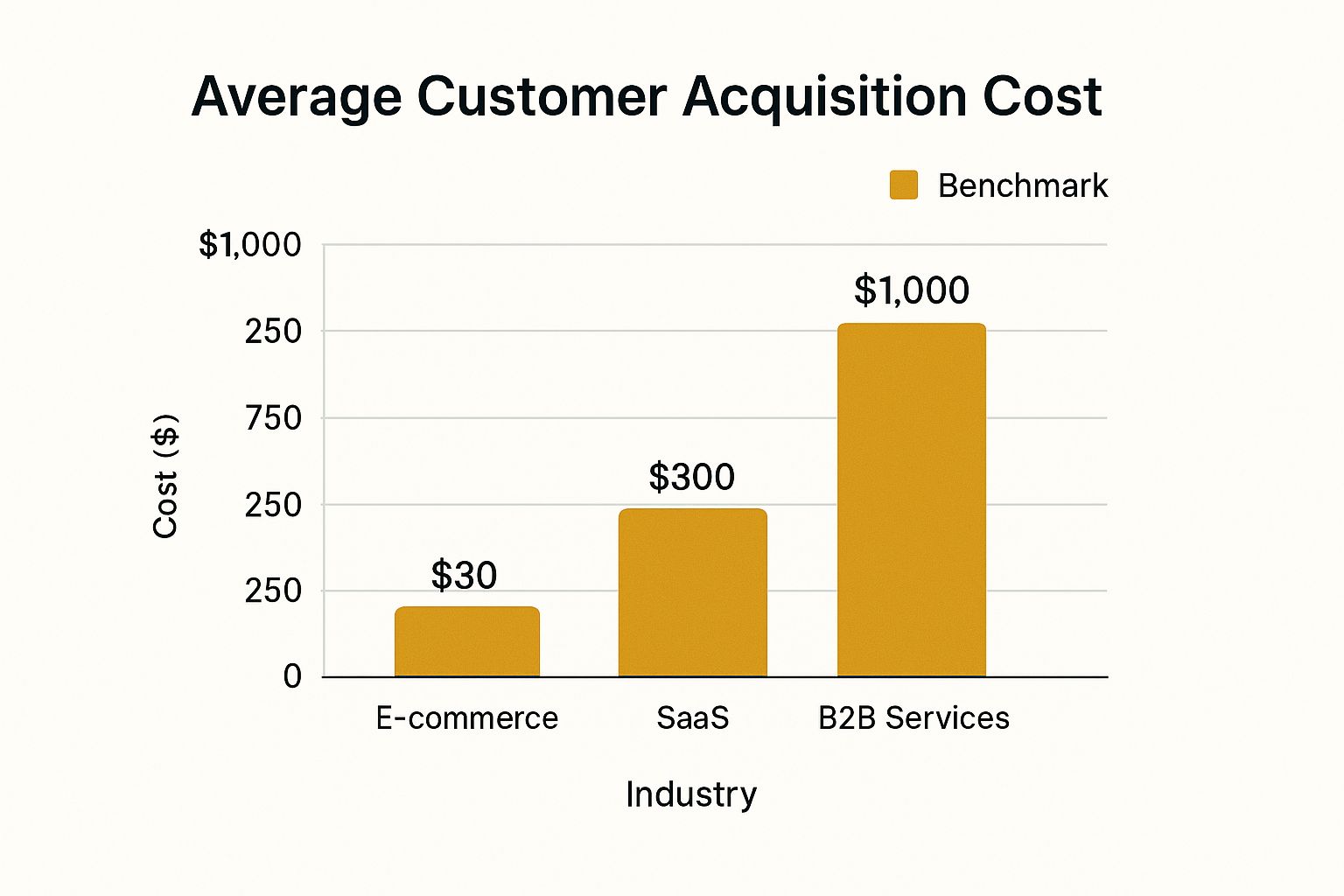
As the bar chart demonstrates, B2B Services have the highest average CAC at $1000, followed by SaaS at $300, and E-commerce at $30. This visualization highlights the significant variations in CAC across different business models, reinforcing the importance of industry benchmarking and tailored acquisition strategies.
2. Customer Lifetime Value (CLV/LTV)
Customer Lifetime Value (CLV/LTV) represents the total revenue a business can reasonably expect from a single customer throughout their entire relationship. This predictive metric helps companies understand how much they can invest in acquiring customers while remaining profitable. It is crucial for long-term strategic planning and effective customer segmentation. CLV empowers businesses to prioritize high-value customers and tailor their marketing efforts accordingly.

Examples of CLV in Action
Several prominent businesses leverage CLV to drive their marketing strategies. Amazon uses CLV to determine Prime membership benefits and personalize investments, recognizing the long-term value of Prime subscribers. Starbucks leverages CLV data for its rewards program tier structure, offering increasingly valuable perks to higher-spending customers. Tesla calculates CLV by factoring in not only vehicle purchases but also service and software upgrades, reflecting the ongoing revenue potential of each customer. These examples highlight the versatility of CLV across diverse industries and business models.
Actionable Tips for Calculating and Utilizing CLV
To effectively leverage CLV, consider the following tips:
- Use cohort analysis: Improve CLV predictions by analyzing customer behaviour within specific groups.
- Segment CLV by customer acquisition channel: Identify the channels that attract the highest-value customers.
- Include all revenue streams: Factor in all potential revenue sources, including recurring subscriptions and upsells.
- Update CLV models regularly: Ensure accuracy by adapting to evolving business conditions and customer behaviour.
- Consider both monetary and referral value: Account for the potential value of customer referrals in your CLV calculations.
Why CLV Deserves its Place in the List
CLV is an essential marketing performance metric for any business focused on long-term sustainable growth. It provides a crucial link between marketing investments and overall profitability. By understanding and optimizing CLV, businesses can make informed decisions about customer acquisition, retention, and overall marketing strategy. This ultimately leads to improved ROI and a stronger bottom line.
3. Return on Advertising Spend (ROAS)
Return on Advertising Spend (ROAS) is a key marketing performance metric that measures the revenue generated for every pound spent on advertising. It's calculated by dividing the revenue attributed to an advertising campaign by the cost of that campaign. Understanding your ROAS provides immediate feedback on advertising campaign effectiveness and is crucial for optimizing media spend. This metric allows businesses to evaluate which advertising efforts are generating the highest returns and adjust their strategies accordingly.
Examples of ROAS in Action
Many businesses leverage ROAS to fine-tune their advertising strategies. E-commerce brands, for instance, might find that Facebook advertising campaigns achieve a 6:1 ROAS, signifying that for every £1 spent, they generate £6 in revenue. Conversely, Google Ads campaigns for the same brand might show a 4:1 ROAS for search advertising. Analysing this difference allows marketers to allocate budget more effectively, perhaps shifting more spend towards the higher-performing Facebook campaigns. Even Amazon advertising campaigns often target a minimum 3:1 ROAS, demonstrating how this metric guides investment decisions across various platforms.
Actionable Tips for Calculating and Utilizing ROAS
To maximize the value of ROAS, consider these tips:
- Set ROAS targets based on profit margins: Don't solely focus on revenue; consider the profitability of each sale.
- Compare ROAS across different attribution windows: Understand how different attribution models impact perceived campaign performance.
- Segment ROAS by customer type and product category: Identify high-value customer segments and profitable product lines.
- Consider blended ROAS across all channels: Get a holistic view of advertising performance across your entire marketing mix.
- Account for assisted conversions: Recognize the contribution of various touchpoints in the customer journey.
Why ROAS Deserves its Place in the List
ROAS is a vital metric for any business investing in advertising. It offers a direct measure of advertising effectiveness, enabling data-driven decisions about budget allocation and campaign optimization. By understanding and optimizing ROAS, businesses can maximize their return on investment and drive revenue growth. Tracking ROAS empowers marketers to shift from simply measuring spend to focusing on the profitability of their advertising efforts.
4. Marketing Qualified Leads (MQLs)
Marketing Qualified Leads (MQLs) represent prospects who have engaged with marketing efforts and demonstrated interest in a company's products or services, but aren't yet ready for direct sales contact. This metric bridges the gap between marketing and sales teams by identifying prospects who meet specific criteria, indicating purchase intent and readiness for further nurturing. MQLs are crucial for focusing sales efforts on leads with higher conversion potential. They help streamline the sales process and improve overall sales efficiency.
Examples of MQLs in Action
Several successful businesses leverage MQLs to refine their sales and marketing strategies. HubSpot uses a lead scoring system combining website behavior (like content downloads and page views) and demographic data to identify and prioritize MQLs. Salesforce automates MQL identification through Pardot, tracking prospect engagement across various marketing channels like email and webinars. Marketo employs progressive profiling to qualify leads based on their content engagement and information gradually gathered over time. These diverse approaches highlight the adaptability of MQL strategies across various platforms and business models.
Actionable Tips for Defining and Utilizing MQLs
To effectively define and use MQLs, consider these tips:
- Regularly review and update MQL criteria with the sales team: Ensure alignment between marketing and sales on lead qualification standards.
- Track MQL to customer conversion rates by source: Identify high-performing marketing channels and optimize lead nurturing strategies.
- Implement lead scoring based on behavior and demographics: Prioritize leads based on their engagement level and fit with your ideal customer profile.
- Create separate MQL definitions for different product lines: Tailor qualification criteria to the specific needs and buying cycles of different product segments.
- Monitor MQL quality through sales feedback: Continuously refine MQL criteria based on sales team insights and conversion data.
Why MQLs Deserves its Place in the List
MQLs provide a crucial link between marketing activities and sales outcomes. They empower businesses to focus resources on the most promising leads, improving sales efficiency and ultimately driving revenue growth. By understanding and optimizing MQLs, businesses can better align their sales and marketing efforts, improve lead nurturing strategies, and maximize their return on marketing investment.
5. Conversion Rate
Conversion Rate measures the percentage of users who complete a desired action out of the total number of users who had the opportunity to convert. This fundamental marketing performance metric applies across all marketing channels and touchpoints, from website visits and landing page clicks to email opens and social media engagements. Analyzing conversion rates provides invaluable insights into campaign effectiveness, user experience, and areas for optimization. Understanding this metric helps businesses identify what resonates with their target audience and what needs improvement to drive desired outcomes.

Examples of Conversion Rate in Action
Several businesses leverage conversion rate optimization to achieve remarkable results. Amazon, for example, continuously optimizes its checkout process, boasting conversion rates reportedly above 13%. This success highlights the power of streamlined user experience and targeted product recommendations. Unbounce, a landing page platform, consistently demonstrates the impact of well-designed landing pages, achieving conversion rates between 15-20%. Even email marketing campaigns by Mailchimp, while often averaging between 2-5%, demonstrate the importance of personalized messaging and segmented audiences to enhance conversion rates.
Actionable Tips for Calculating and Utilizing Conversion Rate
To effectively utilize conversion rate, consider these practical tips:
- Segment conversion rates by traffic source and user type: Identify high-performing segments and tailor strategies accordingly.
- Test different conversion goals and micro-conversions: Track smaller actions leading to the main conversion to identify bottlenecks and areas for improvement.
- Optimize for mobile conversion rates separately: Ensure a seamless mobile experience to cater to the growing mobile user base.
- Use heatmaps and user recordings: Gain visual insights into user behavior and identify conversion barriers.
- Implement progressive profiling: Improve form conversion rates by collecting user information gradually, reducing friction. For more information, learn more about Conversion Rate.
Why Conversion Rate Deserves its Place in the List
Conversion Rate is a crucial metric for any business seeking to maximize the effectiveness of its marketing efforts. It provides a clear measure of how well marketing activities translate into desired outcomes. By understanding and optimizing conversion rates, businesses can identify areas for improvement, enhance user experience, and ultimately drive revenue growth. This data-driven approach allows for informed decision-making and more efficient allocation of marketing resources.
6. Cost Per Lead (CPL)
Cost Per Lead (CPL) calculates the average amount spent to generate a single lead across marketing channels and campaigns. It's calculated by dividing the total marketing spend by the number of leads generated. This metric is particularly valuable for B2B companies and businesses with longer sales cycles, as it helps optimise lead generation investments and compare the efficiency of different marketing channels and tactics. Understanding your CPL helps determine which channels provide the most cost-effective leads. This knowledge enables businesses to refine their marketing strategies, focusing on high-performing channels while minimising expenditure on less effective ones.
Examples of CPL in Action
Several businesses leverage CPL to enhance their lead generation efforts. B2B companies often find that LinkedIn advertising yields leads at a CPL between £25-60, reflecting the platform's professional audience targeting capabilities. Google Ads search campaigns, with their precise keyword targeting, can generate leads at a CPL of £15-40, depending on the competitiveness of the keywords. Content marketing programs, focused on attracting organic traffic through valuable content, can achieve a lower CPL, often between £10-25, demonstrating the long-term cost-effectiveness of this approach. These examples illustrate how CPL varies based on channel and strategy.
Actionable Tips for Calculating and Utilizing CPL
To effectively utilise CPL, consider these tips:
- Segment CPL by lead quality scores: Prioritise channels delivering high-quality leads likely to convert into customers.
- Track CPL trends over time: Identify seasonal fluctuations and adjust campaigns accordingly.
- Compare CPL across different buyer personas: Tailor your approach to specific target audiences.
- Include all associated costs in CPL calculations: Factor in advertising spend, content creation costs, and software expenses for accurate measurement.
- Monitor CPL to customer conversion rates by channel: Gain insights into the overall return on investment for each lead generation channel.
Why CPL Deserves its Place in the List
CPL is a fundamental metric for businesses seeking to optimise their lead generation efforts. It provides a clear picture of the cost-effectiveness of different marketing channels and campaigns. By understanding and optimising CPL, businesses can allocate their marketing budget more efficiently, improve lead quality, and drive greater ROI. Monitoring CPL alongside conversion rates offers a comprehensive view of the entire sales funnel, from lead generation to customer acquisition. This data-driven approach ensures that marketing investments generate a positive return and support sustainable business growth.
7. Brand Awareness Metrics
Brand Awareness Metrics encompass various measurements that track how well target audiences recognize, recall, and understand a brand. These metrics include aided and unaided brand recall, brand recognition, share of voice, and sentiment analysis. Understanding these metrics is essential for evaluating the effectiveness of brand-building campaigns and informing long-term market positioning strategies. By tracking brand awareness, businesses can gauge the impact of their marketing efforts on audience perception and overall brand strength within the market.
Examples of Brand Awareness Metrics in Action
Several iconic brands leverage brand awareness metrics to drive their marketing strategies. Coca-Cola, for instance, conducts global brand tracking studies, consistently measuring brand recognition exceeding 94%. This allows them to maintain their position as a globally recognized beverage leader. Nike utilizes brand sentiment analysis across social media platforms, aiming for and achieving over 70% positive mentions, thereby strengthening their connection with their target audience. Apple, focusing on unaided brand recall, consistently reaches 85% in smartphone category surveys, reinforcing their dominant market position. These examples demonstrate the power of consistent brand awareness tracking across various industries.
Actionable Tips for Utilizing Brand Awareness Metrics
To effectively use Brand Awareness Metrics, consider these actionable tips:
- Establish baseline measurements before campaigns: This practice allows for accurate assessment of campaign impact and provides a benchmark for future initiatives.
- Use multiple measurement methods for a comprehensive view: Combining quantitative and qualitative data provides a more holistic understanding of brand perception.
- Track competitor brand awareness for context: Understanding competitor performance provides valuable insights for strategic positioning and differentiation.
- Segment awareness by target audience demographics: Analyzing awareness within specific segments enables targeted messaging and campaign optimization.
- Connect brand metrics to business outcomes when possible: Demonstrating the impact of brand awareness on sales or lead generation strengthens the case for continued investment in brand building.
Why Brand Awareness Metrics Deserve Their Place in the List
Brand Awareness Metrics are indispensable for businesses looking to build a strong brand presence and achieve long-term success. They provide crucial insights into the effectiveness of marketing efforts in shaping audience perception and driving brand recognition. By consistently tracking and analyzing these metrics, businesses can optimize their marketing strategies, enhance brand equity, and ultimately drive business growth. Understanding how your target audience perceives your brand is the foundation for building lasting customer relationships and establishing a strong market position.
8. Email Marketing Metrics
Email marketing metrics measure the effectiveness of email campaigns, providing crucial insights into audience engagement and overall campaign success. These metrics encompass key performance indicators such as open rates, click-through rates, unsubscribe rates, and email deliverability rates. Understanding these metrics is essential for optimizing email content, refining timing strategies, and maintaining a healthy email list for long-term success. By analyzing these data points, businesses can gain a deeper understanding of their audience's preferences and behaviours.
Examples of Email Marketing Metrics in Action
Many businesses leverage email marketing metrics to enhance their campaigns. Mailchimp reports an average open rate of 21.33% across industries, demonstrating the potential reach of email marketing. For e-commerce specifically, Campaign Monitor data shows clients achieving open rates of 15.68%, highlighting the effectiveness of targeted email campaigns in this sector. Furthermore, HubSpot's analysis reveals that marketing emails generate an average click-through rate of 7.8%, indicating the power of compelling content to drive user action. These examples showcase how businesses use these metrics to benchmark performance and identify areas for improvement.
Actionable Tips for Utilizing Email Marketing Metrics
To effectively leverage email marketing metrics, consider these tips:
- A/B test subject lines: Experiment with different subject lines to identify what resonates best with your audience and improves open rates.
- Segment your lists: Divide your email list based on engagement behaviour to tailor content and improve relevance.
- Monitor deliverability: Track deliverability rates and sender reputation to ensure your emails reach your intended recipients.
- Track revenue per email: Measure the return on investment (ROI) of your email campaigns by calculating the revenue generated per email sent.
- Use progressive profiling: Gather more detailed information about your subscribers over time to personalize email content and improve engagement.
Why Email Marketing Metrics Deserve Their Place in the List
Email marketing metrics are indispensable for any business utilizing email as a marketing channel. They provide valuable insights into campaign performance, enabling data-driven optimization and maximizing ROI. By understanding and acting upon these metrics, businesses can enhance their email marketing strategies, improve engagement, and drive conversions. To understand the broader benefits of incorporating email marketing into your overall strategy, learn more about Email Marketing Metrics. By closely monitoring these metrics, businesses can ensure the continued success and effectiveness of their email marketing efforts.
Top 8 Marketing Metrics Comparison
| Metric | Implementation Complexity 🔄 | Resource Requirements ⚡ | Expected Outcomes 📊 | Ideal Use Cases 💡 | Key Advantages ⭐ |
|---|---|---|---|---|---|
| Customer Acquisition Cost (CAC) | Medium: Requires accurate cost tracking and attribution | Moderate: Data from marketing, sales, finance | Clear cost-per-customer insights; ROI assessment | Budget allocation; channel optimization; investor reporting | Enables predictive revenue modeling; ties spend to outcome |
| Customer Lifetime Value (CLV) | High: Needs historical data and predictive modeling | High: Requires customer data and analytics | Predictive revenue; profitability guidance | Long-term strategic planning; subscription models; segmentation | Justifies acquisition spend; supports retention strategies |
| Return on Advertising Spend (ROAS) | Low: Simple revenue-to-spend ratio calculation | Low: Mainly advertising spend and revenue data | Immediate ad campaign performance feedback | Performance marketing; campaign optimization | Easy to interpret; enables real-time budget reallocation |
| Marketing Qualified Leads (MQLs) | Medium: Needs defined criteria and automation | Moderate: Marketing automation tools and lead data | Early indicator of sales readiness; pipeline growth | B2B marketing; sales and marketing alignment | Improves lead prioritization; supports nurturing workflows |
| Conversion Rate | Low: Basic ratio calculation | Low: Requires visitor and conversion tracking | Measures campaign/user effectiveness; optimization insights | Website, landing pages, email marketing, PPC | Simple to communicate; supports continuous improvement |
| Cost Per Lead (CPL) | Low-Medium: Tracking spend vs. leads | Moderate: Marketing spend and lead data | Lead generation efficiency and budget insights | B2B lead generation; campaign performance comparison | Easy calculation; guides budget allocation |
| Brand Awareness Metrics | High: Complex, multi-method measurement | High: Surveys, social listening, research tools | Brand recognition, sentiment, positioning | Long-term brand building; competitive analysis | Measures intangible brand value; supports investment cases |
| Email Marketing Metrics | Medium: Multiple engagement metrics tracked | Moderate: Email platform analytics and tools | Engagement and ROI insights on email campaigns | Email marketing optimization; audience segmentation | Detailed engagement data; supports personalization and ROI |
Transforming Marketing Performance with Actionable Metrics
This article has explored eight essential marketing performance metrics examples, providing a practical framework for measuring and optimising your marketing efforts. From understanding the cost of acquiring a customer (CAC) to tracking the lifetime value they bring (CLV/LTV), these metrics offer invaluable insights into campaign effectiveness and overall return on investment (ROI). We've delved into the nuances of each metric, providing real-world examples, formulas, and benchmarks to guide your analysis. Remember, these aren't just numbers; they're powerful tools for data-driven decision-making.
Key Takeaways for Enhanced Marketing ROI
By actively monitoring these key marketing performance metrics examples, you can identify areas for improvement, refine your strategies, and ultimately drive sustainable growth. Consider the following key takeaways:
- Balance CAC and CLV/LTV: Aim for a healthy CLV/LTV to CAC ratio, ensuring the value generated by customers significantly outweighs the cost of acquisition.
- Optimise ROAS: Focus on maximizing your return on advertising spend by carefully tracking and analysing campaign performance. Refine targeting, messaging, and creative to improve results.
- Nurture MQLs: Effectively nurture marketing qualified leads (MQLs) through targeted content and personalized communication to drive conversions.
- Improve Conversion Rates: Analyze conversion rates across different channels and stages of the customer journey to identify bottlenecks and implement optimization strategies.
- Monitor Brand Awareness: Track brand awareness metrics like social media engagement, website traffic, and search engine rankings to gauge the effectiveness of your brand-building activities.
Implementing a Data-Driven Approach
Mastering these concepts is crucial for navigating the complexities of the digital marketing landscape, especially in the competitive UK market. By embracing a data-driven approach, small business owners, digital marketing agencies, e-commerce managers, content creators, and marketing professionals alike can achieve measurable results and stay ahead of the curve. Consistent monitoring and analysis are key to unlocking the full potential of these metrics and achieving long-term success.
From Insights to Action: Next Steps
Take action now to leverage these insights and transform your marketing performance. Start by identifying the most relevant metrics for your specific business goals and implement a system for regular tracking and analysis. Don't just collect data; use it to inform your decisions and drive continuous improvement.
Ready to streamline your marketing efforts and take your data analysis to the next level? The Digital Marketing Toolbox offers a comprehensive suite of resources designed to help you track, analyse, and optimise your key marketing performance metrics examples. From automated reporting to cutting-edge analytics tools, The Digital Marketing Toolbox empowers you to make data-driven decisions and achieve measurable results. Visit The Digital Marketing Toolbox to explore our platform and discover how we can help you elevate your marketing performance.


