

Building a successful agency requires more than just talent and strategy; it hinges on the efficiency and power of your technology stack. Juggling multiple clients, campaigns, and data streams without the right marketing software for agencies is a recipe for burnout and missed opportunities. Disparate systems create data silos, manual reporting consumes billable hours, and a lack of integration leads to disjointed client experiences. This operational friction directly impacts your ability to scale, deliver exceptional results, and ultimately, grow your bottom line.
This guide is designed to cut through the noise and provide a clear, practical overview of the essential tools your agency needs. We will analyse a curated selection of platforms, from all-in-one solutions like GoHighLevel and HubSpot to specialised tools for SEO, social media, and client reporting like Semrush and AgencyAnalytics. Each entry includes an honest assessment of its features, ideal use cases, pros, and cons, complete with screenshots and direct links to help you make an informed decision. For a deeper dive into comprehensive options to integrate into your agency's tech stack, consider exploring the top marketing automation platforms for B2B for more advanced solutions. Our goal is to equip you with the insights needed to build a streamlined, powerful, and scalable tech stack that drives both client success and agency growth.
1. The Digital Marketing Toolbox – Grow Your Biz
Best for: Agencies needing a centralised, time-saving resource for discovering and vetting marketing tools.
The Digital Marketing Toolbox from Grow Your Biz isn't a single piece of software but an indispensable strategic resource. It functions as a continuously updated, curated catalogue of marketing technologies, designed specifically to streamline the often-chaotic process of tool discovery for agencies. Instead of spending hours scouring vendor websites and inconsistent reviews, your team gains access to a centralised hub where hundreds of solutions are organised by function, including SEO, PPC, AI content generation, analytics, and social media management.
This platform excels by offering more than a simple directory. Its strength lies in its practical, action-oriented design. You can use intuitive filters to narrow down options based on specific agency needs, conduct side-by-side comparisons to evaluate features, and access direct links to free trials. This significantly reduces the research-to-implementation cycle, allowing you to test and deploy new solutions for client campaigns faster.
Key Features and Agency Use Cases
- Curated Tool Discovery: The catalogue is meticulously organised, ensuring you find high-quality, relevant software for any marketing task without information overload. An agency could use this to find a new email automation platform for a client in the e-commerce sector in under an hour, a process that might otherwise take days.
- Side-by-Side Comparisons: Evaluate features, pricing, and integrations of competing tools in a single view. This is critical when justifying a new software investment to clients or internal stakeholders, providing a clear rationale for your chosen solution.
- Direct Access to Trials: The platform provides direct links to vendor trials for tools like AWeber and Copy.ai, eliminating friction. This allows your team to quickly validate a tool's effectiveness for a specific client campaign before committing to a subscription.
Why It Stands Out
What makes The Digital Marketing Toolbox a top choice for marketing software for agencies is its focus on efficiency and ROI. It addresses a core operational bottleneck: the time and cost associated with vendor research. By organising the landscape and providing clear evaluation pathways, it empowers agencies to build more effective, modern marketing stacks for their clients. This structured approach is fundamental to developing a scalable marketing strategy for your agency's clients.
Pros:
- Comprehensive, curated listings covering all core agency needs.
- Continuously updated to reflect the latest market trends.
- Intuitive filters and comparisons dramatically speed up decision-making.
- Enables rapid testing and adoption of new technologies without technical overhead.
Cons:
- It is an index, not an integrated suite; implementation still relies on third-party vendors.
- The sheer volume of options can be initially overwhelming for newcomers.
Website: https://grow-your-biz.com/
2. GoHighLevel
GoHighLevel is an all-in-one, white-label marketing and CRM platform built specifically for agencies. Its core proposition is enabling agencies to resell a comprehensive suite of tools under their own brand, creating a new revenue stream while consolidating their tech stack. This platform centralises everything from funnel building and email/SMS campaigns to automated booking and reputation management, all managed through a multi-tenant dashboard.
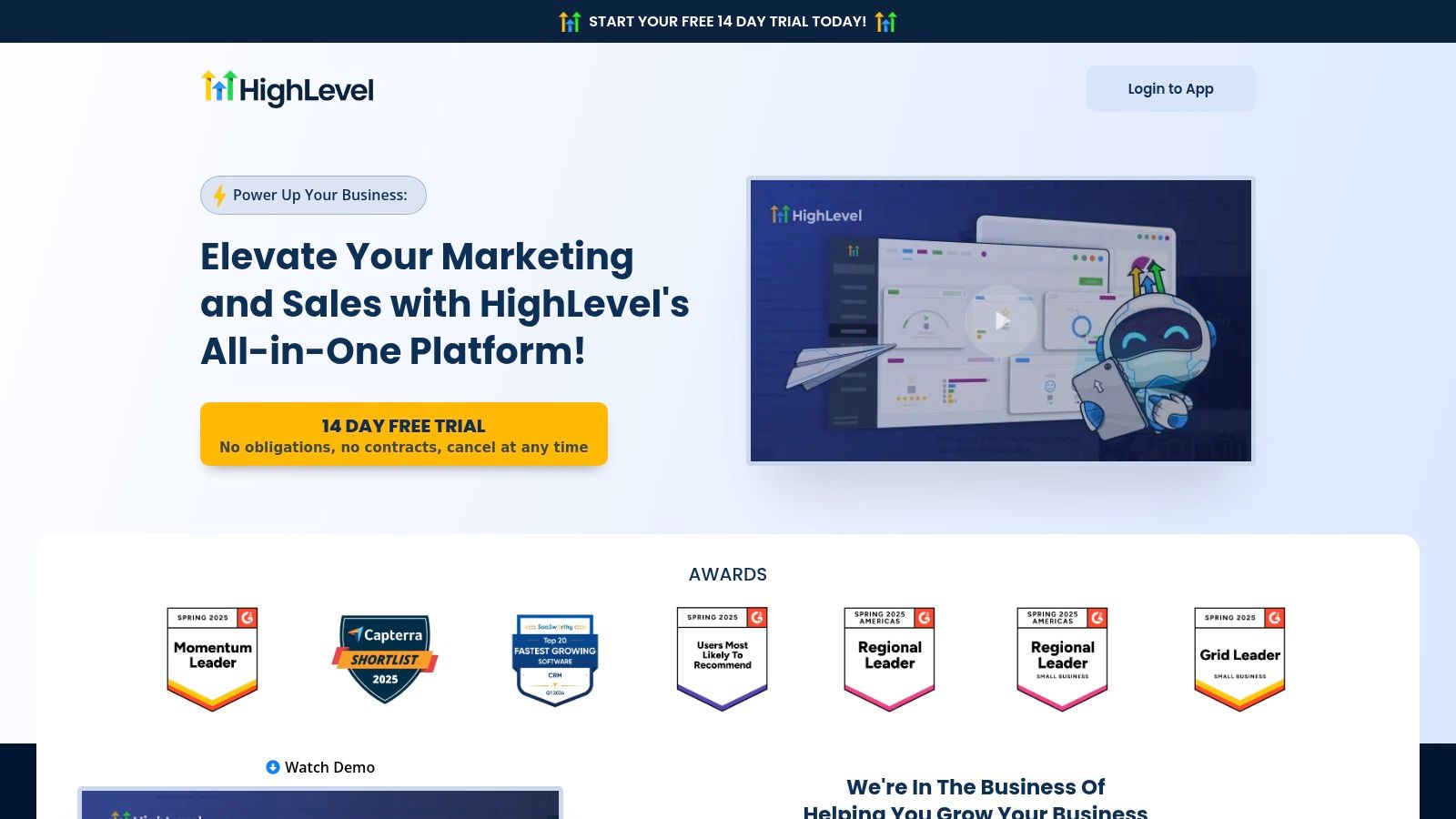
Unlike competitors that simply offer agency plans, GoHighLevel provides the infrastructure for agencies to become software providers themselves. The platform's standout feature is its built-in rebilling capability, allowing agencies to mark up and resell SMS credits, premium workflow actions, and marketplace apps directly to their clients. This turns a cost centre into a profit centre. It's a powerful piece of marketing software for agencies aiming to build a scalable, high-value service offering.
Key Features & Pricing
- Agency-Centric Model: The Unlimited plan provides unlimited client sub-accounts, a customisable desktop app, and full white-labelling.
- Revenue Operations: Built-in rebilling for usage-based services is a key differentiator.
- Pricing: Plans start at £79/month for a single business, but the agency-focused plans are the main draw: Agency Starter at £249/month (10 sub-accounts) and Agency Unlimited at £416/month.
Pros & Cons
- Pro: Purpose-built for agencies, offering a unified client management and service delivery system.
- Pro: Strong revenue generation potential through white-labelling and rebilling.
- Con: The learning curve can be steep, particularly for mastering advanced automation and API integrations.
- Con: Variable costs for SMS/telecoms and premium workflow actions require careful management to maintain profitability.
Website: https://www.gohighlevel.com/
3. HubSpot Marketing Hub
HubSpot Marketing Hub is a leading marketing automation suite built around a powerful, integrated CRM. It is widely adopted by UK agencies for its ability to unify sales and marketing data, offering a single source of truth for client campaigns. The platform combines sophisticated automation, content creation, ad management, and advanced reporting, making it a cornerstone piece of marketing software for agencies managing complex, retainer-based clients.
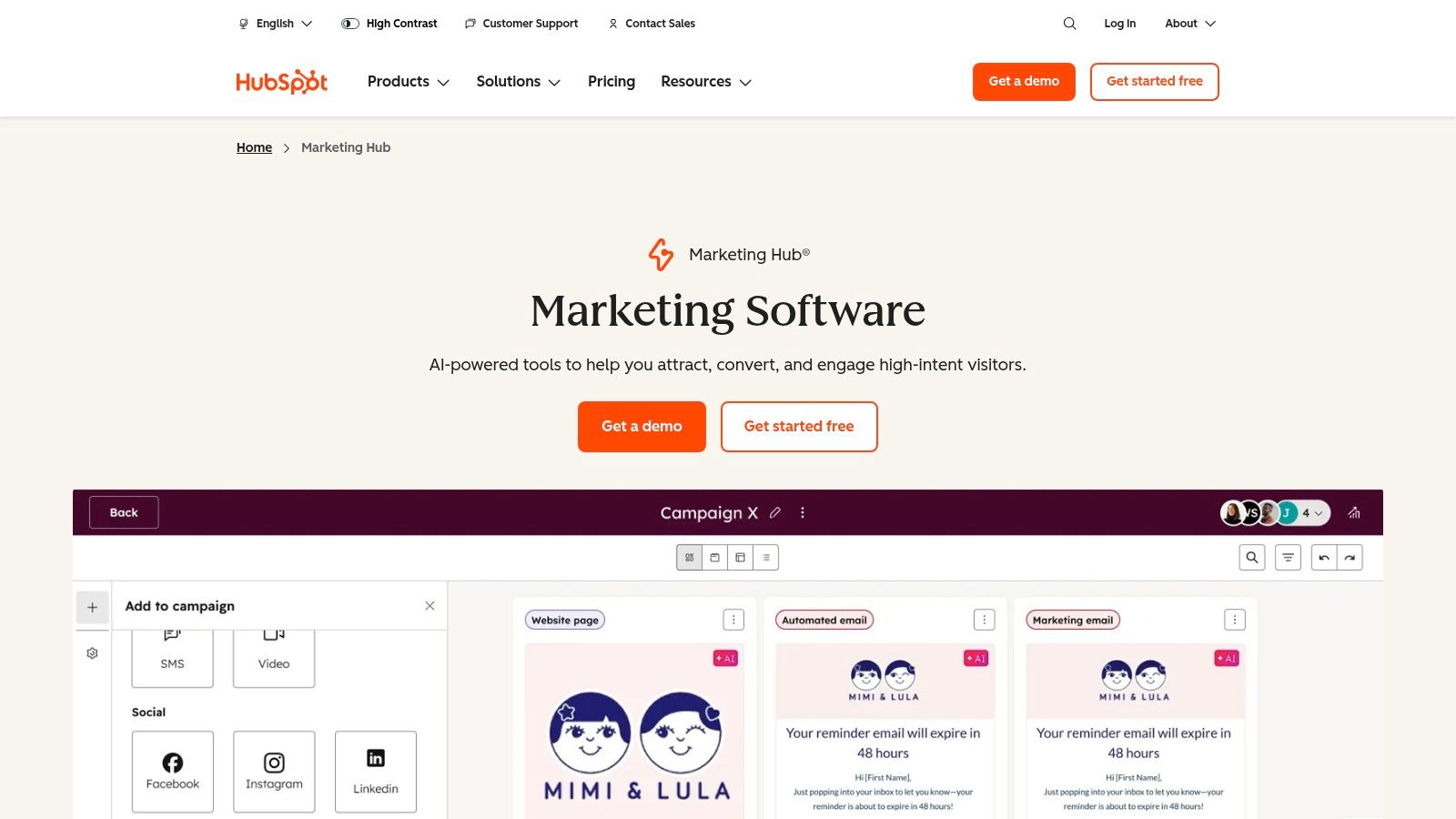
Unlike all-in-one tools focused on white-labelling, HubSpot’s strength lies in its mature partner ecosystem and deep analytics. Agencies can leverage its robust journey analytics and multi-touch revenue attribution to clearly demonstrate ROI to clients. The platform excels at providing the data-driven insights needed for strategic decision-making, supported by a vast marketplace of integrations and extensive training resources for agency partners looking to scale their service delivery.
Key Features & Pricing
- Integrated CRM Platform: All marketing activities are natively connected to a central CRM, providing a complete view of the customer journey.
- Advanced Attribution: Professional and Enterprise tiers offer sophisticated reporting to prove marketing's impact on revenue.
- Pricing: A free tools tier is available. Paid plans scale significantly, with the Professional plan starting at £660/month plus mandatory onboarding fees and additional costs based on contact numbers and user seats.
Pros & Cons
- Pro: A mature, well-supported ecosystem with an extensive partner marketplace and strong brand recognition.
- Pro: Powerful reporting and attribution capabilities are ideal for demonstrating value to large retainer clients.
- Con: The total cost of ownership can become very high, with mandatory onboarding fees and escalating per-contact/seat costs.
- Con: The pricing structure can be complex to navigate, making it challenging for smaller agencies to predict expenses.
Website: https://www.hubspot.com/products/marketing
4. Semrush
Semrush is a comprehensive online visibility management platform that has become a staple for agencies handling SEO, content marketing, competitive research, and paid media. Its power lies in consolidating numerous functions into a single interface, allowing agencies to manage multi-client workflows and gain cross-channel insights without juggling multiple subscriptions. It offers a holistic view of a client’s digital footprint, from keyword rankings to backlink profiles and social media performance.
Unlike point solutions that focus on a single marketing discipline, Semrush aims to be the all-in-one visibility tool that reduces an agency's vendor sprawl. The platform is particularly strong in competitive intelligence, providing deep datasets that help agencies benchmark client performance and identify strategic opportunities. While Semrush is a powerful tool on its own, agencies often find success by combining its insights with other specialised tools; for instance, there are many excellent 12 Competitor Analysis Tools for SEO that can complement its data to uncover even more opportunities. Its robust features make it an essential piece of marketing software for agencies focused on data-driven growth.
Key Features & Pricing
- Extensive Toolkits: Includes specialised toolkits for SEO, Content Marketing, Market Research, Advertising, and Social Media management.
- Agency Growth Kit: An add-on designed for agencies, offering features like white-label reporting, a client portal, and lead generation tools.
- Pricing: Plans start at $129.95/month for the Pro plan. The Guru plan ($249.95/month) and Business plan ($499.95/month) offer more features, projects, and user seats suitable for growing agencies.
Pros & Cons
- Pro: Deep and extensive datasets minimise the need for multiple, disparate vendor subscriptions.
- Pro: The brand is widely recognised and trusted, which can help with client buy-in and reporting credibility.
- Con: Costs can escalate quickly as an agency adds more user seats, projects, or requires higher API usage limits.
- Con: Some of the most advanced features, like API access and Share of Voice metrics, are locked behind higher-tier plans.
Website: https://www.semrush.com/
5. Ahrefs
Ahrefs is a powerhouse SEO suite renowned for its comprehensive backlink index, site auditing capabilities, and in-depth competitor analysis tools. For agencies managing multiple SEO campaigns, it provides the reliable, data-driven insights needed to formulate effective strategies for clients. The platform excels at uncovering link-building opportunities, tracking keyword rankings with historical data, and performing technical SEO health checks.
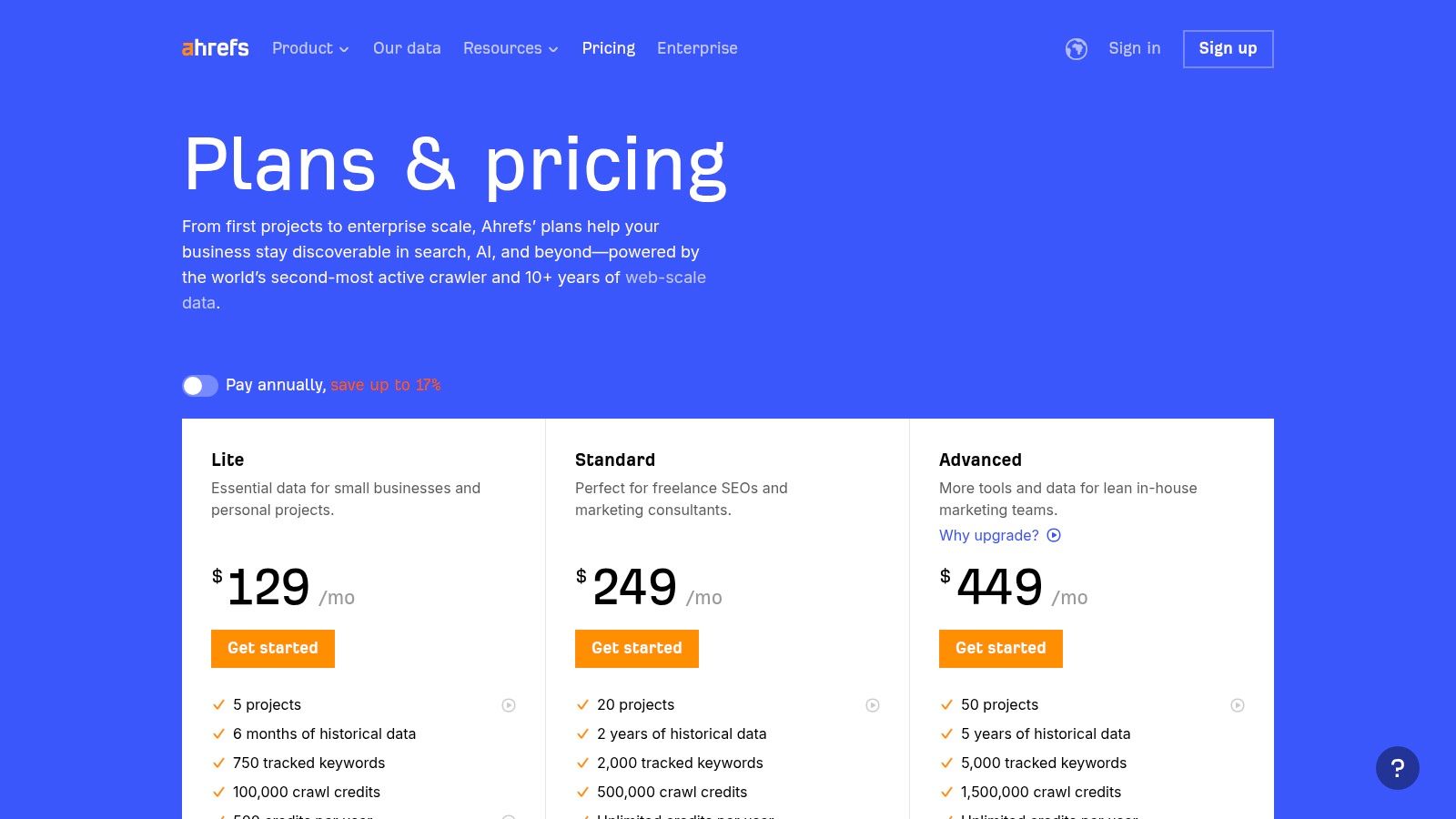
Unlike some all-in-one tools where SEO is just one feature, Ahrefs is a specialised platform trusted by SEO professionals for its data accuracy and depth. Its standout quality is the transparency of its plan limits, clearly outlining the number of projects, crawl credits, and tracked keywords per tier. This clarity makes it an ideal piece of marketing software for agencies that need to manage client budgets and resource allocation without unexpected costs, ensuring predictable campaign expenditure.
Key Features & Pricing
- Core SEO Tools: Includes Site Explorer for backlink analysis, Keywords Explorer, Site Audit for technical SEO, and Rank Tracker.
- Transparent Limits: Agency plans clearly define the number of projects and crawl credits, simplifying client resource management.
- Pricing: Plans are tiered, starting with the Lite plan at £79/month. Agency-suitable plans like Standard (£159/month) and Advanced (£319/month) offer increased project and data limits.
Pros & Cons
- Pro: Highly trusted and accurate backlink data, considered an industry standard for off-page SEO.
- Pro: Clear, transparent usage limits make it easy for agencies to manage costs across multiple client accounts.
- Con: Can become expensive, especially for agencies with a large portfolio of clients requiring higher-tier plans and add-ons.
- Con: The lack of a long-term free trial means commitment is required to fully evaluate its comprehensive toolset.
Website: https://ahrefs.com/pricing
6. AgencyAnalytics
AgencyAnalytics is a purpose-built reporting platform that streamlines how marketing agencies track performance and communicate results to clients. Its core strength lies in consolidating data from over 80 marketing channels into automated, white-labelled dashboards and reports. For agencies juggling multiple clients, this centralises all performance metrics, from SEO and PPC to social media and email marketing, saving countless hours on manual report creation.
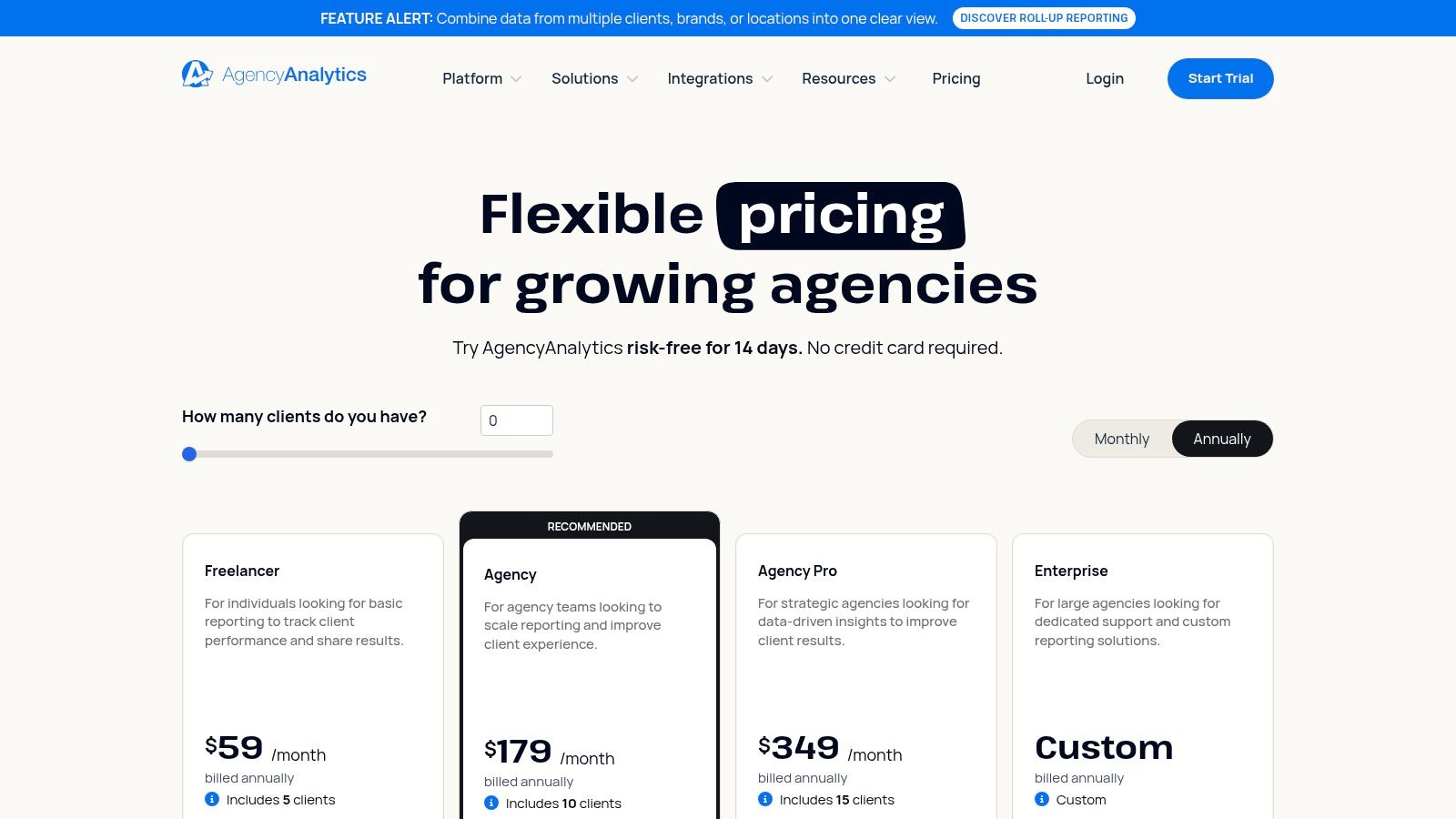
Unlike generic dashboard tools, AgencyAnalytics is designed with the agency workflow in mind. Features like automated report scheduling, custom branding on client portals, and roll-up dashboards for a portfolio-level view are specifically included to enhance client management and operational efficiency. The platform allows agencies to give clients their own logins to a branded portal, offering transparency while reinforcing the agency's value. This makes it a crucial piece of marketing software for agencies focused on data-driven service delivery.
Key Features & Pricing
- White-Label Reporting: Fully customisable client portals and reports with agency branding and automated delivery.
- Broad Integrations: Connects with over 80 platforms, including Google Analytics, SEMrush, and all major social media networks.
- Pricing: The Freelancer plan starts at £99/month for 10 client campaigns. The popular Agency plan is £159/month for 20 campaigns, and custom Premier plans are available for larger needs.
Pros & Cons
- Pro: True agency features like unlimited client logins and white-labelling are included in core plans.
- Pro: Significant time savings on recurring reporting tasks through automation.
- Con: Key tools like the rank tracker and some advanced database connectors are priced as separate add-ons.
- Con: All billing is in USD, which may require currency conversion considerations for UK-based agencies.
Website: https://agencyanalytics.com/pricing
7. Sprout Social
Sprout Social is a premium social media management platform designed for sophisticated publishing, engagement, listening, and reporting. It's particularly well-suited for agencies that require advanced analytics and collaborative team workflows to manage multiple client accounts effectively. The platform offers a unified inbox for all social channels, detailed performance analytics, and powerful social listening tools to track brand sentiment and industry trends.
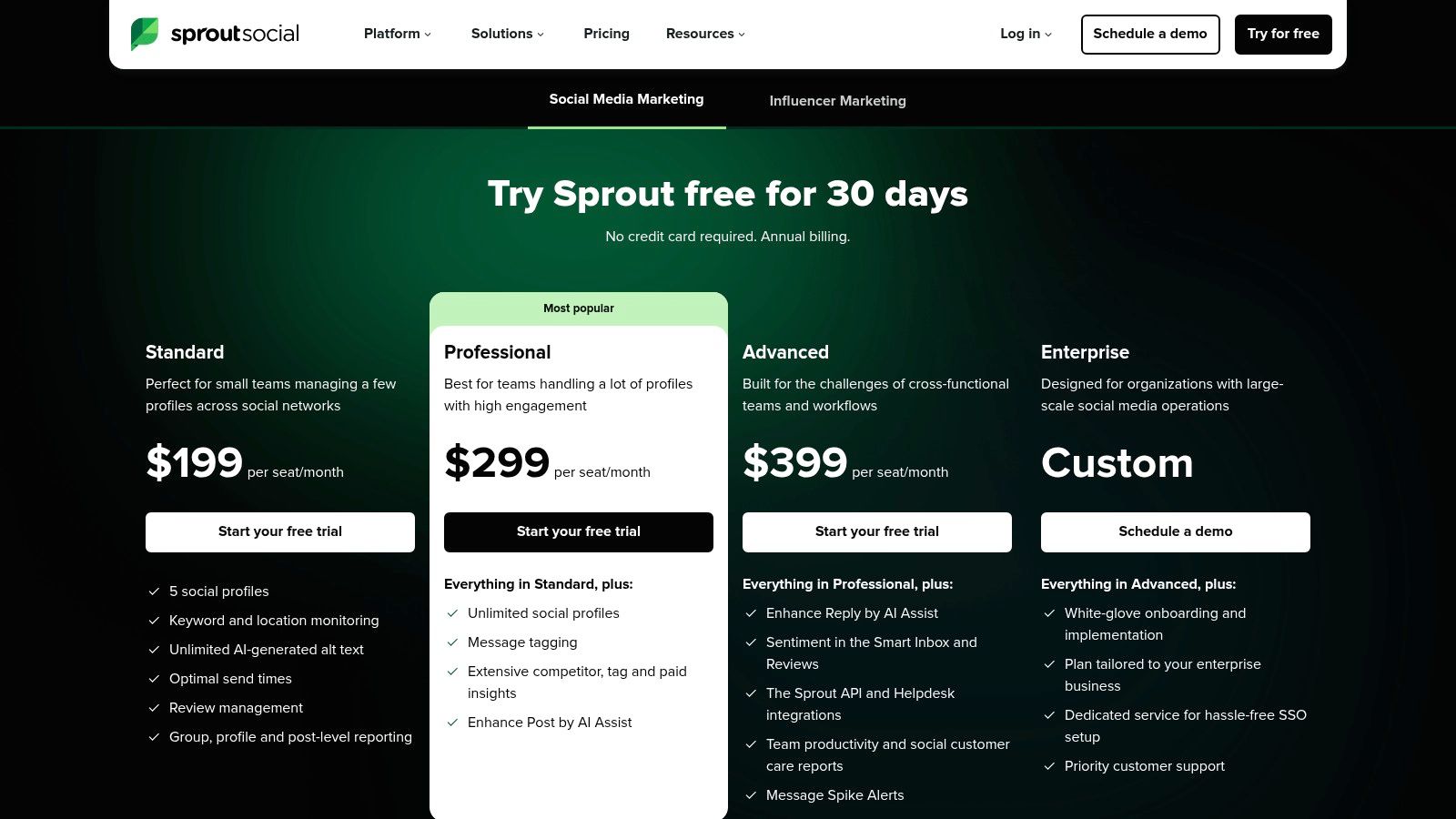
Unlike platforms that bundle unlimited users, Sprout Social uses a per-seat pricing model that can scale with an agency's team size. This makes it a great piece of marketing software for agencies prioritising deep analytical insight and robust, permission-based workflows over sheer user numbers. Its strength lies in providing the granular data and collaboration tools needed to deliver and report on high-impact social media strategies for clients. A 30-day free trial allows for a thorough evaluation before commitment.
Key Features & Pricing
- Advanced Analytics & Listening: Provides in-depth reporting and social listening tools, with more powerful add-ons available.
- Team Collaboration: Features robust approval workflows and permission levels ideal for agency-client management.
- Pricing: The Standard plan is £199 per user/month. The popular Professional plan is £299 per user/month, and the Advanced plan is £399 per user/month, each offering more features and unlimited profiles.
Pros & Cons
- Pro: Powerful and intuitive analytics and social listening capabilities provide deep client insights.
- Pro: Excellent team workflows streamline client content approval and management processes.
- Con: Per-seat pricing can become costly for larger agency teams, impacting scalability.
- Con: Accessing the most advanced, enterprise-level features often requires the highest-tier plans or paid add-ons.
Website: https://sproutsocial.com/pricing/
8. BrightLocal
BrightLocal is a specialised local SEO platform built for agencies managing clients with physical locations. Originating in the UK, it provides a comprehensive suite of tools designed to monitor and improve local search visibility. The platform centralises crucial local marketing tasks like rank tracking, Google Business Profile auditing, online review management, and citation building, making it invaluable for agencies serving businesses from single-shop hairdressers to multi-location franchises.
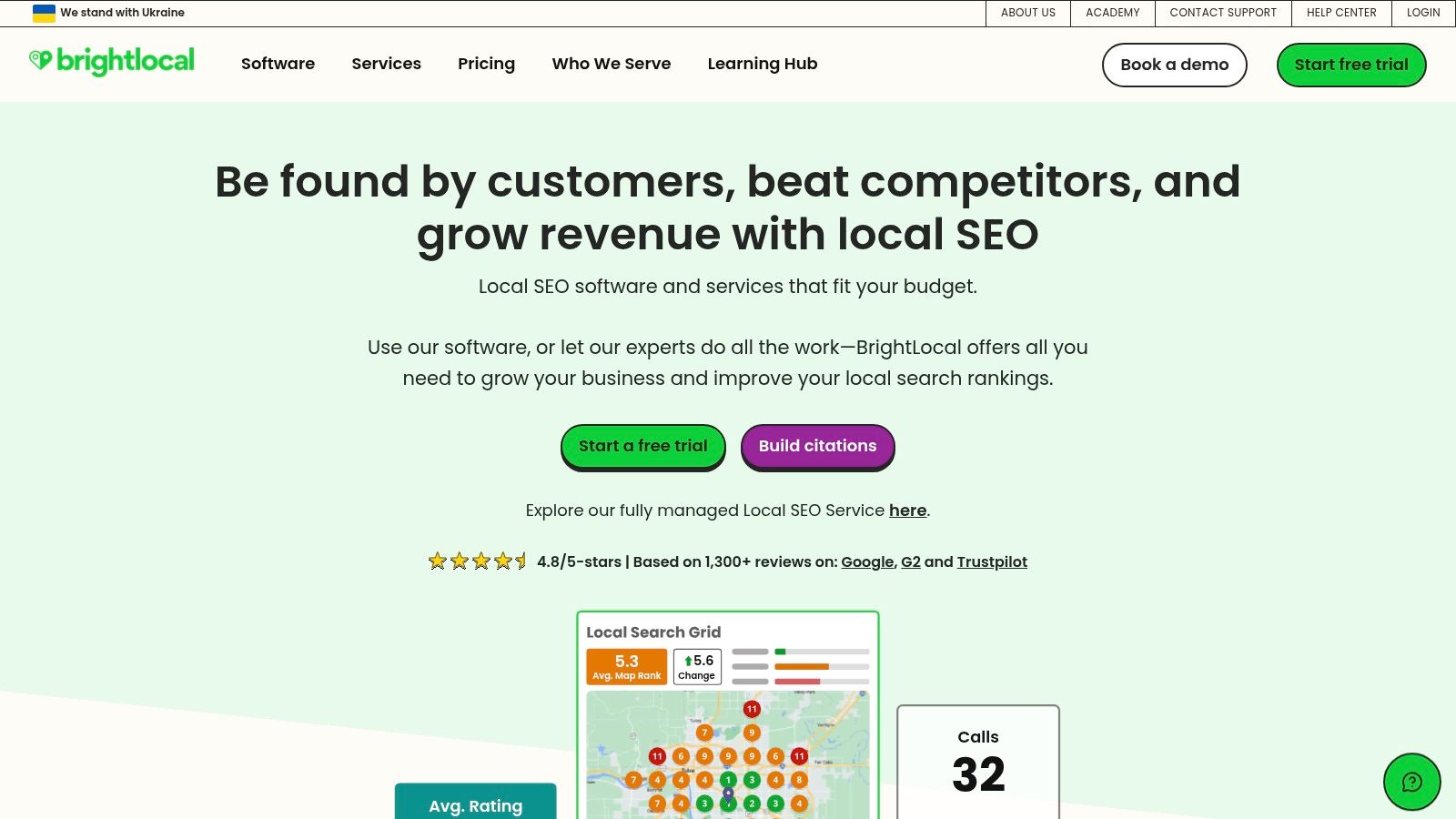
Unlike broader SEO platforms, BrightLocal's focus is exclusively on the local marketing ecosystem. Its standout feature is the combination of automated monitoring with manual, managed services like its Citation Builder, where a team builds and cleans up local business listings on behalf of the agency. This hybrid approach makes it a practical piece of marketing software for agencies that need both granular data and hands-on execution to deliver local SEO results for their clients.
Key Features & Pricing
- Local SEO Toolkit: Includes Local Search Grid for visual rank tracking, GBP auditing, and reputation management.
- Managed Services: Offers one-off and recurring citation building and cleanup campaigns.
- Pricing: Plans are priced per location, starting at £25/month for 3 locations. Agency-focused plans offer white-labelling and start from £65/month for 10 locations, scaling up from there.
Pros & Cons
- Pro: Highly specialised toolset for local SEO, providing deeper insights than general SEO platforms.
- Pro: Clear, transparent pricing based on the number of client locations, making it easy to budget.
- Con: The per-location pricing model can become expensive for agencies with a large number of clients or multi-location businesses.
- Con: While powerful, its focus is narrow; it needs to be paired with other tools for general SEO and content marketing.
Website: https://www.brightlocal.com/
9. Mailchimp
Mailchimp is a cornerstone email marketing platform, often serving as an entry point for small to medium-sized businesses and their agencies. Its core strength lies in its user-friendly email builder, extensive template library, and straightforward automation, making it ideal for clients who need a reliable, professional email presence without a steep learning curve. It provides a full suite of tools, including landing pages, forms, and a basic CRM to manage audience segments.
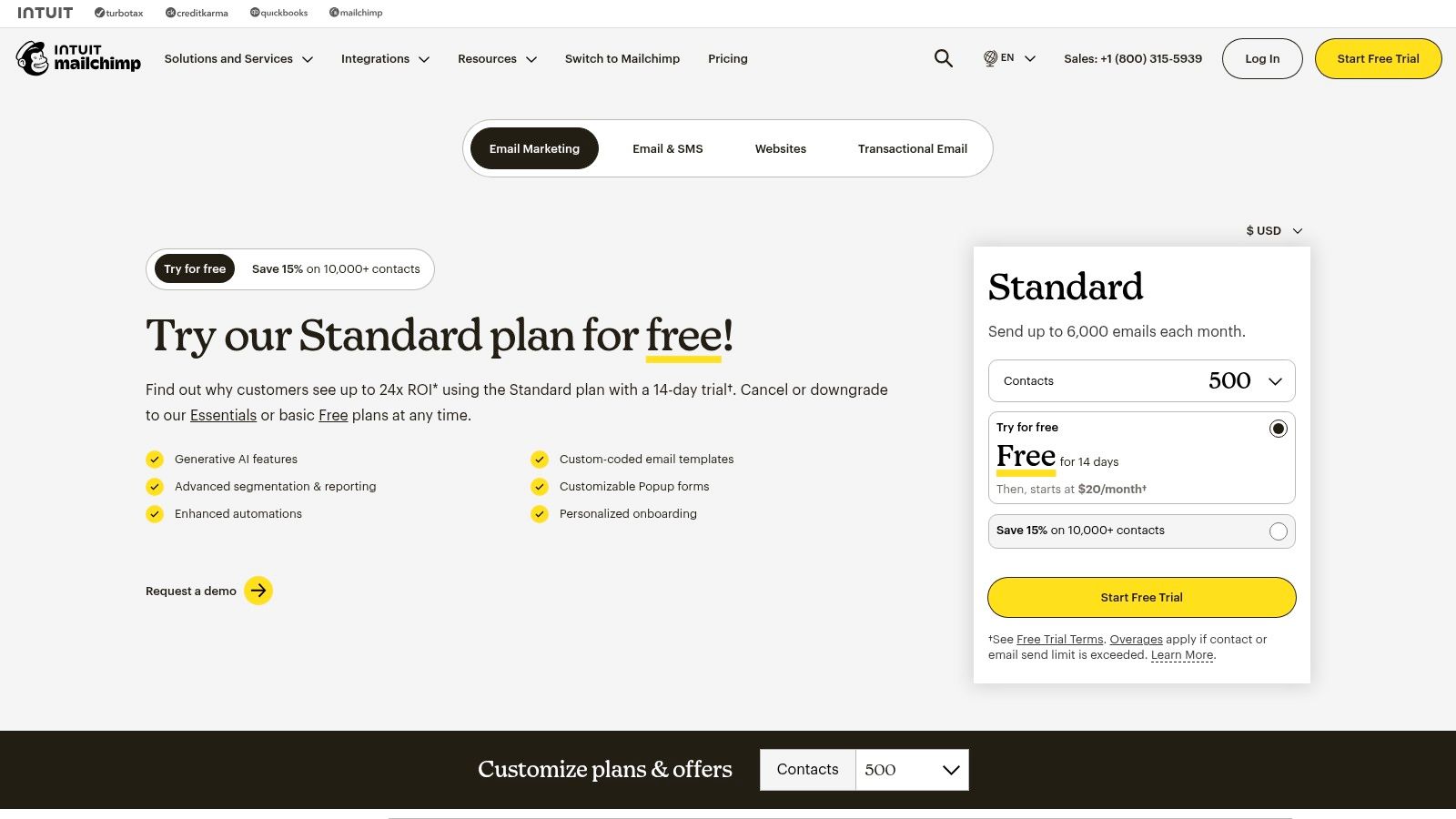
Unlike more complex, all-in-one solutions, Mailchimp focuses on mastering the essentials of email communication. For agencies, its widespread adoption means many clients are already familiar with the platform, simplifying onboarding and campaign execution. This focus on accessibility and core features makes it a practical piece of marketing software for agencies managing numerous SME accounts. To better understand the impact it can have, you can explore the advantages of email marketing.
Key Features & Pricing
- Core Email Tools: Features an intuitive drag-and-drop email builder, customer journey automation, and tools for creating landing pages and forms.
- Tiered Plans: Pricing is primarily based on contact numbers and scales from a free plan to Essentials, Standard, and Premium tiers, offering progressively advanced features like predictive segmentation.
- Pricing: The free plan is limited, with paid plans starting from around £11/month for 500 contacts on the Essentials plan, scaling upwards significantly with contacts and features.
Pros & Cons
- Pro: Extremely user-friendly and quick to deploy, making it perfect for agencies serving the small and mid-market sectors.
- Pro: A massive library of third-party integrations ensures it fits easily into most client tech stacks.
- Con: The contact-based pricing can become expensive quickly, requiring careful list management to control costs for clients.
- Con: Agencies may find that clients with advanced automation or CRM needs will eventually outgrow the platform.
Website: https://mailchimp.com/pricing/
10. ActiveCampaign
ActiveCampaign is a customer experience automation platform that combines email marketing, marketing automation, and a CRM. For agencies, its primary value lies in its sophisticated automation capabilities and a structured Agency Program designed for reselling. This allows agencies to manage complex, multi-touch campaigns for clients, leveraging deep segmentation and personalised communication flows.
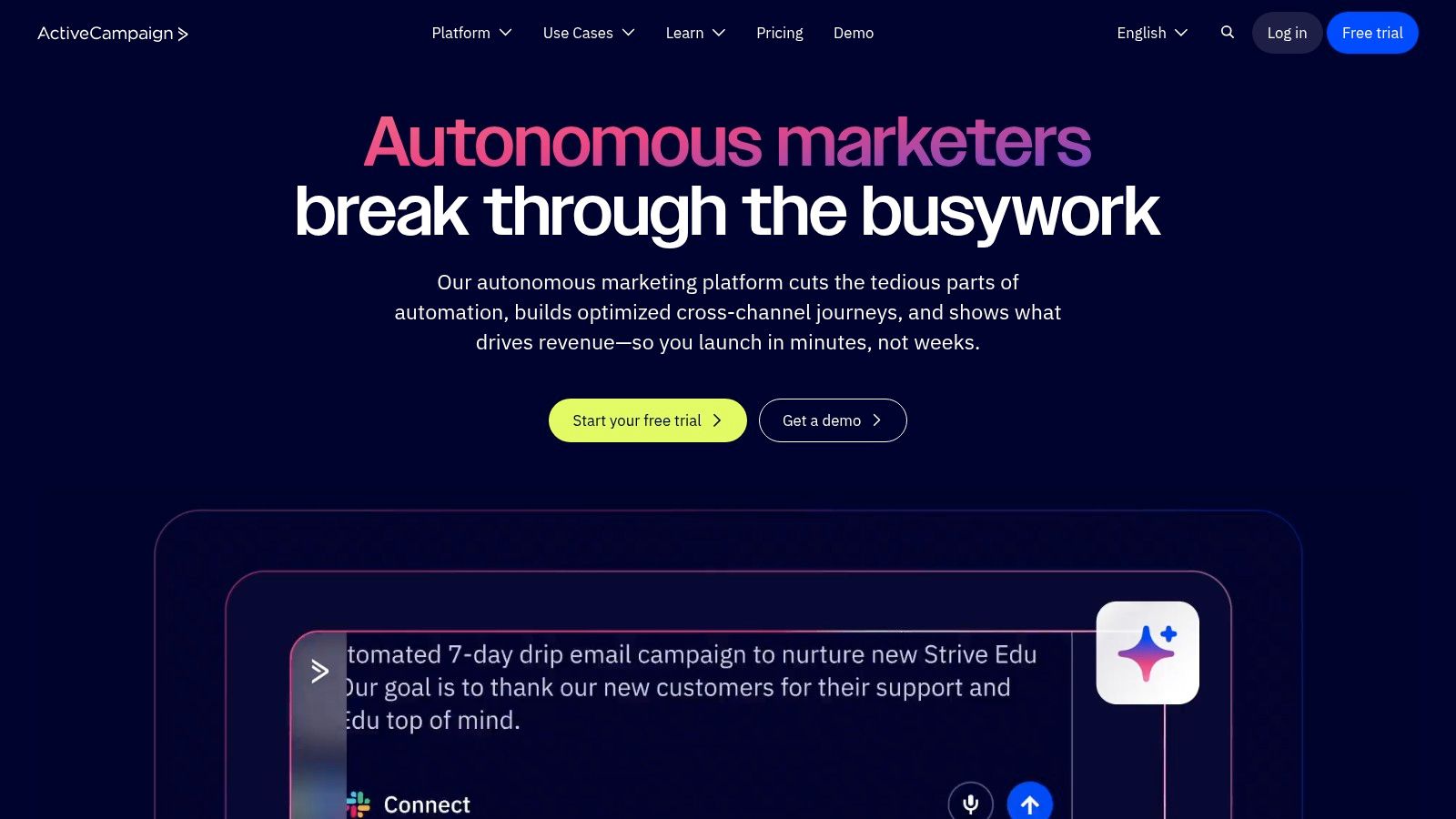
Unlike platforms focused purely on white-labelling, ActiveCampaign stands out with its powerful automation engine that can handle intricate logic-based sequences. The formal Agency Program offers tiered discounts, making it economically viable for agencies to manage multiple client accounts and build a recurring revenue stream around marketing automation services. This makes it a strong piece of marketing software for agencies that specialise in creating and managing advanced email and CRM strategies for their clients.
Key Features & Pricing
- Advanced Automation: Visual workflow builder for creating sophisticated, logic-based automation sequences.
- Agency Program: Tiered discounts from 25%–55% for reselling the platform, based on total monthly recurring revenue.
- Pricing: Begins with a 14-day free trial. Plans are tiered by contact count and feature set, with entry-level pricing making it accessible for clients with small lists.
Pros & Cons
- Pro: Extremely powerful automation and segmentation tools, ideal for data-driven agency campaigns.
- Pro: The reseller programme provides a clear path to profitability for agencies managing multiple client accounts.
- Con: Pricing can become complex and expensive as client contact lists grow and additional features are needed.
- Con: Managing multiple, distinct client brands requires careful organisation within the account structure to avoid overlap.
Website: https://www.activecampaign.com/
11. Brevo (formerly Sendinblue)
Brevo positions itself as an all-in-one marketing platform with a strong European foundation, making it an attractive choice for agencies managing UK and EU-based clients concerned with data residency. It consolidates email, SMS, WhatsApp, and web push notifications into a single dashboard, offering a unified approach to omnichannel communication. This allows agencies to orchestrate multi-channel campaigns for clients without juggling separate, specialised tools.
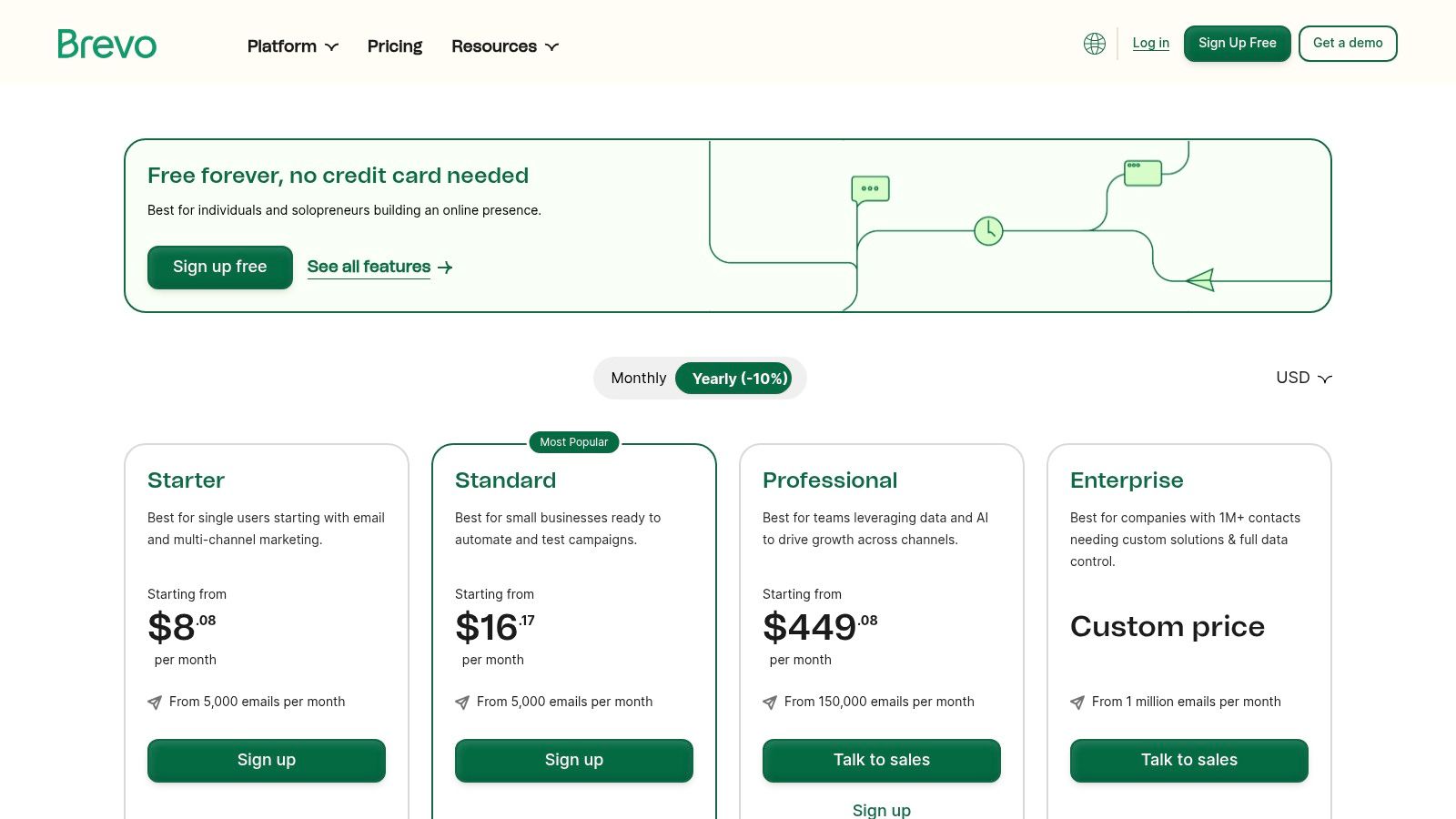
Unlike platforms focused solely on agencies reselling software, Brevo offers a more direct service delivery model. Its appeal lies in its transparent, volume-based pricing and modular add-ons, which allow agencies to build a cost-effective and customised marketing software stack for each client. For agencies needing a robust, GDPR-compliant communication hub that scales predictably with client activity, Brevo provides a solid and reliable foundation.
Key Features & Pricing
- Omnichannel Hub: Manages Email, SMS, WhatsApp, and Web Push campaigns from one interface.
- EU Data Posture: All data is processed and stored on EU-based servers, simplifying GDPR compliance.
- Pricing: A free plan is available for up to 300 emails/day. Paid plans start with Starter (£16.50/month for 20k emails), Business (£49/month with A/B testing and automation), and custom Enterprise tiers.
Pros & Cons
- Pro: Competitive entry-level pricing and a strong focus on EU data handling and compliance.
- Pro: Integrated omnichannel messaging options allow for cohesive client campaign management.
- Con: Key agency features like advanced automation and multi-user access are gated behind more expensive tiers.
- Con: The price jump from the Starter to Business plan is significant, and advanced features can become costly add-ons.
Website: https://www.brevo.com/pricing/
12. Capterra UK (Marketing Automation Directory)
While not a software tool itself, Capterra's UK-localised directory is an essential research platform for any agency evaluating marketing software. It aggregates hundreds of marketing automation tools, allowing agencies to filter, compare, and read verified user reviews specific to the UK market. This is crucial for understanding real-world performance, pricing in GBP, and vendor support relevant to local time zones.
Unlike direct vendor websites, Capterra provides a comparative, third-party perspective. Its strength lies in the depth of its user-generated reviews and side-by-side feature comparisons, which help agencies move beyond marketing copy to assess a tool's practical fit. For an agency building a tech stack or finding a niche solution for a client, this directory is an indispensable first step in the procurement process, saving significant time on initial market research.
Key Features & Pricing
- UK-Specific Directory: Filters and vendor pages are tailored for the UK market, often showing pricing in GBP.
- Verified User Reviews: Provides honest feedback on usability, customer support, and feature performance.
- Pricing: The platform is free for users to browse, compare software, and click through to vendor sites.
Pros & Cons
- Pro: Massively speeds up the vendor discovery and shortlisting process with comprehensive filters.
- Pro: User reviews are invaluable for uncovering common issues and strengths not mentioned in marketing materials.
- Con: Sponsored placements can influence the default sorting order, so always evaluate the entire list.
- Con: Feature and pricing summaries may not be fully up-to-date; always verify details on the official vendor website.
Website: https://www.capterra.co.uk/directory/6/marketing-automation/software
Top 12 Agency Marketing Software Comparison
| Tool | Core features | Quality (UX / Performance) ★ | Value & Pricing 💰 | Target & USP 👥✨ |
|---|---|---|---|---|
| The Digital Marketing Toolbox – Grow Your Biz 🏆 | Curated catalog: SEO, email, PPC, social, AI, widgets + filters & comparisons | ★★★★★ | 💰 Free to browse; links to vendor trials | 👥 Agencies, freelancers, SMBs — ✨fast vendor discovery & side-by-side comparisons |
| GoHighLevel | All-in-one CRM, funnels, email/SMS, automation, white‑label sub-accounts | ★★★★☆ | 💰 Tiered agency plans; add-on telecom costs | 👥 Agencies/resellers — ✨white-label & rebilling for revenue ops |
| HubSpot Marketing Hub | CRM-connected automation, ads, forms, attribution, partner marketplace | ★★★★★ | 💰 Free → Enterprise; seats & contacts add cost | 👥 Mid-market to enterprise agencies — ✨deep attribution & ecosystem |
| Semrush | Keyword & competitive research, site auditing, Social Toolkit, AI features | ★★★★★ | 💰 Tiered plans; higher tiers for advanced features | 👥 SEO/content teams & agencies — ✨extensive datasets for visibility |
| Ahrefs | Backlink index, site audits, rank tracking, competitive insights | ★★★★★ | 💰 Clear plan tiers; no long free trial | 👥 SEO specialists & agencies — ✨trusted backlink data & transparency |
| AgencyAnalytics | White‑label dashboards, client portals, 80+ integrations, scheduled reports | ★★★★☆ | 💰 Clear client-based plans; rank tracker add‑on | 👥 Agencies needing reporting efficiency — ✨true white‑label roll-ups |
| Sprout Social | Publishing, engagement, listening, analytics, team workflows | ★★★★☆ | 💰 Seat-based pricing; 30‑day trial | 👥 Social teams & agencies — ✨powerful listening & reporting |
| BrightLocal | Local rank tracking, GBP audits, review management, citation building | ★★★★☆ | 💰 Per-location tiers; API add-ons | 👥 Local SEO agencies & multi-location clients — ✨UK-focused pricing |
| Mailchimp | Email builder, journeys, forms, landing pages, basic CRM | ★★★★☆ | 💰 Free → Premium by contacts | 👥 SMBs & agencies servicing SMEs — ✨easy templates & wide integrations |
| ActiveCampaign | Advanced automation, segmentation, CRM, agency reseller program | ★★★★★ | 💰 Contact-based tiers; agency discounts available | 👥 Agencies & campaign teams — ✨strong automation + reseller economics |
| Brevo (Sendinblue) | Email, SMS, WhatsApp, web push, landing pages — EU data posture | ★★★★☆ | 💰 Volume-based tiers; transparent add-ons | 👥 EU/UK clients & SMEs — ✨omnichannel with EU-focused data handling |
| Capterra UK (Directory) | UK-localised listings, reviews, filters, vendor pages | ★★★★☆ | 💰 Free to use; links to vendor trials | 👥 Buyers doing vendor research — ✨user reviews & UK currency context |
Building Your Agency's Perfect Tech Stack
Choosing the right marketing software for agencies is less about finding a single "best" tool and more about strategically assembling a technology stack that amplifies your team's strengths and supports your clients' unique goals. Throughout this guide, we've explored a diverse range of platforms, from comprehensive all-in-one solutions like GoHighLevel and HubSpot to specialised powerhouses such as Semrush for SEO and Sprout Social for social media management.
The core takeaway is that no single platform can do everything perfectly. A high-performing agency often relies on a carefully integrated ecosystem of tools. Your ideal setup might combine a robust client reporting tool like AgencyAnalytics with a specialised local SEO platform like BrightLocal to deliver unparalleled, transparent results for local business clients. Similarly, pairing an advanced email automation system like ActiveCampaign with a top-tier SEO suite ensures you can attract traffic and effectively nurture those leads into loyal customers.
Making the Right Choice for Your Agency
Before committing to new software, it's crucial to look beyond the feature list and consider the practical implications. Your decision-making process should be guided by a clear understanding of your agency's specific needs.
Here are the key factors to evaluate:
- Scalability: Will this software grow with your agency and your clients? Consider how pricing tiers and feature sets accommodate an expanding client roster and more complex campaign demands. A tool that's affordable now might become prohibitively expensive as you scale.
- Integration Capabilities: How well does a potential tool play with your existing software? Seamless integration is vital for creating efficient workflows and building a single source of truth for your data. Poor integration leads to manual data entry, information silos, and wasted time.
- Client Management & Reporting: For agencies, the ability to manage multiple client accounts from a single dashboard is non-negotiable. Look for platforms that offer white-labelling, customisable dashboards, and automated reporting features that make it easy to demonstrate your value.
- Team Adoption & Support: A powerful tool is useless if your team finds it difficult to use. Prioritise software with an intuitive user interface, comprehensive training resources, and responsive customer support. Consider running a trial period with key team members to gauge usability and gather feedback.
Ultimately, the most effective tech stack is a dynamic entity, evolving as your agency grows and the digital marketing landscape shifts. The goal isn't to find a permanent solution, but to build a flexible, powerful, and cost-effective toolkit. By focusing on integration, scalability, and your team's specific workflow, you can assemble a collection of marketing software that not only streamlines your operations but also becomes a significant competitive advantage, enabling you to deliver exceptional results for every client.
Ready to simplify your toolkit without sacrificing power? The Digital Marketing Toolbox combines essential marketing functions into one streamlined, affordable platform designed specifically for growing businesses and agencies. Explore how our all-in-one solution can consolidate your tech stack and drive client success at The Digital Marketing Toolbox.


