

For any UK small business, having the right technology is no longer a luxury-it's the engine for growth. Juggling social media, emails, customer relationships, and SEO can quickly become overwhelming without a smart, efficient system. This guide cuts through the noise to showcase 12 of the best marketing tools for small businesses available in 2025.
We'll move beyond generic feature lists to provide practical insights, real use cases, and honest assessments of each platform's strengths and limitations. Whether you're aiming to automate workflows, create stunning visuals, or drive targeted traffic, this curated list will help you build a marketing stack that saves time, reduces costs, and delivers measurable results.
Each entry is organised for quick evaluation, complete with screenshots, direct links, and a clear breakdown of pricing. Our goal is straightforward: to help you identify the specific platforms that will best support your business objectives. This resource is designed to be your go-to reference for building a powerful, cost-effective toolkit that scales with your ambition. We provide the analysis you need to make informed decisions and invest in software that truly fuels your growth.
1. The Digital Marketing Toolbox
The Digital Marketing Toolbox earns its top spot by functioning less as a single tool and more as a centralised command centre for your entire marketing stack. Instead of spending hours researching disparate solutions, this platform consolidates a vast, curated catalogue of leading marketing tools for small businesses into one intuitive interface. It simplifies the often-overwhelming process of building an effective marketing toolkit by allowing you to discover, compare, and test software across every essential category.
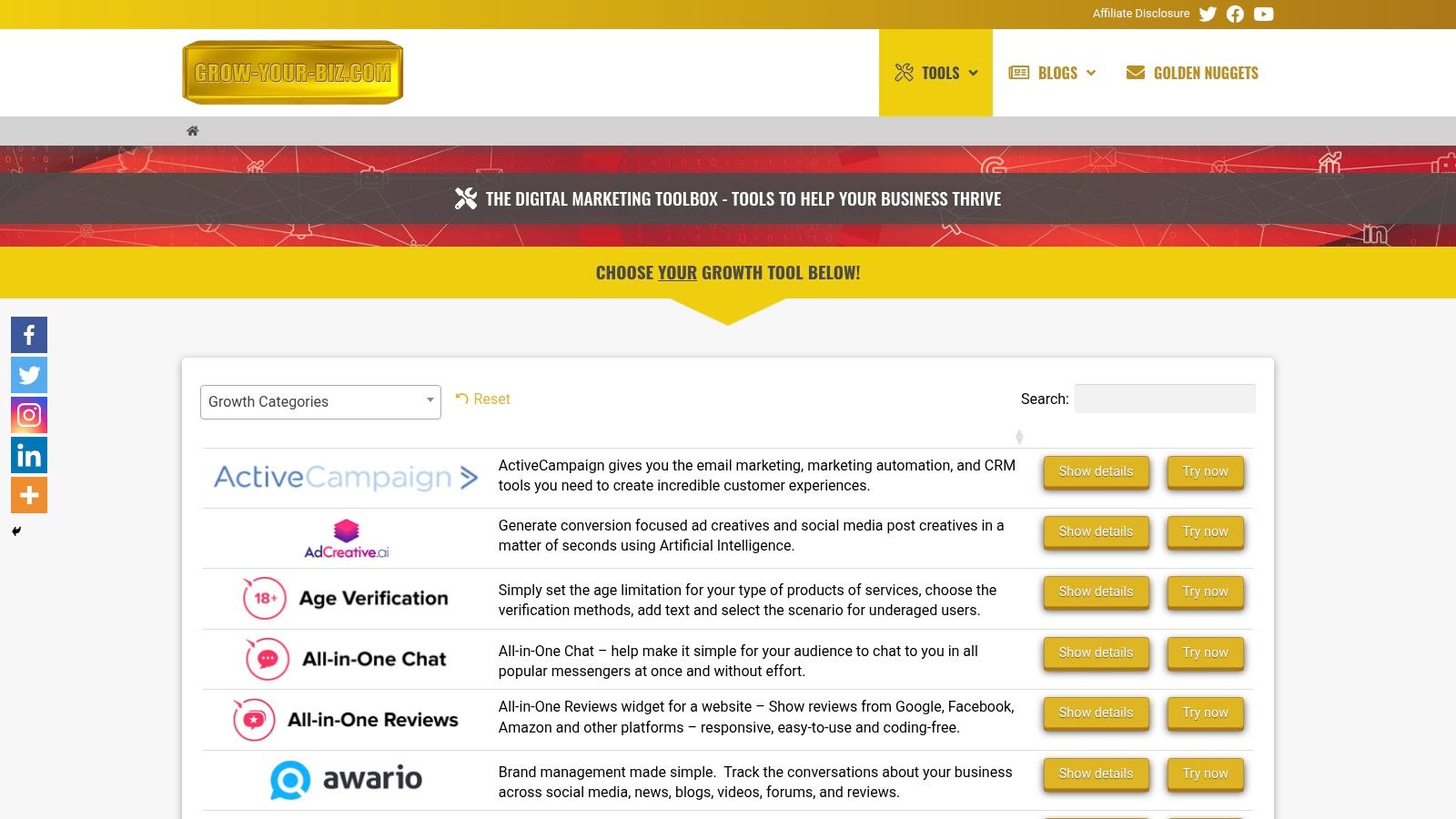
Its primary strength lies in its powerful filtering and comparison engine. Whether you need an AI content generator, an SEO analyser, or an email automation platform, you can quickly evaluate top-tier options like Copy.ai or AWeber side-by-side. This practical approach demystifies tool selection and empowers you to make informed decisions based on features and your specific business needs, directly aligning with an effective marketing strategy.
Standout Features and Implementation
The platform excels by providing direct access to free trials, allowing you to test-drive tools before committing financially. This risk-free exploration is invaluable for small businesses operating on tight budgets.
- Best For: Small businesses, agencies, and e-commerce managers seeking a streamlined way to build and manage their marketing technology.
- Key Strength: Its intuitive interface and side-by-side comparison feature eliminate guesswork, helping you choose the right tools with confidence.
- Pro Tip: Use the category filters to identify gaps in your current marketing efforts. For instance, explore the "Website Widgets" section to find tools that can immediately boost on-site engagement and lead capture.
- Pricing: The platform itself is free to use; pricing for individual tools is set by third-party vendors.
- Website: grow-your-biz.com
2. HubSpot
HubSpot offers a powerful, all-in-one marketing, sales, and service platform, making it one of the most comprehensive marketing tools for small businesses looking to scale. It consolidates everything from email marketing and social media management to a fully-featured CRM, eliminating the need to juggle multiple, disconnected applications. Its primary strength lies in its ability to provide a single, unified view of the customer journey.
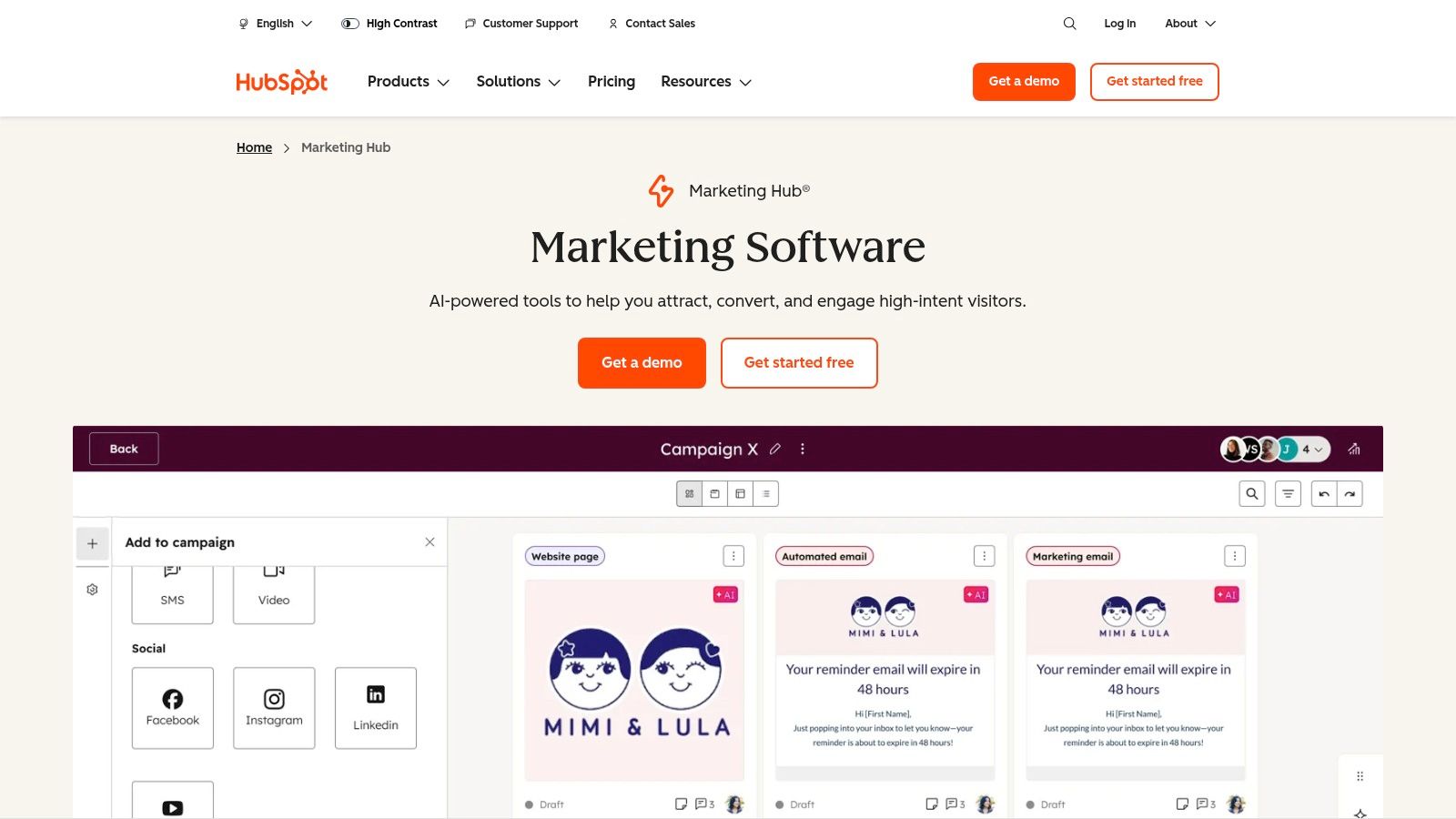
The platform’s generous free tier is a major draw, offering access to its core CRM, email marketing, forms, and landing pages without any initial investment. For UK-based businesses, HubSpot’s strong local user base and support network are significant advantages. New users can leverage HubSpot Academy, a fantastic free resource with certifications that help you master the platform quickly and effectively.
Key Features and Pricing
| Features | Starter | Professional | Enterprise |
|---|---|---|---|
| Email Marketing | Included | Included | Included |
| Forms & Landing Pages | Included | Included | Included |
| Ad Management | Google, FB, LinkedIn | Google, FB, LinkedIn | Google, FB, LinkedIn |
| Visual Automation | Basic | Advanced | Advanced |
| CRM Contacts | 1,000,000 Free | 1,000,000 Free | 1,000,000 Free |
Pros and Cons
- Pros: True all-in-one stack reduces tool complexity, excellent onboarding and training via HubSpot Academy, strong integration ecosystem.
- Cons: Paid tiers can become expensive as contact lists grow, and Professional/Enterprise plans have mandatory onboarding fees.
Website: https://www.hubspot.com/products/marketing
3. Mailchimp
Mailchimp is a powerhouse in the email marketing world, renowned for its user-friendly interface that makes it incredibly easy for small businesses to get started. It’s one of the most accessible marketing tools for small businesses looking to build an email list, automate communications, and design professional-looking campaigns without needing a technical background. The platform has evolved to include a simple CRM, basic landing pages, and robust e-commerce integrations, making it a solid entry point into digital marketing.
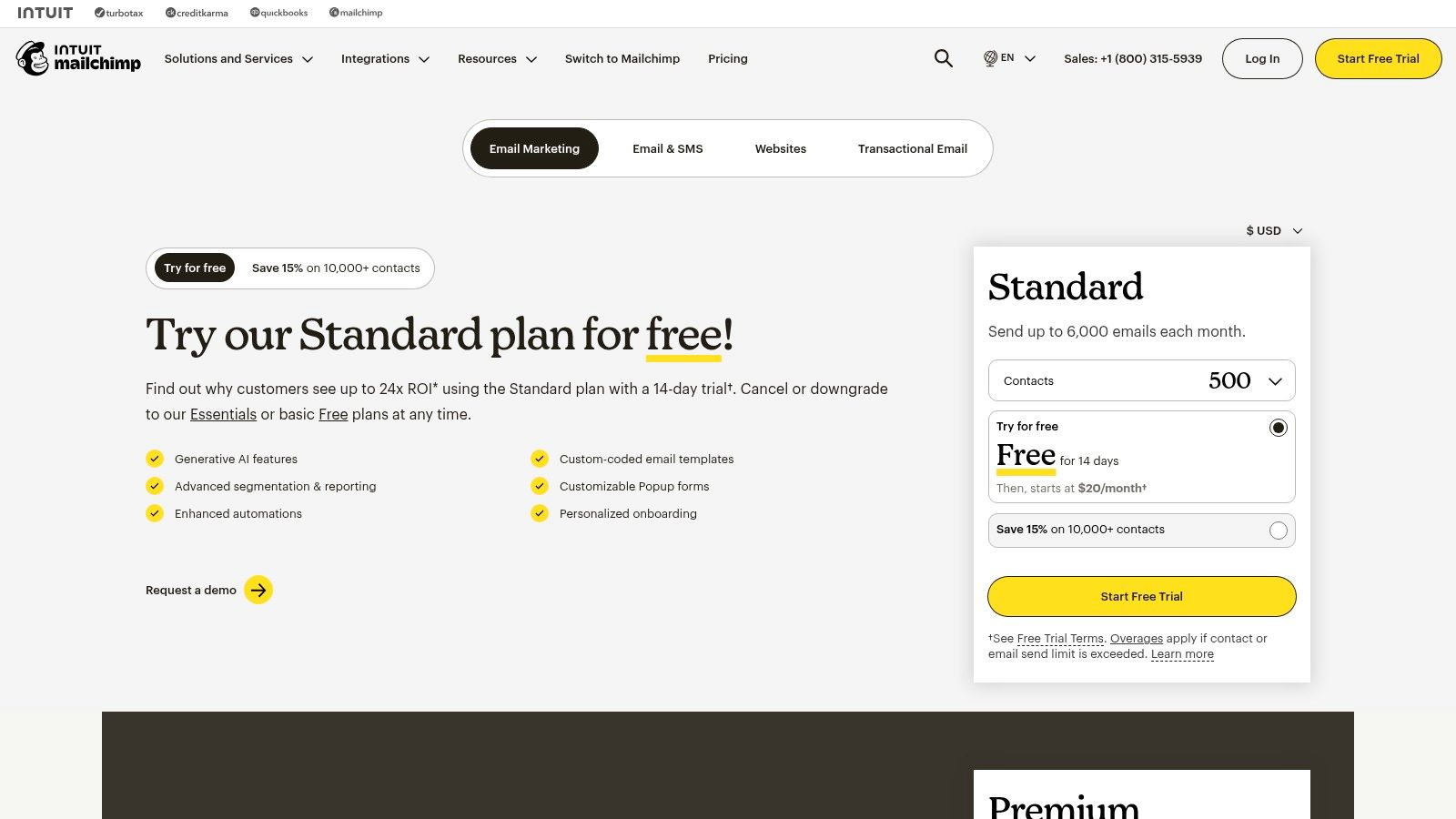
Its core strength is its intuitive drag-and-drop campaign builder and visual journey automator, which simplifies complex marketing workflows. For UK businesses, Mailchimp offers local currency support and SMS marketing add-ons. Its comprehensive analytics and reporting also provide clear insights into campaign performance, helping businesses understand the advantages of email marketing firsthand. The platform’s helpful content and guides ensure new users can quickly get up to speed.
Key Features and Pricing
| Features | Free | Standard | Premium |
|---|---|---|---|
| Email Marketing | Included (w/ branding) | Included | Included |
| Basic Automations | Single-step only | Multi-step Journeys | Advanced Journeys |
| Landing Pages | Included | Included | Included |
| AI Content Assist | Not available | Included | Included |
| Integrations | 300+ | 300+ | 300+ |
Pros and Cons
- Pros: Very quick to launch for non-technical teams, robust template library and analytics, wide integration support.
- Cons: Costs can increase significantly as your contact list grows, and the free plan has strict branding and usage caps.
Website: https://mailchimp.com/pricing/marketing/
4. Canva
Canva is an essential creative suite for any small business needing to produce professional-looking, brand-consistent marketing assets without a dedicated design team. It empowers users to create everything from social media posts and videos to brochures and presentations, making it one of the most versatile and accessible marketing tools for small businesses. Its core strength is its massive library of templates and a drag-and-drop interface that simplifies the entire design process.
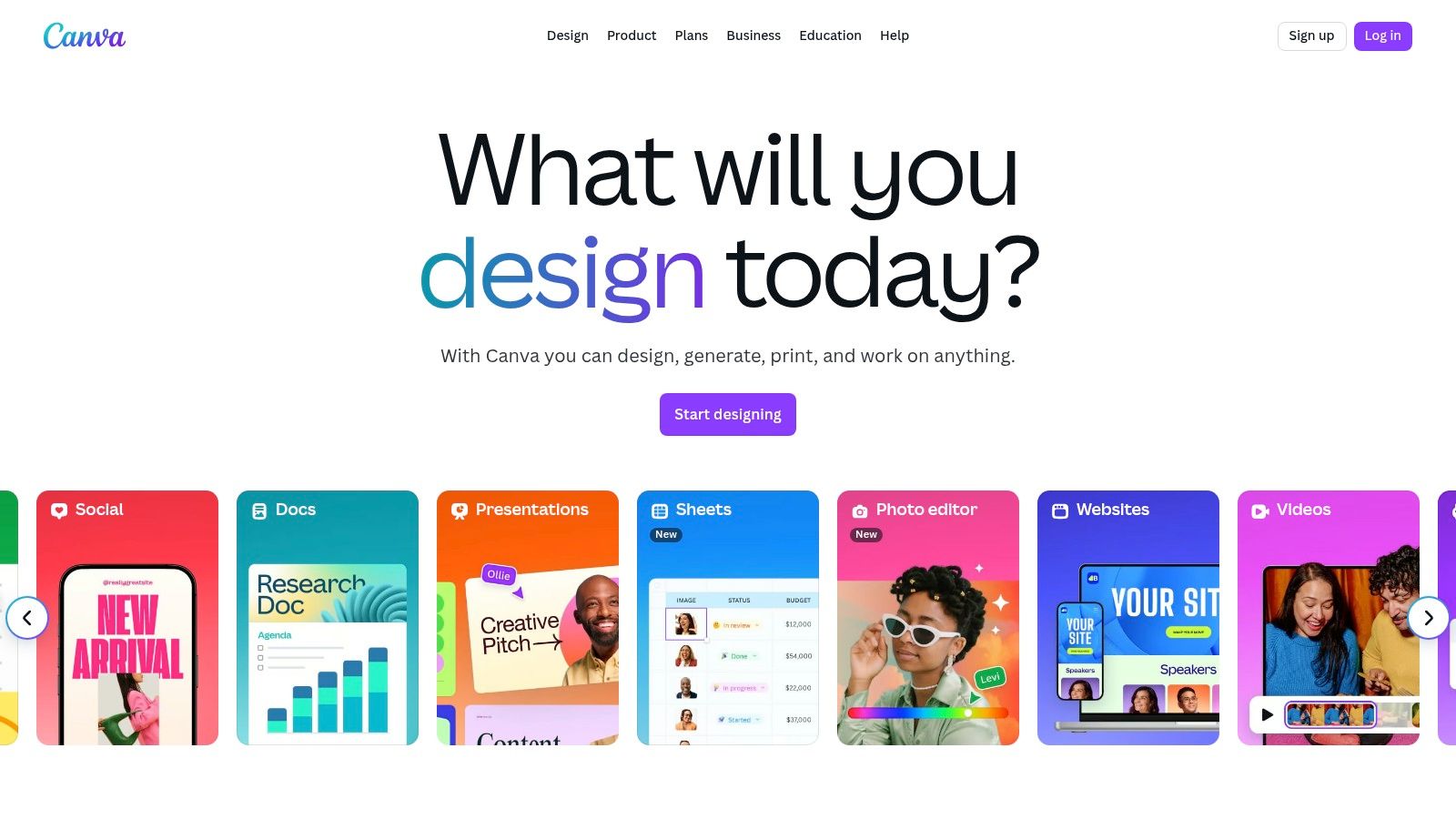
The platform’s user-friendly nature means anyone can produce high-quality graphics in minutes, not hours. For UK businesses, this speed is a huge advantage for creating timely social media content or marketing materials. Features like the Brand Kit ensure every asset remains on-brand with consistent colours, fonts, and logos, while its integrated content scheduler allows you to design and publish directly to social platforms from one place.
Key Features and Pricing
| Features | Free | Pro | Teams |
|---|---|---|---|
| Templates & Stock Assets | 250,000+ | 100+ Million | 100+ Million |
| Brand Kits | Basic | 100 | 300 |
| Background Remover | – | Included | Included |
| AI "Magic" Tools | Limited | Included | Included |
| Team Collaboration | Limited | Real-time | Advanced |
Pros and Cons
- Pros: Extremely low learning curve and fast production, excellent value for solo creators and small teams, constant updates with new templates and assets.
- Cons: Advanced brand controls and SSO are reserved for higher tiers, and Teams pricing was revised in late 2024, so it’s worth confirming current rates.
Website: https://www.canva.com/
5. Buffer
Buffer is an affordable and intuitive social media management platform, perfect for micro-businesses and solo entrepreneurs looking for straightforward scheduling and analytics. As one of the most reliable marketing tools for small businesses, it excels at simplifying the process of publishing content consistently across multiple social networks. Its clean interface and streamlined workflow remove the complexity often found in more advanced suites.
The platform is celebrated for its transparency and excellent customer support, making it a trusted partner for UK businesses. Standout features include a handy AI assistant for generating captions, a first-comment tool to boost engagement on Instagram, and a unified inbox for managing comments and DMs. Its focus on core publishing and analytics features makes it incredibly easy to set up and use from day one.
Key Features and Pricing
| Features | Free | Essentials | Team |
|---|---|---|---|
| Social Channels | Up to 3 | Starts at 1 per plan | 1 Included per User |
| Scheduling & Publishing | Basic | Advanced | Advanced |
| AI Assistant | Limited | Included | Included |
| Engagement Tools | Not Included | Included | Included |
| Analytics & Reporting | Not Included | Included | Included |
Pros and Cons
- Pros: Transparent, low pricing and strong customer support, very easy and quick to set up and use, famously stable service with public business metrics.
- Cons: Feature set is lighter than enterprise suites (e.g., no social listening), and channel-based pricing can add up if many profiles are managed.
Website: https://buffer.com/
6. Semrush
Semrush stands as a dominant force in the digital marketing landscape, offering a comprehensive suite of SEO, PPC, and competitor intelligence tools. It's one of the most powerful marketing tools for small businesses aiming to understand their online visibility, from tracking keyword rankings to dissecting a competitor's advertising strategy. Its core strength is its vast database, which provides deep insights into virtually any domain or keyword.
The platform empowers users to conduct detailed site audits, discover organic traffic opportunities, and analyse backlink profiles with precision. While its comprehensive nature can feel overwhelming initially, its project-based dashboard helps to organise tasks effectively. While comprehensive tools like Semrush are valuable, exploring top free competitor analysis tools can be a strategic move for small businesses on a tight budget.
Key Features and Pricing
| Features | Pro | Guru | Business |
|---|---|---|---|
| Keyword Research | Core metrics | Historical data | API Access |
| Site Audit (Pages/Month) | 100,000 | 300,000 | 1,000,000 |
| Rank Tracking (Keywords) | 500 | 1,500 | 5,000 |
| Competitor Analysis | Traffic & Keywords | Content Marketing | Product Listing Ads |
| Content Tools | SEO Writing Assistant | Included | Included |
Pros and Cons
- Pros: Deep, regularly updated data for accurate insights, an all-in-one platform for both organic and paid campaign analysis, useful for both agencies and DIY small businesses.
- Cons: Can be relatively expensive for businesses with very small budgets, and the wide array of features comes with a significant learning curve.
Website: https://www.semrush.com/
7. Google Ads
Google Ads is an indispensable platform for businesses aiming to capture high-intent customers at the exact moment they are searching for products or services. As one of the most powerful marketing tools for small businesses, it offers unparalleled reach across Google Search, YouTube, and the Display Network. Its primary strength lies in its pay-per-click (PPC) model, allowing businesses to control budgets tightly while targeting specific demographics, locations, and keywords.
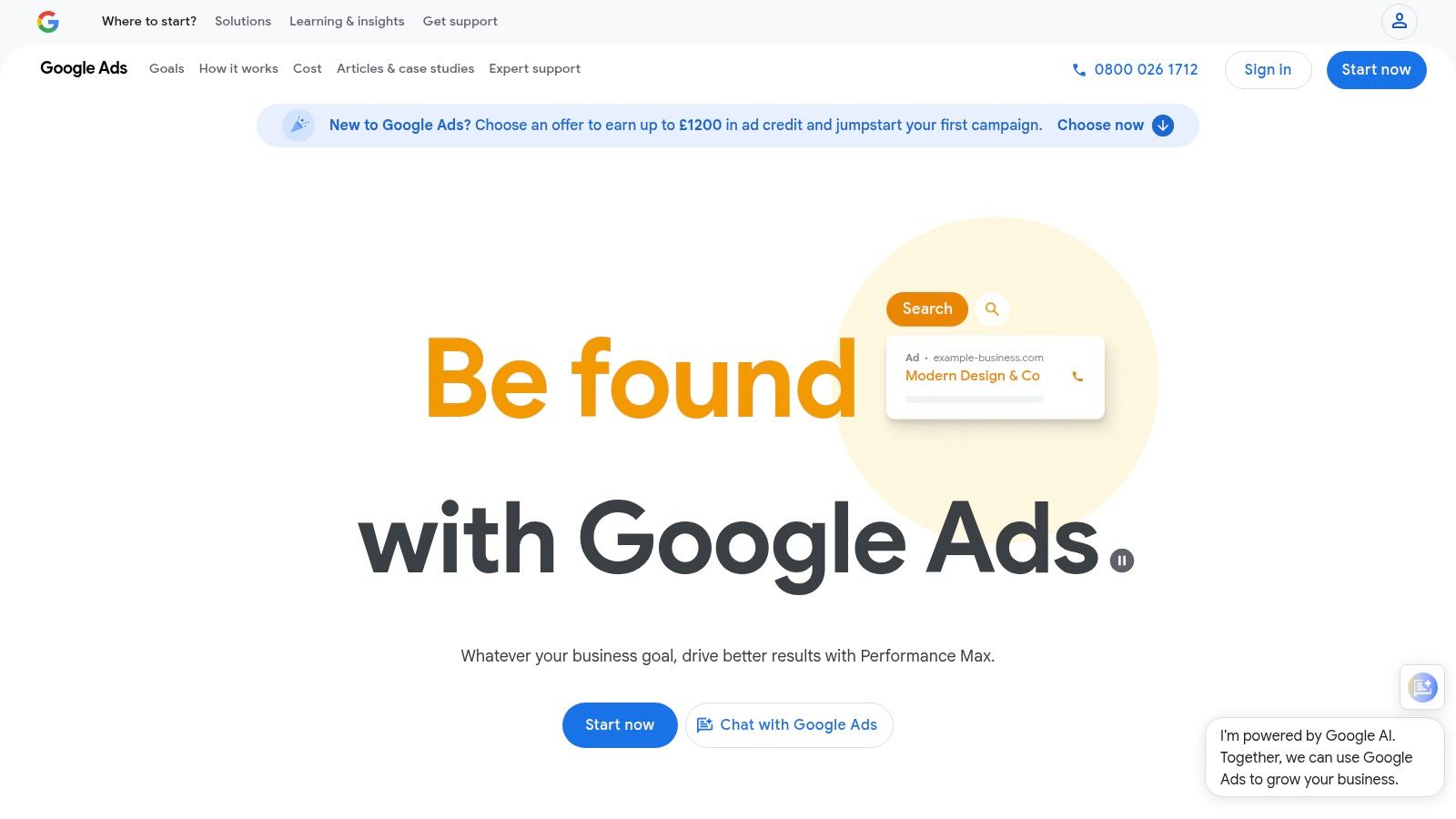
The platform is highly scalable, enabling a small UK-based business to start with a modest daily budget and expand as they see a return on investment. For those new to paid advertising, understanding the fundamentals is key; you can explore the basics in this beginner's guide to digital marketing. To gain an edge in your campaigns, consult a comprehensive Google Ads Competitor Analysis Guide to understand what rivals are doing successfully.
Key Features and Pricing
| Features | Search Ads | Performance Max | Display & YouTube |
|---|---|---|---|
| Bidding Strategy | CPC/CPA/ROAS | Goal-Based (e.g., Sales) | CPC/CPM/CPV |
| Targeting | Keywords, Location | Audience Signals | Demographics, Interests |
| Budget Control | Daily or Monthly Caps | Daily or Monthly Caps | Daily or Monthly Caps |
| Conversion Tracking | Comprehensive | Comprehensive | Comprehensive |
| Minimum Spend | None | None | None |
Pros and Cons
- Pros: Instant, scalable reach with high-intent audiences, full control over budgeting with no minimum spend, extensive learning resources and support available.
- Cons: Competitive auctions require ongoing optimisation, and there is a steep learning curve for attribution and tracking setup.
Website: https://ads.google.com/intl/en_uk/home/
8. Meta Ads
Meta Ads provides a formidable advertising platform, enabling small businesses to reach vast, engaged audiences across Facebook, Instagram, Messenger, and WhatsApp. It stands out as one of the most powerful marketing tools for small businesses due to its unparalleled audience targeting capabilities, allowing brands to connect with users based on demographics, interests, and behaviours. This precision is particularly effective for local UK businesses aiming to build brand awareness or drive targeted lead generation campaigns.
The platform's strength lies in its rich, visual ad formats that capture attention in busy social feeds. For businesses on a tight budget, Meta Ads is highly accessible, allowing campaigns to run on small daily or lifetime budgets. Effective use involves leveraging its A/B testing features to experiment with different creatives and audiences, which is crucial for optimising performance and navigating the platform’s "learning phase" to achieve stable results.
Key Features and Pricing
| Features | Budgeting | Targeting | Creative | Billing |
|---|---|---|---|---|
| Budget Control | Daily or lifetime | Detailed interest/behaviour | Multi-placement ads | Flexible thresholds |
| Audience Tools | Lookalike audiences | Included | Included | Included |
| Optimisation | Advantage campaign budget | Included | Included | Included |
| Testing | A/B testing capabilities | Included | Included | Included |
Pros and Cons
- Pros: Powerful visual ad formats effective for discovery, strong local and demographic targeting options, accessible for small daily budgets.
- Cons: Cost per mille (CPM) can fluctuate; requires frequent creative testing, and the learning phase behaviour affects ad delivery performance.
Website: https://www.facebook.com/business/ads
9. Wix
Wix has evolved from a simple website builder into an integrated platform that offers a suite of marketing tools for small businesses directly within its ecosystem. Its core strength is enabling entrepreneurs to create a professional, mobile-responsive website quickly using a drag-and-drop editor or AI assistance, without needing any code. Beyond site creation, it bundles essential marketing functionalities like email campaigns, social media integrations, and robust SEO tools.
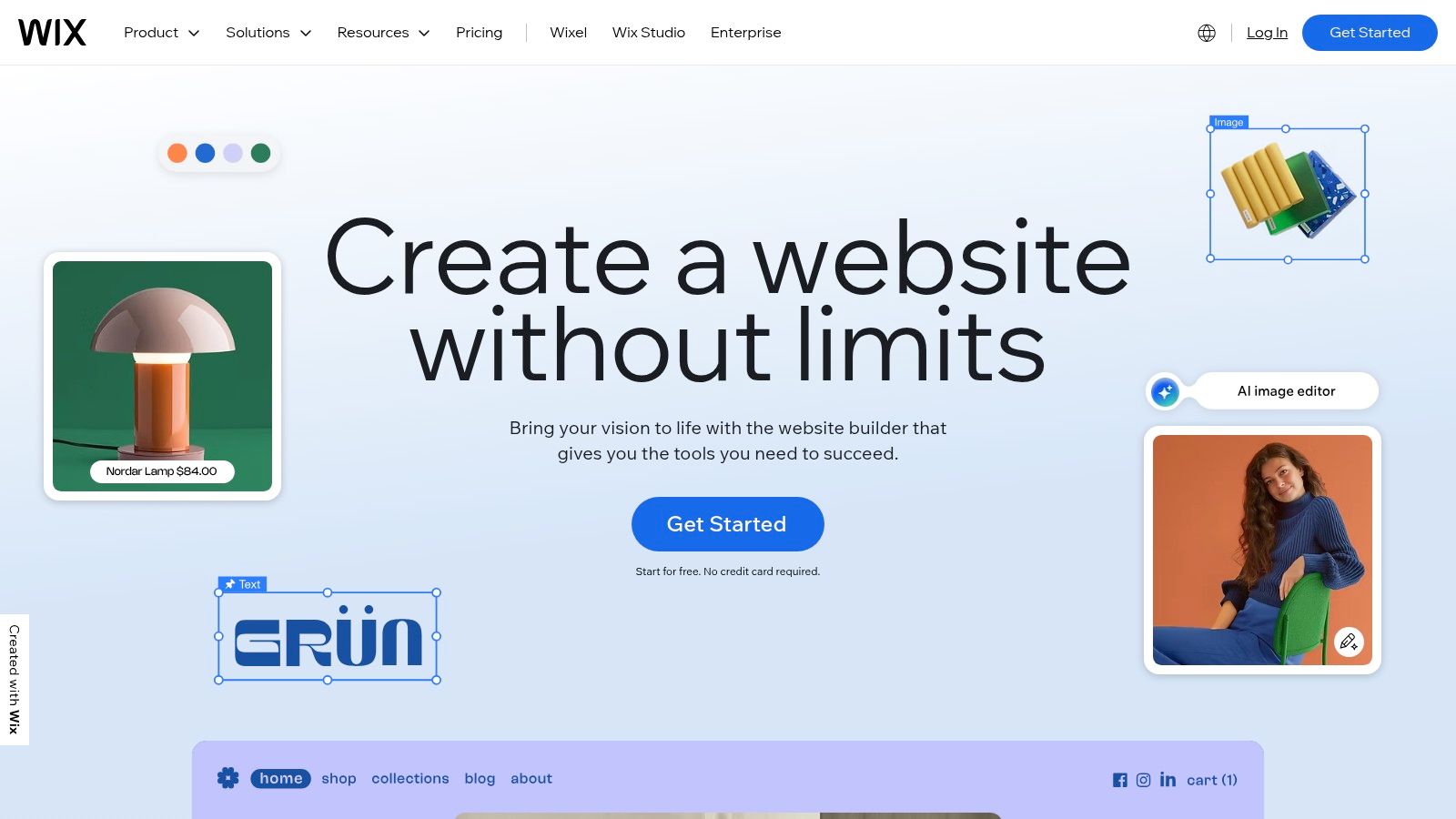
This all-in-one approach is ideal for businesses that want to manage their online presence from a single dashboard. For UK-based companies, Wix offers clear pricing in GBP and frequently runs promotions, making it a cost-effective starting point. The platform's built-in ecommerce features, including abandoned cart recovery and event bookings, provide a solid foundation for businesses looking to sell products or services online without the complexity of managing separate systems.
Key Features and Pricing
| Features | Light (£7.50/mo) | Core (£14/mo) | Business (£20/mo) |
|---|---|---|---|
| Custom Domain | Included | Included | Included |
| Marketing Suite | Basic | Standard | Standard |
| Site Analytics | Basic | Standard | Standard |
| Ecommerce | Not Included | Full Suite | Full Suite |
| Email Campaigns | 3 Campaigns/mo | 5 Campaigns/mo | 10 Campaigns/mo |
Pros and Cons
- Pros: Fast to launch a professional, mobile-ready website, good value bundled plans for small businesses, UK-specific pricing tiers and frequent promotions.
- Cons: Add-ons like domains and apps can raise total cost of ownership, migrations to custom tech stacks can be complex later.
Website: https://www.wix.com/
10. Zoho Marketing Automation
Zoho Marketing Automation offers a comprehensive and cost-effective suite of marketing tools for small businesses, especially those already invested in the Zoho ecosystem. It provides a robust platform for managing email campaigns, lead journeys, and website visitor tracking without the enterprise-level price tag. Its primary strength is the seamless integration with Zoho CRM and other business apps, creating a unified system for customer engagement.
The platform focuses on functionality, offering advanced segmentation, lead scoring, and behaviour-based triggers across all its paid plans. For UK businesses, its GDPR compliance and clear data handling policies are a significant advantage. For businesses looking to streamline their operations, exploring the broader concept of small business marketing automation can provide a comprehensive understanding of its benefits. Zoho provides a strong, unified solution to put those concepts into practice.
Key Features and Pricing
| Features | Standard | Professional | Ultimate |
|---|---|---|---|
| Email Marketing | Unlimited Emails | Unlimited Emails | Unlimited Emails |
| Journey Builder | Included | Included | Included |
| Web Behaviour Tracking | Included | Advanced | Advanced |
| Segmentation | Basic | Advanced | Advanced |
| Lead Scoring | Included | Advanced | Advanced |
Pros and Cons
- Pros: Strong price-to-capability balance for growing SMBs, seamless integration with the wider Zoho business suite, generous allowances for contacts and visitors.
- Cons: User interface and templates are more functional than design-focused, and the add-on pricing structure can be initially confusing.
Website: https://www.zoho.com/marketingautomation/
11. Capterra
Unlike the other entries on this list, Capterra isn’t a marketing tool itself but an essential research platform for discovering them. It offers a vendor-agnostic software comparison engine, making it one of the best starting points for finding the right marketing tools for small businesses. By aggregating verified user reviews, detailed feature lists, and buyers' guides, it helps you objectively evaluate and shortlist potential solutions before committing. Its primary strength is in cutting through marketing jargon to reveal how a tool actually performs in a real-world business context.
The platform is entirely free to use for research, providing an invaluable resource for UK businesses seeking tools that fit specific operational needs and budgets. You can filter software by features, company size, industry, and pricing models. Its curated "Shortlists" and comparison features allow you to place tools side-by-side, simplifying the decision-making process and helping you identify the most suitable options quickly and confidently.
Key Features and Pricing
| Features | Free User | Vendor (Listing) |
|---|---|---|
| Software Categories | Full Access | Basic or Paid Listing |
| Verified User Reviews | Full Access | N/A |
| Comparison Tools | Included | N/A |
| Buyers’ Guides | Included | N/A |
| Cost to Research | Free | Free or PPC |
Pros and Cons
- Pros: Independent, vendor-neutral starting point for research, helps narrow down choices and validate vendor claims, frequently updated with new reviews and guides.
- Cons: Sponsored placements can influence search result visibility, and you must always validate final pricing and features directly on the vendor's website.
Website: https://www.capterra.com/
12. AppSumo
AppSumo isn't a single tool but a marketplace offering lifetime deals (LTDs) and deep discounts on emerging software, making it a goldmine of affordable marketing tools for small businesses. It's the ideal platform for cost-conscious entrepreneurs looking to experiment with new technology or secure lifetime access to tools for a one-off payment. The platform curates deals across a huge range of categories, from SEO and email automation to video creation and chatbots, often from promising start-ups.
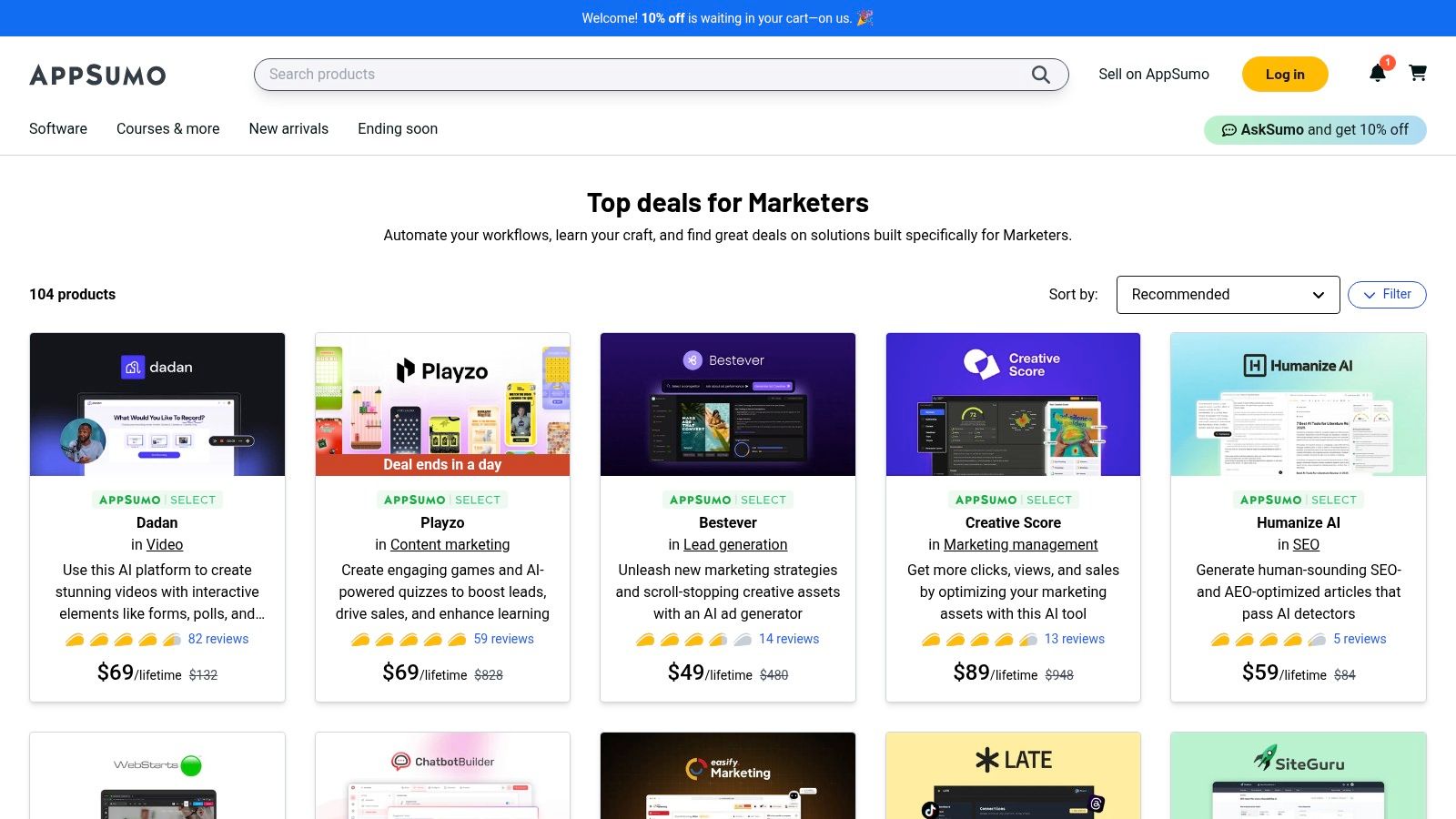
The primary value for a small business is the ability to build a powerful marketing stack without committing to recurring monthly subscriptions. For UK businesses, it provides access to a global pool of innovative software that might otherwise be unknown. User reviews and a straightforward refund policy help mitigate the risk of investing in a newer tool, allowing you to test its fit for your specific needs.
Key Features and Pricing
| Features | Availability | Pricing Model |
|---|---|---|
| Lifetime Deals (LTDs) | On most products | One-time payment |
| Marketing Software Categories | SEO, Email, Social, Video, etc. | Varies per deal |
| User Reviews & Questions | Included on every deal page | N/A |
| Money-Back Guarantee | Typically 60 days | N/A |
Pros and Cons
- Pros: Potential for dramatic long-term savings on software costs, excellent for discovering and trying niche or emerging tools, new deals are added weekly.
- Cons: Lifetime deal tools can be early-stage with uncertain roadmaps, and ongoing support is dependent on the individual software vendor.
Website: https://appsumo.com/collections/best-for/marketers/
Top 12 Marketing Tools Feature Comparison
| Product | Core Features / Capabilities | User Experience / Quality ★ | Value Proposition 💰 | Target Audience 👥 | Unique Selling Points ✨ |
|---|---|---|---|---|---|
| 🏆 The Digital Marketing Toolbox | Extensive catalog: SEO, AI content, email, PPC, social, push, webinars | Intuitive filtering & comparison ★★★★ | Curated ROI-driven tool recommendations 💰 | Small biz, agencies, freelancers 👥 | All-in-one centralized platform with trials ✨ |
| HubSpot | CRM, email marketing, ads, automation, forms/landing pages | Strong onboarding & integrations ★★★★ | Scalable pricing, free tier available 💰 | SMEs, agencies, marketers 👥 | Native CRM + HubSpot Academy training ✨ |
| Mailchimp | Email marketing, automation, templates, CRM, landing pages | Easy start, powerful templates ★★★ | Free tier with limits, cost grows 💰 | SMBs, ecommerce, beginners 👥 | AI assist & multichannel integrations ✨ |
| Canva | Graphic/video design, brand kits, templates, collaboration | Very easy, fast production ★★★★ | Affordable plans, good for small teams 💰 | Creatives, marketers, solopreneurs 👥 | AI-powered "Magic" tools & scheduler ✨ |
| Buffer | Social publishing, scheduling, engagement inbox, AI caption assistant | Simple, reliable, transparent ★★★★ | Low pricing, easy setup 💰 | Micro-businesses, social teams 👥 | AI caption tools & strong support ✨ |
| Semrush | SEO, PPC, keyword research, audits, content tools | Deep data, powerful insights ★★★★ | Premium pricing, full suite 💰 | Agencies, SEO pros, SMBs 👥 | Combined organic & paid campaign tools ✨ |
| Google Ads | Search, YouTube, display ads, targeting, bidding | Scalable reach, comprehensive tracking ★★★★ | Pay per click, flexible budgets 💰 | Advertisers, SMBs, enterprises 👥 | Granular targeting & Performance Max campaigns ✨ |
| Meta Ads | Facebook, Instagram, Messenger, WhatsApp ads, targeting | Visual ads, effective local targeting ★★★ | Accessible budgets, CPM varies 💰 | Local businesses, marketers 👥 | Multi-placement, lookalike audiences ✨ |
| Wix | Website builder, SEO, email campaigns, ecommerce | Fast setup, mobile-ready ★★★ | Good bundled plans 💰 | SMBs, entrepreneurs, ecommerce 👥 | AI site setup, integrated marketing apps ✨ |
| Zoho Marketing Automation | Email journeys, segmentation, landing pages, multi-channel marketing | Functional UI, solid automation ★★★ | Cost-effective for SMBs 💰 | Growing SMBs, Zoho users 👥 | Deep CRM integration & WhatsApp marketing ✨ |
| Capterra | Software comparison, reviews, buyers’ guides | Independent research platform ★★★ | Free to use 💰 | Buyers, small biz, researchers 👥 | Verified reviews & curated shortlists ✨ |
| AppSumo | Discounted/lifetime deals on marketing SaaS | Deal marketplace, user reviews ★★★ | Potential cost savings on SaaS 💰 | Cost-conscious marketers, startups 👥 | Lifetime deals & unique SaaS discounts ✨ |
Building Your Perfect Marketing Stack
We've explored a wide range of powerful marketing tools for small businesses, from all-in-one CRM giants like HubSpot and Zoho to specialised platforms for design, social media, and SEO like Canva, Buffer, and Semrush. The sheer volume of choice can feel overwhelming, but the goal isn't to adopt every tool available. Instead, the objective is to strategically assemble a "marketing stack" that is tailored to your unique business needs, budget, and growth ambitions. The perfect set of tools is not a one-size-fits-all solution; it’s a personalised engine built to drive your specific marketing strategy forward.
Key Takeaways for Your Business
Remember that the most effective marketing stack is one that evolves with your business. What works for a solo entrepreneur just starting out will differ significantly from the needs of a growing e-commerce brand with ten employees. The central theme connecting all these platforms is the drive towards efficiency, data-driven decisions, and enhanced customer engagement. By automating repetitive tasks, gaining deeper insights into customer behaviour, and creating professional-quality content, you can level the playing field and compete effectively in your market.
The journey begins not with a tool, but with a clear understanding of your biggest challenges. Are you struggling to generate leads? Is customer retention your primary concern? Or do you need to build brand awareness from the ground up? Your answers to these questions will guide your selection process.
Actionable Next Steps
To move from reading to doing, consider these practical steps:
- Prioritise Your Needs: Identify your most pressing marketing gap. If you have no organised way to manage customer relationships, a CRM like HubSpot should be your priority. If your social media presence is non-existent, a tool like Buffer is a logical starting point.
- Leverage Free Trials: Almost every tool we’ve discussed, from Mailchimp to Semrush, offers a free trial or a freemium plan. Use these opportunities to test the user interface, explore key features, and see how the platform fits into your existing workflow before making a financial commitment.
- Think About Integration: Your tools should work together, not create isolated data silos. Before choosing a new platform, check its integration capabilities with the software you already use. A well-integrated stack saves time and provides a more holistic view of your marketing performance.
- Start Small and Scale: Don't feel pressured to implement a complex, multi-platform system overnight. Begin with one or two essential marketing tools for small businesses that address your most significant pain point. As you master them and see a return on your investment, you can gradually expand your stack.
Ultimately, the right technology empowers you to focus on what you do best: running your business. By thoughtfully selecting and implementing the right marketing tools, you are not just buying software; you are investing in a more efficient, scalable, and profitable future. Your perfect marketing stack is out there, waiting to be built.
Ready to discover and compare hundreds of tools in one place? The Digital Marketing Toolbox offers unbiased, detailed reviews and side-by-side comparisons to help you find the perfect software for your specific business needs. Start building your ideal marketing stack today.


