
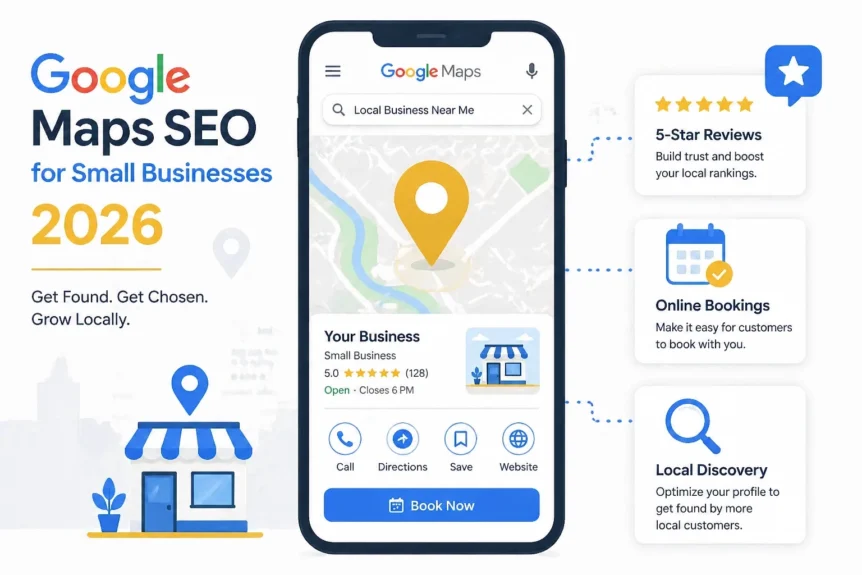
Let’s be blunt: If your business isn't showing up on Google Maps in 2026, you basically don’t exist to the local customer.
We were chatting with a local coffee shop owner last week who was burning cash on high-end Facebook ads but seeing zero foot traffic. Our go-to advice for him? Stop fighting the algorithm on social media and start owning the Local Map Pack.
In 2026, the game has changed. We’re living in a world of “zero-click” searches, where over 58% of users get exactly what they need, directions, reviews, or a phone number, without ever clicking through to a website. Google Maps has become the cockpit of your business's digital spaceship. If you aren't optimized, you're just floating in the void.
So, is it worth the effort? Absolutely. Ranking in the top three of the Map Pack generates nearly 93% more customer actions than any other SERP feature. Let’s break down how you can dominate your local area without needing a Ph.D. in computer science.
The 2026 Local Landscape: AI and Zero-Click Clicks
The truth is, Google’s AI Overviews now act as a personal concierge. When someone asks their phone, “Where’s the best gluten-free bakery near me?” they aren't looking for a list of blue links. They want a specific recommendation backed by data.
What we love about this shift is that it actually levels the playing field for small businesses. You don’t need the biggest budget; you just need the best relevance and trust signals.

For the Solo Shop Owner
If you’re flying solo, your focus should be on accuracy and speed.
- Verify everything: Ensure your Google Business Profile (GBP) is 100% complete.
- The “Near Me” Factor: Use local landmarks in your descriptions. Instead of just saying “Main Street,” say “Two blocks down from the Historic Clock Tower.”
- Mobile-First is Only-First: 90% of local map searches happen on mobile. If your profile looks messy on a 6-inch screen, you've already lost.
The “Foundational Four”: Your Quick-Win Checklist
Forget the sticker price of expensive SEO agencies for a second. You can do the heavy lifting yourself by focusing on these four pillars. We almost always point people toward these first because the ROI is immediate.
1. The Google Business Profile (Your Digital Storefront)
Your GBP is the most important asset you own. In 2026, Google allows for much richer attributes.
- Services and Products: Don't just list “Plumber.” List “Emergency Pipe Repair,” “Eco-friendly Water Heater Installation,” and “24/7 Drain Unclogging.”
- Keywords in Description: Incorporate local keywords naturally. Use our best digital marketing tools to find what people in your specific zip code are searching for.
2. The Currency of Trust: Reviews
Let’s talk straight: A 4.2-star rating is the new “C” grade. In 2026, customers are looking for a 4.8 or higher. But it’s not just the score; it’s the velocity.
- Respond to Every Review: AI now scans your responses to see if you’re active.
- Keyword-Rich Reviews: When a customer says, “The organic sourdough was amazing,” Google’s AI notes that you are a top-tier provider for that specific product.
Golden Nugget: Don't just ask for a review; ask for a specific mention. “If you loved our espresso, let us know in your review!” This feeds the AI exactly what it needs to rank you for high-intent keywords.

3. NAP Consistency (Name, Address, Phone)
If your address is “123 Main St” on Google but “123 Main Street” on Yelp, the AI gets a tiny bit confused. In the world of SEO, confusion equals lower rankings. Use a tool from our digital marketing toolbox to audit your citations across the web and ensure every single one is identical.
4. Local Citations and Schema Markup
You want to “wrap” your website in code that tells Google exactly where you are. This is called LocalBusiness Schema. It’s like giving the Google bot a map and a flashlight to find your business in the dark.
Advanced Tactics: The 2026 Edge
Ready to move from page 3 to the #1 spot? These are the “pro” moves that we see most small businesses ignoring.
AI and Voice Search Optimization
“Hey Google, find a mechanic open now.” To win that search, you need to have your “Open Now” status accurate and your services clearly defined in plain English. Avoid jargon; use the words your customers use when they're stressed and in a hurry.

Geocoding Your Images
What we love about this trick is how simple it is. Before you upload a photo of your new storefront or a happy customer to your GBP, make sure the photo contains GPS metadata. It tells Google, “This photo was actually taken at these exact coordinates,” which screams authenticity to the ranking algorithm.
Content That Screams “Local”
Stop writing generic blog posts. Write about the local high school football game, the neighborhood street fair, or how the local weather affects your services.
- Neighborhood Guides: Create a page on your site about “The Best Places to Eat Near Our Office.”
- Local FAQs: Answer questions like “Where can I park near [Your Business Name]?”
| Feature | Map Pack SEO | Traditional Organic SEO |
|---|---|---|
| Primary Goal | Foot traffic & Phone calls | Website traffic & Leads |
| Key Metric | Proximity & Reviews | Backlinks & Content |
| Speed to Result | Fast (Weeks) | Slow (Months) |
| Cost | Low (Mostly time) | Medium to High |
For the Multi-Location Agency
If you’re managing five or fifty locations, you can’t do this manually. You need a centralized dashboard to push updates, respond to reviews, and track rankings. We recommend checking out our SEO tools comparison to find a platform that can handle bulk GBP management without breaking the bank.
Managing multiple locations is like juggling chainsaws: one slip-up in NAP consistency across your listings can tank your rankings for the whole group.

The “Moment of Truth”: Your Action Plan
So, which tool should you choose to start with? Honestly, don’t overthink it.
The truth is, Google Maps SEO is a game of momentum. If you spend 15 minutes today updating your business hours and responding to three reviews, you’re already ahead of 70% of your competition.
Here is your 24-hour mission:
- Audit your GBP: Is every field filled out? If not, do it now.
- Request 3 Reviews: Reach out to your three happiest customers from this week.
- Check your NAP: Ensure your website and Google profile have the exact same contact info.
- Run a quick check: Use one of these top 7 free SEO audit tools for 2026 to see where you currently stand.
Local SEO isn't about being a tech genius; it's about being the most helpful, most visible, and most trusted option in your neighborhood. Start today, and by next month, you’ll be the one the AI recommends first.

Now, get out there and put your business on the map, literally!


