
In a crowded digital landscape, push notifications represent a direct, powerful line to your audience, capable of driving incredible engagement or causing instant uninstalls. The difference lies entirely in strategy. Moving beyond generic, intrusive blasts is no longer optional; it's essential for building a sustainable connection with your users. This guide is built to provide a clear, actionable framework, exploring the most impactful push notification best practices that transform your messages from disruptive noise into a welcome, valuable service.
We will move beyond theory and delve into the nuanced art of advanced personalisation, the critical science of timing, and the persuasive power of compelling, actionable copy. You will learn how to create messages that feel genuinely helpful, not just another sales pitch. For developers and marketers working within specific frameworks, understanding the technical implementation is equally crucial. For a detailed exploration of how push notifications can significantly boost user engagement in Ionic applications, consider reading a complete guide to Ionic push notifications for boosting engagement which covers the technical setup in depth.
This listicle is designed to be a comprehensive resource, offering practical steps you can implement immediately. By mastering the eight core principles we cover, from permission priming to A/B testing, you'll not only see a measurable increase in your open rates and click-throughs but also build lasting user loyalty and drive meaningful conversions. Ready to turn your notifications into a powerful growth engine that your audience actually appreciates? Let's begin.
1. Personalisation and Segmentation
Sending a generic, one-size-fits-all message to your entire user base is one of the fastest ways to increase opt-out rates. This is where personalisation and segmentation become critical push notification best practices. Personalisation tailors messages to individual users based on their specific data, such as their name, behaviour, or preferences. Segmentation involves grouping your audience by shared characteristics like location, purchase history, or app usage frequency to deliver more relevant content.

The goal is to make each user feel like the notification was crafted specifically for them, transforming a potentially disruptive alert into a welcome and valuable interaction. For instance, Spotify excels at this by sending "Discover Weekly" notifications based on a user's listening habits, while Amazon famously drives a significant portion of its revenue through product recommendations based on browsing and purchase behaviour.
How to Implement Personalisation and Segmentation
To get started, you don't need a complex algorithm. You can begin with simple, yet powerful, segmentation and gradually build towards more advanced, data-driven personalisation.
- Start Simple: Begin by creating basic segments. Differentiate between new users (who might receive a welcome series) and returning users (who could get a "we miss you" offer).
- Leverage Behavioural Triggers: Set up notifications based on user actions. A classic example is an abandoned cart reminder, which is highly personalised and contextually relevant.
- Incorporate User Preferences: Allow users to choose the types of notifications they receive. A news app, for example, could let users select topics like "Technology" or "Sports."
- Use Geolocation: Send timely offers when a user is physically near one of your store locations. Starbucks famously increased offer redemption rates by 150% with this geo-targeting strategy.
Advancing Your Strategy
Once you have the basics in place, you can combine multiple data points for hyper-personalisation. Imagine a retail app sending a notification about a discount on running shoes to a user who has previously browsed for running gear and is currently near a store. This level of relevance is what makes push notifications a powerful tool rather than an annoyance. Effective push notifications are often a core component of successful lead nurturing campaigns. For a deeper dive into crafting communications that move prospects through the funnel, explore these lead nurturing best practices.
2. Optimal Timing and Frequency Management
Sending a perfectly crafted message at the wrong time is just as ineffective as sending a generic one. This is why mastering timing and frequency is one of the most crucial push notification best practices. Optimal timing is about delivering your message when users are most receptive and likely to engage. Frequency management is the art of communicating often enough to stay top-of-mind without causing notification fatigue and prompting an opt-out.
The goal is to integrate your notifications seamlessly into a user's daily routine, making them feel timely and helpful rather than intrusive. Duolingo, for example, sends learning reminders based on individual user activity patterns, discovering that testing different times led to a 5x increase in engagement. Similarly, Uber Eats strategically sends meal-time notifications approximately 30 minutes before users typically place orders, capitalising on moments of high intent.
How to Implement Optimal Timing and Frequency
Achieving the right balance requires a data-led approach combined with common-sense user empathy. Start with broad best practices and refine your strategy based on user behaviour.
- Analyse Peak Engagement Windows: Dig into your app analytics to identify when your users are most active. While many apps see peaks between 10 AM-1 PM and 6 PM-9 PM, your audience may be different.
- Implement Strict Frequency Caps: Prevent overwhelming users by setting clear limits. A good starting point is no more than one promotional message per day and a maximum of 3-5 per week.
- Prioritise Transactional Notifications: Messages like order confirmations, delivery updates, or password resets should be sent immediately, as users expect them in real-time.
- Respect User Timezones: Avoid sending a notification at 3 AM. A message scheduled for "9 AM" should be delivered at 9 AM in the user's local time, not your company's headquarters' time.
Advancing Your Strategy
Once you have established a baseline, you can introduce more sophisticated techniques like A/B testing send times and allowing user customisation. The difference between a carefully managed frequency and an overly aggressive one is stark, directly impacting long-term user retention.
The bar chart below clearly visualises how a measured approach to notification frequency can significantly boost user retention compared to a high-volume strategy.
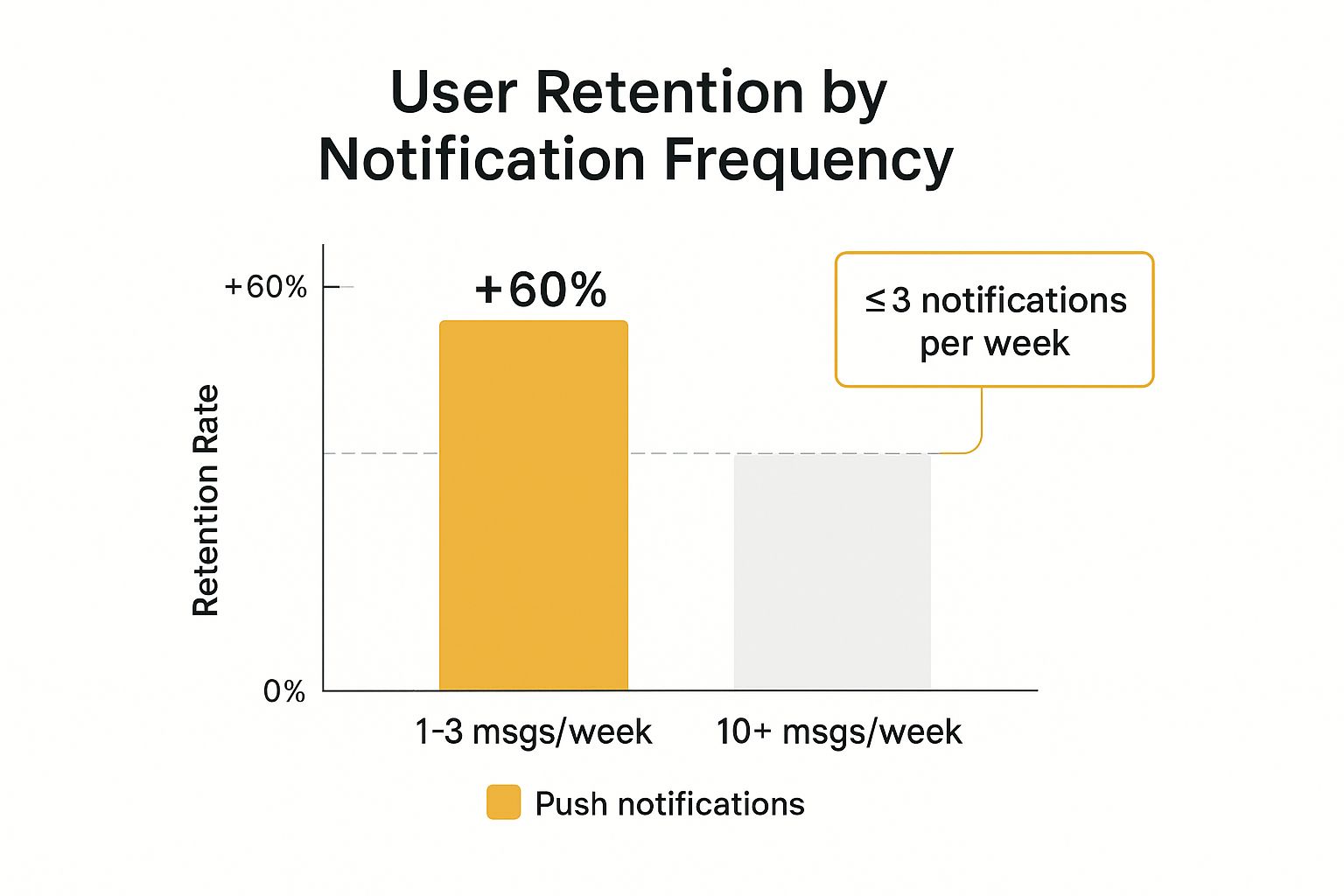
The data highlights a clear insight: users who receive a manageable number of notifications (1-3 per week) are substantially more likely to remain active than those who are inundated with messages. This careful management of timing and frequency is a cornerstone of a sustainable marketing strategy for small business, ensuring that each touchpoint adds value rather than detracts from the user experience.
3. Clear, Compelling, and Actionable Copy
Once you've segmented your audience and personalised your message, the copy itself becomes the final, crucial step. A notification's copy must be concise, valuable, and drive a specific action. Clear copy tells the user what the message is about instantly. Compelling copy grabs their attention and makes them care. Actionable copy gives them a clear next step, making it one of the most critical push notification best practices for driving engagement.
The goal is to deliver a complete, valuable message within strict character limits, ensuring users understand the benefit and the required action in a single glance. For example, Domino's '🍕 Your pizza is 5 minutes away!' is a masterclass in simplicity and value. Similarly, Headspace's 'Feeling stressed? Take a 3-minute breathing break' is empathetic, clear, and provides an immediate, low-effort solution. This directness transforms the notification from an interruption into a helpful service.
How to Implement Clear, Compelling, and Actionable Copy
Writing effective push notification copy is a science. It involves balancing brevity with clarity and persuasion, all while respecting the user's attention.
- Lead with Value: Immediately answer the user's question: "What's in it for me?" Start with the benefit. For instance, 'Save 50% on trainers today' is more effective than 'Our trainer sale starts today'.
- Use Numbers and Specifics: Quantifiable details are more tangible and believable. 'Price drop! Save £47 on your Tokyo hotel' (Booking.com) is far more compelling than 'Save on your next hotel booking'.
- Create Authentic Urgency: Drive immediate action by using time-sensitive language, but avoid generic phrases. 'Your 2-for-1 offer expires at midnight' works better than a vague 'Limited time only'.
- Include a Clear Call-to-Action (CTA): Tell users exactly what to do next. Use action-oriented verbs like 'Shop Now', 'Claim Your Reward', or 'Read the Article'.
Advancing Your Strategy
Once you've mastered the fundamentals, you can refine your copy with more advanced techniques. Test the use of one or two relevant emojis; studies show they can increase engagement by over 20%. Use second-person language ('Your order is ready') to create a direct, personal connection. Most importantly, A/B test everything: headlines, body copy, CTA phrasing, and emoji placement. Data from these tests will reveal what resonates most with your audience, allowing you to continually optimise your copy for maximum impact.
4. Rich Media and Interactive Elements
Sending plain text is no longer enough to capture a user's attention in a crowded notification tray. This is where rich media and interactive elements emerge as essential push notification best practices. Rich push notifications enhance standard text alerts with images, GIFs, videos, and audio. Interactive elements, such as action buttons, allow users to engage directly with a notification without needing to open the app.
The goal is to create a more visually compelling and functional experience, transforming a simple alert into a mini, actionable preview of your app's content. For example, Uber provides a rich notification showing a map with the driver's location and car details, while Instagram boosts re-engagement by displaying photo previews of new likes and comments, making the alert instantly more valuable and context-rich.
How to Implement Rich Media and Interactive Elements
Incorporating rich media doesn't have to be overly complex. You can start with simple additions and progressively introduce more advanced interactive features to boost engagement and utility.
- Start with Images: The simplest way to start is by adding a relevant, high-quality image. Zomato, for instance, includes appetising food images in its order updates and promotional notifications, which has been shown to boost click-through rates significantly.
- Add Action Buttons: Provide users with quick-action shortcuts. A meeting reminder could have "Snooze" and "Join Call" buttons, or a delivery update could offer a "Track Parcel" button that deep links directly to the tracking screen.
- Optimise for Performance: Ensure your media files are optimised for quick loading. Keep images under 1MB and use them to add value, not just for decoration. Always provide a plain-text fallback for devices or operating systems that don't support rich media.
- Test Across Devices: Visuals and interactive elements can render differently across various iOS and Android versions. Test your notifications on multiple devices to ensure a consistent and functional user experience.
Advancing Your Strategy
Once you're comfortable with images and buttons, you can explore more dynamic formats. A brand like Nike Run Club excels by sending workout summaries complete with route maps and achievement badges. Tinder has even experimented with swipeable carousel notifications showing multiple potential matches. This evolution from a static alert to an interactive micro-experience is what makes rich push notifications so powerful. By providing immediate value and functionality, you make your app an indispensable part of the user's daily routine.
5. Permission Priming and Opt-In Strategies
One of the most critical missteps in mobile app marketing is requesting notification permissions the moment a user first opens your app. Permission priming is the practice of strategically requesting permission after you have demonstrated clear value, significantly boosting opt-in rates. It involves educating users on the benefits of notifications and using a custom, in-app "soft ask" before triggering the official, irreversible system permission dialogue.
The goal is to provide context and motivation, transforming the permission request from an intrusive demand into a logical next step. Duolingo famously masters this by waiting until a user completes their first lesson, then explaining how notifications will help them maintain their learning streak. Similarly, the Calm app offers a free trial session before asking for permission to send meditation reminders, connecting the request directly to a positive user experience.
How to Implement Permission Priming
Effective permission priming hinges on timing and communication. It’s about asking the right way at the right moment, ensuring users understand the "what's in it for me" before they commit.
- Wait for the 'Aha!' Moment: Never ask for permission on the first app launch. Wait until a user has completed a key action or experienced the core value of your app, such as adding their first stock to a watchlist in a finance app like Robinhood.
- Use a Custom Pre-Permission Dialogue: Before showing the official iOS or Android prompt, display a custom screen that explains the specific benefits. For example, 'Get real-time alerts when your flight is delayed' is far more compelling than a generic 'Allow notifications'.
- Leverage Contextual Triggers: Ask for permission when it’s most relevant. If a user is exploring a sale section, that's the perfect time to ask if they'd like to be notified about future discounts.
- Offer Granular Control: Empower users by letting them choose what they want to hear about. A news app could let users select topics like 'Technology' or 'Health', increasing the perceived value and relevance of opting in.
Advancing Your Strategy
Once you’ve established a priming strategy, you can refine it with testing and better framing. A/B test the timing of your request; for some apps, it might be after two sessions, while for others, it’s after the first major purchase. Use positive language like 'Stay in the loop' instead of the demanding 'Allow notifications'. These small adjustments in your permission priming process are crucial push notification best practices that can dramatically increase your addressable audience and campaign effectiveness.
6. Deep Linking and Contextual Landing
Sending a push notification that drops a user on your app's generic home screen is a jarring and inefficient experience. This is where deep linking and contextual landing become essential push notification best practices. Deep linking is the practice of creating a link that directs users to a specific, relevant page or screen within your mobile app, not just the homepage. Contextual landing ensures the in-app experience seamlessly continues the conversation started in the notification.
The goal is to eliminate friction and maintain the user's intent. When a user taps a notification about a specific product, they expect to see that product immediately. Forcing them to navigate from the home screen to find it wastes their time and dramatically increases the likelihood they will abandon the session. Amazon pioneered this, ensuring price drop alerts take you directly to the product page, and Airbnb notifications for bookings open the specific reservation details.
How to Implement Deep Linking and Contextual Landing
Implementing a robust deep linking strategy is crucial for creating a smooth user journey and maximising the return on your push notification efforts. It turns a simple alert into a direct path to conversion.
- Implement Universal Links and App Links: Use Apple's Universal Links for iOS and Google's App Links for Android. These are the modern standards that allow a single web link to open either your website or your app, depending on whether the app is installed.
- Maintain Context: The most critical rule is to fulfil the promise of the notification. If your message mentions a 20% discount on running shoes, the deep link must lead to a page featuring those running shoes with the discount clearly visible.
- Build Graceful Fallbacks: Plan for scenarios where a deep link might fail (e.g., the product is out of stock). Instead of showing a frustrating error screen, redirect the user to a relevant alternative, like the product category or a page of similar items.
- Consider Deferred Deep Linking: This advanced technique is for users who tap a notification but don't have your app installed. It directs them to the App Store or Google Play to download the app, and upon first launch, takes them to the specific content from the original notification.
Advancing Your Strategy
Effective deep linking is more than just a technical setup; it's a core part of the user experience. You can enhance its impact by passing parameters within the notification payload, such as a user ID or a promo code, to pre-apply discounts or personalise the landing page further. Tracking deep link performance separately from general notification open rates will provide clearer insights into which campaigns are most effective at driving specific in-app actions. This level of detail is a cornerstone of a high-performing mobile engagement strategy.
7. A/B Testing and Data-Driven Optimisation
Relying on assumptions or guesswork to craft your push notifications is a recipe for low engagement and high opt-out rates. This is where A/B testing and data-driven optimisation become indispensable push notification best practices. A/B testing, also known as split testing, involves systematically experimenting with different versions of a notification to see which performs better. Data-driven optimisation is the process of using the insights gained from these tests to continuously refine and improve your strategy over time.
The goal is to move beyond what you think will work and discover what actually resonates with your users through empirical evidence. For example, Duolingo famously tested over 100 notification variants and discovered that playful, personalised messages outperformed generic reminders by a factor of five. Similarly, Walmart found that sending online grocery order notifications at 7 PM resulted in 40% higher conversions than those sent at 9 AM, an insight only achievable through rigorous testing.
How to Implement A/B Testing and Data-Driven Optimisation
Getting started with A/B testing doesn't require a massive data science team. You can begin with simple, controlled experiments that can yield significant improvements in your notification performance.
- Test One Variable at a Time: To get clear, attributable results, isolate a single element for each test. This could be the message copy, send time, call-to-action (CTA), or the use of an emoji, but never all at once.
- Ensure Statistical Significance: For your results to be reliable, test with a large enough sample size. A common industry standard is a minimum of 1,000 users per variant to ensure you can make decisions with confidence.
- Measure Business Impact: Don't just track engagement metrics like open rates. Tie your tests to key business outcomes like conversions, purchases, or user retention to understand the true value of your optimisations.
- Use a Holdout Group: To measure the true incremental impact of your notifications, set aside a small control group (typically 5-10% of users) that doesn't receive the notification. This shows you the uplift your campaign is actually generating.
Advancing Your Strategy
Once you are comfortable with basic A/B tests, you can develop a more sophisticated, continuous optimisation programme. Create a testing calendar to plan and track experiments, ensuring a constant flow of data and insights. Document every result, including the failures, as they often provide the most valuable lessons about what your audience doesn't respond to. This systematic approach transforms your push notification strategy from a static communication channel into a dynamic, high-performing growth engine. These principles of testing and measurement are fundamental across many marketing channels. For those new to these concepts, exploring a beginner's guide to digital marketing can provide a solid foundation.
8. Transactional vs. Promotional Balance
Failing to distinguish between essential updates and marketing messages is a cardinal sin in mobile communication. This is why managing the balance between transactional and promotional notifications is one of the most vital push notification best practices. Transactional notifications are triggered by user actions and are essential for the service to function, like order confirmations or delivery updates. Promotional notifications are marketing-driven messages designed to encourage engagement or sales, such as special offers or new product announcements.
The core principle is to prioritise the user’s need for information over the brand’s desire to sell. Users expect and rely on transactional alerts, but promotional messages can easily be perceived as intrusive if not handled with care. For example, Uber almost exclusively uses transactional notifications for critical updates like driver arrival and trip receipts, ensuring users never miss essential information. In contrast, its promotional offers are rare and timed carefully. Similarly, a bank's app will prioritise fraud alerts and payment confirmations, keeping marketing messages to an absolute minimum.
How to Implement a Transactional vs. Promotional Balance
A successful strategy hinges on clear definitions and user-centric controls. Your goal is to build trust by delivering necessary information reliably while offering marketing content as an optional, value-added extra.
- Define Clear Criteria: Establish internal rules. A transactional message is one the user initiates or requires for the service to work (e.g., a password reset). A promotional message is company-initiated to drive a marketing goal. Never disguise marketing as a transactional alert.
- Prioritise Transactional Messages: These notifications must always be delivered, regardless of a user’s marketing opt-out status. They are part of the core service agreement.
- Offer Granular Controls: Build a preference centre where users can opt out of "Offers and Promotions" while remaining subscribed to "Order Updates" or "Account Alerts." This empowers users and drastically reduces total opt-out rates.
- Limit Promotional Frequency: Even with an opt-in, respect user attention. A good benchmark is a maximum of 1-2 promotional pushes per week, while transactional notifications can be sent as needed.
Advancing Your Strategy
Once you have established this clear separation, you can refine your approach to make both types of notifications more effective. For non-urgent transactional updates, such as a weekly activity summary, consider batching them into a single notification to reduce noise. For promotional messages, ensure they always provide genuine value, like exclusive discounts or hyper-personalised recommendations based on user behaviour. This balanced approach is crucial for maintaining a healthy and engaged user base, much like a well-managed email campaign. For more insights on balancing different communication types, you can explore the advantages of email marketing.
Push Notification Best Practices Comparison
| Push Notification Strategy | Implementation Complexity 🔄 | Resource Requirements ⚡ | Expected Outcomes 📊 | Ideal Use Cases 💡 | Key Advantages ⭐ |
|---|---|---|---|---|---|
| Personalization and Segmentation | High – complex data collection and AI integration | High – data infrastructure, analytics, and development | ↑ Engagement (2-4x), ↑ Conversion, ↓ Unsubscribes | User behavior-driven marketing, targeted messaging | Highly relevant content, stronger user relationships |
| Optimal Timing and Frequency Management | Medium – requires behavioral data analysis and scheduling | Medium – analytics, send-time algorithms | ↑ Visibility, ↑ Engagement, ↓ Opt-outs (20-30%) | Time-sensitive user engagement, reducing notification fatigue | Maximizes reach, respects user preferences |
| Clear, Compelling, and Actionable Copy | Low to Medium – focused on messaging optimization | Low – copywriting, creative resources | ↑ Click-through and conversion rates | All notification types needing clear CTAs | Drives immediate user actions, differentiates brand voice |
| Rich Media and Interactive Elements | High – advanced formatting, multimedia asset production | High – visual assets, testing on multiple devices | ↑ Engagement (50-150%), ↑ Brand recognition | Apps wanting immersive, interactive notifications | Enhanced user experience, improved communication |
| Permission Priming and Opt-In Strategies | Medium – UX design and phased permission prompting | Medium – UX design, development for custom prompts | ↑ Opt-in rates (40-200%), ↓ Permission denials | New user onboarding, improving opt-in consent | Better opt-in rates, informed user decisions |
| Deep Linking and Contextual Landing | High – detailed technical setup, cross-team coordination | High – development, testing, analytics | ↑ Conversion rates (2-5x), ↓ User drop-off | Driving specific in-app actions from notifications | Seamless user journeys, better attribution |
| A/B Testing and Data-Driven Optimization | Medium to High – setup and analysis complexity | Medium to High – analytics tools, expertise | Continuous performance improvement, optimized ROI | Any campaign aiming for data-backed optimization | Identifies best-performing strategies, reduces guesswork |
| Transactional vs. Promotional Balance | Medium – requires notification categorization and controls | Medium – preference management, compliance | Maintains trust, ↓ Opt-out rates, ↑ Engagement | Apps with mixed transactional and marketing notifications | User trust, complies with regulations, balanced messaging |
Putting It All Together: Your Blueprint for Notification Success
We've explored eight foundational pillars of a successful push notification strategy. From the granular detail of personalisation to the strategic overview of A/B testing, it’s clear that effective notifications are far more than just simple alerts. They are a sophisticated communication channel, a direct line to your user that, when respected and used wisely, can become one of your most powerful tools for engagement and retention.
The journey from a basic notification system to a truly exceptional one isn't about implementing a single tactic. Instead, it’s about weaving these distinct practices into a single, cohesive blueprint. Think of it as a system where each component strengthens the others. Your compelling copy is amplified by rich media. Your perfect timing is made effective by deep segmentation. Your smooth opt-in process is justified by the valuable, contextual content you deliver through deep links.
The Synergy of Best Practices
True mastery of push notifications comes from understanding how these elements interact. Imagine sending a perfectly personalised offer (Personalisation) that arrives just as a user finishes their workday (Optimal Timing), featuring a vibrant image of the product (Rich Media), with a clear call to action (Compelling Copy) that takes them directly to a pre-filled checkout page (Deep Linking).
This seamless experience is the goal. It transforms a potentially intrusive interruption into a welcome, helpful, and valuable interaction. This holistic view is central to adopting push notification best practices that genuinely resonate with your audience, moving beyond mere announcements to build a meaningful dialogue.
Your Actionable Next Steps
Feeling overwhelmed by the possibilities is natural. The key is to start small and build momentum. Don’t attempt to overhaul your entire strategy overnight. Instead, create a prioritised plan for incremental improvement.
Here’s a practical starting point:
- Conduct a Quick Audit: Review your last ten push notifications. How many of the eight best practices did they incorporate? Identify the most significant gap. Was it a lack of personalisation? Generic copy? This gives you an immediate focus area.
- Implement One Change: Choose the lowest-hanging fruit. If you've never used rich media, try adding an emoji or a simple image to your next campaign. If your copy is generic, focus on writing three different, action-oriented versions for an A/B test.
- Measure and Learn: Before you launch your test, define what success looks like. Is it a higher click-through rate? An increase in conversions within 24 hours? Use the data from this small experiment to inform your next move.
- Iterate and Expand: Once you see positive results from one practice, integrate another. Combine your newly improved copy with better segmentation. Add interactive buttons to your personalised messages.
This iterative process of implementing, measuring, and refining is the core engine of a data-driven strategy. It ensures that every adjustment is a step forward, guided by real user behaviour rather than guesswork.
Ultimately, excelling at push notifications is a commitment to your user’s experience. It’s a promise that you will respect their attention, understand their needs, and consistently deliver value directly to their screen. By thoughtfully applying these push notification best practices, you do more than just boost metrics; you build trust, foster loyalty, and create brand advocates. You transform a simple marketing channel into an indispensable part of your customer relationship, ensuring your voice is not only heard but welcomed.
Ready to put these advanced strategies into practice without the technical headache? The tools curated by The Digital Marketing Toolbox are designed to help you implement sophisticated segmentation, A/B testing, and rich media campaigns effortlessly. Explore our recommended platforms and find the perfect solution to elevate your push notification game today.


