

Good SEO blog writing is really a blend of art and science. It’s all about creating fantastic content that your audience loves, while also speaking the language that search engines like Google understand. Get it right, and you'll climb the rankings, pulling in organic traffic that turns into genuine followers and, ultimately, customers.
Why SEO-Driven Blogging is Your Secret Weapon for Growth
Let's be honest. Just "writing a blog" and hoping people find it is a recipe for disappointment, especially in the crowded UK market. A strategic approach, however, completely changes the game. It’s the engine that powers sustainable, long-term growth by turning your blog from a simple online diary into a serious tool for attracting your ideal customers.
You have to get inside the mind of your modern customer. When they have a problem, they don't just idly browse—they head straight to Google to search for answers, compare products, or find an expert. This is precisely why your content needs to be treated as a core part of your business, not just a marketing add-on.
From Just Another Blog to a Business Powerhouse
It's easy to see your blog as just a collection of articles. That’s a mistake. A much better way to think about it is to see every single post as a digital salesperson, working tirelessly for you 24/7. A properly optimised article does some heavy lifting:
- It grabs high-intent traffic: You'll attract people who are actively looking for the exact solutions you offer.
- It builds your authority: Every helpful post cements your reputation as a go-to expert in your field.
- It brings in quality leads: By offering real value, you naturally convert readers into potential customers.
The numbers really drive this point home. A massive 42% of UK users turn to search engines when they're looking to discover new products and services. That's more than double the number who rely on social media for the same thing, which tells you exactly where you should be focusing your efforts.
To put the power of SEO-driven blogging into perspective, here are a few key statistics for the UK market.
UK Blogging and SEO By The Numbers
| Statistic | Finding | What This Means for You |
|---|---|---|
| Market Growth | The UK SEO market hit £19.2 billion in 2023, growing 11.2% annually since 2018. | This isn't a niche tactic; it's a major business investment. Your competitors are already on it. |
| Search vs. Social | 42% of UK consumers use search to find products, versus just 19% on social media. | While social is important, search is where purchase intent is highest. Prioritise your efforts accordingly. |
| Content's Role | Over 80% of marketers actively use content marketing. | Producing quality content is now the standard. SEO is what makes your content stand out from the noise. |
These figures paint a clear picture: SEO isn't just a trend, it's a fundamental part of how modern business gets done online.
SEO blog writing is no longer a 'nice-to-have'—it's a critical investment. A single, well-optimised blog post can continue to deliver traffic and build your authority for years, compounding its value over time.
This guide is your playbook for making that happen. By following the techniques we're about to cover, you can transform your company’s website from a simple online brochure into a growth-driving machine. We'll connect the dots between smart content marketing for small businesses and the nitty-gritty tactics that get you ranking.
The goal is to create content so genuinely useful that it becomes an essential resource for your audience. We've seen this work time and again, and you can see plenty of examples on our own Grow Your Biz blogs.
Finding Keywords That Drive The Right Traffic
Great SEO blog writing doesn't start with a blank page and a flash of inspiration. It begins long before you write a single word. The real groundwork is in targeting the right keywords—not just the ones with huge search numbers, but the specific phrases your ideal customers are actually typing into Google to solve their problems. This isn't guesswork; it's a strategic investigation.
Forget abstract theory for a moment. To pull in the right kind of traffic, you've got to get your hands dirty with keyword research. Think of yourself as a detective, piecing together clues to figure out what your audience genuinely wants. This is the bedrock of any solid digital marketing effort. If you're just getting your feet wet, our beginner's guide to digital marketing is a great place to see how all these pieces connect.
This visual gives you a fantastic walkthrough of what a modern keyword research workflow looks like, from brainstorming those first ideas to making your final selections.
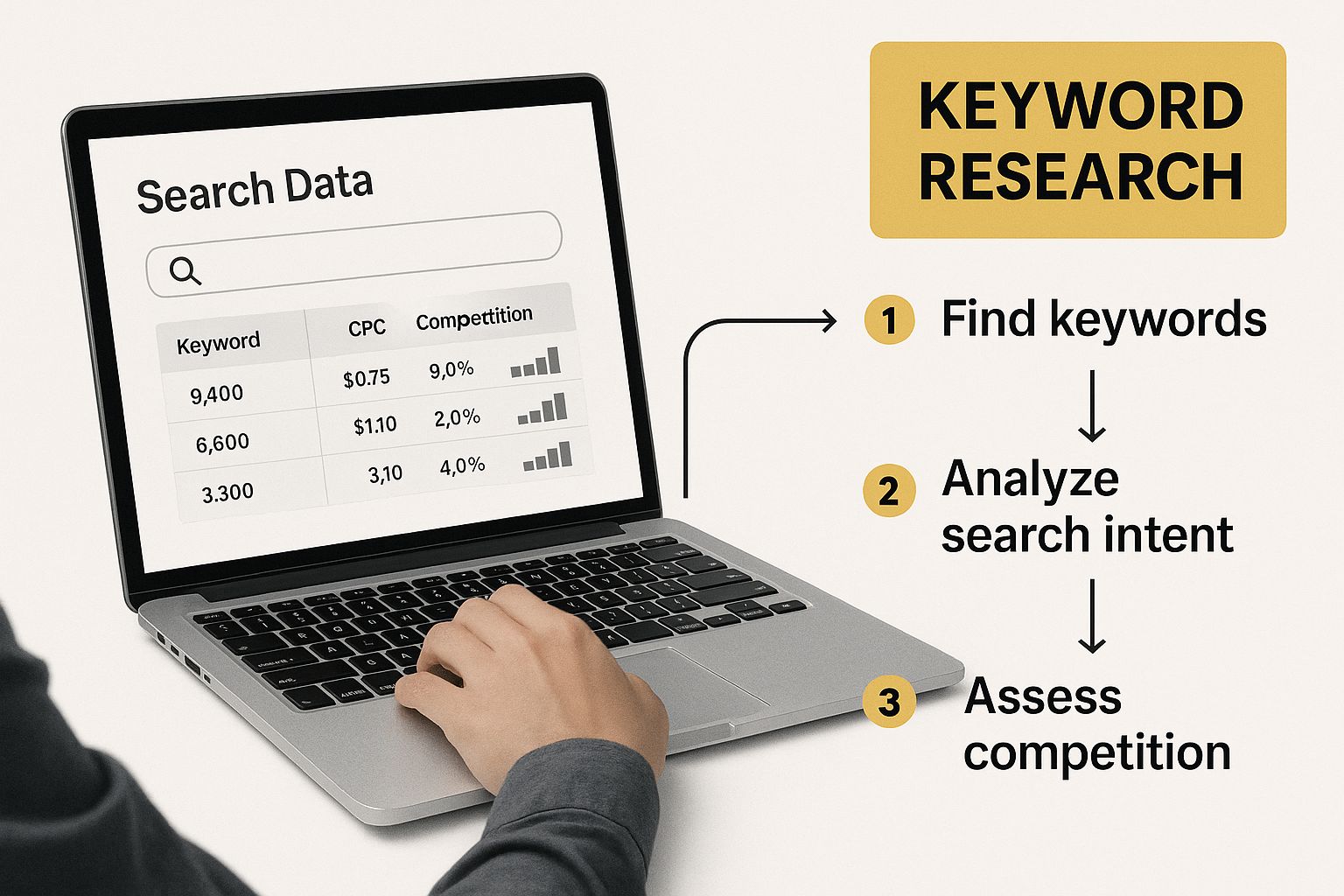
The main takeaway here is that research is a continuous cycle of discovery, analysis, and refinement. It's not a one-and-done task you can tick off a list.
Decoding Search Intent
The single most critical concept I want you to grasp is search intent. Simply put, it’s the why behind every search query. Getting this right is what separates amateur bloggers from professional SEOs. Every search has a purpose, and your content absolutely must align with that user's goal.
- Informational Intent: The user wants to learn something. Think "how to tile a bathroom," "what is inflation," or "benefits of green tea." Blog posts are tailor-made for this.
- Navigational Intent: The user is trying to get to a specific site. They might search for "Grow Your Biz blog" instead of remembering and typing the full URL.
- Transactional Intent: The user has their wallet out and is ready to buy. Searches like "buy air fryer," "Asos discount code," or "cheap flights to Spain" fall into this category. These are usually best served by a product or service page.
- Commercial Investigation: The user plans to buy soon but is still weighing up their options. You'll see searches like "best running shoes for beginners," "Ahrefs vs Semrush review," or "iPhone 15 alternatives." This is a sweet spot for in-depth comparison posts and guides.
Your SEO blog writing should primarily focus on informational and commercial investigation queries. This is your chance to build trust and authority by being genuinely helpful before you ever ask for the sale.
Don't just chase vanity metrics. A keyword with 100 monthly searches from people ready to buy is infinitely more valuable than one with 10,000 searches from people who are just window shopping.
Uncovering Keyword Opportunities
Right, let's get practical. How do you actually find these golden keywords? In my experience, the best approach is a mix of smart tools and good old-fashioned common sense.
Start by brainstorming "seed" keywords. These are the broad, foundational topics related to your business. For example, if you sell handmade leather wallets, your seed keywords might be things like "leather wallets," "men's accessories," and "card holders."
Next, plug those seed terms into a keyword research tool. While premium tools like Ahrefs are the industry standard for a reason, you don't have to break the bank. Google's own Keyword Planner is a fantastic free tool to get you started. These tools will spit out hundreds of related keyword ideas, along with two crucial bits of data:
- Search Volume: An estimate of how many times a keyword is searched each month.
- Keyword Difficulty: A score (usually out of 100) that estimates how hard it will be to rank on the first page of Google for that term.
The sweet spot you're looking for is a keyword with respectable search volume and a low difficulty score. That's your low-hanging fruit.
The Power of Long-Tail Keywords
As you sift through the data, you'll notice that some keywords are short and broad (e.g., "seo tips"), while others are much longer and more specific (e.g., "seo tips for small business blogs in the UK"). These longer, more conversational phrases are what we call long-tail keywords.
Individually, their search volume might seem low. But don't be fooled. They are far less competitive and tend to have much higher conversion rates because the search intent is crystal clear. Someone searching for that long-tail phrase knows exactly what they're looking for.
Basing your SEO blog writing strategy on a cluster of related long-tail keywords is an incredibly powerful tactic. For a deeper dive, check out this comprehensive guide on keyword research for SEO. By creating content that answers these highly specific questions, you signal your expertise to both search engines and the people you most want to attract.
Writing Content That Readers and Search Engines Actually Value

You’ve got your keyword list sorted. Now for the hard part—actually writing the blog post. This is where so many SEO strategies fall apart. It’s no longer enough to just sprinkle your keywords into an article. You have to create something that genuinely helps the reader and satisfies the intent behind their search.
The real goal is to produce a piece so comprehensive and insightful that it becomes the go-to resource for anyone searching that term. This means digging deeper than the surface-level advice everyone else is giving and offering real, practical solutions. When you get this right, you create a powerful asset that both people and search engines will love.
Building Trust with E-E-A-T
Google’s quality rater guidelines are all built around a core concept called E-E-A-T: Experience, Expertise, Authoritativeness, and Trustworthiness. Don't think of this as a technical SEO chore; see it as a blueprint for creating credible, high-value content.
- Experience: Don't just tell; show. Instead of saying, "this is a good strategy," share a story about when you personally used that strategy and what happened. Real-world examples are golden.
- Expertise: Prove you know your stuff. Go beyond the basics and explain the why behind your recommendations. Connect the dots for your reader.
- Authoritativeness: Back up what you're saying. Link out to reputable studies, cite data from trusted industry reports, and mention established experts in your field.
- Trustworthiness: Be transparent. Have a clear author bio, make your contact information easy to find, and ensure your site is secure with HTTPS. These are massive trust signals.
Folding E-E-A-T into your SEO blog writing is about a fundamental mind-shift. You stop writing for a search engine and start writing for a person, which, ironically, is exactly what search engines want you to do.
Weaving in Keywords Naturally
Nothing screams "amateur SEO" louder than clunky, forced keyword usage. This practice, often called "keyword stuffing," makes your writing sound robotic and can actually hurt your rankings. The trick is to let your keywords flow naturally into the conversation.
Imagine you're targeting the keyword "best dog walking shoes."
- Bad: "For the best dog walking shoes, you need comfort. Our review of the best dog walking shoes will help you find the best dog walking shoes for your walks."
- Good: "Finding the right footwear can completely change your daily walks. The best dog walking shoes should offer a solid blend of support, durability, and all-weather grip to handle any park or pavement."
See the difference? The second example feels human. It uses the main keyword where it makes sense and then supports it with related concepts like "footwear," "support," and "grip." This builds topical authority without sounding like a broken record.
Structuring Your Content for Skimmers
Let's be honest—very few people read articles online word-for-word. They skim. Your job is to structure your post so that a skimmer can pull out the most important information in just a few seconds. A great user experience is a powerful SEO signal.
You are writing for humans first. If your content is a dense wall of text, people will click away—and Google will notice. Readability isn't just a nicety; it's a ranking factor.
Here are a few simple ways to make your content far more scannable:
- Keep Paragraphs Short: Stick to a maximum of 2-3 sentences per paragraph. This creates breathing room and makes the page feel less intimidating.
- Use Clear Headings: Break your article into logical chunks with H2 and H3 subheadings. Make them descriptive so readers know exactly what each section covers.
- Embrace Bullet Points: Whenever you're listing features, steps, or examples, use bullet points. They are incredibly easy for the human eye to scan and process.
- Bold Important Phrases: Make key terms and statistics bold to draw the reader's eye to the most critical takeaways.
By organising your content this way, you’re catering to how people actually read online. This helps readers and also gives search engines a clearer map of your content's structure. As technology continues to evolve, it's also worth understanding how AI writers are changing the SEO landscape to stay ahead of the curve.
Right, you've done the hard work. The research is done, the draft is written, and you've created something genuinely useful. But before you hit publish, there's one more crucial phase: on-page SEO.
This isn't about gaming the system. It's about adding the final polish that helps search engines understand what your content is about and why it deserves to be seen. Think of it as dressing your article for success—the substance is there, but without the right presentation, it might get lost in a sea of search results.
These technical tweaks are what turn a great draft into a powerful SEO asset.
Crafting Titles and Descriptions That Win the Click
Your title tag and meta description are your shop window on the search results page. You're competing for attention against a dozen other listings, so a generic title just won't cut it.
The goal here is twofold: you need to include your primary keyword, but you also have to give someone a compelling reason to choose your link. The difference this makes is staggering. A First Page Sage study found the #1 spot on Google grabs a 39.8% click-through rate, which plummets to just 18.7% for the second position. A brilliant title can be the difference.
Let's say you're targeting "how to prune roses."
- Boring: How to Prune Roses
- Much Better: How to Prune Roses Like a Pro (7 Simple Steps for More Blooms)
See the difference? The second option still has the keyword, but it also promises a specific outcome (more blooms) and sets a clear expectation (7 simple steps). It's far more appealing.
Then there's your meta description—that little snippet of text under the title. It doesn't directly affect your rankings, but it has a massive impact on whether someone clicks. This is your 155-character sales pitch. Use your main keyword, add a strong call-to-action, and tell the reader exactly what they'll get from your article.
Structuring Your Content with Smart Heading Tags
Headings (H1, H2, H3, etc.) aren't just for making things look pretty. They build a logical skeleton for your content that both people and search engines use to understand its structure. They're a roadmap, making it easy to see the main topics and sub-topics at a glance.
Here’s the breakdown:
- Your H1 Tag: This is your main title, the big one. You should only ever have one H1 on a page, and it must contain your primary keyword. It’s the title of the book.
- H2 Tags: These are your main chapters. Use them to break the article into its core sections. It’s a great place to weave in primary or secondary keywords where they fit naturally.
- H3 Tags: These are the sub-sections within your chapters. They’re perfect for breaking down individual points and adding more detail and structure.
When you nest your headings properly—an H3 follows an H2, for example—you create an article that’s easy to scan and digest. This improves things like time on page, and you can be sure Google is paying attention to that.
Optimising Your Images for Speed and Visibility
Images are essential. They break up walls of text and can explain complex topics in an instant. But if they aren't optimised, they can drag your page speed down and add zero SEO value.
First things first: compress your images before you even think about uploading them. Huge image files are one of the biggest reasons for slow-loading pages, which is a known ranking factor. A free tool like TinyPNG can slash your file sizes without making your images look grainy.
Second, give your images descriptive file names and alt text.
- Bad File Name: IMG_8734.jpg
- Good File Name: seo-blog-writing-on-page-checklist.jpg
- Alt Text: "A checklist graphic showing on-page SEO tasks like title tags and image optimisation."
The file name gives search engines an initial clue. But the alt text (alternative text) is even more vital. It describes the image for visually impaired users who rely on screen readers, and it tells search engines what the image shows, which can help it rank in Google Images.
Don't sleep on internal linking. It’s one of the most powerful and underused on-page SEO tactics out there. Every internal link you add is a vote of confidence from one of your pages to another, building a strong, interconnected web of content.
Building a Web of Smart Internal Links
Internal links are simply hyperlinks that point from one page on your website to another. They are incredibly important for a few reasons:
- They help search engines find your content: Crawlers follow these links to discover and index all the pages on your site.
- They pass authority between pages: A link from a high-authority page (like your homepage) can give a significant boost to the page it links to.
- They keep visitors engaged: By guiding readers to other relevant articles, you improve their experience and keep them on your site longer.
When you create a link, always use descriptive anchor text—that’s the clickable text itself. Instead of a lazy "click here," use something like "learn more about our keyword research process." This gives both users and search engines clear context about where the link is going, making all your SEO blog writing efforts that much more effective.
Promoting Your Content to Build Authority

So, you’ve poured hours into crafting the perfect article and finally hit ‘publish’. It’s a great feeling, but this is the starting line, not the finish. A brilliant piece of SEO writing is completely lost if no one ever sees it. To build genuine authority and climb the rankings, you need a solid plan for getting your content in front of the right eyeballs.
This goes way beyond just dropping a link on your social media and hoping for the best. Real promotion is about squeezing every drop of value out of each article, transforming that single piece of content into multiple assets that connect with different people on different platforms.
Amplify Your Reach by Repurposing Content
The hard work you've already put into your blog post can be multiplied with a smart repurposing strategy. Think of your article as the central hub of a wheel, with spokes reaching out to all the places your audience hangs out. This doesn’t just stretch your reach; it also caters to how people actually like to consume content.
Here are a few practical ways I’ve seen this work wonders:
- Script a short-form video. Pull out the key takeaways and turn them into a snappy script for a YouTube Short, TikTok, or Instagram Reel. This is a game-changer for capturing audiences who prefer watching to reading.
- Design a shareable infographic. Visuals cut through the noise. Use a simple tool like Canva to transform your main stats or step-by-step instructions into a clean infographic. It’s perfect for sharing on platforms like Pinterest or LinkedIn.
- Craft a compelling Twitter thread. Break down your article's main arguments into a series of punchy tweets. Each tweet builds on the last, telling a story and funneling engaged readers back to the full post.
- Produce a presentation deck. Condense your guide into a slick slide deck and upload it to a platform like SlideShare. This is a fantastic way to position yourself as an expert and connect with a more professional audience.
This is a cornerstone of any effective marketing strategy for small business because it makes every piece of content work that much harder. You're not just creating more noise; you're strategically distributing your best ideas across the web.
Earning Backlinks The Smart Way
While repurposing content gets you seen, earning backlinks gets you respected by Google. In SEO, backlinks are the currency of the internet. When another reputable website links to your content, it’s a massive vote of confidence, telling search engines that your article is credible and valuable.
This is precisely why blogging with a sharp SEO focus is such a dominant strategy. A staggering 68% of all online experiences kick off with a search engine, making visibility absolutely critical. We know that blogs actively chasing SEO strategies—including link building—can rack up 97% more backlinks, directly boosting their authority. It’s hardly surprising that 71% of UK bloggers point to SEO as their most vital tool for driving traffic. You can dig into more of these powerful blogging statistics on ElectroIQ.com.
Backlinks are more than just links; they are third-party votes of confidence. Earning them consistently is one of the clearest indicators to Google that you are a genuine authority in your field.
So, how do you actually get them? One of the most tried-and-true methods is broken link building.
An Actionable Outreach Template
The idea behind broken link building is simple: you find dead links on other websites in your niche and politely offer your fantastic content as a replacement. It's helpful, not spammy.
Here's how it works:
- First, find relevant resource pages on high-authority sites. A quick search for
"your topic" + "helpful resources"is a great place to start. - Next, scan these pages for broken links. A free browser extension like Check My Links automates this and saves you a ton of time.
- Finally, you reach out with a friendly, helpful email.
Here’s a simple template that has worked well for me because it’s genuine and straight to the point:
Subject: A broken link on your [Topic] resources page
Hi [Name],
I was looking for some information on [Topic] today and came across your excellent resources page: [URL of their page]
Just wanted to give you a quick heads-up that one of the links appears to be broken. The link to "[Anchor text of broken link]" seems to lead to a dead page.
We actually just published a comprehensive guide on [Your article's topic] that might be a great replacement. It covers [mention one or two key points].
Here it is, in case you think it’s a good fit: [URL to your article]
Either way, hope this helps and keep up the great work!
Best,
[Your Name]Common SEO Blog Writing Questions Answered
https://www.youtube.com/embed/8NjBWQIaf3I
As you get your hands dirty with SEO blog writing, you'll find that theory and practice are two different things. It’s one thing to understand the concepts, but another to actually put them to work day in and day out.
This is where the real questions pop up. We’ve gathered the most common queries we get from clients and partners to give you straight-to-the-point answers, helping you clear those practical hurdles with a bit more confidence.
How Long Should An SEO Blog Post Be?
There’s no magic word count that guarantees a top spot on Google. The real goal is to cover your chosen topic so completely that your reader walks away with zero remaining questions. It’s about value, not volume.
That said, for competitive keywords, you'll often find that longer, more comprehensive content wins. A good rule of thumb is to aim for something in the 1,500 to 2,500-word range.
A smart tactic? Google your target keyword and have a look at the top 3-5 articles. How long are they? What ground do they cover? Your job is to create something even more thorough and helpful. This is often your best clue for how long your post should be.
How Often Should I Publish New Blog Posts?
This is the age-old question, and the answer isn't what most people expect: consistency always trumps frequency.
Publishing one truly outstanding, well-researched article per week is infinitely more powerful than churning out five half-baked posts. Quality is what builds trust with your audience and authority with search engines.
If you’re just starting out with a brand-new website, publishing a little more often—say, 2-3 times a week—can help speed up how quickly Google finds and indexes your pages. But once you're established, a steady rhythm of one high-value post per week is a solid, sustainable strategy. The key is to pick a schedule you can realistically maintain without sacrificing quality.
Should I Update Old Posts Or Only Write New Ones?
You absolutely have to do both. Ignoring your old content is one of the biggest mistakes you can make in content marketing. Updating and republishing existing posts is arguably one of the highest-impact activities you can undertake.
Updating existing content is a powerful SEO lever. These posts often have established authority and backlinks, giving you a massive head start. Refreshing them can deliver significant ranking boosts with far less effort than creating a new article from scratch.
Think about it: these older articles might already have some ranking authority and, crucially, backlinks pointing to them. By refreshing them with updated information, better optimisation, and fresh examples, you can give them a whole new lease on life. A savvy content strategy balances creating brand-new content with regularly auditing your archives to find posts ripe for a refresh.
Can I Use AI For SEO Blog Writing?
Yes, but with a big caveat. Think of AI as your co-pilot, never the pilot. AI tools can be brilliant for speeding things up. They can help you brainstorm ideas, draft outlines, and smash through writer’s block.
However, letting AI write an entire article from start to finish is a recipe for failure. To rank well and truly connect with people, your content needs a unique voice, personal insights, and real-world experience. This is the very essence of Google's E-E-A-T guidelines (Experience, Expertise, Authoritativeness, and Trustworthiness). AI simply can't fake lived experience.
So, use AI for the heavy lifting. But the final article must be shaped, fact-checked, and enriched by a human expert. This is how you create content that is accurate, trustworthy, and genuinely useful—the non-negotiables for lasting SEO success.
Ready to find the perfect tools to power your content strategy? At The Digital Marketing Toolbox, we bring together the best resources for SEO, content creation, and analytics, all in one place. Stop guessing and start growing. Explore our curated toolkits today!


