
Creating great content is only half the battle. If that content isn't optimised for search engines, it remains practically invisible to the very audience you want to reach. Many businesses invest heavily in writing, only to find their articles buried on page ten of Google, failing to generate meaningful organic traffic. This common frustration stems from a disconnect between crafting a compelling narrative and applying the technical fundamentals of search engine optimisation.
This guide is designed to close that gap. We are moving beyond vague advice to provide a practical framework of actionable seo content writing tips. You won't find generic suggestions here. Instead, this listicle breaks down the essential strategies needed to get your content seen, from mastering keyword research and user intent to structuring articles for maximum readability and technical performance.
By implementing these proven techniques, you can ensure your hard work pays off. You will learn how to create content that not only engages and informs your readers but also systematically climbs the search engine rankings. Let’s transform your content from a well-written but hidden asset into a powerful, traffic-driving tool for your business.
1. Master the Foundation: Advanced Keyword Research
Keyword research is the bedrock of all successful SEO content writing tips, yet many creators barely scratch the surface. Moving beyond basic, high-volume terms is essential. Advanced keyword research involves a deeper analysis of user intent, competitive landscapes, and long-tail opportunities to ensure your content truly resonates with both search engines and your audience.
This strategic approach focuses on understanding why a user is searching, not just what they are searching for. It means organising keywords into thematic clusters that align with your business goals and the customer journey.
Beyond Single Keywords: Building Topic Clusters
Instead of targeting one primary keyword per article, think in terms of "topic clusters." This involves identifying a broad "pillar" topic and several related sub-topics or "cluster" keywords that support it. This structure signals to Google that you are an authority on the subject.
- Pillar Keyword Example: "small business accounting"
- Cluster Keyword Examples: "bookkeeping tips for startups," "best accounting software UK," "how to calculate VAT for a small business"
By creating content for each cluster keyword and linking it back to your main pillar page, you build a powerful internal network.
Uncovering Search Intent
One of the most crucial SEO content writing tips is to match your content format to the user's intent. Search intent generally falls into four categories: informational, navigational, commercial, and transactional.
Pro Tip: Analyse the current top-ranking results for your target keyword. Are they blog posts (informational), product pages (transactional), or comparison guides (commercial)? This tells you exactly what kind of content Google believes satisfies that query. For example, a search for "buy noise-cancelling headphones" will yield e-commerce pages, not a history of audio technology. Aligning your content with this proven format significantly increases your chances of ranking.
2. Create High-Quality, Comprehensive Content
In the world of SEO content writing tips, "quality over quantity" is a mantra, but true success lies in combining quality with comprehensiveness. This means creating content that so thoroughly covers a topic that it becomes the definitive resource for a user's query. This approach, often called "10x content," aims to be ten times better than anything else ranking for the target keyword.
This strategy is about demonstrating expertise and authority. By addressing every conceivable question and providing immense value within a single piece, you signal to Google that your page is the best possible result for a user's search. This is central to satisfying Google's E-A-T (Expertise, Authoritativeness, and Trustworthiness) guidelines.

Go Beyond Surface-Level Answers
Shallow content rarely ranks. To create a comprehensive resource, you must dig deeper than your competitors. This involves more than just a high word count; it requires depth, original insights, and a structure that guides the user seamlessly through the topic.
- Competitor Gap Analysis: Analyse the top 10 search results to find what they've missed. Are there unanswered questions or sub-topics you can cover in more detail?
- Include Unique Elements: Add original data, expert quotes, case studies, or custom graphics to provide value that cannot be found elsewhere.
- Logical Flow: Structure your content with the most critical information first (the "inverted pyramid" method) and use clear, descriptive headings to organise sections.
Structure for Readability and SEO
A long, comprehensive article can be intimidating. The key is to make it scannable and easy to navigate, improving both user experience and on-page SEO. To truly create 10x content consistently, consider how you can effortlessly scale your content creation with AI to maintain quality and output.
Pro Tip: For any article over 2,000 words, implement a clickable table of contents at the beginning. This allows users to jump directly to the section that interests them most and helps Google generate "jump to" links in the search results, improving your visibility. Making this a core part of your marketing strategy for a small business can significantly boost user engagement.
3. Optimize Title Tags and Meta Descriptions
Your title tag and meta description are your content's first impression on the search engine results page (SERP). They are crucial HTML elements that summarise your page for both users and search engines. An optimised title tag acts as a powerful ranking signal and a compelling headline, while a well-written meta description persuades users to click, directly influencing your click-through rate (CTR).
This strategic combination is a fundamental aspect of on-page SEO. Neglecting these elements means leaving traffic and engagement on the table, no matter how excellent the content on the page itself is. This is one of the most direct SEO content writing tips you can implement for an immediate impact.

Crafting High-Impact Titles
Your title tag is the clickable headline in search results. It must be concise, descriptive, and contain your primary keyword, ideally near the beginning. Think of it as a newspaper headline designed to grab attention and communicate value instantly.
- Keyword-Driven Example: Shopify uses "Start Your Business with Shopify®" to target a core commercial intent.
- User Intent Example: Canva’s "Free Online Photo Editor | Edit Photos with Canva" perfectly matches what a user searching for that tool needs to see.
By front-loading your keyword and adding a compelling value proposition, you satisfy both search engine algorithms and user expectations.
Writing Meta Descriptions that Convert
While not a direct ranking factor, the meta description is your sales pitch in the SERPs. It’s your chance to tell the user why your page is the best answer to their query and encourage a click. A great meta description provides a clear summary and often includes a call-to-action.
Pro Tip: Analyse your competitors' meta descriptions for your target query. Look for patterns in language, calls-to-action, and unique selling points. Then, write a description that stands out. For an informational query, answer the question directly. For a commercial query, highlight a key benefit or offer, such as "free delivery" or "expert advice." This small optimisation can significantly boost your CTR, a signal Google does pay attention to.
4. Structure Content with Proper Header Tags (H1-H6)
Header tags (H1, H2, H3, etc.) are far more than just a way to make text bigger; they create a logical and hierarchical outline for your content. This structure is critical for both search engines and human readers, helping them understand the organisation and primary themes of a page at a glance.
A well-organised heading structure acts as a roadmap. For users, it makes content scannable and digestible, improving their experience. For search engines like Google, it provides clear signals about the relevance and context of different sections, which is a fundamental aspect of on-page SEO.
Building a Logical Hierarchy
The key is to use header tags sequentially to create a clear, nested structure. Your H1 is the main title, H2s are the main sections, H3s are sub-sections of H2s, and so on. Never skip levels, such as jumping from an H2 to an H4, as this breaks the logical flow.
- H1 Tag: The main title of your page. Use only one per page. Example: "The Ultimate Guide to SEO Content Writing Tips"
- H2 Tags: The main sub-headings that break the article into key topics. Example: "Mastering Keyword Research," "Crafting Compelling Meta Descriptions"
- H3 Tags: Sub-points that elaborate on an H2 topic. Example: "Understanding Search Intent," "Using Long-Tail Keywords"
This hierarchical approach is perfectly demonstrated on sites like the Mayo Clinic, where health articles use question-based H2s and H3s to directly answer user queries, helping them capture featured snippets.
Making Headers Work for SEO and Users
Descriptive, well-crafted headers improve both readability and your chances of ranking for related queries. They should clearly tell the reader what each section is about while naturally incorporating relevant keywords.
Pro Tip: Think of your headers as a table of contents. A user should be able to read only your H1, H2s, and H3s and understand the entire scope and structure of your article. Use CSS for styling, not headers. Choose the heading level (H1-H6) based on its place in the content hierarchy, not because you want a certain font size. This ensures your content is accessible and properly understood by search crawlers.
5. Write for User Intent and Search Intent
Search intent (or user intent) is the "why" behind a search query. It's the ultimate goal a user wants to achieve, and failing to address it is one of the quickest ways to become invisible on Google. This is one of the most critical SEO content writing tips because search engines are obsessively focused on providing results that best satisfy user needs.
Creating content that aligns with this intent ensures you are delivering genuine value, not just chasing keywords. It's the difference between a user finding your page and immediately leaving (a high bounce rate) versus finding exactly what they needed and engaging with your content.
The Four Core Types of Search Intent
To master this, you must first understand the primary categories of intent. Organising your content strategy around these ensures you create the right asset for the right audience at the right time.
- Informational Intent: The user is seeking knowledge. E.g., "how to tie a tie."
- Commercial Investigation: The user is researching before a purchase. E.g., "best laptops for video editing."
- Transactional Intent: The user is ready to make a purchase. E.g., "buy iPhone 14 Pro."
- Navigational Intent: The user is looking for a specific website. E.g., "Facebook login."
REI, for instance, excels at this by creating expert buying guides for commercial intent and distinct product pages for transactional intent.
How to Align Content with Intent
Matching your content format and substance to the user’s goal is non-negotiable for ranking high. If you misalign, Google will favour a competitor who gets it right.
Pro Tip: The best way to diagnose search intent is to analyse the SERPs (Search Engine Results Pages) for your target keyword. Look at the top 10 results. Are they blog posts, product pages, comparison tables, or videos? This is Google telling you what type of content it believes best satisfies that query. Your job is to create a superior version of that proven format. For "how to" queries, provide tutorials; for "best" queries, create comparison lists.
6. Optimize Content Readability and User Experience
Creating content that ranks well is no longer just about keywords; it's about the holistic experience you provide to the user. One of the most impactful SEO content writing tips is to focus on readability and user experience (UX), as these factors directly influence how long visitors stay on your page and interact with your content, sending powerful positive signals to search engines.
Readability is about making your content easy to digest and understand. A user who finds your text difficult to process is likely to leave immediately. Similarly, a poor user experience, such as a slow-loading page or confusing navigation, creates frustration and increases bounce rates, telling Google your page isn’t a good result for that query.
Crafting Scannable, User-Friendly Content
Most online readers don't read word-for-word; they scan. Structuring your content to accommodate this behaviour is crucial for engagement. This means breaking down complex ideas into simple, digestible formats that guide the reader's eye through the page.
- Paragraph Length: Keep paragraphs short, ideally no more than 3-4 sentences.
- Headings and Subheadings: Use H2s and H3s to create a clear visual hierarchy and signpost different sections of your content.
- Visual Breaks: Incorporate relevant images, bullet points, and numbered lists to break up walls of text and make information easier to absorb.
By making your content scannable, you respect the user's time and improve the chances they will find the information they need.
Prioritising Technical UX for SEO
Beyond formatting, technical performance is a cornerstone of good UX and a confirmed Google ranking factor. The Page Experience update, which introduced Core Web Vitals, formalised the importance of a seamless technical experience for users.
Pro Tip: Use tools like Grammarly or the Hemingway Editor to assess your content's readability score. For a general audience, aim for a Flesch Reading Ease score between 60-70. This ensures your writing is accessible without being overly simplistic. Small adjustments to sentence length and word choice can significantly improve this score and your content's overall effectiveness.
The following infographic illustrates the three core metrics that form the foundation of on-page user experience performance.
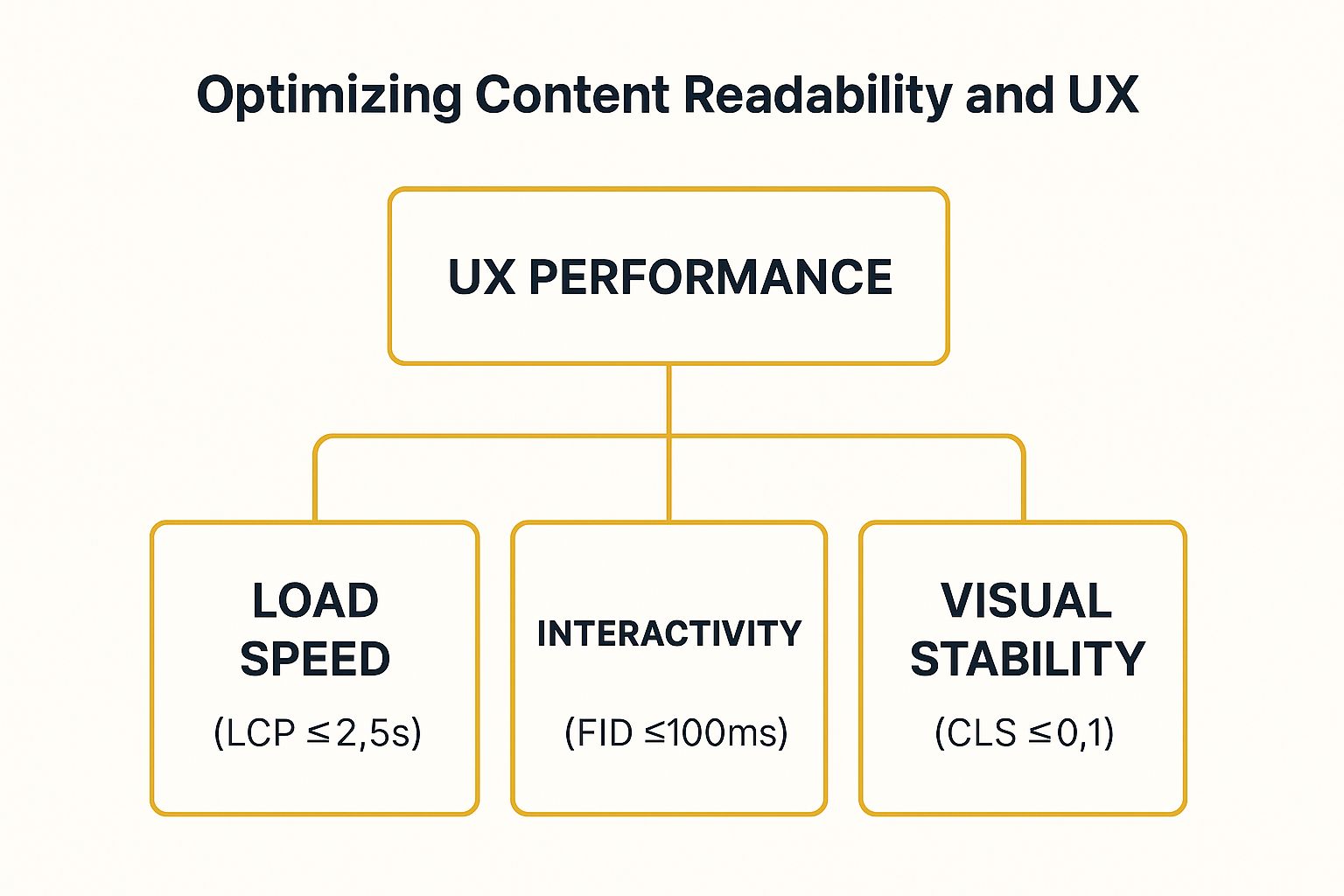
This hierarchy shows that achieving strong UX performance requires mastering load speed, interactivity, and visual stability within specific thresholds. Integrating these technical considerations is a vital part of a comprehensive content strategy, much like understanding the basics covered in a beginner's guide to digital marketing.
7. Implement Strategic Internal Linking
Internal linking is one of the most powerful yet underutilised SEO content writing tips. It involves creating hyperlinks from one page on your website to another, creating a web of connections that guides both users and search engine crawlers. A deliberate internal linking strategy distributes authority across your site, establishes a clear information hierarchy, and helps Google discover and index your content more efficiently.
This approach transforms your website from a collection of standalone pages into a cohesive, interconnected resource. By strategically linking your content, you signal to search engines which pages are most important and how they relate to one another.
Weaving a Web of Authority
Instead of letting pages exist in isolation, you can use internal links to create a strong, logical structure. This is the core principle behind the topic cluster model, where you link supporting "cluster" articles back to a central "pillar" page, funnelling authority to your most important content.
- Pillar Page Example: A comprehensive guide on "UK E-commerce SEO"
- Cluster Page Links: Articles on "product page optimisation," "Shopify site speed," and "local SEO for retailers" would all link back to the main pillar guide.
This structure helps Google understand your expertise on a subject, making it easier for your pillar content to rank for broad, competitive terms.
Guiding Users and Search Engines
Effective internal linking improves user experience by helping visitors find related, valuable content, keeping them on your site longer. For search engines, it provides clear pathways to crawl your site, ensuring that even deeper pages are discovered.
Pro Tip: When publishing a new article, make it a standard practice to add 3-5 contextual internal links to relevant, existing pages on your site. Additionally, go back to older, high-authority articles and add a link to your new post. This simple process immediately passes authority to the new content and helps it get indexed and ranked faster. To further weave a web of authority, understanding the importance of internal linking for SEO is paramount for success, particularly for platform-specific strategies.
8. Optimize Images and Multimedia for SEO
Visuals are a powerful component of engaging content, but they are often an SEO afterthought. Optimising images and multimedia involves much more than simply uploading a picture; it's a technical and strategic process that boosts page load speed, enhances user experience, and creates new pathways for search traffic.
This practice ensures your visual assets are discoverable by search engines and accessible to all users. A well-optimised image can rank on its own in Google Images, driving significant traffic, while also making your main content more appealing and faster to load.
Technical and Contextual Optimisation
Effective image SEO combines technical performance with descriptive context. Search engines cannot "see" an image, so they rely on the surrounding code and text to understand its content and relevance to the user's query. This is a crucial element of on-page SEO content writing tips.
- File Naming: Always rename files descriptively before uploading. Use
blue-suede-shoes.jpginstead of the genericIMG_4815.jpg. - File Compression: Use tools like TinyPNG or Squoosh to reduce file sizes without sacrificing quality. This directly improves page speed, a key ranking factor.
- Alt Text: Write descriptive alt text (alternative text) for every image. This helps screen readers for accessibility and tells search engines what the image is about.
By implementing these steps, you provide clear signals to Google, increasing the chance your visuals will appear in both standard and image search results.
Actionable Steps for Implementation
Beyond the basics, several advanced techniques can further enhance your multimedia SEO. These steps help ensure your images are not only indexed but also presented effectively to users across different devices.
Pro Tip: Your primary goal is to make images work for your SEO, not against it. Start by resizing images to the exact dimensions they will be displayed on your site. Don't upload a 4000px wide image for a space that is only 800px wide. Use modern formats like WebP, which offer superior compression, and enable lazy loading to defer loading of off-screen images until a user scrolls to them. This combination dramatically improves load times and the user experience.
Implementing these practices transforms images from simple page decorations into hard-working SEO assets. For businesses looking to manage these technical details effectively, exploring a virtual marketing service can provide the necessary expertise to ensure all on-page elements are fully optimised.
SEO Content Writing Tips: 8-Point Comparison Guide
| Item | Implementation Complexity 🔄 | Resource Requirements ⚡ | Expected Outcomes 📊 | Ideal Use Cases 💡 | Key Advantages ⭐ |
|---|---|---|---|---|---|
| Conduct Thorough Keyword Research | Medium to High: detailed analysis and tool use needed | Moderate: SEO tools subscriptions and time investment | Better targeted content, increased organic traffic | Planning SEO strategy, identifying content opportunities | Data-driven targeting, reveals user intent, content gap ID |
| Create High-Quality, Comprehensive Content | High: requires deep research, expert input, multimedia integration | High: content creators, researchers, multimedia assets | Higher rankings, authority establishment, better engagement | Authoritative guides, pillar content, complex topics | Strong E-A-T signals, featured snippets, user trust |
| Optimize Title Tags and Meta Descriptions | Low to Medium: technical but straightforward | Low: copywriting skills, minor time per page | Improved CTR, better search visibility | Every webpage SEO optimization | Immediate SEO impact, clear user expectations, easier sharing |
| Structure Content with Proper Header Tags (H1-H6) | Low to Medium: requires planning and consistent formatting | Low: editor awareness and content structuring | Improved readability and SEO context, better UX | Any content aiming for clarity and SEO structure | Enhanced scannability, snippet chances, accessibility improved |
| Write for User Intent and Search Intent | Medium: in-depth intent research and content alignment required | Moderate: content strategy and research time | Higher rankings, user satisfaction, better conversions | All SEO content creation, especially targeting specific queries | Aligns content to user needs, reduces bounce, boosts featured snippets |
| Optimize Content Readability and User Experience | Medium: requires content editing, formatting, UX considerations | Moderate: design, editing, page speed improvements | Lower bounce, higher engagement, better mobile rankings | Blog posts, product pages, content-heavy sites | Accessibility, faster loads, better comprehension |
| Implement Strategic Internal Linking | Medium: strategic planning and ongoing maintenance | Moderate: editorial time and site audits | Improved crawlability, distributed authority, better UX | Large sites with multiple related contents | Boosts priority pages, enhances navigation, link equity flow |
| Optimize Images and Multimedia for SEO | Medium to High: technical optimization and quality checks | Moderate to High: tools for compression and markup | Faster load times, increased image search traffic | Image-heavy sites, e-commerce, multimedia-rich content | Better performance, accessibility, visual search presence |
Turning Tips into Traffic: Your Next Steps
You've just navigated a comprehensive blueprint of modern SEO content writing tips. We've moved beyond surface-level advice, delving into the practical mechanics of how to create content that both search engines and human readers will value. From the foundational necessity of thorough keyword research to the subtle art of strategic internal linking, each tip is a crucial component in a much larger, interconnected system designed to drive sustainable organic growth.
The journey from understanding these principles to mastering them lies in consistent application. It’s easy to feel overwhelmed by the sheer number of optimisations discussed, from header tag hierarchies and image alt text to aligning perfectly with user intent. However, the true power of these strategies is realised not through a one-time effort, but by integrating them into your routine content creation workflow. The most successful content marketers and business owners are those who treat these practices as non-negotiable standards for every piece of content they publish.
From Knowledge to Action: Your Implementation Plan
The key is to start small and build momentum. Don't try to overhaul your entire website overnight. Instead, focus on creating a repeatable process that turns these advanced SEO content writing tips into habits.
Here is a simple, actionable plan to get started:
- Conduct a Content Audit: Select one of your existing, underperforming blog posts. Use the tips from this article as a checklist. Ask critical questions: Does the title tag accurately reflect the content and include the primary keyword? Is the content structured logically with H2s and H3s? Are there opportunities to add internal links to other relevant posts?
- Prioritise High-Impact Changes: Focus on the "quick wins" first. Optimising title tags, improving readability by shortening sentences, and adding relevant internal links can often yield noticeable results with minimal effort. This initial success will provide the motivation to tackle more complex tasks.
- Create a Pre-Publish Checklist: Formalise your new workflow. Before you hit "publish" on any new article, run it through a checklist based on the eight core principles we've covered. This ensures no critical element is overlooked and reinforces the consistent application of best practices.
Mastering these concepts is not just about climbing search engine rankings; it's about building authority, fostering trust with your audience, and creating a reliable source of qualified traffic for your business. Each optimised article becomes a valuable, long-term asset that works for you around the clock, attracting new customers and reinforcing your brand's credibility. By methodically implementing these SEO content writing tips, you will transform your content from a simple marketing tactic into a powerful, revenue-generating engine.
Ready to implement these strategies with greater speed and precision? The Digital Marketing Toolbox provides a curated suite of AI-powered writing assistants, SEO analytics, and content optimisation tools designed to streamline your workflow. Stop guessing and start creating high-performance content today by exploring the solutions at The Digital Marketing Toolbox.


