
Let's be blunt: is it still worth pouring time and effort into SEO for blog posts when things like AI Overviews and zero-click searches are becoming the norm? Absolutely, but the playbook has definitely changed. These days, effective SEO is less about blindly chasing that coveted #1 spot and more about creating incredibly well-structured, genuinely valuable content that gets featured in snippets and AI-powered summaries.
Does Blog SEO Still Work In An AI World?
The entire conversation around blog SEO has shifted, and rightly so. With AI weaving its way into search results and more queries being answered right on Google's results page, it’s only natural to wonder if the effort is still worth it. The truth is, it absolutely is—but the strategy looks nothing like it did a few years ago. The new focus isn't just on keywords; it's about becoming the trusted source that actually powers these new search features.
Recent UK data reveals something interesting. Even with an estimated 58–60% of searches now ending as 'zero-click' answers, the impact of strategic SEO hasn't faded. In fact, over 90% of UK businesses that actively manage SEO for their blogs say their efforts are still paying off, and handsomely. This tells us one thing loud and clear: a smart, modern approach to search optimisation continues to deliver a solid return on investment. You can find more insights on this trend over at https://grow-your-biz.com/blogs/.
Evolving From Keywords To Concepts
The new game in blog post SEO is all about building topical authority. Gone are the days of writing one-off articles and hoping for the best. Today's most successful content strategies involve creating interconnected webs of content that cover a subject from every conceivable angle. This method, often called creating topic clusters, sends a powerful signal to search engines that you're a genuine expert.
It represents a fundamental shift in how we think about content:
- The Old Way: Cramming a single keyword into a post as many times as possible to rank for that specific term.
- The New Way: Building a series of interlinked posts that answer every related question a user could possibly have about a wider topic.
When you do this, you're proving your website is a reliable, comprehensive resource. That makes it far more likely Google will pull from your content for its AI-generated answers and featured snippets.
The principle here is straightforward: if you want search engines to see you as an authority, you have to behave like one. That means providing deep, well-structured answers that fully satisfy what the user is looking for.
The Evolution of Blog SEO Tactics
To really understand this shift, it helps to see the old and new approaches side-by-side. The tactics that worked five years ago are now outdated, replaced by more sophisticated methods that align with how modern search engines think.
| SEO Element | Traditional Approach | Modern AI-Focused Approach |
|---|---|---|
| Keywords | Focus on exact-match keywords. | Target concepts and user intent. |
| Content | A single, long-form post. | A cluster of related, interlinked articles. |
| Goal | Rank #1 for a specific keyword. | Become the source for AI Overviews & snippets. |
| Structure | Basic headings and paragraphs. | Use structured data, FAQs, and clear formatting. |
This evolution is all about moving from simple keyword-chasing to building genuine expertise that both users and algorithms can recognise and trust.
The data below really drives home the tangible impact of optimising your posts compared to just hitting 'publish' and hoping for the best.
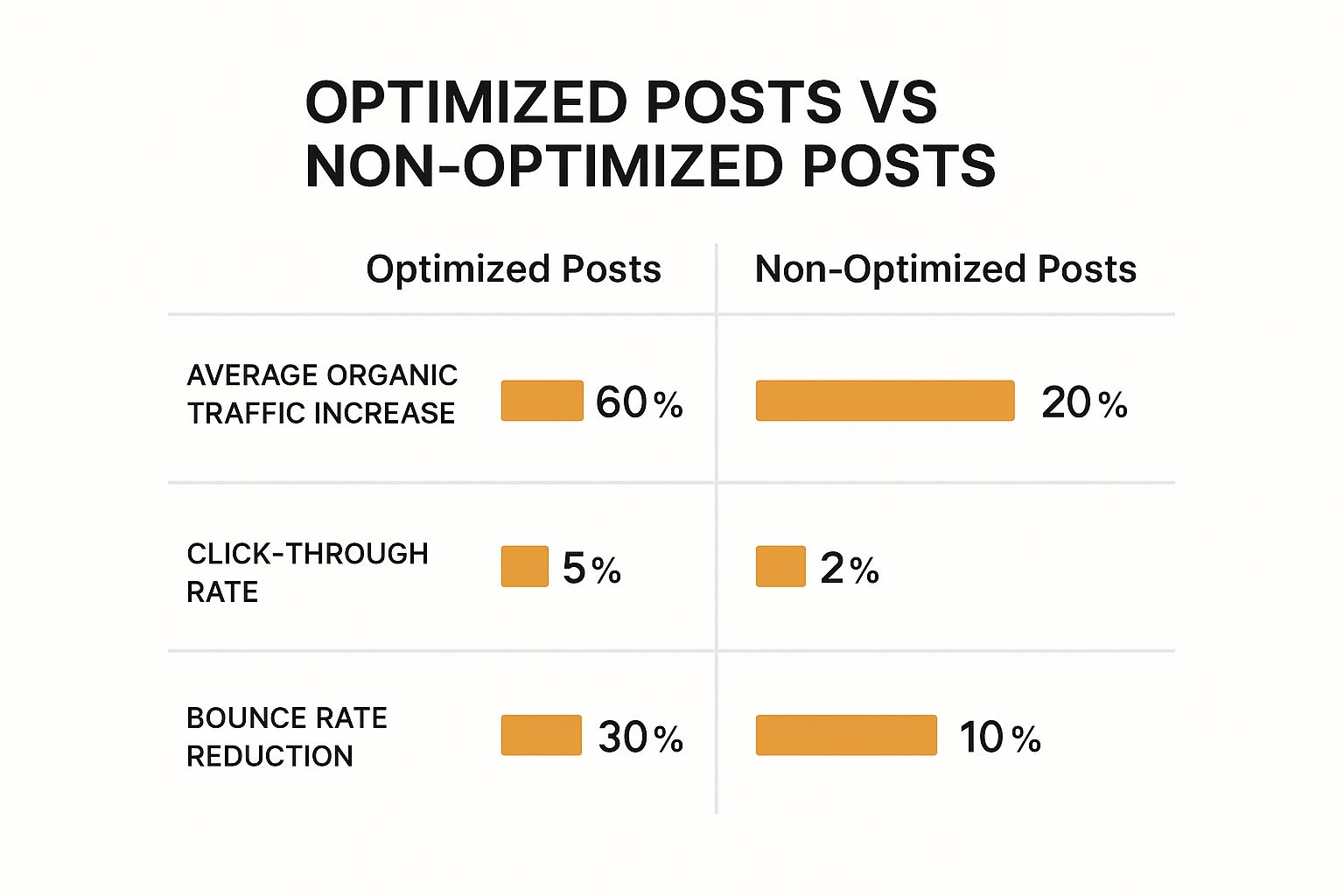
As you can see, optimised posts attract significantly more traffic and keep readers more engaged. It's clear proof that putting in the SEO work is a powerful engine for growth. By focusing on quality, structure, and providing real value, you ensure your content doesn't just survive in the age of AI—it thrives.
Finding Keywords That Drive Real Traffic

Effective SEO for blog posts doesn't start with writing. It starts with a bit of detective work. Before you even think about a headline, you need to get inside your audience's head and figure out what they're actually typing into Google.
It's tempting to go after the big, popular keywords everyone is fighting for, but the real magic often lies elsewhere. Success comes from uncovering the specific problems your ideal customer is trying to solve. You’re looking for keywords that reveal user intent—the why behind their search.
Think about it. Someone searching for "running shoes" is just browsing. But a search for "best running shoes for flat feet" tells you something completely different. That person has a specific need and is likely much closer to making a purchase. Targeting these long-tail keywords brings the right kind of traffic to your door.
Uncovering Long-Tail Keyword Opportunities
Long-tail keywords are simply longer, more detailed search phrases. They won't have the massive search volume of broader terms, but that's their strength. They're far less competitive and attract a highly targeted audience, meaning they often convert incredibly well. It’s the difference between casting a huge, hopeful net and spearfishing with precision.
So, where do you find these gems?
- Google's Autocomplete: This is your first port of call. Start typing a broad keyword into the search bar and watch what Google suggests. Those aren't random guesses; they are actual searches from real people.
- The "People Also Ask" Box: This little box on the search results page is an absolute goldmine. It hands you a list of related questions your audience wants answers to. Weave these into your content, and you’re directly addressing their needs.
- Analyse Your Competitors: Check out the top-ranking articles for your topic. What questions are they answering? Pay close attention to their subheadings—they often reveal the keyword strategy that got them to the top.
Key Insight: Don’t just copy what your competitors are doing right. Actively search for what they've missed. Answering a question they overlooked can be your shortcut to page one and a steady stream of qualified traffic.
Building Topic Clusters for Authority
Instead of publishing one-off blog posts that exist in a vacuum, start thinking in terms of topic clusters. This is a powerful strategy where you create a central "pillar" post covering a broad topic. This pillar then links out to several "cluster" posts, each diving deep into a specific sub-topic.
This is a core concept you’ll find in any solid beginners’ guide to digital marketing because it signals to search engines that you're a true authority on the subject.
Let's say your pillar post is "A Complete Guide to Home Coffee Brewing." Your cluster posts could then branch out into topics like:
- "How to Choose the Right Coffee Beans"
- "Comparing French Press vs. Pour-Over"
- "The Best Grinders for Espresso"
Each of these cluster posts links back to the main pillar page. This clean, organised structure helps search engines see the relationships between your content, cementing your site's reputation as a go-to resource. It also creates a natural pathway for your visitors, keeping them on your site longer and proving your expertise.
Creating Content That Google and Readers Love

Right, you’ve nailed down your keyword strategy. Now the real fun begins. The truth is, high rankings are earned with exceptional content, not by simply stuffing keywords into a generic article. It's about crafting posts that are genuinely useful and authoritative, for both the person reading them and the search engine bots crawling them.
This is where you'll hear a lot about Google’s quality guidelines, often boiled down to the acronym E-E-A-T. It stands for Experience, Expertise, Authoritativeness, and Trustworthiness. Think of it less as a rigid set of rules and more as a framework for building content that people actually want to read and share. Nailing these four areas is a cornerstone of modern SEO for blog posts.
Show, Don’t Just Tell with E-E-A-T
So, how do you actually apply this to your writing? It’s not about just claiming you're an expert; it's about proving it with every piece you publish.
- Experience: Get personal. If you’re reviewing a piece of software, show screenshots of yourself using it. If you're giving business advice, share a real case study—successes and failures included. First-hand accounts are gold.
- Expertise: Don't just rehash what everyone else is saying. Offer your own unique insights, include original data if you have it, or present a perspective that can't be found in the top five search results. This shows you truly understand the subject matter.
- Authoritativeness: This is the long game. You build authority by consistently publishing high-quality, focused content over time, establishing yourself as the go-to voice on a particular topic.
- Trustworthiness: Be transparent. Always cite your sources, link out to credible studies, and make sure your site is secure (HTTPS is a must). A simple author bio explaining why you're qualified to talk about this stuff also does wonders for building trust.
When you focus on these elements, you’re doing more than just answering a query—you’re starting to build a relationship with your reader.
Structure for Scannability and Featured Snippets
Let’s be honest: nobody likes staring at a solid wall of text. The way you structure your content is just as vital as the words themselves. People scan online, so your job is to make your most important points jump off the page.
That means using clear headings and subheadings (your H2s and H3s) to break up the article and guide the reader. And keep your paragraphs short. I’m talking one to three sentences, max. This creates a ton of white space, making your content feel less intimidating and much easier to read, especially on a phone.
An article’s structure is its secret weapon. Clear headings and short paragraphs don’t just improve readability; they make your content prime real estate for Google's featured snippets, which have the highest click-through rate at 42.9%.
Writing for Depth and Mobile Users
If you really want to stand out, your content needs to have depth. This doesn't mean writing thousands of words just for the sake of it. It means aiming to create the single best, most comprehensive resource on the internet for that specific query. There's a reason long-form content (over 3,000 words) often performs so well, sometimes generating three times more traffic than shorter posts—it covers a topic from every angle, leaving the reader completely satisfied.
And crucially, you have to think mobile-first. With 92.3% of UK users now accessing the internet on their smartphones, a clunky mobile experience is a deal-breaker. Your site needs to load fast, and your content must be effortless to read on a small screen. Those short, scannable paragraphs we just talked about? They're a massive part of a winning mobile strategy. For a deeper dive into the numbers, you can find more SEO statistics at AIOSEO.com.
Combine true depth with a flawless mobile experience, and you've got a formula that keeps both your readers and the search engines happy.
Alright, let's get into the nitty-gritty of on-page SEO. You've done the keyword research and drafted your content, but now it's time for the technical tweaks that tell search engines what your post is all about. This is where you can really pull ahead of the competition.
It's amazing how many businesses get this wrong. While around 60% of UK businesses say they have an SEO strategy, a mere 20% actually put a strong focus on the on-page fundamentals like meta tags and internal links. For you, that's not a problem—it's a huge opportunity. Getting these details right can make a massive difference.
Nailing Your On-Page SEO Elements
Crafting Click-Worthy Titles and Descriptions
Think of your title tag and meta description as your advert on the Google results page. A punchy title makes someone stop scrolling, and a great description convinces them to click on your link instead of someone else's.
- Title Tags: You've got about 60 characters to work with, so make them count. Get your main keyword in there, preferably near the start. Frame it as a solution. Instead of something generic like "Photography Guide," try "10 Easy Tips to Learn Beginner Photography Fast." See the difference?
- Meta Descriptions: While these don't directly affect your rankings, they have a massive impact on your click-through rate. You have roughly 160 characters to summarise the post and give people a compelling reason to read it. Think of it as the trailer for your article.
These little bits of text are your first handshake with a potential reader. Make it a firm one.
This screenshot gives you a great visual of the core on-page SEO components. You can see how the title, headings, and body content all work together to signal relevance. It really shows that a well-optimised page is a team effort, with each element playing its part.
Structuring Your Content with Header Tags
Header tags (H1, H2, H3, etc.) are your post's skeleton. They give it a clear, logical structure that's easy for both humans and search engines to follow.
Your main title should always be your H1 tag—and you only get one of those per page. Use it for your main topic. Then, use H2s and H3s to break up your content into logical, easy-to-scan sections. This makes your article far less intimidating to read and helps Google understand the hierarchy of your information. It's also the perfect place to naturally work in some of your secondary keywords.
Pro Tip: Don't forget about your URLs! A clean, readable URL is a quick and easy win. It should be short, descriptive, and contain your primary keyword.
For example,yourwebsite.co.uk/blog/on-page-seo-tipsis miles better thanyourwebsite.co.uk/blog/post?id=123.
The Power of Internal Links and Images
Internal links are the secret sauce that connects your content. When you link from your new post to other relevant articles on your site, you're essentially creating a web of information. This helps search engines discover your older content and understand the relationships between your posts. It also spreads "link equity" (or authority) around your site, which can give your other pages a nice little boost.
Finally, let's talk images. Every single image you use needs descriptive alt text. This text is crucial for accessibility, as it helps screen readers describe the image to visually impaired users. But it's also another signal to search engines about your content.
To make sure you've covered all your bases, a good On-Page SEO Checklist can be a lifesaver. It helps you tick off every element, ensuring nothing gets missed.
Getting Your Content Seen and Shared

It’s a classic mistake: you pour your heart and soul into a brilliant blog post, hit publish, and then… crickets. A great article that nobody ever reads is a huge waste of effort. The moment your post goes live, the real work begins – making sure it actually connects with an audience. Simply dropping a link on your social media accounts just won't cut it if you want to gain real traction.
Clever promotion is all about finding fresh audiences in different places and formats. Think about how you can repurpose what you’ve already created. Could those key points make a sharp, shareable infographic? What about recording a quick video of you discussing the main takeaways? Each new format opens up a new avenue to people who might prefer watching or listening over reading.
This approach lets you multiply your reach without having to constantly brainstorm brand-new topics from scratch. It’s all about working smarter, not harder, to get your message out there.
Building Links Through Relationships
Backlinks are still a massive trust signal for search engines, but the old days of cold-emailing hundreds of sites begging for links are well and truly over. Today, effective link building is about fostering genuine relationships within your niche. Ditch the mass, impersonal emails and start focusing on building real connections with other creators and businesses in your field.
Take the time to engage with their content thoughtfully. Share their work, leave insightful comments, and join in on community discussions. By the time you do reach out, you won't be a total stranger but a familiar face. I've found this approach leads to far higher-quality, more relevant backlinks that Google actually values.
The best link-building strategies I've seen are built on a foundation of genuine value. Instead of just asking for a link, offer something useful first—a unique insight, an interesting piece of data, or even a well-written guest post. This way, you build partnerships, not just a backlink profile.
Strategic Outreach and Guest Posting
Targeted outreach is another crucial piece of the promotion puzzle, and email is still one of the most powerful tools for it. You can explore the advantages of email marketing to get a better handle on this, but the core idea is simple: create a small, hand-picked list of influential people or publications who would genuinely find your content valuable. A personal, well-crafted message that explains why your post is relevant to their audience will always outperform a generic email blast.
On top of that, start looking for guest posting opportunities on respected, authoritative websites. This is a win-win-win situation:
- It gets your brand in front of a new, highly relevant audience.
- You earn a fantastic, high-quality backlink from a trusted source.
- It helps establish you as a credible authority in your industry.
Finding these spots is often as straightforward as a quick Google search for phrases like "[Your Niche] + write for us" or "[Your Topic] + guest post". For an even deeper dive into getting your blog noticed, check out these top SEO tips for blogs.
By combining smart content repurposing with genuine relationship-building and strategic outreach, you give your content the best possible chance to be seen, shared, and truly valued.
Common Questions About Blog Post SEO
https://www.youtube.com/embed/8NjBWQIaf3I
Once you start digging into SEO for blog posts, it's perfectly normal for a lot of questions to bubble up. You're about to invest a lot of time and effort, so getting some clarity first is just smart. Let's walk through some of the most common queries I hear, with straight-to-the-point answers to get you on the right track.
How Long Should a Blog Post Be?
Everyone wants a magic number, but the honest answer is: there isn't one. The real focus should always be on depth and satisfying the reader's reason for searching.
Sure, you'll see data showing that posts over 2,000 words tend to rank better, but that's a correlation, not a cause. They rank well because they're often incredibly thorough. The goal is to create the single best answer on the internet for that specific query. A simple question might be fully answered in 800 words, while a complex "how-to" guide could need well over 3,000 words to be truly comprehensive.
How Often Should I Publish New Posts?
This is a classic one. My advice is always the same: consistency beats frequency, every single time. Publishing one brilliant, deeply researched post per week is infinitely more valuable than churning out three rushed, mediocre articles just to meet a schedule.
For most UK businesses, aiming for one to four high-quality posts per month is a brilliant, sustainable goal. This pace gives you the breathing room to do proper research, thoughtful writing, careful optimisation, and effective promotion for each piece. It means every article you publish has a fighting chance to rank well and serve your audience for years to come. For a deeper dive into all the moving parts, this guide on blog search engine optimization is a fantastic resource.
Key Takeaway: One of the most powerful—and most overlooked—SEO tactics is the "content refresh." Go back to your older, relevant posts and update them with new information, current stats, and fresh keywords. This can give you a massive ranking boost for a fraction of the effort it takes to write something from scratch.
Does AI-Written Content Hurt SEO?
This is the big question right now, and the answer isn't a simple yes or no. It's all about how you use it.
Using AI as a brainstorming partner, an outliner, or even a first-draft assistant can be a massive productivity win. I use it myself for these tasks. The danger comes from letting AI write entire articles from start to finish without any real human input.
Google's quality guidelines are laser-focused on rewarding content that shows E-E-A-T (Experience, Expertise, Authoritativeness, and Trustworthiness). A machine can't fake genuine, first-hand experience. It can't offer the unique insights that come from years of working in a field. The winning formula is a human-AI collaboration. Let the tech handle the heavy lifting, but make sure a human expert injects their unique voice, personal stories, and hard-won knowledge to make the final article truly valuable. That blend of machine efficiency and human authenticity is what succeeds in search today.
Ready to stop guessing and start growing? At The Digital Marketing Toolbox, we bring together the best tools to streamline your SEO, content creation, and promotion efforts. Discover top-rated solutions to drive measurable results and take your marketing to the next level. Visit us at https://grow-your-biz.com to explore the toolbox.


