
Understanding The Google Sites SEO Landscape In The UK
Google Sites provides a user-friendly platform, particularly appealing to UK small businesses and organizations looking to create websites. However, this simplicity presents unique SEO challenges. Traditional SEO advice doesn't always apply, necessitating a tailored approach for Google Sites. This section explores these unique aspects, highlighting both the opportunities and limitations for UK businesses using this platform. We'll delve into what differentiates SEO for google sites and why some UK businesses excel while others face difficulties.
Navigating The Unique Challenges and Opportunities
A key difference with Google Sites is its inherent integration with the Google ecosystem. This offers advantages like automatic indexing and mobile-friendliness, both important ranking factors for Google. Google Sites also handles much of the technical backend, freeing up time for content creation. However, this also means less direct control over specific technical aspects. For instance, advanced features like custom robots.txt files and server-side redirects aren't directly available, requiring creative solutions. This can pose a challenge for larger UK businesses accustomed to more granular SEO control.
Another key element is the platform's structure. Google Sites’ template-based system can make implementing complex site architectures difficult. While this streamlined approach simplifies site management, it can restrict flexibility for larger websites with numerous pages. UK businesses with large product catalogs or extensive content libraries may need to adapt their structural strategies. Conversely, this simplified structure can benefit smaller UK businesses needing a straightforward online presence.
Leveraging Search Behaviour in The UK
Understanding how UK consumers use search engines is critical for Google Sites optimization. In the UK, search engines are the primary tool for finding products and services. Approximately 42% of people in the UK use search engines when looking for something to buy, more than double the number using social media. This underscores the importance of optimizing your Google Site for relevant search queries within the UK. Learn more about UK search engine usage at Artios. This reliance on search engines highlights the potential for UK businesses to reach their target audience through effective Google Sites SEO.
Real-World Success Stories From UK Businesses
Despite the limitations, many UK businesses successfully use Google Sites. They've found innovative ways to leverage its strengths and navigate its constraints. For example, a small UK bakery uses Google Sites to promote daily specials and take online orders. By focusing on local SEO and engaging content, they've built a strong online presence within their community. Similarly, a UK-based charity uses Google Sites to share its mission and collect donations, demonstrating the platform’s versatility. These examples demonstrate that a strategic approach can yield strong results, regardless of platform limitations. Understanding your target audience, creating relevant content, and optimizing for local search are all essential for Google Sites SEO success in the UK.
Mastering On-Page SEO Within Google Sites' Framework

Maximizing your Google Site's visibility in UK search results requires a strategic approach to on-page SEO. This involves optimizing elements within your site's framework to appeal to search engines and engage your target audience. This section will guide you through essential steps to achieve this, transforming potential limitations into competitive advantages.
Optimizing Titles and Content Structure
Think of your page title as your shop window display; it needs to be attractive and clearly communicate what's inside. Crafting compelling titles that accurately reflect your content is crucial. Ensure your titles incorporate relevant keywords related to your business and target audience in the UK.
For example, instead of a generic title like “Services,” use a specific title like “Bespoke Web Design Services in London.” This specificity helps search engines understand the content of your page and target it to the right audience.
Structuring your content logically helps both users and search engines understand the information presented. Use headings (H2, H3, etc.) to break down content into digestible sections and highlight key takeaways. This improves readability and helps Google understand the context and relevance of different sections within your pages.
Image Optimization and Internal Linking Strategies
Image optimization is essential for SEO, even within Google Sites' constraints. Use descriptive alt text for every image, clearly describing the image's content and incorporating relevant keywords. This helps search engines understand the context of the images and improves accessibility. Think of alt text as a verbal description for someone who can't see the picture.
Building a robust internal linking structure is also key. Link relevant pages within your Google Site. This allows users to easily navigate your site and discover more content, while also helping search engines understand the relationship between different pages. For example, a page about “SEO for Google Sites” might link to another page on “Content Marketing Strategies for UK Businesses.”
This interlinking strengthens your site's overall structure and boosts your authority on relevant topics. You might be interested in: How to master the basics of digital marketing.
Implementing Schema Markup (Where Possible)
While schema markup isn't fully supported within Google Sites, it can be implemented in certain ways to provide context to search engines. For instance, embedding a map with your business location provides valuable location data to Google, strengthening your local SEO. This is especially beneficial for businesses targeting customers within specific UK regions.
Explore creative workarounds to implement schema wherever possible to enhance your search visibility. Even limited implementation can offer benefits for your site's ranking.
Content Quality and Focus
Content is king, especially for Google Sites SEO. Creating high-quality, UK-focused content that resonates with your target audience is essential. This means using language and terminology relevant to British audiences and addressing their specific needs and interests.
For example, if targeting businesses in Scotland, incorporate terminology and cultural references relevant to that region. This targeted approach helps establish your expertise and build trust with your audience.
Focus on providing valuable information and answering the questions your target audience is actively searching for. Regularly updating your content keeps it fresh and relevant, signaling to search engines that your site is actively maintained and provides current information. This is crucial for maintaining high rankings in the competitive UK search landscape.
Creating UK-Focused Content That Ranks and Converts

Creating high-quality content is essential for successful SEO. However, crafting content that truly connects with a UK audience requires a more targeted approach. This means understanding not only what they search for but also how they search, the specific language they use, and the cultural context influencing their online behavior. Ultimately, it's about optimizing your content for both Google's algorithms and local UK search intent.
Researching UK-Specific Keywords
Effective keyword research is the foundation of any SEO strategy, especially for Google Sites targeting the UK. This requires going beyond general keywords and exploring the precise terms and phrases used by your British target audience. For example, if you're selling athletic shoes, consider regional variations in terminology. Are people searching for “trainers,” “plimsolls,” “sneakers,” or another term altogether?
Also, consider the search intent. Are users seeking information on different shoe types, reviews of specific brands, or the best online retailers? Understanding this intent lets you tailor content to precisely match audience needs. Tools like Google Keyword Planner, SEMrush, and Ahrefs can be invaluable for this type of research.
Developing Content Clusters and Topical Authority
Creating content clusters is a powerful way to establish topical authority in your niche. This involves creating a series of interlinked pages around a central theme, with each page delving into a different aspect of that theme. This demonstrates your expertise to Google, boosting your ranking potential for related keywords.
For example, a UK-based gardening business could create a content cluster around “growing vegetables in the UK.” This might include pages on “best vegetables to grow in the UK climate,” “managing common UK garden pests,” and “selecting the right soil for your UK garden.”
Incorporating British Cultural Nuances
Connecting with a UK audience means speaking their language, both literally and figuratively. Use British English spellings and grammar, and incorporate cultural references and terminology that resonate with your demographic. Focus on information relevant to the UK. For instance, financial advice should be tailored to the UK tax system and financial regulations.
In 2025, UK businesses face significant SEO changes due to Google’s updates and the integration of AI like BERT. These changes emphasize high-quality, helpful content, making relevant content creation even more critical. Learn more about these Google ranking updates here. Read also: How to craft a winning marketing strategy for your small business.
Maintaining Content Quality and Freshness
Consistency is essential for content creation. Establish a regular posting schedule, whether weekly, bi-weekly, or monthly, and maintain it. This builds momentum and signals to Google that your site is actively updated.
Regularly review and refresh your existing content. Update outdated information, add new insights, and ensure relevance to your target audience. This preserves your rankings and keeps your content valuable to readers.
Technical SEO Optimization You Can Actually Control
While Google Sites handles a lot of the technical work behind the scenes, there are still key optimization opportunities that can make or break your site's success. This section explores the technical SEO elements you can control within Google Sites, specifically focusing on improving your search visibility in the UK.
Core Web Vitals and Mobile-First Indexing
Core Web Vitals, which measure loading speed, interactivity, and visual stability, are essential for ranking well. While Google Sites simplifies website creation, you still need to optimize image sizes and embedded content, as these can significantly impact loading times. Compress images using tools like TinyPNG before uploading them to your Google Site. For instance, large, unoptimized images can drastically slow down your page load speed, negatively impacting your Largest Contentful Paint (LCP) score.
Because mobile browsing is so common in the UK, mobile-first indexing compatibility is critical. Google Sites automatically generates mobile-friendly versions of your pages, which simplifies this process. However, you should still preview your site on different mobile devices to ensure it displays correctly and offers a smooth user experience on various screen sizes.
Site Architecture and Navigation Within Google Sites
Think of effective site architecture like a well-organized library—easy for both users and search engine bots to navigate. Within the limitations of Google Sites, prioritize clear and intuitive navigation. Avoid complex, multi-layered page structures that bury important content deep within your site. Instead, aim for a shallow structure where users can access most pages within a few clicks from the homepage.
To illustrate the distribution of pages across different levels of your site, take a look at the infographic below, ‘Page Distribution by Hierarchy Level'.
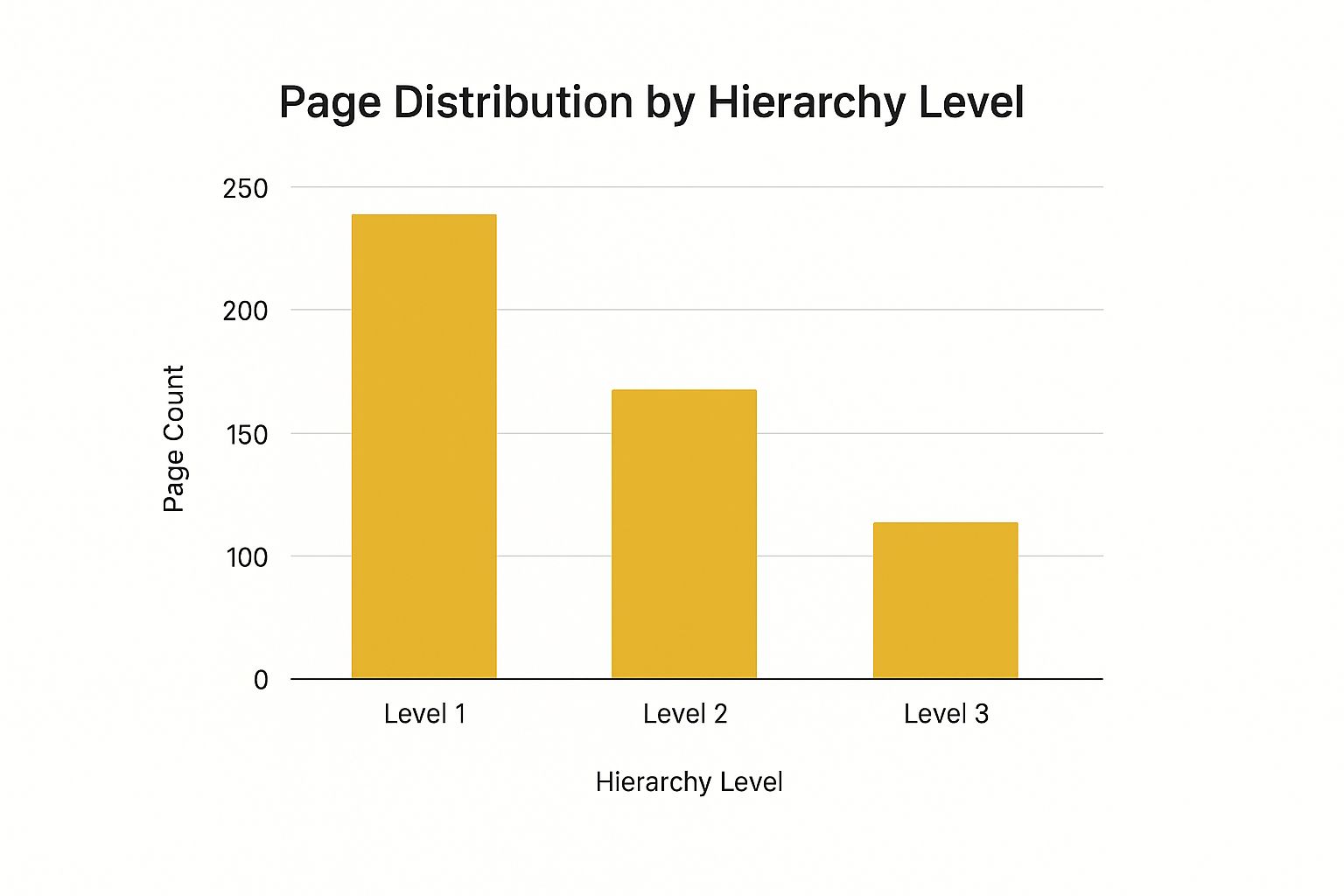
This visual representation emphasizes the importance of distributing content effectively. Concentrating too many pages at deeper levels can negatively impact both crawlability for search engines and the overall user experience.
Troubleshooting Common Google Sites Performance Issues
Google Sites, despite its user-friendliness, can still experience performance issues that affect your UK SEO. Slow loading times, broken links, and poor mobile responsiveness are frequent offenders. Regularly check your site for these issues using tools such as Google PageSpeed Insights to pinpoint and quickly resolve any bottlenecks. Broken links, especially, can severely damage your site's credibility and user experience.
Implementing Responsive Design for Enhanced User Experience
Responsive design, which ensures your website adapts seamlessly to different screen sizes, is crucial for modern SEO. Google Sites offers inherent mobile responsiveness. However, fine-tuning the mobile experience by testing and adjusting elements like font sizes and button placements can further optimize usability across all devices used by your UK audience. This leads to a positive user experience, encouraging engagement and reducing bounce rates.
To further illustrate the SEO capabilities within Google Sites, consider the following table:
Google Sites SEO Features Comparison
A comprehensive comparison of available SEO features in Google Sites versus traditional CMS platforms, showing what's possible and what requires workarounds.
| SEO Feature | Google Sites Capability | Implementation Method | UK-Specific Considerations |
|---|---|---|---|
| Page Titles & Meta Descriptions | Supported | Directly editable within the page settings | Ensure descriptions accurately reflect UK-focused content |
| Structured Data | Limited built-in support | Workarounds using custom code or third-party tools may be required | Consider schema markup for local UK businesses |
| XML Sitemaps | Automatically generated | Google Sites handles this automatically | No specific UK considerations |
| Redirects | Limited functionality | Workarounds may be required | No specific UK considerations |
| Image Optimization | Manual optimization required | Compress and resize images before uploading | No specific UK considerations |
This table highlights some key differences between Google Sites and other platforms regarding SEO features. While some elements are readily available, others require creative workarounds to achieve optimal results.
By addressing these controllable technical elements, you can significantly boost your Google Site's performance, user experience, and ultimately, its visibility in UK search results. While the platform has its limitations, strategically utilizing these technical SEO opportunities can be key to success in the competitive UK online environment.
Dominating Local SEO For UK Markets
For UK businesses, local SEO offers a powerful way to connect with potential customers searching online. By optimizing your Google Site for local search terms, engaging with local events, and building partnerships within your community, you can attract highly qualified traffic. This means truly understanding the online behavior of customers in the UK.
Integrating Your Google My Business Profile
A key element of local SEO is integrating your Google My Business (GMB) profile with your Google Site. This connection helps Google understand your physical location and boosts your visibility in local search results. Ensure your GMB profile is complete with accurate information, including your business address, phone number, opening hours, and website URL.
Customer reviews on your GMB profile are invaluable. Positive reviews not only build trust with potential customers but also significantly influence local search rankings. Responding to reviews, both positive and negative, demonstrates your commitment to customer satisfaction and encourages further engagement.
Creating Location-Specific Content
Content that resonates with local UK communities is essential for attracting a targeted audience. A restaurant in Edinburgh, for example, could create blog posts about local food festivals, highlight nearby attractions, or offer special discounts for residents.
Optimizing your content for “near me” searches, which are increasingly common among UK consumers, is also vital. Include location-based keywords in your page titles, meta descriptions, and content itself. Instead of “Best Italian Restaurant,” try “Best Italian Restaurant in Glasgow.”
Building Local Citations and Managing Online Reviews
Local citations, mentions of your business name, address, and phone number on other websites, are crucial for local SEO. List your business on relevant UK directories like Yell.com and Scoot. Consistent formatting of your business information across all citations ensures search engines accurately link your business with the correct locations.
Managing online reviews is equally important. Respond to reviews, address concerns, and encourage positive feedback across various platforms. Consider providing a guide, like this one on How to master virtual marketing, to help your customers engage effectively.
Targeting Specific UK Regions
Tailoring your content and SEO strategies to target specific UK regions can significantly improve your reach. This involves researching regional keywords, understanding local search trends, and adapting your messaging to resonate with specific communities.
For instance, a business targeting Welsh customers might create content in both English and Welsh. This demonstrates cultural sensitivity and expands your potential audience, showcasing your commitment to understanding and serving their needs.
By implementing these local SEO strategies, you can significantly improve your Google Site's visibility in specific UK markets. This targeted approach will drive more relevant traffic to your site, leading to increased conversions and measurable business growth.
Building Authority Through Strategic Link Building
Building domain authority is crucial for any website, and Google Sites is no exception. This is especially true in the competitive UK online market. Google Sites presents unique challenges for traditional link building, requiring a clever and resourceful approach to acquiring backlinks and boosting your site's authority.
Earning High-Quality Backlinks From UK Websites
Think of backlinks as votes of confidence from other websites. The more high-quality votes you receive, the more authoritative your site appears to Google. For Google Sites, focus on earning backlinks from reputable UK websites relevant to your niche. This might involve guest posting on industry blogs, participating in relevant online forums, or collaborating with other businesses in your local UK market.
For example, a UK-based travel blog hosted on Google Sites could connect with other travel bloggers or tourism websites for link exchange opportunities. This not only earns valuable backlinks but also expands brand visibility within the relevant online community.
Developing Relationships With British Influencers and Journalists
Connecting with British influencers and journalists offers a powerful way to gain exposure and earn high-quality backlinks. Consider sending press releases about new content, inviting influencers to review products or services, or offering exclusive content to relevant journalists. Strong relationships can result in valuable media coverage and authoritative backlinks, significantly improving your site's authority.
Creating Link-Worthy Content That Attracts Attention
Content remains key for attracting backlinks. Create high-quality, UK-focused content that naturally draws interest. Consider in-depth guides, original research, or compelling data visualizations. Ask yourself what kind of content other UK websites in your industry would find valuable and strive to fill that gap. This could be a guide to local regulations, a market trend analysis, or a case study showcasing success with Google Sites SEO.
Optimizing Internal Links Within Your Google Site
While external backlinks are important, don't overlook internal linking. Strategically linking between relevant pages within your Google Site distributes link equity, strengthening the overall authority of your content and improving user navigation. Ensure important pages are adequately linked, using descriptive anchor text relevant to the linked page. For example, use “learn more about UK SEO strategies” instead of “click here.”
Ethical Link Building Practices
Always follow Google's guidelines for ethical link building. Avoid buying links or participating in link schemes, which can lead to penalties. Focus on organically earning links through high-quality content and genuine outreach. Building genuine relationships with website owners and influencers is crucial for long-term link building success.
Identifying Valuable Link Opportunities in the UK Market
Research your competitors’ backlink profiles to uncover potential link opportunities within the UK. Tools like Ahrefs and SEMrush help identify websites linking to your competitors but not to you. This research provides a roadmap for targeted outreach, focusing on acquiring backlinks from sources already interested in your niche.
To help visualize the opportunities available, let's look at the following table:
UK Link Building Opportunities For Google Sites
A strategic breakdown of link building opportunities specifically available to UK businesses using Google Sites, including difficulty levels and potential impact
| Link Source Type | Difficulty Level | Potential Impact | UK-Specific Strategies |
|---|---|---|---|
| UK Industry Blogs | Medium | High | Guest posting, collaborations, offering exclusive content |
| Local UK Business Directories | Low | Medium | Ensure consistent NAP information |
| UK News and Media Outlets | High | Very High | Targeted press releases, building relationships with journalists |
| Social Media Engagement (UK Audiences) | Low | Medium | Sharing valuable content, engaging with relevant communities |
| UK Forum Participation | Medium | Medium | Providing helpful answers, sharing insightful resources |
This table highlights the variety of link building avenues available, from engaging with local business directories to pursuing media coverage. Each approach offers a different level of difficulty and potential impact. By understanding these nuances, you can prioritize your efforts effectively.
By implementing these strategic link building tactics, you can effectively build a strong online presence in the UK market using Google Sites. This requires focused effort, creativity, and a commitment to ethical practices. By prioritizing genuine relationships, valuable content, and strategic link opportunities, you can steadily improve your Google Site’s authority and visibility in UK search results.
Key Takeaways

Successfully optimizing your Google Site for UK search requires a strategic approach. You need to understand the platform's limitations, leverage its strengths, and tailor your approach to the British market. This section summarizes key actionable strategies and sets realistic expectations for achieving SEO success with Google Sites in the UK.
Prioritizing Your SEO Efforts
Focus on high-impact areas for your Google Site. On-page optimization, which includes compelling titles and effectively structured content, offers immediate control and significantly influences search visibility. This forms the foundation for all other SEO work.
Creating high-quality, UK-focused content is also essential. Address the specific needs and interests of your British audience using relevant language and terminology. This improves user experience and signals relevance to search engines, boosting your UK search ranking.
Mastering the Technical Aspects
Google Sites handles much of the technical backend. However, you still control crucial aspects like Core Web Vitals. Optimizing image sizes and streamlining embedded content improves your site’s loading speed, a key factor in user experience and search ranking. For instance, compressing images before uploading dramatically improves your LCP (Largest Contentful Paint) score.
Site architecture is another key area. A clear and intuitive navigation structure enhances user experience and ensures search engines can efficiently crawl and index your content.
Dominating Local UK Search Results
Local SEO offers huge potential for businesses targeting UK customers. Optimizing your Google My Business (GMB) profile and integrating it with your Google Site provides crucial location data to Google, increasing your visibility in local searches. Make sure your GMB profile includes your accurate business address, phone number, and opening hours.
Creating location-specific content also strengthens local SEO. Incorporate regional keywords and references that resonate with specific UK communities. This targeted approach attracts a more qualified audience and increases conversions.
Building Authority Over Time
Building domain authority takes sustained effort, especially with Google Sites. Focus on earning high-quality backlinks from reputable UK websites in your niche. Consider guest posting, collaborations, or building relationships with British influencers.
While time-consuming, consistent effort yields significant long-term benefits, boosting your website's credibility and improving its UK search ranking.
Key Takeaways Checklist
Here’s a handy checklist summarizing the core elements for Google Sites SEO success:
- On-Page Optimization: Compelling titles, structured content, optimized images
- Content Creation: High-quality, UK-focused content addressing audience needs
- Technical SEO: Optimized Core Web Vitals, efficient site architecture
- Local SEO: Complete GMB profile, location-specific content
- Link Building: High-quality backlinks from reputable UK sources
Measuring Your Success and Long-Term Strategies
Use Google Analytics and Google Search Console to track and analyze your SEO efforts. Monitor key metrics like organic traffic, keyword rankings, and bounce rates to identify areas for improvement. This data informs your long-term strategy.
SEO is an ongoing process. Continuously adapt your strategies based on performance data, emerging trends, and algorithm updates to ensure sustained growth and visibility in UK search results.
Ready to improve your digital marketing? Explore The Digital Marketing Toolbox at https://grow-your-biz.com for tools and resources to elevate your online presence and drive measurable results. This platform provides access to a wide range of solutions, from analytics and SEO to email marketing and AI-driven content generation, empowering you to achieve sustainable growth.


