
Trying to find the right SEO software in today's crowded market feels a bit like navigating a maze. This guide is designed to cut through that noise with a proper seo software comparison for UK businesses. We'll get into the nitty-gritty of top platforms like Semrush, Ahrefs, and Moz to help you figure out which one truly fits your needs.
Why Your Business Needs the Right SEO Software
Choosing an SEO platform isn't just another software subscription; it's a foundational decision for your entire digital marketing plan. Think of it as the central nervous system for your organic growth strategy. It's not just about tracking a few keywords. A solid tool gives you the hard data needed to understand your market, get a leg up on the competition, and prove your marketing efforts are paying off. This is especially true here in the UK, where the digital marketing scene is booming.

The numbers back this up. The UK SEO software market alone is generating USD 5.4 billion in revenue in 2024 and is expected to hit USD 11.3 billion by 2030. This shows just how much British businesses are relying on these tools to get seen online. Understanding these SEO market trends is key to staying ahead.
Core Functions of Leading SEO Platforms
To make a smart choice, you first need to know what you're actually looking for. While every platform has its unique quirks, the big players all offer a core set of tools designed to work together to boost your search presence. In this guide, we'll be comparing them across these key battlegrounds:
- Keyword Research: Pinpointing the exact words and phrases your potential customers are typing into Google.
- Backlink Analysis: Digging into your own link profile and spying on your competitors’ strategies to build your site’s authority.
- Technical Site Audits: Running a fine-toothed comb over your website to find and fix technical snags that are holding you back in search results.
- Competitor Intelligence: Keeping a close eye on what your rivals are doing, so you can spot gaps in the market and defend your position.
At the end of the day, SEO is a non-negotiable part of any modern digital strategy. If you're new to all this, our beginner's guide to digital marketing can help you see how these tools fit into the wider picture.
| Core Functionality | Semrush | Ahrefs | Moz Pro |
|---|---|---|---|
| Primary Strength | All-in-one marketing toolkit | Best-in-class backlink data | Local SEO & authority metrics |
| Keyword Database | Very Large & Diverse | Large & Accurate | Good, with strong local data |
| Site Audit Tool | Comprehensive & Detailed | Fast & User-Friendly | Solid & Educational |
| Beginner Friendliness | Moderate Learning Curve | Moderate Learning Curve | Very High |
Our SEO Software Evaluation Framework
To give you a genuinely useful comparison of SEO software, we had to create a consistent way to judge each platform. We’ve developed a straightforward evaluation framework that cuts through the marketing noise and gets straight to what matters for real-world performance.
Our goal is to be both objective and practical, helping you weigh up your options based on your actual business needs. This is more important than ever as search continues to evolve. For example, considering how a tool helps with newer challenges like getting found by AI search engines is crucial for any forward-thinking strategy.

Our Five Core Assessment Pillars
We built our review process around the everyday tasks and strategic goals that marketing pros actually face. We believe these five pillars represent the most critical factors when you’re deciding which SEO software is the right fit.
Here’s a look at what we scrutinise:
-
Core Features and Data Accuracy
First and foremost, we dig into the data itself. We look at the size of the keyword database, how frequently the backlink index is updated, and how deep the site audit crawlers go. After all, a strategy built on shaky data is doomed from the start. -
User Experience and Workflow Efficiency
How easy is it to actually use the tool? We assess the platform's learning curve and overall design. We're looking at how quickly you can get things done, whether that’s a quick competitor analysis or putting together a detailed content brief.
A powerful tool is only effective if your team can integrate it seamlessly into their daily workflow. Complicated interfaces and clunky navigation can negate the value of even the most advanced features, hindering productivity and adoption.
-
Reporting and Integration Capabilities
This pillar focuses on how well the software plays with others and presents its findings. We check out the clarity of its dashboards, the flexibility of its reporting options, and its ability to connect with essential marketing tools like Google Analytics, CRMs, or project management software. -
Pricing and Overall Value for Money
This is about more than just the monthly subscription fee. We break down what you get at each price point—features, usage limits, and scalability—to determine the true return on investment for different types of businesses. -
Customer Support and Learning Resources
Finally, what happens when you get stuck? We evaluate the quality and responsiveness of the support team and look at the depth of the educational materials on offer, from video tutorials and webinars to comprehensive knowledge bases.
Comparing the Top SEO Software Platforms
Choosing the right SEO platform feels like a monumental decision, and for good reason. To get past the polished marketing and endless feature lists, you have to dig into how the big three—Semrush, Ahrefs, and Moz—actually perform day-to-day. Each one has its own personality and really shines in different areas, so the "best" choice is less about the tool and more about your specific goals. It helps to first get a feel for the broader landscape of general SEO tools to see where these powerhouses fit in.
This breakdown will cut through the noise and focus on the three pillars of any solid SEO strategy: keyword research, backlink analysis, and technical site auditing. We’ll look at the subtle differences in how each platform handles these tasks, giving you a clear picture of their real-world strengths.
Keyword Research and Content Ideation
Every SEO campaign starts with knowing what people are searching for. While all three platforms have powerful keyword research tools, they come at it from different angles, with different databases, metrics, and workflows.
Semrush feels less like a simple SEO tool and more like a complete market intelligence suite. Its keyword database is absolutely massive, giving you not just search volume but also trends, CPC data, and competition levels. The real gem here is the Keyword Magic Tool. It automatically groups huge lists of keywords into topic clusters, which is a lifesaver when you're trying to map out a complete content strategy or build out a new site section.
On the other hand, Ahrefs is all about the precision and trustworthiness of its data. While its keyword database is huge, its proprietary "Keyword Difficulty" score is widely considered one of the most reliable predictors of how hard it'll be to rank. I particularly love the "Questions" filter in their Keywords Explorer; it’s a goldmine for finding long-tail keywords and is my go-to when brainstorming user-focused articles.
Moz Pro has always prioritised making SEO accessible, and its keyword tools reflect that. The Keyword Explorer offers an intuitive "Priority" score that rolls search volume, difficulty, and organic click-through rate into one simple number. This is brilliant for teams who are still building their SEO confidence, as it helps them spot high-impact opportunities without getting overwhelmed by data.
The bottom line: Semrush’s strength is its scale and topic clustering, making it perfect for planning big, comprehensive content strategies. Ahrefs delivers best-in-class data accuracy for serious competitive analysis, while Moz offers the most straightforward, user-friendly path to finding actionable keywords.
Backlink Analysis and Competitor Intelligence
A website’s authority is built on the back of its link profile. Picking apart your own links—and those of your competitors—is essential for growth, and this is where you’ll find some of the starkest differences between the platforms.
Ahrefs is, without a doubt, the king of backlink analysis. It has the largest index of live backlinks, and it’s updated constantly, giving you the most accurate, up-to-the-minute view of the link graph. The Site Explorer tool is an absolute beast, letting you see new, lost, and broken backlinks almost in real-time. For anyone running serious link-building campaigns, Ahrefs is pretty much non-negotiable.
Semrush is no slouch in this department either. Its Backlink Analytics offers deep dives into referring domains and anchor text distribution. The feature that really stands out for me is the Backlink Gap tool. It lets you compare your link profile against up to four competitors at once, making it incredibly easy to spot the high-quality links they have that you're missing out on.
As the inventor of the now industry-standard Domain Authority (DA) metric, Moz Pro provides a solid and reliable Link Explorer. Its index might not be as vast as Ahrefs', but its "Spam Score" is an incredibly useful feature for cleaning up your own backlink profile and steering clear of dodgy links. It’s an excellent choice for monitoring your site's overall authority and health over the long term.
Technical SEO and Site Auditing
You can have the best content and links in the world, but it won't matter if your site is a technical mess. All three platforms offer powerful site audit tools, but they differ in how they crawl your site and what they prioritise.
Semrush's Site Audit is incredibly comprehensive, checking for over 140 different technical and on-page issues. What it does really well is organise all those findings into themed reports like Crawlability, Performance, and Internal Linking. This structured view helps you prioritise fixes based on what’s most urgent, making it a favourite for managing large, complex websites.
The Site Audit from Ahrefs is known for being lightning-fast and having a clean, intuitive interface. The crawl finishes quickly, and the dashboard gives you a great visual overview of your site's health. Each issue comes with a clear explanation and actionable advice, which is perfect for users who just want to find and fix problems without getting lost in technical weeds.
Moz Pro bakes its technical audit right into its "Campaigns" feature, so you get continuous, ongoing monitoring. It presents its findings in a really educational way, explaining not just what's wrong but why it matters for SEO. This makes it an amazing learning tool for in-house teams looking to level up their own expertise.
Core Feature Comparison Semrush vs Ahrefs vs Moz
To make sense of it all, it helps to see their core strengths laid out side-by-side. Each platform has a clear philosophy that guides its feature set.
| Feature Category | Semrush | Ahrefs | Moz Pro |
|---|---|---|---|
| Primary Focus | All-in-one market intelligence | Best-in-class link data & accuracy | User-friendly authority building |
| Keyword Research | Broad topic clustering & PPC data | High-accuracy difficulty scores | Simplified priority metrics |
| Backlink Analysis | Strong competitor gap analysis | Largest & freshest link index | Industry-standard authority score |
| Technical Audit | Highly detailed, categorised reports | Fast, visual, and user-friendly | Educational & integrated with campaigns |
So, where does that leave you? The best platform really comes down to what you spend most of your time doing. If you need a powerful all-in-one tool to drive a broad marketing strategy, Semrush is a fantastic choice. If your work is heavily focused on deep competitor research and aggressive link building, Ahrefs is the leader of the pack. And if you value a user-friendly experience and want to build foundational SEO knowledge, Moz is an outstanding option.
Matching SEO Software to Your Business Needs
Comparing SEO software only really clicks when you start connecting the feature lists to your actual day-to-day business challenges. It’s one thing to see a tool has a certain capability; it’s another to visualise how it will slot into your workflow and solve a real problem. The "best" tool isn't the one with the most features—it's the one that helps you hit your specific goals.
It's also not just about what the software does, but how you access it. Here in the UK, the market has overwhelmingly moved towards cloud-based platforms. This isn't surprising, as it means lower upfront costs, no manual updates to worry about, and the freedom to manage your SEO from anywhere. If you want to dive deeper into the numbers, research from Fortune Business Insights breaks down this global trend.
This decision tree gives you a quick way to map your main objective to the kind of tool that's built for the job.
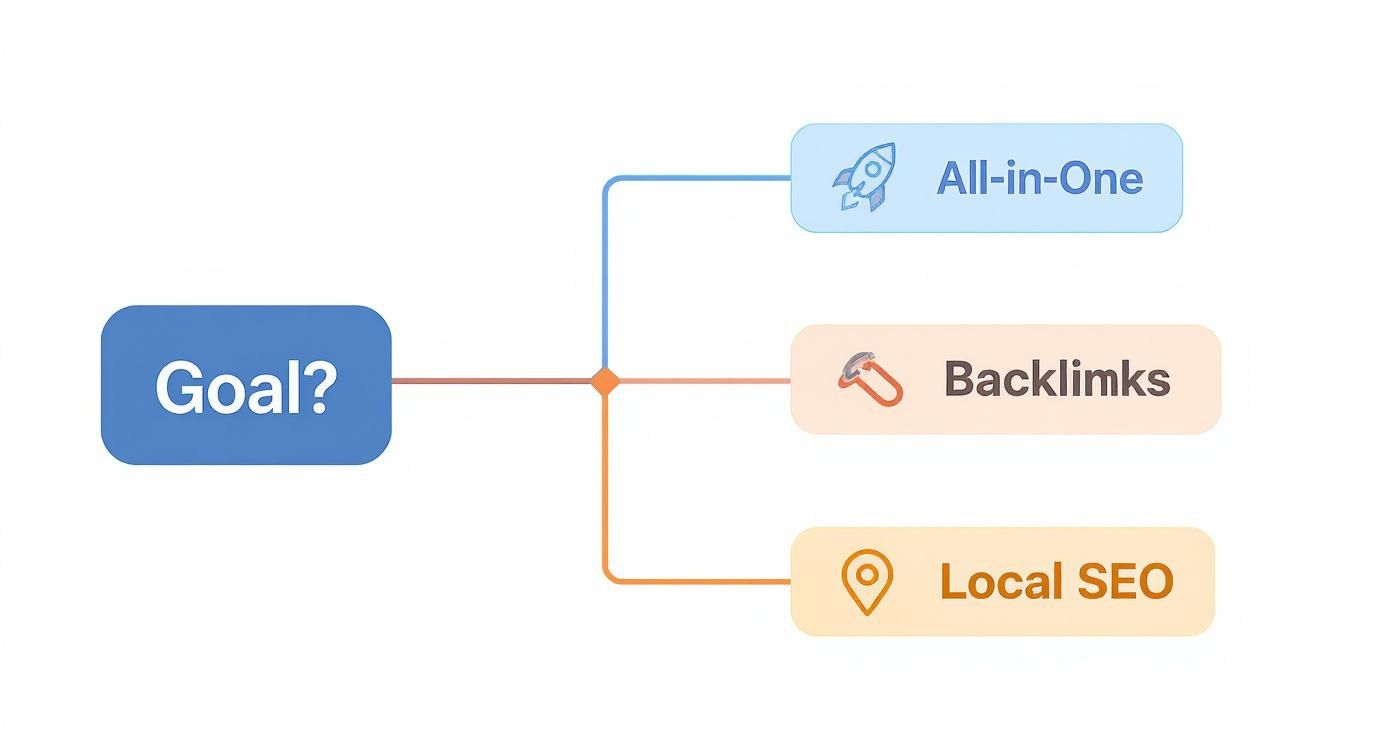
By mapping your primary goals to these broad categories, you can narrow your search to a platform designed with your needs in mind. To make this even clearer, let's walk through three very different business scenarios and see which of the leading platforms fits best.
The Local Service Business
Let's say you run a plumbing company in Manchester. You don't need to rank nationally for "boiler repair." Your entire business depends on showing up when a homeowner in your local area searches for "emergency plumber near me." For you, local SEO is everything.
In this situation, Moz Pro is a clear winner. Its Moz Local feature is tailor-made for this exact challenge. It lets you manage and sync your business listings across dozens of directories from a single dashboard. This is crucial for keeping your name, address, and phone number (NAP) consistent everywhere, which is a massive ranking signal for local searches.
The workflow is simple but effective. You’d use Moz Local to push your correct business details out to all the key UK directories. Then, you'd use Moz Pro's Rank Tracker—set to your specific postcodes—to see exactly how you're ranking in the local map pack. This combination directly solves the biggest headache for a local business with real precision. For more tips on getting in front of local customers, have a look at our guide on building a marketing strategy for small business.
The Digital Marketing Agency
Now, let's switch gears to a digital marketing agency in London. They're juggling a dozen clients, all with different goals and budgets. Their world revolves around efficiency, scalability, and proving their worth with polished, professional reports. They need a tool that can keep multiple projects organised, not just a jumble of data.
Semrush was practically built for this. Its entire structure is based on projects, allowing the agency to set up a separate, ring-fenced workspace for each client. Inside each project, you can run site audits, track keyword rankings, and monitor backlink campaigns without anything getting mixed up.
The killer feature for any agency is the ability to streamline client management and reporting. Semrush’s white-label reporting tools let you generate customised, professionally branded PDF reports in minutes. This turns a task that used to take hours of manual work into a few clicks.
This is a huge time-saver and makes the agency look incredibly professional. The workflow involves setting up each client as a new project, scheduling automated weekly or monthly reports, and even using the Lead Generation tool to hunt for new prospects. It's a complete, end-to-end solution for running an agency.
The Content-Heavy E-commerce Brand
Finally, imagine a UK-based online shop that sells high-end coffee equipment. Their entire marketing strategy is built on content: expert brewing guides, in-depth product comparisons, and detailed reviews. Their biggest challenge is constantly finding fresh content ideas that attract people ready to buy, not just window shoppers.
This is where Ahrefs truly shines, thanks to its phenomenal content and backlink analysis tools. The e-commerce brand's content manager would essentially live in Ahrefs' Content Explorer. By typing in a topic like "espresso machine," they can instantly see thousands of articles, then filter them by organic traffic, social shares, or the number of sites linking to them.
This workflow is all about spotting an opening. The manager might find a competitor’s product review that gets heaps of traffic but has almost no backlinks. That’s a clear signal that they could create a better, more detailed piece of content and potentially rank for it much faster. They could also use the Site Explorer to see the exact keywords driving traffic to a competitor's product pages, giving them a ready-made list of high-intent keywords to target. For any business that wins by creating the best content, Ahrefs is indispensable.
Analysing Costs and Making the Final Decision
Choosing the right SEO software is about more than just finding the cheapest monthly subscription. The real trick is to look past the sticker price and understand the long-term value. What seems like a bargain today can quickly become a costly bottleneck as your business, and your ambitions, start to grow.
The true cost often lies hidden in the fine print—the usage limits. Things like the number of projects you can run, the keywords you can track, or even how many reports you can pull in a day directly affect your team's workflow and, ultimately, your return on investment.
Breaking Down the Pricing Tiers
Every major platform—Semrush, Ahrefs, and Moz—structures its pricing to cater for everyone from one-person consultancies to massive enterprise teams. Their entry-level plans are a great way to get your foot in the door, but they come with some serious limitations you need to be aware of from the outset.
Take Semrush's "Pro" plan. It’s a brilliant starting point for many small businesses, but it caps you at just five projects. That’s fine if you’re focusing on one website, but for an agency or a business with multiple digital assets, you’ll hit that wall fast. Ahrefs' "Lite" plan is fantastic for competitor research, but it also puts a ceiling on how many keywords you can track over time.
Moz Pro’s "Standard" plan is often the most approachable for newcomers, but its strict limits on keyword research queries can really put the brakes on a content-heavy strategy. You have to think about where you'll be in a year, not just where you are today. For any business serious about its online presence, this kind of foresight is essential. If you're exploring ways to scale your outreach, our guide on the benefits of virtual marketing can offer some valuable perspectives.
A classic mistake is picking a plan based on today's price tag without forecasting tomorrow's needs. Hitting a usage cap mid-campaign can force you into an expensive, unplanned upgrade or grind your progress to a halt.
Comparing Entry-Level Value
To help you get a clearer picture right from the start, let's look at what the entry-level packages really offer. This table zeroes in on the key trade-offs you'll face, focusing on the common limitations that usually push people to upgrade.
Here is a quick overview of the starting tiers.
Pricing Tier Overview for SEO Software
| Software | Starting Price (Monthly) | Best For | Key Limitations |
|---|---|---|---|
| Semrush Pro | ~£108 | Small businesses, all-rounders | 5 Projects, 500 tracked keywords, 10,000 results per report |
| Ahrefs Lite | ~£85 | Freelancers, content creators | 5 Projects, 750 tracked keywords, limited site audit crawls |
| Moz Pro Standard | ~£78 | Beginners, local businesses | 3 Campaigns, 300 keyword rankings, 150 keyword queries/month |
The numbers here tell a story. While Moz Pro is the most wallet-friendly option to begin with, that sharp limit on keyword queries makes it a tough sell for anyone pursuing an aggressive content marketing strategy. Ahrefs gives you a lot more keyword tracking for your money, while Semrush offers a solid, well-rounded package, albeit at a slightly higher starting price.
Ultimately, the "best" plan depends entirely on your immediate priorities and workflow.
A Framework for Your Final Decision
With the costs and limitations out in the open, it's time to make a final, informed choice. Don't rush it. A structured approach will ensure the tool you pick becomes a genuine asset, not just another line item on your expense report.
Here’s a simple, practical framework to guide you:
- Maximise Free Trials: This is non-negotiable. Sign up for trials of your top two contenders at the same time. Use them to perform the exact same tasks—track the same keyword list, audit the same landing page, research the same competitor. This is the only way to get a true side-by-side feel for data accuracy and usability.
- Involve Your Team: The most powerful tool is the one your team actually wants to use. Get your colleagues involved in the trial period. An interface that feels intuitive to you might be a nightmare for someone else, and getting team buy-in from the start is crucial for successful adoption.
- Ask the Tough Questions: Before pulling out the company card, ask yourself: Does this platform solve my single biggest SEO problem right now? And, will its limits hold back my growth over the next 12 months? Answering these questions honestly is the best way to avoid buyer’s remorse and find a true partner for your long-term organic growth.
Answering Your Lingering SEO Software Questions
Even after a side-by-side comparison, it's totally normal to have a few questions rattling around. Picking the right SEO platform is a big commitment, both in time and money, so it pays to be thorough. This section tackles the most common queries we hear, moving beyond feature lists to address the practical stuff.
We'll get into the nitty-gritty of data reliability, whether you can get by with free tools, and what the real learning curve looks like for these powerful platforms.
Which SEO Software Has the Most Accurate Data?
This is the million-dollar question, isn't it? The truth is, "accuracy" really depends on what you're measuring. There isn't one single winner across the board; each platform has its own strengths.
For backlink analysis, Ahrefs is pretty much the undisputed champion. Its crawlers are constantly scanning the web, meaning its link index is massive and updated incredibly frequently. If link building is a core part of your strategy, the freshness and depth of its data are second to none.
When it comes to keyword research, particularly metrics like search volume and keyword difficulty, Semrush has a fantastic reputation. Its huge keyword database and clever algorithms often give you numbers that feel very close to what's actually happening in Google's world, making it a solid choice for planning your content.
And then there's Moz, famous for its Domain Authority (DA) metric. While its raw data indexes might not be as colossal as the others, DA has become a go-to benchmark across the industry for a quick snapshot of a site's overall clout.
Ultimately, the "most accurate" tool is the one whose data best mirrors what you're seeing in your own niche. I always recommend using the free trials to run the same reports on your own site and a few key competitors. See which platform's numbers feel the most realistic and useful to you.
Can I Just Use Free SEO Tools Instead of Paying for a Platform?
Look, free tools are fantastic and absolutely have their place. You can't do SEO without Google Search Console. It gives you essential data straight from the source. But it's designed to tell you about your site, not to give you the inside scoop on your competition.
This is where paid platforms really earn their keep. Here’s what you’re paying for:
- Proper Competitive Intelligence: Paid tools let you pull back the curtain on your rivals. You can see exactly which keywords they rank for, where their best links come from, and what content is driving their traffic.
- All Your Data in One Place: Instead of juggling a dozen different tools, a good platform brings everything—keywords, links, technical audits, rank tracking—into one dashboard. It's a massive time-saver.
- Strategic Firepower: Features that help you spot content gaps, find unlinked brand mentions, or automate client reporting are almost always exclusive to paid subscriptions.
For any business that's serious about growing through search, a paid SEO platform isn't really a luxury; it's a necessary investment. It's what gives you the strategic edge to actually compete.
How Long Does It Take to Learn These SEO Platforms?
The learning curve definitely varies from one tool to the next, mostly based on how much they try to do and how they lay it all out.
Moz is widely seen as the most approachable for newcomers. The interface is clean, it doesn't overwhelm you with options, and their educational guides are top-notch. You can get the hang of its main features within a week or two of consistent use.
Semrush is a bigger beast, so it takes a bit longer. Because it’s an all-in-one marketing suite with tools for PPC and social media, there's just more to explore. That said, its SEO modules are well-organised, and you could feel pretty comfortable with them in about a month.
Ahrefs sits somewhere in the middle. Its core functions for site audits, keyword research, and backlink checks are very intuitive. But to really master its more advanced features, like Content Explorer or its powerful batch analysis tools, you'll need to dedicate a bit more time.
Plan on spending a few weeks to get comfortable with the basics of any of them. To become a true power user who can squeeze every drop of value out of the advanced features? That'll likely take a few months of living and breathing in the platform.
What’s the Single Most Important Feature to Look For?
Everyone's needs are different, so there isn't one "magic" feature that's right for everybody. However, any truly effective SEO campaign is built on three pillars, and your software needs to be rock-solid on all of them.
First and foremost is a powerful and accurate keyword research tool. This is the foundation of everything, from the content you create to the links you build.
Next up is a comprehensive backlink analysis tool. You simply can't build authority or understand what your competitors are doing without one.
Finally, a reliable rank tracker is non-negotiable. It's how you measure your progress, prove the value of your work, and show a clear return on investment. If a platform nails these three things, you're in a very good starting place.
At The Digital Marketing Toolbox, we cut through the noise to bring you curated recommendations and direct comparisons of the best tools for your business. Let us help you find platforms that match your goals and deliver real results. Visit us at https://grow-your-biz.com to find your perfect marketing solution today.


