
So, how do you choose the right SEO tool? It really boils down to this: Semrush is the all-in-one marketing powerhouse for agencies, Ahrefs delivers the gold standard in backlink and competitor data for dedicated SEO specialists, and Moz offers a really intuitive, user-friendly experience that’s perfect for beginners and small businesses. Your final choice hinges on what you need to achieve, your team's experience, and of course, your budget.
Choosing Your SEO Toolkit for the UK Market
This kind of comprehensive dashboard is what you get with a top-tier SEO tool, giving you a summary of key metrics at a glance. What's impressive is how these platforms manage to wrangle huge amounts of data—from organic traffic trends to keyword positions—and present them as genuinely useful insights.
Picking the right SEO software is about more than just finding the one with the longest feature list. A one-size-fits-all approach just doesn't cut it, especially in the competitive UK market where local search habits and regional competition demand a much sharper strategy.
Setting the Stage for a Fair Comparison
This guide isn't about a superficial overview. We’re going to give you a practical framework for making a decision. I’ll put three of the biggest names in the industry—Semrush, Ahrefs, and Moz—under the microscope, looking at them through the lens of what actually matters for UK businesses.
Here's what we'll be breaking down:
- Data Accuracy: How good is their UK-specific search volume and backlink data? Can you trust it?
- User Interface: How quickly can your team get up to speed without endless training sessions?
- Scalability: Will the tool still be a good fit as your business grows?
- Feature Alignment: Does the platform’s main strength line up with your biggest priority, whether that's dominating local SEO, boosting e-commerce sales, or building content authority?
The SEO software market in the UK pulled in around £4.2 billion in revenue in 2024, and that figure is expected to more than double by 2030. While big companies are a huge part of that, it's the small and medium-sized enterprises (SMEs) that are growing the fastest. This just goes to show how crucial the right tools have become for businesses of all sizes.
A Practical Framework for Selection
The aim here is to give you a clear path to making a smart choice that actually pays off. A solid SEO platform is a fundamental part of any good https://grow-your-biz.com/marketing-strategy-for-small-business/, making sure your efforts are driven by data, not just guesswork. As you build out your toolkit, remember to include handy browser-based tools; some of the best SEO Chrome extensions are brilliant complements to these larger platforms.
The best SEO tool isn’t the one with the most features; it’s the one that seamlessly integrates into your workflow and provides the specific, accurate data you need to make smarter decisions for your target market.
With that in mind, let's dive in and see how these platforms really stack up against each other where it counts.
Core Feature Showdown for SEO Mastery
When you're comparing SEO tools, a simple feature checklist doesn't tell the whole story. What really matters is how those features hold up in the real world. We're about to get into the nitty-gritty of Semrush, Ahrefs, and Moz, focusing on the four pillars that make or break any SEO campaign.
This isn't just about who has the biggest database. We'll be looking at the nuances—like how one tool's keyword difficulty score differs from another, how fresh the backlink data really is, and whether a site audit gives you genuinely actionable advice. This head-to-head will show you which platform is the right fit for your specific goals.
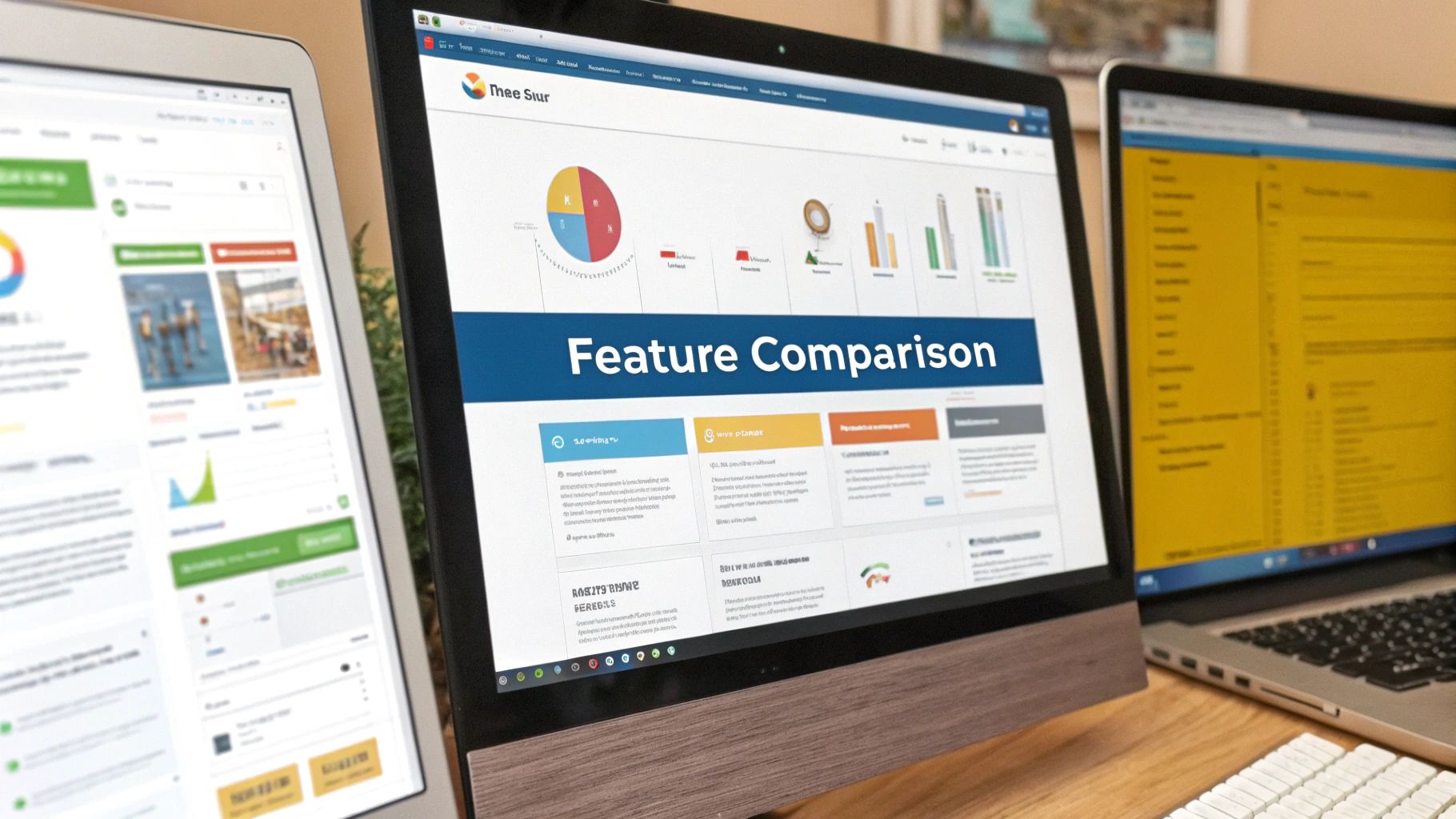
This chart gives a quick visual summary of how these platforms stack up, balancing their feature sets against overall usability and customer support.
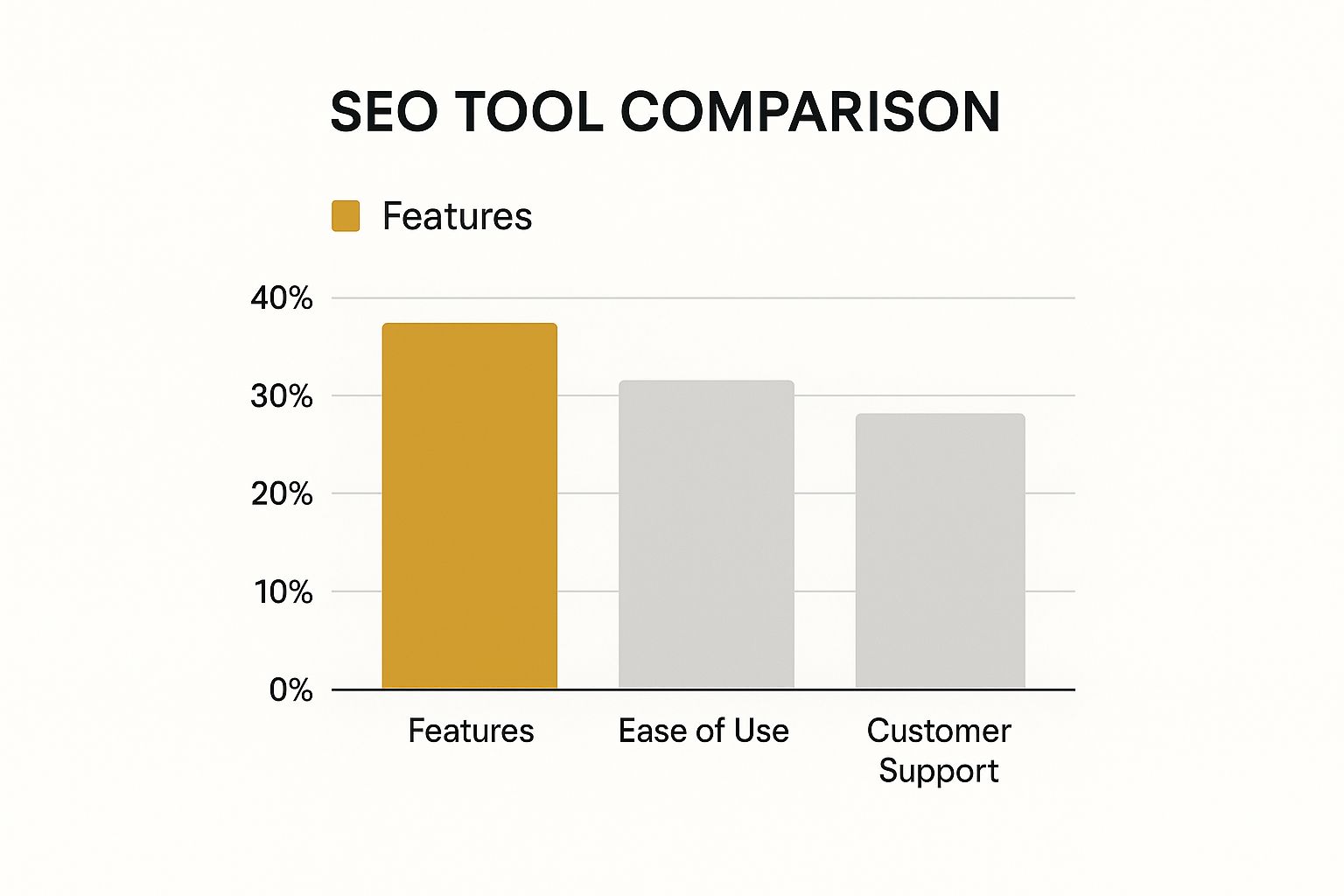
As you can see, while they're all heavyweights, each one strikes a different balance. Your choice really depends on what you prioritise most—be it raw data, ease of use, or a comprehensive feature set.
To give you a clearer picture, let's break down how Semrush, Ahrefs, and Moz compare in the most critical areas of SEO.
Core SEO Feature Comparison at a Glance
| Feature Area | Semrush | Ahrefs | Moz |
|---|---|---|---|
| Keyword Research | Massive database with excellent topic clustering and PPC integration. An all-in-one marketing powerhouse. | Praised for its accurate Keyword Difficulty and unique "Clicks" metric, offering deeper SEO insights. | Beginner-friendly with a helpful "Priority" score to quickly identify high-impact keywords. |
| Backlink Analysis | A huge and growing database with a standout Backlink Audit Tool for cleaning up toxic links. | The industry gold standard. Its crawler is second only to Google, providing the freshest and largest index. | Strong core features powered by its famous Domain Authority (DA) metric. Great for high-level reporting. |
| Site Auditing | Extremely thorough, checking for over 140 technical SEO issues with clear, actionable fix recommendations. | Incredibly fast crawler with excellent data visualisation, making it easy to spot trends and widespread problems. | Provides a solid foundation for technical audits, flagging critical issues effectively and integrating well with its suite. |
| Rank Tracking | Offers daily updates and excels at tracking SERP features (featured snippets, local packs), giving a complete view of visibility. | Reliable and frequently updated tracking with robust features for tagging and comparing against competitors. | Dependable national and local tracking with clear, easy-to-understand reports perfect for clients. |
Now, let's dive deeper into each of these areas.
H3: Keyword Research Capabilities
Solid keyword research is the absolute foundation of good SEO. All three platforms have powerful tools for this, but their approaches and the data they serve up are quite different, which can genuinely shape your strategy.
Semrush really stands out with its Keyword Magic Tool. Its database is enormous, but its real genius lies in topic clustering. It automatically groups related keywords, which makes planning out content hubs and pillar pages an absolute breeze. Plus, its integration with PPC data gives you a much better sense of a keyword's commercial intent.
Ahrefs, on the other hand, is famous for the accuracy of its keyword difficulty (KD) score and its killer "Clicks" metric. This feature is brilliant—it estimates how many people actually click on a search result, which is crucial now that so many SERPs are filled with featured snippets and other elements that don't require a click.
Then there's Moz, which has always prioritised a clean, user-friendly experience with its Keyword Explorer. It boils down complex data into a simple "Priority" score, which combines search volume, difficulty, and organic click-through rate. This makes it incredibly easy for newcomers to spot the best opportunities without getting bogged down in data.
Semrush provides the most complete keyword toolkit for a broad marketing strategy. Ahrefs gives you sharper, more granular data points for pure SEO. Moz makes the entire process accessible for anyone just starting out.
Whichever tool you choose, make sure it allows you to do deep competitor research. To really pull ahead, you need to master keyword gap analysis and uncover the valuable terms your rivals are ranking for that you've completely missed.
H3: Backlink Analysis Depth and Freshness
A backlink index is one of the most valuable assets an SEO tool has. Its size, speed, and accuracy directly impact your ability to build a winning link profile and spy on your competitors.
There's a reason Ahrefs is widely seen as the gold standard here. It runs the second-most active web crawler on the planet (right behind Google), meaning its index of live backlinks is bigger and fresher than anyone else's. For serious link builders, the level of detail in its Site Explorer—showing new, lost, and broken links—is simply indispensable.
Semrush has closed the gap significantly in recent years and now boasts a very competitive backlink database. Its trump card is the Backlink Audit Tool. It cleverly integrates with Google Search Console, helping you find and disavow toxic links in a much more streamlined way.
Moz's Link Explorer is built around its famous Domain Authority (DA) metric. While its index might not be quite as massive or updated as frequently as Ahrefs, Moz does an excellent job of presenting link data in a way that’s easy to understand. This makes it perfect for high-level analysis and creating client-friendly reports.
H3: Site Auditing and Technical SEO
You can't build a great SEO strategy on a broken website. A technical audit uncovers the foundational issues that could be holding you back, and each tool has its own unique way of tackling this.
The Site Audit tool from Semrush is an absolute beast, checking for over 140 different technical and on-page SEO problems. It organises everything neatly into Errors, Warnings, and Notices and gives you clear "how to fix" instructions, which is a massive help for SEOs at any skill level.
Ahrefs' Site Audit is all about speed and visualisation. It crawls sites incredibly fast and presents the data in beautiful, interactive charts. This makes it incredibly easy to spot site-wide trends, like problems with internal linking or a sudden increase in slow pages.
Moz offers a solid audit with its On-Demand Crawl. It does a good job of flagging the most critical issues and plugs in nicely with the rest of its tools. However, it doesn't quite have the exhaustive checklist of Semrush or the slick data visualisations of Ahrefs.
H3: Rank Tracking Accuracy and Features
At the end of the day, you need to know if your efforts are working. Monitoring your keyword positions is how you measure success, and the best tools offer accuracy, frequent updates, and detailed competitor tracking.
- Semrush (Position Tracking): This is my go-to for a holistic view of the SERPs. It gives you daily updates and is fantastic at tracking SERP features. You'll know instantly if you've captured a featured snippet, a spot in the local pack, or an image pack, which gives you a much more accurate picture of your true visibility.
- Ahrefs (Rank Tracker): Ahrefs provides rock-solid tracking with frequent updates and great competitor tagging. I love its interface for comparing your ranking progress against several competitors side-by-side over time. It makes spotting trends incredibly easy.
- Moz (Rank Checker): Delivers reliable tracking for both national and local search. Its real strength is in its reporting; the historical data views are clean and simple, making it easy to show progress to clients or bosses who aren't SEO experts.
Getting the UK Data Right: Which Tool Can You Trust?
This shot from Ahrefs' Keyword Explorer gives you a glimpse into the kind of data we rely on every day, from keyword difficulty to global search volume. But for any business targeting the UK, the million-dollar question is: how well do these numbers actually reflect what’s happening on Google.co.uk?
Let's be blunt: in any serious SEO tools comparison, data accuracy is everything. Bad data leads to bad strategy. It means wasted time, blown budgets, and missed opportunities, a scenario that's all too common when you're working in a specific market like the United Kingdom.
The UK search landscape has its own quirks—local slang popping up in long-tail keywords, unique shopping habits, and distinct regional competition. A tool that's brilliant for the US market won't necessarily give you the reliable insights you need over here.
So, let's put Semrush, Ahrefs, and Moz under the microscope and see how they really stack up on UK-centric data, from keyword volume and backlink indexing to the precision of their rank tracking.
Keyword Volume Estimates for the UK
Keyword search volume is a foundational SEO metric, but it’s never a perfect science. Every tool has its own secret sauce—proprietary algorithms and data sources—which is why you’ll often see wildly different numbers for the same keyword.
For the UK market, Ahrefs has a standout feature: its "Clicks" metric. This goes beyond just telling you how many people search for a term. It estimates how many of those searches actually lead to a click, which is crucial information in an age of zero-click searches and Google stealing your traffic with rich SERP features.
Semrush, on the other hand, often reports higher search volumes across the board, thanks to its colossal database. This can be great for spotting broad trends, but some SEOs I know find its estimates for niche UK terms a bit on the optimistic side.
Moz plays it safe with its Keyword Explorer, giving you volume estimates in ranges. It’s a more conservative approach, and frankly, a more honest one. It openly acknowledges the guesswork involved, making it a solid choice if you prefer to build your strategy on cautious forecasts.
When it comes to UK campaigns, the real goal isn't finding the one "correct" search volume. It's about consistency. Pick a tool you trust and stick with it. That way, you're always measuring your own progress against a stable, reliable benchmark.
You can't ignore the context here. Google absolutely dominates the UK, holding a staggering 93.35% of the search market. A tool's ability to interpret Google's data is non-negotiable. And with AI tools like ChatGPT now driving 78.31% of AI chatbot referral traffic in the UK, the challenge for these platforms is to keep their data models relevant. For more on this, you can dig into the UK search engine statistics on Klatch.co.uk.
Backlink Index for UK Domains
For digging into competitor strategies or finding new link-building opportunities, a fresh and comprehensive backlink index is essential. This is especially true when you're focused on high-value .co.uk domains.
Ahrefs has long been the gold standard here. Its web crawler is legendary for its speed and scope, giving you a backlink index that’s both massive and updated constantly. If you need to spot new and lost links from UK sites almost as they happen, Ahrefs is hard to beat.
Semrush has closed the gap significantly and now boasts a very competitive backlink database. Its real ace in the hole for UK users, though, is the Backlink Audit tool. It’s fantastic for sniffing out and managing toxic links you might have picked up from old local directories or low-quality regional blogs.
Moz’s Link Explorer, which is the engine behind its famous Domain Authority (DA) metric, offers a brilliant high-level view. Its index might not be quite as deep as Ahrefs', but it excels at making complex data easy to understand—perfect for putting together reports for clients or bosses who aren't deep in the SEO weeds.
Rank Tracking Precision on Google.co.uk
At the end of the day, accurate rank tracking is how you prove your SEO is actually working. The trick is finding a tool that can precisely monitor your keyword positions on Google.co.uk, including all the local variations that matter.
Here’s a quick rundown of how they compare for UK tracking:
- Semrush: Its daily updates are a huge plus. Semrush really shines at tracking your ownership of SERP features, like local map packs and featured snippets, which gives you a much clearer picture of your true visibility on UK search result pages.
- Ahrefs: You can count on Ahrefs for reliable and frequent data updates. Its biggest strengths are the tagging and competitor comparison features, which make it incredibly easy to track your performance against key UK rivals over time.
- Moz: Delivers dependable rank tracking for both national and local keywords. The reports are clean and simple, making them ideal for showing progress on UK-specific terms to clients or your internal team without overwhelming them with data.
Figuring Out Pricing and What’s Worth Your Money
Let's be honest, picking an SEO platform just because it's the cheapest is a trap many people fall into. The monthly cost is only the starting point. The real story is about the value you get back and whether it actually helps your business grow. A "cheap" tool can end up costing you a fortune in missed opportunities, while a more expensive one can easily pay for itself when used right.
We're going to break down the real-world value of the top SEO tools. Forget the sticker price for a moment and let's look at how their costs stack up against what they offer for different types of users, from one-person-bands to massive agencies. The goal here is to help you match your budget to your actual needs, making sure every pound you spend is a smart one.
Value for Freelancers and Solopreneurs
When you're flying solo, every penny counts. But so does your time. You need a tool that handles the essentials—keyword research, rank tracking, and a decent site audit—without the hefty price tag meant for big corporate teams. Paying for features you'll never use is just burning cash.
This is where a tool like Moz Pro often hits the sweet spot. Its entry-level plans give you solid, reliable data for your core SEO work, all wrapped up in an interface that doesn't require a PhD to navigate. It’s perfect when you're juggling one or two client projects. The limits on keywords and site crawls are usually more than enough for freelance work, giving you professional power without breaking the bank.
For a freelancer, the best value isn't the cheapest tool. It's the one that gives you the most powerful core features you can afford. You want to maximise your impact without paying for scalability you just don't need yet.
Finding the Right Fit for Small to Medium Businesses
Small to medium-sized businesses (SMEs) are all about growth. What you need today could be completely different in six months. The trick is to find a platform with plans that can scale with you. The last thing you want is the headache of switching tools right when you're gaining momentum.
Semrush is brilliant for this. Its tiered pricing is designed for a growing business. You can start with an essential plan and simply upgrade as your marketing gets more ambitious. This flexibility is key. An SME might start with just SEO, but soon expand into PPC, content marketing, or social media—all of which are covered in Semrush’s higher-level plans.
Think about these factors:
- Project Limits: How many websites are you tracking? If you have your main site and a sister brand, a basic plan might not cut it.
- Keyword Tracking: As your content strategy gets more sophisticated, you’ll need to track way more keywords. Make sure the plan can keep up.
- User Seats: Does more than one person on your team need access? The cost of adding extra users can sneak up on you and really affect the total price.
This layered approach means you’re only paying for what you’re actively using, which makes it a very cost-effective choice for businesses on the up.
Calculating ROI for Large Agencies
For a big agency juggling dozens of clients, the conversation changes. It's less about the monthly fee and more about data limits and pure efficiency. The sticker price might look high, but it’s often a drop in the ocean compared to the value you get from better data, API access, and the ability to manage campaigns at scale. Hitting data limits can create bottlenecks that cost an agency far more in wasted time and missed client opportunities than the subscription itself.
This is where a platform like Ahrefs really comes into its own. Its plans, especially the top-tier ones, are famous for their generous data allowances on everything from site crawls to keyword reports and backlink analysis. For an agency doing deep-dive competitor research across several industries at once, that kind of data access isn't a luxury—it's essential.
What's more, Ahrefs' powerful API is a massive value-add for agencies. It lets you build custom reporting dashboards and plug the data into other business tools, which streamlines your whole workflow and delivers better insights for clients. In that context, the higher price directly translates into getting more done, more effectively, and delivering better results. It stops being an expense and becomes a critical investment.
Comparing User Experience and Workflow Efficiency
Even the most powerful SEO tool is useless if your team finds it a nightmare to navigate. Let's get into the nuts and bolts of how Semrush, Ahrefs, and Moz actually feel to use day-to-day, and how their design affects your team's workflow.
A clunky platform is a productivity killer, plain and simple. It slows you down and can even lead to expensive mistakes. On the flip side, a clean, logical interface means you can find what you need, pull insights, and get on with your day.
The All-in-One Dashboard vs Focused Toolsets
Semrush throws everything at you in one place. It’s built to be a complete marketing command centre, and its dashboard is absolutely packed with data. This all-in-one approach can be a bit much for beginners, presenting a fairly steep learning curve. But for an agency juggling SEO, PPC, and social media, having it all under one roof is a massive time-saver.
Ahrefs, on the other hand, feels like it was built by SEOs, for SEOs. The interface is clean and puts the data front and centre. It might look less intimidating than Semrush initially, but don't be fooled. To really get the most out of it, you need a solid grasp of SEO concepts. The entire workflow is laser-focused on core tasks like backlink audits and competitor deep dives.
For many, the decision boils down to a simple trade-off. Do you want a unified hub for all your marketing, like Semrush? Or do you need a specialised, high-performance toolkit for a dedicated SEO pro, like Ahrefs?
The UK SEO market is a testament to the importance of effective tools. Valued at roughly £19.2 billion in 2023, it’s expected to climb to £25 billion by 2028. With 90% of UK businesses confident in their SEO efforts, the demand for tools that are both powerful and user-friendly is at an all-time high. You can find more on the booming UK SEO market on artios.io.
Championing User-Friendliness
Moz has always been the go-to for user-friendliness. It’s the perfect starting point for anyone just dipping their toes into search engine optimisation. The platform’s clean design and helpful little explainers walk you through complex data, turning a potentially overwhelming process into a learning experience.
This screenshot from Moz really highlights its clean, approachable dashboard, which makes complex metrics easy to digest.
The emphasis on clear visuals and key performance indicators is a lifesaver for beginners or for when you need to present a straightforward progress report to stakeholders. In a market full of dense data dashboards, this focus on clarity really sets Moz apart.
For business owners or marketers who wear many hats, Moz's intuitive workflow is a huge win. It lowers the barrier to entry, which is exactly what you need when you're just starting out. If you're looking for more foundational knowledge, check out our beginner's guide to digital marketing.
Ultimately, the 'best' user experience really depends on your team's skills and needs. A full-service agency will probably gravitate towards Semrush's integrated power. A freelance SEO specialist will likely feel right at home in Ahrefs. And a small business owner will appreciate how Moz lets them get straight to work without a massive learning curve.
So, Which Tool Should You Choose?
Alright, we’ve walked through the nitty-gritty of each platform. Now comes the moment of truth: picking the right one for you. There's no magic bullet here; the "best" tool is simply the one that fits your budget, your team's skills, and what you’re actually trying to achieve.
To make it easier, I've broken down my final recommendations based on the type of user you are. Forget a one-size-fits-all answer. This is about finding the perfect fit for your specific situation.
For Agencies: The All-in-One Powerhouse
If you run a marketing agency, you're juggling a dozen things at once. One minute you're deep in SEO for one client, the next you're pulling PPC reports for another. You need a single platform that can keep up without forcing you to switch between five different tabs.
This is where Semrush really shines. It’s built for exactly this kind of multi-channel world. You can seamlessly jump from keyword research to analysing a Google Ads campaign or checking social media performance. For an agency, that integration isn't just a nice-to-have; it saves a ton of time and helps you see the bigger picture for each client.
For SEO Specialists: The Deep-Dive Toolkit
Now, if you're a dedicated SEO consultant or an in-house expert, your needs are different. You live and breathe data. You need the most accurate backlink profiles, the most granular competitor insights, and the power to spot opportunities nobody else sees.
For pure, unadulterated SEO data, especially for backlink analysis and competitor intelligence, Ahrefs is still the gold standard. Its web crawler is legendary for a reason—it’s the closest thing you’ll get to Google’s own index.
If your day-to-day involves running complex link-building campaigns, pulling apart a competitor's strategy piece by piece, or conducting deep technical audits, then Ahrefs is your weapon of choice. It’s a specialist’s tool, laser-focused on giving SEO professionals the sharpest edge possible.
For Beginners and Small Businesses: The Friendly Guide
Finally, what if you're just starting out? Maybe you're a small business owner or new to the world of SEO. The last thing you need is a dashboard that looks like the cockpit of a spaceship. The priority here is getting clear, actionable insights without a massive learning curve.
In this case, Moz Pro is an excellent place to start. Its interface is clean and intuitive, and resources like its famous Domain Authority metric and brilliant educational guides make the whole process feel less intimidating. It gives you the power to make smart decisions without overwhelming you, which is perfect when you're building your SEO foundations.
Your Top SEO Tool Questions Answered
Choosing the right SEO software is a big decision, and it’s natural to have a few questions before you commit. Let's tackle some of the most common queries I hear from people trying to find the perfect tool for their needs.
Which SEO Tool Is Best For A Beginner?
If you're just dipping your toes into search engine optimisation, I almost always point people towards Moz Pro. Its interface is clean and genuinely easy to get the hang of. Plus, it’s packed with helpful guides and educational content that walk you through the fundamentals without making your head spin. It keeps the focus on core SEO metrics, which is exactly what you need when you're starting out.
Is Semrush Or Ahrefs Better For Backlink Analysis?
This is the classic heavyweight bout of the SEO world. While both are powerhouses, Ahrefs is widely regarded as the industry leader specifically for backlink analysis. Why? It has one of the largest and most frequently updated backlink indexes on the planet. For serious competitive analysis or a really ambitious link-building campaign, that level of detailed, accurate data is simply non-negotiable.
A common mistake I see is people trying to replace a paid subscription with free tools. While great for basic checks, platforms like Google Search Console just don't offer the deep competitive insights or project management features needed for a serious, scalable SEO strategy.
Can I Use Free SEO Tools Instead Of Paid Ones?
Free tools are a fantastic starting point, but any business that’s serious about growth will eventually hit a wall. A paid subscription isn't just a cost; it's an investment in the comprehensive data and scalable project management you need to actually move the needle. You can learn more about how our platform helps centralise your marketing efforts by reading about the launch of Grow Your Biz.
Remember, the tool is only as good as the person using it. To get the most out of your software, you need a solid grasp of fundamental practices. You can find more practical SEO tips and strategies to pair with your new tool.
Ready to build the ultimate marketing stack for your business? At The Digital Marketing Toolbox, we provide a centralised platform to discover, compare, and implement the best digital marketing solutions to drive sustainable growth. Find your perfect fit at https://grow-your-biz.com.


