
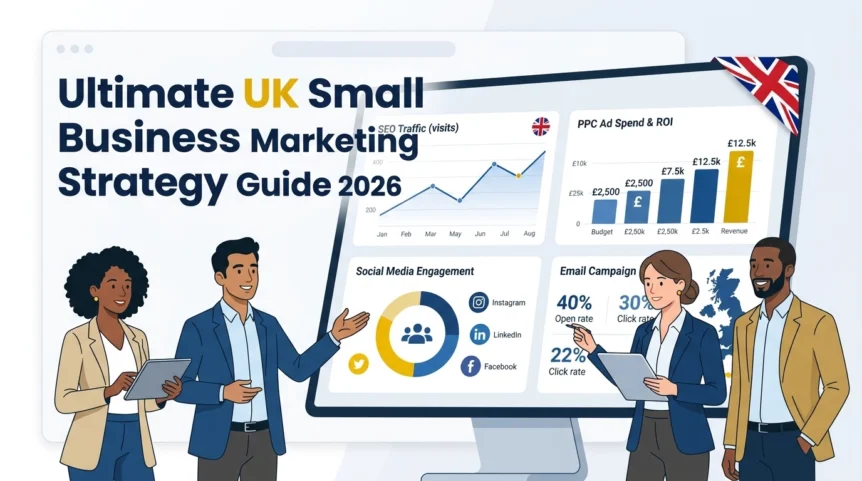
SEO Meta Description: Small business marketing strategy for UK companies in 2026: learn the channels, tools, and tactics that drive leads, sales, and sustainable growth.
URL: https://grow-your-biz.com/small-business-marketing-strategy/
A small business marketing strategy is still one of the biggest growth levers for UK companies in 2026. Running a small business in the UK right now is not for the faint-hearted. Costs are up, attention spans are down, and every platform is shouting for your budget. But here’s the good news: a smart small business marketing strategy still works brilliantly when it’s built like a system, not a scramble.
There are around 5.5 million small businesses in the UK, which means competition is fierce, but opportunity is massive. So if your current plan is a mix of occasional Instagram posts, a half-finished email list, and the hope that Google will somehow "figure it out", we need to fix that before your marketing budget wanders off for a lie-down.
This guide is a straight-talking, step-by-step masterclass in building a small business marketing strategy that actually works. We’ll cover what matters, what to ignore, and how Grow Your Biz fits in as the engine room behind the whole thing. Because strategy is great. But strategy with the right digital marketing tools is how you actually grow your business online.
Step 1: Understand the UK Marketing Landscape in 2026

So, what’s actually changed? Quite a lot. UK customers are searching in more conversational ways, comparing options faster, and expecting businesses to look credible from the first click. They’re not just typing "accountant Manchester" anymore. They’re asking things like, "Who’s the best small business accountant near me with good reviews and fixed monthly pricing?"
That’s why modern SEO now overlaps with Answer Engine Optimisation (AEO). Your content needs to answer real questions clearly, fast, and better than the next business. If it doesn’t, you’re invisible.
And let’s keep it real: UK small businesses don’t have endless budgets. Most need marketing that works without swallowing £2,000+ a month in wasted effort. That’s where systems beat guesswork every time.
Why Automation Matters More Than Ever
Forget the sticker price for a moment. The real cost is manual work. If you or your team are still posting everything by hand, chasing every lead manually, and building campaigns from scratch every week, you’re burning cash in slow motion.
This is where the Grow Your Biz toolbox earns its keep. Tools like ActiveCampaign help automate lead nurturing, while AdCreative speeds up ad production without making your brand look cheap.
Golden Nugget: The best small business marketing strategy in 2026 is not "do more marketing." It’s "build smarter workflows with the right digital marketing tools."
Step 2: Pick the Right Strategy for Your Type of Business
We’re not going to pretend every business needs the same plan. That’s nonsense. A local trades business in Leeds has very different needs from an ecommerce brand in Bristol. So let’s break it down properly.
For the "Flying Solo" Freelancer
You’re wearing every hat. Sales, delivery, admin, marketing, and probably tea-making too.
- The Focus: Visibility without extra faff.
- The Move: Put local SEO first. If you serve a town, city, or region, that’s your battlefield.
- The Tool Stack: Use SocialBee to schedule content, and build a simple follow-up flow in ActiveCampaign so leads don’t go cold while you’re doing actual client work.
For the Local Service Business
Think plumbers, electricians, salons, mortgage brokers, and accountants.
- The Focus: Calls, bookings, and quote requests.
- The Move: Own your Google Business Profile, location pages, reviews, and mobile conversions.
- The Tool Stack: Pair a strong website with UserMaven to see which pages drive enquiries and where visitors are dropping off.
For the Scaling Small Agency or Team
You’ve got momentum, but now inefficiency starts to hurt.
- The Focus: Conversion, retention, and clean reporting.
- The Move: Tighten up your funnel, segment your leads, and stop treating every prospect the same.
- The Tool Stack: Use ActiveCampaign for segmentation and automation, UserMaven for attribution, and AdCreative to speed up campaign production.
Moment of Truth
Which one are you? If you don’t know your business model, your online marketing for small business plan will feel like flying a cockpit of a spaceship with no dashboard.
Step 3: Build the Strategy Framework

A proper small business marketing strategy needs a framework you can actually follow. Not a fluffy mission statement. Not a 47-tab spreadsheet you never open again. A working plan.
1. Nail Your Positioning
Why should someone choose you over the bigger, louder competitor? If your answer is "great service", that’s not a differentiator. That’s the bare minimum.
You need a clear angle:
- Faster turnaround
- Better value
- Specialist expertise
- More local trust
- Easier onboarding
- Better aftercare
For UK small businesses, this matters even more because customers often compare three to five providers before they enquire. If your message is vague, you lose.
2. Understand Real Buyer Intent
Demographics alone won’t save you. "Small business owner, age 30–50, based in the UK" tells us almost nothing.
Ask:
- What problem are they trying to solve today?
- What makes them search now instead of next month?
- What would stop them from buying?
- What proof do they need before they trust you?
That’s the stuff that shapes content, landing pages, ads, and email flows.
3. Study Competitors Without Copying Them
Let’s be blunt: if a competitor is ranking, converting, and showing up everywhere, they’re telling you something. Study the pattern. Look at their keywords, offers, landing pages, review strategy, and content gaps.
Then do it better. Sharper promise. Clearer page. Better follow-up.
And if you need the right digital marketing tools to spot those gaps, that’s exactly where the Grow Your Biz toolbox comes in.
Golden Nugget: Strategy is not about doing more channels. It’s about making every channel pull its weight.
Step 4: Build Your Core Marketing Engine
Your website is either your best salesperson or a very expensive brochure. There’s no middle ground. If it doesn’t rank, convert, and follow up properly, it’s leaking money.
SEO and Content That Pull Their Weight
Is SEO still worth it? Absolutely. But low-effort content won’t cut it. In 2026, the winning approach is simple: use AI for speed, then add human insight for trust.
That means:
- Answer real customer questions
- Create service and location pages for UK searches
- Add proof, reviews, and examples
- Improve site speed and mobile usability
- Structure content so Google and AI tools can understand it fast
Use our guide on SEO Audit Tools if your site needs a check-up. Because if your pages crawl like it’s 2014, your rankings and conversions will suffer.
Email Marketing Still Prints Money
Email is still one of the best-value channels in online marketing for small business. Why? Because you own the audience. No algorithm tantrums. No sudden reach collapse.
Use email to:
- Welcome new leads
- Nurture undecided buyers
- Re-engage old customers
- Upsell existing clients
- Recover abandoned enquiries
And yes, this is another place where ActiveCampaign helps turn a messy process into a system.
Video and Social Content That Feels Human
You do not need a film crew. You need clarity. Quick explainer videos, product demos, customer wins, behind-the-scenes clips, and founder-led updates work because they feel real.
For most small businesses, polished enough beats perfect. And with SocialBee in the mix, you can batch and schedule content instead of scrambling every morning for something to post.
Step 5: Choose the Right Channel Mix
Let’s look at the cold, hard truth on where UK small businesses should usually spend time and money first:
| Marketing Channel | Effort Level | ROI Potential | Best Used For |
|---|---|---|---|
| Local SEO | Medium | Very High | Winning searches in your town, city, or service area. |
| Email Marketing | Low (Automated) | High | Nurturing leads and driving repeat business. |
| Social Video | Medium/High | Medium/High | Building trust and showing your brand in action. |
| Paid Search (PPC) | High | Variable | Fast traffic for high-intent offers with clear margins. |
| AEO / Answer-Focused Content | Medium | High | Showing up for conversational and AI-driven searches. |
So, which channel should come first? For most UK firms, the sweet spot is:
- Website and conversion fixes
- Local SEO or core SEO
- Email automation
- Consistent social content
- Paid ads once the funnel works
That order matters. Don’t pour £800 into ads if your website can’t close the deal.
Step 6: Make Social Media Support Sales
Social media is not the strategy. It’s a channel. A useful one, yes, but still just one part of the machine.
- Instagram & TikTok: Great for visual proof, before-and-afters, quick tips, and showing personality.
- Facebook: Still useful for community-driven local businesses and remarketing.
- LinkedIn: Strong for B2B, partnerships, and service businesses selling expertise.
The trick is consistency with purpose. Every post should do one of three things:
- Build trust
- Answer a buying question
- Push people towards the next step
If it does none of those, it’s probably fluff.
This is another reason the Grow Your Biz toolbox matters. SocialBee helps turn social from a daily headache into a repeatable system.
Step 7: Measure the Numbers That Actually Matter

Forget vanity metrics. Likes don’t pay wages. Reach doesn’t cover rent. A real small business marketing strategy tracks what affects revenue.
Focus on:
- Customer Acquisition Cost (CAC): How much does it cost in £ to win a customer?
- Customer Lifetime Value (CLTV): What is that customer worth over time?
- Conversion Rate: How many visitors actually call, book, buy, or enquire?
- Lead-to-Sale Rate: How many leads turn into paying customers?
- Channel ROI: Which activity is actually making money?
If you don’t know these numbers, you’re not steering the business. You’re guessing.
That’s why tools like UserMaven matter. They help you see which pages, channels, and campaigns are pulling their weight, without turning reporting into a full-time job.
The Moment of Truth
So, where should you start this week?
Here’s the practical order:
- Clarify your offer
- Fix your website’s conversion path
- Improve your SEO foundations
- Set up one email automation
- Track what’s working
- Scale only after the basics are solid
Simple. Not easy, but simple.
And that’s really the whole point of this guide. To grow your business online, you do not need a bloated plan or a pile of random subscriptions. You need a clear strategy, solid execution, and a toolbox that helps you move faster.
Ready to build a proper UK growth engine? Explore the full Grow Your Biz digital marketing toolbox and find the right digital marketing tools to support your next stage of growth.


