

A social media content strategy is essentially your master plan for creating and sharing content across your social networks. It’s the rulebook you write for yourself that lays out what you’re going to post, when you’re going to post it, and why any of it matters to your business.
The Foundation of Effective Social Media Marketing
Imagine trying to build a house without a blueprint. You might have all the right materials—bricks, wood, windows—but without a plan, you're just stacking them haphazardly. You'd likely end up with a wobbly, disjointed structure that wastes time and money.
A social media content strategy is that blueprint. It stops you from just "posting stuff" and hoping for the best. It turns random acts of marketing into a focused, goal-driven system that builds something real.
This isn't just about avoiding chaos; it's about getting real results. Marketers who take the time to document their strategy consistently outperform those who don't. It shifts social media from a daily chore into a reliable engine for growth. To really dig into building your own plan, check out this guide on how to create a content strategy that drives results.
From Chaos to Cohesion
At its heart, a solid strategy gives every single post, story, and video a clear job to do. It’s the difference between shouting into an empty room and starting a meaningful conversation with people who actually want to listen.
A well-thought-out plan delivers on several fronts:
- Builds Brand Consistency: It ensures your voice, messaging, and visuals feel the same everywhere. This consistency is the bedrock of brand recognition and trust.
- Boosts Audience Engagement: When you know why you're posting, you can focus on creating content your audience genuinely finds helpful, entertaining, or inspiring. That's what earns you the likes, comments, and shares.
- Drives Measurable Results: It ties your social media activity to real-world business goals and key performance indicators (KPIs), so you can actually see what’s working and what’s not.
A social media content strategy isn't about posting more; it’s about posting with more purpose. It aligns your creative efforts with your business goals, making every piece of content an asset that works for you.
Ultimately, this strategy is your brand's compass. It helps you understand not just what to create, but how that content serves a bigger picture—whether that’s boosting brand awareness, finding new leads, or building a loyal community around your work. It's the first and most important step to making sure your efforts pay off.
Defining Your Audience and Setting Clear Goals

Before you even think about writing a single post, your social media content strategy needs to answer two make-or-break questions: who are you talking to, and what on earth are you trying to achieve? Posting without this clarity is like shouting into the wind—you might make some noise, but you have no idea who will hear it or what they'll do.
To get it right from the start, you need to get to know your audience on a deeper level. It's not enough to just scratch the surface with basic details like age and location. The real magic happens when you create content that genuinely connects with people.
Building Your Audience Personas
An audience persona is essentially a character sketch of your ideal customer. It’s a semi-fictional profile that brings your target market to life, helping you get inside their heads and understand their motivations, frustrations, and online habits.
Think of it as moving from a blurry photograph to a high-definition portrait. To do this, you need to dig into the psychographics—the why behind what your audience does.
- Values and Beliefs: What do they stand for? Are they all about sustainability, or is convenience their top priority?
- Interests and Hobbies: What do they do for fun? Which influencers, brands, or blogs do they follow when they’re scrolling?
- Pain Points and Challenges: What’s keeping them up at night? What problem can you solve for them?
- Online Habits: Where do they hang out online? Are they early birds on LinkedIn or late-night scrollers on TikTok?
You can find these details by diving into your social media analytics, sending out a quick customer survey, or even just paying attention to the conversations happening in your comments and DMs. The aim is to go from a vague idea like "mums in their 30s" to a detailed persona like "Eco-conscious Chloe, a 34-year-old working mum who craves quality family time and seeks out ethical brands that make her life easier."
A detailed persona means you’re no longer creating content for a faceless crowd. You’re talking to a specific person, which makes your messaging far more relevant, empathetic, and effective.
Setting S.M.A.R.T. Social Media Goals
Once you know who you’re talking to, you need to figure out what winning looks like. Vague ambitions like "get more followers" or "boost engagement" are nice ideas, but they aren't real goals. A truly powerful social media content strategy is built on the S.M.A.R.T. framework.
S.M.A.R.T. stands for:
- Specific: Be crystal clear. Instead of "grow our audience," say "Increase our Instagram follower count."
- Measurable: Put a number on it. "Increase Instagram followers by 1,000."
- Achievable: Be realistic. Can you actually gain 1,000 followers with your current time and budget? If not, adjust the target.
- Relevant: Make sure it matters. Does a bigger Instagram following actually support your wider business goals, like driving sales or website traffic?
- Time-bound: Give yourself a deadline. "Increase Instagram followers by 1,000 within the next quarter."
This simple framework turns fuzzy wishes into a concrete action plan. It connects your day-to-day social media tasks to real, measurable business results, making it much easier to show the value of your work.
In a crowded market, getting this foundation right is everything. By 2025, the UK social media advertising market is expected to hit nearly £9.95 billion, and you’ll be competing for the attention of the 79% of the population active on social platforms. This breakdown of social media statistics from Sprout Social offers a great look at how different demographics behave online.
By nailing down your audience and setting S.M.A.R.T. goals, you're laying the groundwork for a strategy that actually works. It ensures your efforts are focused, efficient, and perfectly aligned with your overall marketing strategy for a small business.
Where Should You Post? Choosing the Right Social Media Platforms

One of the most common pitfalls I see in a social media content strategy is the temptation to be everywhere at once. It’s an easy mistake to make. You see your competitors on five different platforms and think you need to be there too.
But spreading yourself too thin is like trying to have meaningful conversations in a dozen different rooms simultaneously. Your message gets lost in the noise, your efforts feel diluted, and you don’t end up connecting with anyone in a real way. The secret isn't about having a presence everywhere; it's about making an impact somewhere.
Think of it like fishing. You wouldn’t just cast a line into any old pond and hope for the best. You’d go where you know the fish you want to catch are actually swimming. The same logic applies here. You need to focus your energy on the platforms where your ideal audience is already hanging out.
Doing this not only saves a huge amount of time and resources, but it also makes sure your brilliant content actually gets seen by the people who are most likely to become your biggest fans.
Match Your Platforms to Your People and Your Purpose
So, where do you start? Go back to your audience personas and your business goals. Every social media platform has its own distinct culture, user base, and unwritten rules of engagement. Your job is to find that sweet spot where your audience’s habits, your brand’s personality, and the content you can realistically create all overlap.
For example, a B2B software company trying to connect with tech executives will find a much warmer reception on LinkedIn than on TikTok. On the flip side, a fashion brand that wants to catch the eye of Gen Z will get far more mileage out of short, snappy videos on TikTok and Instagram Reels.
To narrow it down, ask yourself these questions:
- Where does my audience actually hang out online? Use your research to pinpoint the top 2-3 platforms where they’re most active. Don't guess.
- What kind of content are we good at creating? If your team is brilliant with high-quality video, YouTube and TikTok are obvious contenders. If you have a real talent for thoughtful, professional writing, then LinkedIn articles or X threads could be a better fit.
- Which platforms support my business goals? If your main goal is to drive e-commerce sales, you’ll want platforms with slick shopping features, like Instagram and Pinterest. If it’s all about establishing your authority, LinkedIn and X (formerly Twitter) are your best bets.
A Quick Look at the Major Players
To make the right choice, you need to understand the unique personality of each network. They aren't just different containers for the same content; each one serves a different purpose for its users.
LinkedIn: The Professional Network
This is the undisputed king of B2B marketing, networking, and career development. With 45 million members in the UK, its audience is laser-focused on their careers and open to industry insights, company news, and in-depth content that proves you know your stuff.
Instagram: The Visual Storyteller
Instagram is a visual playground, making it a natural home for brands in fashion, food, travel, and beauty. Success here is all about creating an aspirational and beautiful brand identity through high-quality photos, Reels, and Stories.
TikTok: The Trendsetter
Driven by trends, humour, and raw authenticity, TikTok is all about short-form video. It’s the place to connect with younger audiences through creative, entertaining, and often unpolished content that feels real.
Facebook: The Community Builder
With a massive and varied user base of 38.3 million in the UK, Facebook is a true all-rounder. It’s fantastic for building communities in Facebook Groups, running highly targeted ads, and sharing everything from videos and blog posts to company updates.
Choosing the right platforms isn't about joining the most popular ones; it's about joining the right ones for your brand. A focused presence on two relevant channels will always outperform a scattered presence on five irrelevant ones.
Here in the UK, the social media scene is well-established and diverse. Data from early 2025 shows that while YouTube remains a giant, different platforms serve very different needs, which really drives home the need for a tailored approach. You can get a better sense of current trends by checking out the latest UK social media statistics from Metricool.
Ultimately, picking your platforms is a cornerstone of any solid digital marketing plan. To see how this fits into the bigger picture, take a look at our beginner's guide to digital marketing.
Right, so you've figured out who you're talking to and what you're trying to achieve. Now for the fun part: what on earth are you actually going to post? This is where your content pillars come in.
Think of content pillars as the main themes of your brand's conversation. They are the 3-5 core topics you’ll return to again and again. It’s the sweet spot where your brand’s knowledge overlaps with what your audience genuinely cares about.
This simple framework saves you from the trap of posting random, disconnected updates. Instead, every single piece of content you create ties back to a central theme, building a cohesive brand voice that people start to recognise and trust.
How to Choose Your Content Pillars
Picking the right pillars is a bit of an art. It's a balance between what you want to shout about and what your audience actually wants to listen to. For instance, a sustainable fashion brand won't just post photos of clothes. Their pillars might be ‘Ethical Sourcing,’ ‘Styling for Longevity,’ and ‘Meet the Makers.’ This gives them a rich, focused mix of content to draw from.
To unearth your own, dig into these three areas:
- Your Expertise: What can you talk about with real authority? This is your chance to offer genuine value and build credibility. Don't be shy.
- Your Audience’s Passions: What gets your followers talking? Sift through their comments, questions, and the type of content they’re already sharing. Their behaviour tells you everything.
- Your Brand Story: What makes you, you? Whether it’s your unique process, your company values, or the people behind the scenes, this is how you build a real human connection.
By defining these pillars, you’re creating a simple yet incredibly powerful roadmap. It ensures that even as you mix up your content formats, everything still feels like it’s coming from the same brand with a clear, unwavering purpose.
Translating Pillars into Engaging Content
Once your pillars are locked in, the next step is deciding how you’ll bring them to life. This is where you can really flex your creative muscles, adapting your core message for different platforms and what your audience there expects to see. A single pillar can fuel dozens of different posts.
Let's take that ‘Ethical Sourcing’ pillar as an example. You could spin that one theme into:
- An Instagram Reel: A snappy, behind-the-scenes video from a supplier’s workshop.
- A Carousel Post: A detailed, multi-slide story showing a material's journey from field to fabric.
- A LinkedIn Article: A thought leadership piece on why transparent supply chains are non-negotiable in your industry.
- A User-Generated Content Campaign: A call-out for customers to share photos of their products using a specific hashtag.
The goal is to build a content mix that feels diverse enough to keep your audience interested but cohesive enough to constantly reinforce your core message. Your pillars are the theme; the formats are how you tell the story.
This is where knowing what works on each platform becomes non-negotiable. Some content types just fly on certain networks. For UK audiences in 2025, short-form video is king, with TikTok leading the charge at an incredible 5.4% engagement rate per post. Instagram Reels aren't far behind at 1.22%, easily outperforming standard carousel posts. You can get a better sense of these differences by checking out this deep dive into UK social media statistics.
These numbers really matter. They tell a story about where your audience is most likely to interact with you.
UK Social Media Platform Engagement Rates
When deciding where to focus your efforts, looking at average engagement rates across different platforms in the UK can be incredibly revealing. It’s not just about the size of the audience, but how likely they are to actually interact with what you post. This table breaks down what you can expect.
| Platform | Average Engagement Rate Per Post | Best Performing Content Format |
|---|---|---|
| TikTok | 5.4% | Short-Form Vertical Video |
| 1.22% | Reels & Carousels | |
| YouTube | 0.8% | Long-Form Video & Shorts |
| 0.15% | Video & Community-Focused Posts | |
| 2.6% (B2B) / 0.6% (B2C) | Text/Image Posts & Articles | |
| X (Twitter) | 0.07% | Short Text Updates & Memes |
The data clearly shows a massive gap between the highly interactive, video-first platforms like TikTok and Instagram versus more traditional networks. This doesn't mean you should abandon everything else, but it does mean you need to be strategic about the type of content you create for each one.
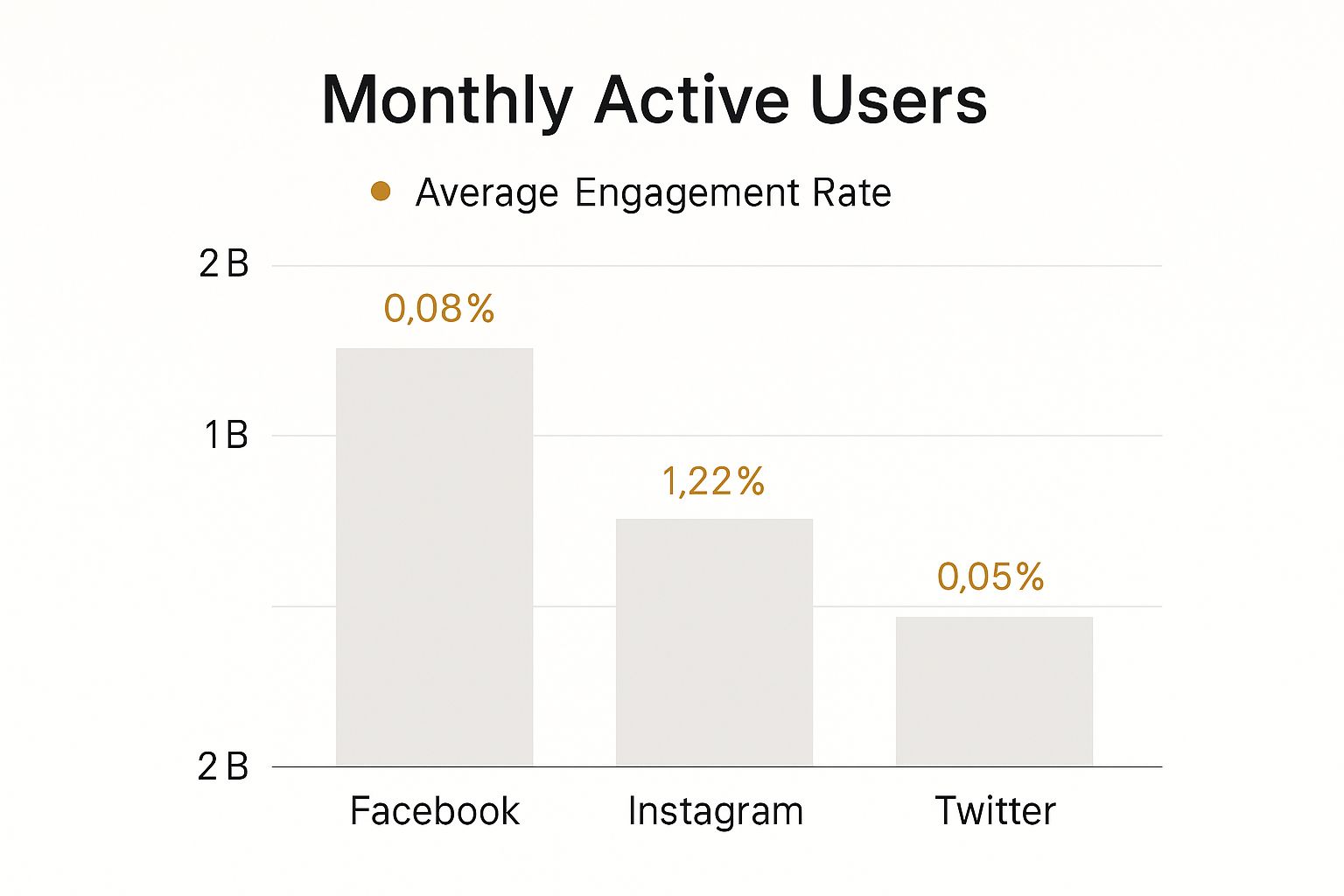
This graphic drives home the point perfectly. A platform like Facebook might have an enormous user base, but its average engagement is a fraction of Instagram's. It's a classic case of quality over quantity—reach means nothing without real interaction.
By pairing strong, relevant pillars with a smart mix of content formats designed for each platform, your strategy evolves. It stops being a random list of ideas and becomes a dynamic, effective plan that keeps your feed fresh while steadily building your authority on the topics that matter most.
Creating a Sustainable Content Calendar

A brilliant social media strategy with well-defined content pillars is just an idea until you actually execute it. This is where the content calendar comes into play, turning that grand vision into a practical, day-to-day action plan. It’s the difference between having a blueprint and actually laying the bricks.
Think of it as your social media command centre. A properly organised calendar gets rid of that daily panic of, "What on earth should I post today?" and replaces it with a clear, deliberate schedule. It ensures your content mix is balanced, your messaging stays on point, and you never miss a chance to connect with your audience.
Without this structure, you're just winging it. You’ll end up posting sporadically, forgetting key campaign dates, and letting your carefully crafted strategy drift. A calendar is your anchor, keeping your efforts focused and, most importantly, sustainable for the long haul.
Building Your Calendar Framework
A truly functional content calendar is more than just a list of dates and post ideas. It’s a comprehensive document that gives you a complete snapshot of your upcoming content at a single glance. And you don't need fancy software to get started—a simple spreadsheet can work wonders.
For each post, your calendar should track a few key details:
- Date and Time: The exact moment the post will go live.
- Platform: Which social network is this content for (e.g., Instagram, LinkedIn)?
- Content Pillar: Which core theme does this post support?
- Content Format: Is it a Reel, a carousel, a simple text post, or a Story?
- Copy: The full caption, including any calls to action.
- Visuals: A link to the final image, video, or graphic.
- Status: A simple tracker to show where it is in the process (e.g., Idea, In Progress, Scheduled, Published).
By organising this information, you create a single source of truth for your entire team. To get this right and maintain consistency, using a social media content calendar blueprint is a great way to plan and organise your posts from the get-go.
Finding Your Posting Cadence
One of the first questions everyone asks is, "How often should I post?" Honestly, there's no magic number. The real answer is finding a rhythm that is sustainable for you and valuable for your audience. Pushing out seven low-quality pieces a week is far less effective than sharing three genuinely high-impact posts.
Start by thinking about the nature of each platform. Fast-paced networks like X (formerly Twitter) or TikTok often reward more frequent, in-the-moment content. On the other hand, platforms like LinkedIn or Instagram tend to favour less frequent but more polished and thoughtful posts.
Keep a close eye on your analytics. If you ramp up your posting frequency and see engagement start to dip, it might be a sign of audience fatigue. Your calendar is the perfect tool for testing different cadences to find that sweet spot that maximises reach without overwhelming your followers.
The best posting frequency is the one you can consistently maintain with high-quality content. Consistency builds expectation and trust, which is far more important than sheer volume.
The Power of Content Batching
Trying to create fresh content every single day is a surefire recipe for burnout. This is where content batching—creating multiple posts in a single, dedicated session—becomes a total game-changer. It’s easily the most efficient way to fill your calendar and keep your quality high.
Batching works by grouping similar tasks together. For example, you could structure your week like this:
- Ideate on Monday: Brainstorm all your post ideas for the next two weeks.
- Write on Tuesday: Draft all the captions and copy for those ideas.
- Create on Wednesday: Film all your videos and design all your graphics in one go.
- Schedule on Thursday: Load everything into your scheduling tool.
This method streamlines your workflow, letting you get into a creative flow state without constantly switching gears. It frees up the rest of your week to focus on community engagement, analysing performance, and other important strategic work. For more great content ideas and strategic guides, be sure to explore our regularly updated marketing blog.
By combining a structured calendar with an efficient creation process like batching, you turn your social media strategy into a well-oiled machine that consistently delivers results.
Measuring Your Success and Fine-Tuning Your Strategy
So you’ve built a brilliant social media content strategy. That's a huge first step, but it's only half the journey. The other, arguably more crucial half, is figuring out if any of it is actually working. Without measuring your performance, you’re just posting into the void, hoping for the best.
A great strategy isn't something you set and forget. Think of it as a living, breathing plan that needs to adapt and improve. And what fuels that improvement? Data. By tracking the right numbers, you can stop guessing what your audience wants and start giving it to them with confidence.
Look Past the Vanity Metrics
It’s tempting to get swept up in vanity metrics—things like follower counts and page likes. They look impressive on a report, but they don’t tell you much about your real impact. Having a massive audience is meaningless if they’re not engaging with your content or taking actions that actually help your business.
Real success comes from tracking metrics that are directly linked to the S.M.A.R.T. goals you set earlier. These are your Key Performance Indicators (KPIs), and they reveal the true health of your social media efforts. To really get a handle on what's driving growth, you need to master your social media Key Performance Indicators (KPIs).
Here’s a simple way to connect your goals to the right data points:
- For Brand Awareness: Keep an eye on Reach (the number of unique people who see your post) and Impressions (the total number of times your post was seen). This shows you how far your message is spreading.
- For Engagement: This is all about interaction. Track Likes, Comments, Shares, and Saves. These actions are a clear sign that your content is hitting the mark.
- For Website Traffic: Your Click-Through Rate (CTR) is king here. It tells you the percentage of people who saw your post and were interested enough to click the link.
- For Sales and Conversions: This is where the rubber meets the road. Track your Conversion Rate from social media to see how many followers are turning into actual customers.
A social media strategy without data is just a collection of hopeful posts. A strategy guided by data becomes a powerful business tool that delivers a measurable return on investment.
To make this even clearer, it helps to map your KPIs directly to your overarching business goals. The right metric depends entirely on what you're trying to achieve.
Mapping Social Media KPIs to Business Goals
| Business Goal | Primary Social Media KPIs to Track | Example Metric |
|---|---|---|
| Increase Brand Awareness | Reach, Impressions, Audience Growth Rate | A 20% increase in post reach quarter-over-quarter. |
| Boost Community Engagement | Likes, Comments, Shares, Mentions, Saves | Achieving an average engagement rate of 4% per post. |
| Drive Traffic to Website | Click-Through Rate (CTR), Link Clicks | Generating 500 website clicks from a specific campaign link. |
| Generate New Leads | Form Fills, Gated Content Downloads | Capturing 50 new leads from a webinar sign-up post. |
| Increase Sales/Revenue | Conversion Rate, Revenue from Social Clicks | Attributing £2,000 in sales to a social media promo code. |
As you can see, connecting a specific number to your goal makes it tangible and easy to report on. This moves you from "we want more engagement" to "we need to hit a 4% engagement rate".
Use Analytics and A/B Testing to Get Better Over Time
Every major social platform—from Facebook and Instagram to LinkedIn—has built-in analytics dashboards. These are your best friends. Dive into them regularly to understand your audience, see which posts are performing best, and even find out when your followers are most active online.
These insights should guide your next moves. If you notice your videos consistently get double the engagement of your static images, that’s a massive clue. It's time to invest more in video production.
This data-driven approach naturally leads to A/B testing. It sounds technical, but it’s simple: you create two slightly different versions of a post to see which one performs better. You could test things like:
- Different headlines or captions.
- Various images or video thumbnails.
- Alternative calls-to-action (e.g., “Learn More” vs. “Shop Now”).
By testing these small variables one at a time, you slowly but surely discover what truly grabs your audience’s attention. This cycle of analysing, testing, and refining turns your strategy into a powerful engine for continuous improvement, ensuring your efforts get sharper and more effective over time.
Right then, let's tackle some of the common questions that always come up, even with the most well-thought-out plan. Think of this as your go-to FAQ for when you’re in the thick of managing your social media and need a quick, practical answer.
These are the things that often trip marketers up. Getting them right will help you steer clear of common pitfalls and keep your strategy on track.
How Often Should I Post on Social Media?
Honestly, there's no single magic number here. The right posting frequency really comes down to the specific platform you're using and what your audience has come to expect from you.
As a general rule of thumb, aiming for 3-5 posts a week on platforms like Instagram and Facebook is a solid starting point. For something more fast-paced like TikTok, you might find that daily content works better.
But here’s the most important thing to remember: consistency always trumps quantity. It’s far more effective to share three genuinely valuable posts each week than to churn out seven that are rushed and mediocre. Keep a close eye on your engagement rates and reach—that data will tell you exactly what’s working and when you need to adjust.
What Is the Difference Between a Content Strategy and a Content Calendar?
This is a classic point of confusion, but the distinction is actually quite straightforward. The simplest way to think about it is that your strategy is the ‘why’, while your calendar is the ‘what’ and ‘when’.
Your social media content strategy is your high-level blueprint. It outlines your goals, who you’re talking to, and the core themes you'll focus on. The content calendar is the tactical, on-the-ground tool you use to bring that strategy to life day by day.
Your calendar is where the rubber meets the road. It’s where you schedule the specific posts, write the copy, and plan the visuals. One can’t really work without the other; they are two sides of the same strategic coin.
How Do I Find New Content Ideas?
The fear of running out of ideas is real for every single content creator. The good news is that inspiration is usually hiding in plain sight. Always start with your core content pillars—they act as your guardrails, making sure everything you create is on-brand and serves your purpose.
When you need to branch out from there, try a few of these proven methods:
- Listen to your audience: What are people asking in your comments and DMs? Those questions are basically free content ideas.
- Check out the competition: See what’s resonating with their audience. You're not looking to copy them, but to spot gaps you can fill with your own unique angle.
- Use topic research tools: Websites like AnswerThePublic are brilliant for seeing the exact questions people are typing into search engines about your industry.
- Just ask! Run polls in your stories, post a Q&A sticker, or send out a survey. Find out directly from your followers what they want to learn or see from you.
My best advice? Keep a running list of ideas—in a notebook, a spreadsheet, wherever—so you never have to stare at a blank page again.
Discover the best tools to bring your strategy to life. At The Digital Marketing Toolbox, we’ve curated the top solutions for social media management, content creation, and analytics to help you grow. Explore and compare your options.


