

Cohort analysis is a powerful way to understand how people interact with your business over time. Rather than lumping all your users into one giant, anonymous pool, it slices them into smaller, related groups called cohorts. This lets you track and compare their behaviour as they move through their customer journey.
What Is Cohort Analysis, Really?

Think of it like a school's graduating classes. You wouldn't analyse every student from every year all at once; that would be chaos. Instead, you'd look at the "Class of 2024" as one group, the "Class of 2023" as another, and so on. This lets you see how each specific year group performs over time. Cohort analysis applies this exact logic to your customers.
Looking at your user base as a single entity often hides the most important trends. Cohort analysis solves this by grouping users based on a shared starting point, such as the month they signed up or the day they made their first purchase.
This simple shift in perspective can reveal incredible patterns in user behaviour—like engagement levels, spending habits, and long-term loyalty—that are completely invisible in your overall metrics. Once you understand these nuances, you can start making much smarter, more targeted business decisions. For more on foundational concepts like this, our beginners guide to digital marketing is a great place to start.
The Building Blocks of Cohort Analysis
To get your head around it, you only need to grasp three core components. These are the foundation of any cohort analysis you'll ever run.
- The Cohort: This is the specific group of users you're examining. The key is that they all share a common characteristic, which is usually their acquisition date (e.g., "everyone who signed up in March").
- The Acquisition Date: This is the specific timeframe that defines your cohort. It's their shared starting line—whether that’s a particular day, week, or month.
- The Metric: This is the key performance indicator (KPI) you're tracking for that group over time. It could be anything from customer retention rate and repeat purchases to how often they use a certain feature.
Cohort analysis provides a clear lens to see how different groups of customers truly interact with your business over its lifecycle. It moves you from generic, company-wide averages to specific, actionable insights about user behaviour.
The idea of tracking groups over time isn't new. In fact, it has deep roots in scientific research. A famous example is the 1970 British Cohort Study (BCS70), which started following over 17,000 babies born in a single week across the UK. Now running for more than 50 years, this study has yielded incredible data on everything from health to economic success. You can read more about this long-running study and its fascinating impact.
Why Cohort Analysis Is a Game-Changer for Growth
Knowing what cohort analysis is is one thing, but understanding why it’s so essential for growing your business is where the magic really happens. Its greatest strength? It gives you a brutally honest look at customer retention. Instead of looking at one single, often misleading, company-wide retention rate, you can see exactly how long different customer groups actually stick around.
This clarity is everything. It lets you ditch the vanity metrics and start asking much smarter questions. For example, you can directly compare a cohort of customers you acquired through a paid social media campaign against another group from organic search. This quickly shows you which channels bring in loyal, high-value users and which ones just deliver a quick burst of sign-ups that vanish.
This kind of insight is fundamental to building a smart marketing strategy for small business, as it directly ties what you spend on acquisition to the long-term value you get back.
Pinpointing What Truly Matters
Cohort analysis is also your best detective for finding that "aha!" moment in your customer's journey. You know the one—the specific action or set of actions that flips a switch and turns a casual user into a devoted fan. By creating behavioural cohorts (grouping users by what they did, like inviting a friend or finishing an onboarding tutorial), you can see if their retention rates soar above those who didn't take that action.
Let's say you discover that users who try Feature X within their first week have a 20% higher retention rate after three months. Boom. You've just found a massive lever for growth. That data gives you a clear mission: get every new user to that feature, and fast.
By isolating the actions of your most successful users, cohort analysis gives you a repeatable playbook for creating more of them. It turns guesswork about user value into a data-driven strategy.
Measuring the Real Impact of Change
Finally, cohort analysis gives you undeniable proof that your product improvements are actually working. Picture this: you roll out a major update to your user interface in March. To measure its success, you can simply compare the retention curve of your March cohort (the first to see the new design) with the February cohort.
If the March group shows better long-term engagement and a lower drop-off rate, you have solid proof your changes made a positive difference. Without this direct comparison, you’d just be looking at a blended average, making it impossible to know for sure what worked. Digging into what causes customers to leave, often through a detailed churn rate analysis, is crucial for lasting success. This approach shifts you from correlation to causation, empowering you to make confident, data-backed decisions that drive real, sustainable growth.
How to Run Your First Cohort Analysis
The idea of running a cohort analysis can sound a bit intimidating, maybe like something you’d need a data science degree for. But honestly, it’s much more straightforward than you might think. Let’s walk through the process step-by-step, and you'll see how to turn what feels complex into a clear, manageable task. You don't need expensive software to get started—just a good question and your user data.
Everything starts with a clear business question. A fuzzy goal like "improve retention" is a dead end because it’s too broad. You need to get specific. A much better question would be, "How did our new onboarding process, launched in March, affect user retention after 30 days compared to the users who joined in February?" This kind of focus tells you exactly what data you need to pull.
Gathering Your Essential Data
To answer a question like that, you only need three key pieces of information for each user. Think of them as the basic ingredients for your analysis.
- A Unique Identifier: This is anything that lets you tell one user apart from another, like a user ID, customer number, or email address.
- An Acquisition Date: This is the crucial timestamp that sorts each user into their cohort. In our example, it would be the date they signed up.
- Ongoing Activity Dates: You’ll need a record of when users come back and do something meaningful, whether that’s logging in, making a purchase, or using a key feature.
Once you have these three data points, you've got everything you need to build your first cohort chart, which is often called a retention table. The next step is to group users by their sign-up month and then track their activity over the following weeks or months.
The infographic below shows how this works in practice, from the initial marketing campaign that brings people in to the retention analysis that shows who sticks around.
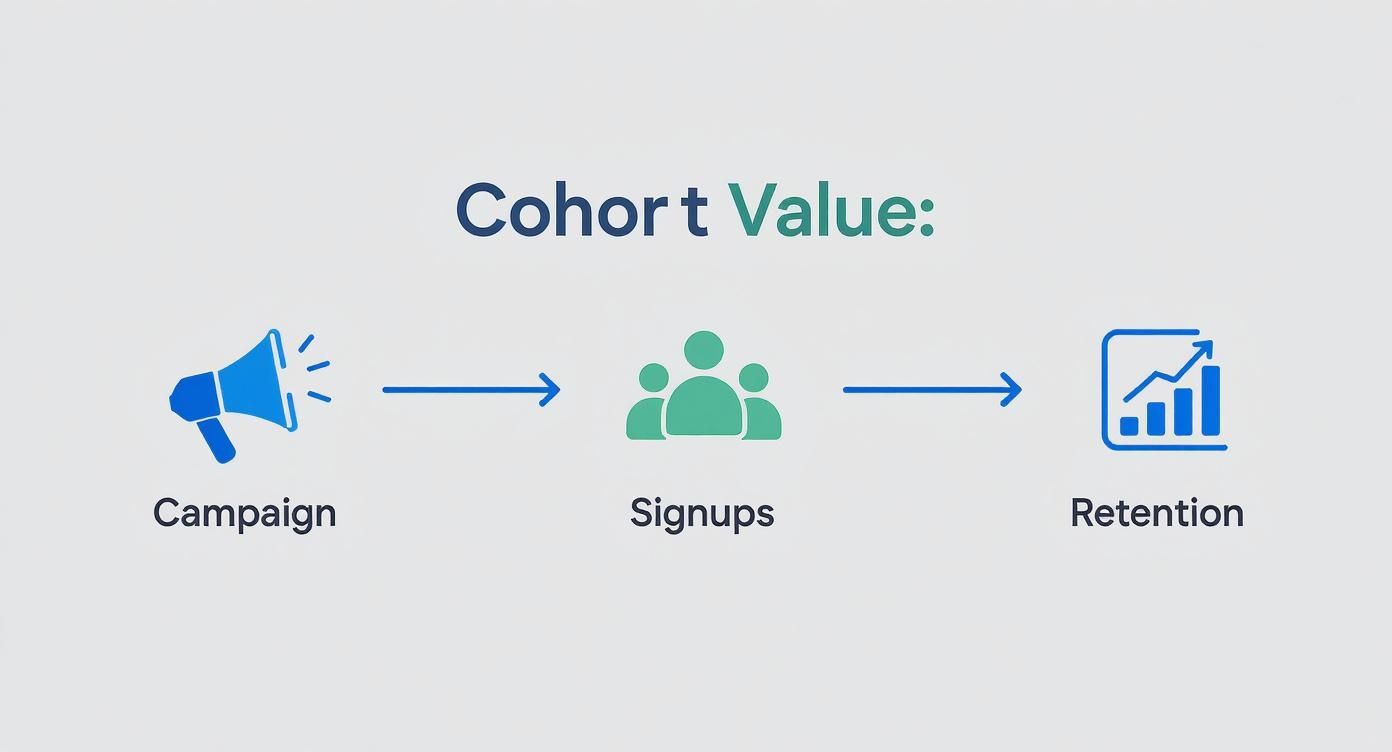
As you can see, every retention analysis traces back to a specific moment of acquisition, connecting your marketing efforts directly to long-term user behaviour.
Structuring Your Retention Table
Okay, let's get this data organised into a proper cohort chart. This table is the heart and soul of your analysis, giving you a clear, at-a-glance view of how your users behave over time.
Each row in the table represents a cohort. For our example, that means all the users who signed up in a particular month (like February or March). The columns track the user’s lifecycle in intervals, like Month 0 (the month they signed up), Month 1, Month 2, and so on.
The cell where a row and column meet shows the percentage of users from that original cohort who were still active during that specific period. You’ll notice the first column (Month 0) always shows 100%—that’s because everyone is, by definition, active in the month they join.
By organising your data this way, you’re no longer just looking at raw numbers. You’re starting to see a story unfold. You can quickly compare the March cohort against the February one and see if your new onboarding process actually made a measurable difference in keeping people engaged.
Reading the Story Your Cohort Data Is Telling

A cohort chart isn't just a grid of numbers; it's a story about your users. Every row and column holds a clue about their journey with your brand, but you have to know how to spot the patterns. Learning to read these clues is what turns a static report into a dynamic tool for making smarter decisions.
You can interpret a cohort retention table in two main ways: by reading it horizontally and by reading it vertically. Each direction answers a different, but equally vital, question about your user base.
Following One Cohort’s Journey Over Time
Reading across a single row reveals the life story of one specific cohort. This horizontal view tracks a group—say, your "January Signups"—from their very first day through the following weeks or months. It shows you exactly how their engagement holds up or drops off over time.
For instance, do you notice a steep decline between Month 1 and Month 2? That’s a classic sign of an onboarding issue. Your initial hook might be strong, but users aren't discovering long-term value. A healthy row, on the other hand, shows a gradual decline that eventually levels off, which points to a loyal core of retained users.
This kind of long-term tracking has roots in social sciences. A great example is the Millennium Cohort Study (MCS), which follows around 19,000 UK children born between 2000-2002 to understand the long-term impact of social policies. You can learn more about this detailed tracking from the Centre for Longitudinal Studies.
Comparing Different Cohorts at the Same Stage
Scanning down a column lets you compare different cohorts at the same point in their user lifecycle. By looking down the "Month 3" column, for example, you can see the retention rate for every cohort exactly three months after they first signed up.
This vertical comparison is incredibly useful for gauging the impact of your actions. Did you roll out a major new feature in March? Look at the Month 3 retention for the March cohort and compare it to the February and January groups. You'll quickly see if the feature made a real difference.
If newer cohorts consistently outperform older ones at the same lifecycle stage, it's a strong signal that your product improvements, marketing changes, or user experience updates are working.
This is where the real magic happens. You might find that every cohort acquired after you redesigned your user interface has a 5% higher retention rate by Month 2. That’s solid proof that your changes worked.
To really pull meaningful insights from your data and make smart decisions quickly, it helps to get comfortable with mastering real-time data analytics. By blending both horizontal and vertical analysis, you can diagnose problems within a single cohort's journey and then validate your solutions by comparing them against others.
Choosing the Right Type of Cohort for Your Goal
To get real value from cohort analysis, your first job is to decide how you're going to group your users. This isn't just a small detail; it’s the foundation of your entire analysis. The way you define your cohorts dictates the questions you can ask and, ultimately, the answers you’ll find.
Choosing the right grouping is the key to unlocking genuinely useful data. There are two main ways to slice it, and each serves a very different purpose. Getting to grips with both will give you a much richer picture of how your customers behave.
Acquisition Cohorts: Pinpointing When Things Happen
The most common starting point for many is the acquisition cohort. It's pretty straightforward: you group users together based on when they first signed up, installed your app, or bought something from you. Think of it as sorting your users into graduating classes—the "Class of January," the "Class of February," and so on.
These cohorts are fantastic for understanding how user behaviour, especially retention, evolves over their lifetime with your brand. They’re brilliant for spotting the exact moment users start to drift away and for judging how well your onboarding process works.
Let’s say an e-commerce brand runs a massive Black Friday sale. They could create a cohort of everyone who signed up that day and track their spending habits over the next six months. By comparing this group to a cohort from a quiet week in October, they can see if the sale attracted loyal customers or just people after a one-off deal. It’s a simple but powerful way to gauge the real quality of customers from a big campaign.
Acquisition cohorts tell you when users drop off. They reveal critical moments in the early customer lifecycle, helping you pinpoint exactly where your onboarding or initial value proposition might be failing.
Behavioural Cohorts: Digging into the "Why"
While acquisition cohorts are all about the 'when', behavioural cohorts are about the 'what'. This approach groups users based on specific actions they took (or didn't take) during a set period. We're moving beyond the timeline here to really get under the skin of user engagement and churn.
You could create a cohort of users who tried a key feature, another for those who completed your onboarding tutorial, or even one for people who abandoned their shopping cart. The possibilities are endless.
Imagine a SaaS company rolls out a new AI reporting tool. They could build a behavioural cohort of trial users who engaged with that feature in their first week. By comparing their long-term subscription rates to users who ignored the feature, the company can put a real number on its value.
Similarly, you could explore the advantages of email marketing by creating cohorts based on who opened your welcome email series versus who didn't. This gives you a crystal-clear view of how effective that initial outreach really is.
Acquisition vs Behavioural Cohorts
So, which one should you use? It really depends on the question you're trying to answer. Here’s a quick comparison to help you decide.
| Aspect | Acquisition Cohort | Behavioural Cohort |
|---|---|---|
| Grouping Basis | Based on when a user joined or first converted (e.g., sign-up date). | Based on what a user did or didn't do (e.g., used a feature, viewed a page). |
| Primary Question | "How does behaviour change over the customer lifecycle?" | "How does a specific action impact long-term value and retention?" |
| Best For | Tracking long-term retention, measuring onboarding effectiveness, and analysing campaign ROI over time. | Identifying "aha!" moments, understanding feature adoption, and segmenting users by engagement level. |
| Example | Comparing the 6-month retention of users who signed up in January vs. February. | Comparing the subscription rate of users who used Feature X vs. those who didn't. |
Ultimately, these two types of cohorts aren't mutually exclusive. The most sophisticated analysis often involves combining them. You might start with an acquisition cohort to spot a drop-off in engagement and then use a behavioural cohort to figure out exactly why it's happening.
Right, so you've got the hang of cohort analysis. It's a fantastic tool, but like any powerful instrument, you can get some seriously wonky results if you're not careful. It’s easy to fall into a few common traps that can make your insights misleading, or worse, just plain wrong.
Let’s look at some of the classic blunders I see people make.
Don't Fall for These Common Mistakes
One of the biggest mistakes is working with cohorts that are just too small. If your cohort only has a handful of people, any blip in their activity looks like a massive trend. In reality, it’s probably just random chance. You need a big enough group for the patterns you see to be statistically significant and trustworthy.
Another classic error is completely ignoring what’s happening in the outside world. Let's say you ran a massive Black Friday sale in November. The cohort you acquired that month will probably behave very differently from the one you got in a sleepy, sale-free February. Comparing them side-by-side without acknowledging that huge promotion is comparing apples to oranges.
Keep Your Data Clean and Your Context Clear
Inconsistent tracking can completely derail your analysis before it even starts. If you change how you define an 'active user' halfway through the year, you can't compare cohorts from January with those from July. You're measuring different things, which makes the whole exercise pointless. Consistency is king.
You also have to think about how populations change over time, especially in long-term studies. For instance, a UK Public Health Data Asset that started with the 2011 Census initially covered 47.5 million people. By mid-2020, its coverage of people aged 10 and over had dropped to 86.0%. Why? People move, or sadly, pass away. The cohort naturally shrinks. If you don't account for this, your conclusions about long-term trends could be way off. You can read more about these longitudinal challenges if you're interested in the nitty-gritty.
Before you draw any conclusions, always gut-check your analysis with a few simple questions. Is my cohort large enough to matter? What external factors might be skewing these results? And are my definitions consistent across the board?
Steering clear of these pitfalls is what separates a pretty chart from a genuinely powerful strategic tool. It's about being diligent and making sure the story your data is telling is one you can actually rely on.
Your Top Questions About Cohort Analysis, Answered
Getting started with cohort analysis often brings up a few common questions. Let's tackle some of the practical hurdles you might encounter.
What's the Difference Between Cohort Analysis and Segmentation?
It's easy to get these two mixed up, but the distinction is crucial. Segmentation is all about grouping users by who they are—think demographics, location, or purchase history. It's a static picture. You might have a segment for "all users from London."
Cohort analysis, on the other hand, groups users by a shared experience within a specific timeframe. For instance, "everyone who signed up in January" is a cohort. The magic happens when you track this group's behaviour over their entire journey. You can even get more granular by looking at the "London segment" within the "January sign-up cohort."
In short: Segmentation tells you who your users are right now. Cohort analysis tells you how the behaviour of users who started at the same time evolves.
What Are the Best Tools for Cohort Analysis?
You don't need a massive budget to get started. A simple spreadsheet like Google Sheets or Microsoft Excel can work perfectly well for some initial, basic analysis.
However, once you're ready for more automated and powerful insights, you’ll want to look at dedicated product analytics platforms. Tools like Google Analytics, Mixpanel, and Amplitude have fantastic, built-in cohort analysis features. They take care of the heavy lifting on data collection and visualisation, so you can focus on what the numbers actually mean.
How Often Should I Run a Cohort Analysis?
There’s no single right answer here—it really depends on the pulse of your business. If you're running a fast-moving mobile app and pushing out new updates every week, you'll want to check your weekly cohorts to see what impact those changes are having.
For a B2B SaaS business with a much longer customer lifecycle, a monthly or even quarterly analysis will likely give you more meaningful data. The key is to check in often enough to spot trends before they become problems and make smart, timely decisions based on what you find.
Ready to put all this into action? At The Digital Marketing Toolbox, we hand-pick the best analytics, SEO, and engagement tools designed to help you turn raw data into real growth. Discover the right solutions for your business today!


