
Ever wondered how much it actually costs to win a new customer? That's precisely what Cost Per Acquisition (CPA) tells you. Think of it as the final price tag for acquiring one new paying customer through a specific marketing campaign.
CPA cuts through the noise and answers the most critical question for any growing business: how much did we really spend to get that sale?
Decoding Your True Customer Cost

Let's use an analogy. If you owned a coffee shop, you wouldn't calculate the cost of a latte by just looking at the price of the coffee beans. You’d have to factor in the milk, the cup, the electricity for the espresso machine, and even a portion of the barista's wages.
CPA works the exact same way for your marketing. It’s not just about what you spend on ads; it’s the total, all-in investment needed to turn a prospect into a paying customer. Getting a handle on your CPA is the first step toward building a truly profitable growth strategy, helping you look beyond surface-level stats like clicks and impressions.
To really nail down what CPA means for your business, it helps to break down its core parts.
CPA at a Glance Key Components
| Component | What It Means for Your Business |
|---|---|
| Total Marketing Spend | This is the entire cost of a campaign, including ad spend, creative costs, software fees, and staff time. |
| New Customers Acquired | This refers only to brand-new, paying customers who came directly from that specific campaign. |
| The Final CPA Figure | The result gives you a clear, hard number on the efficiency of your marketing investment. |
Seeing these components laid out makes it clear that CPA is a bottom-line metric focused squarely on financial performance.
Acquisition vs. Conversion: What's The Difference?
People often get 'acquisition' and 'conversion' mixed up, but the distinction is crucial for your bottom line. They might sound similar, but they measure very different things.
An acquisition is a new, paying customer. A conversion is any valuable action a user takes, like signing up for a newsletter, downloading an ebook, or filling out a contact form.
Think of it this way: a conversion is a step on the path to a sale, while an acquisition is the sale. Your CPA exclusively tracks the ultimate goal—securing that paying customer.
This matters because you could have a fantastic cost per lead (a type of conversion), but if none of those leads ever actually buy from you, your real Cost Per Acquisition could be sky-high and completely unsustainable.
Understanding models like Pay-Per-Click (PPC) advertising is a great way to see how campaign costs are generated. If you're just starting out, our beginner's guide to digital marketing can give you a solid foundation for how different channels work together to influence your overall CPA.
How to Calculate Your Cost Per Acquisition
Getting to grips with your Cost Per Acquisition is actually less complicated than you might think. At its heart, the whole thing hinges on one simple formula, but it’s a formula that gives you a crystal-clear snapshot of how well your marketing is really working.
The Foundational CPA Formula:
Total Campaign Cost ÷ Number of New Customers Acquired = Cost Per Acquisition (CPA)
This calculation answers the big question: "How much did we actually spend to bring each new customer through the door?" But here's the catch—the accuracy of your final CPA figure is only as good as the numbers you put in. The devil is in the detail of what you include in your "Total Campaign Cost".
A classic misstep is to look only at the ad spend. It’s an easy mistake to make, but it gives you a dangerously optimistic CPA that isn't rooted in reality. To get the true picture, you need to be honest and account for every single cost tied to that campaign. Only then can you make smart decisions based on real data, not just wishful thinking.
Defining Your Total Campaign Cost
So, what exactly goes into that "total cost"? To calculate your CPA properly, you’ve got to add up all the associated expenses. A complete cost breakdown goes way beyond what you paid for the ad placements themselves.
Here are the key things you absolutely must include in your calculation:
- Direct Ad Spend: This is the easy one. It’s the money you paid directly to platforms like Google, Meta, or LinkedIn to run your ads.
- Creative and Production Costs: Did you pay a designer for the visuals? Hire a copywriter? Those fees are a direct part of the cost of acquiring a customer.
- Software and Tool Subscriptions: Don't forget the tech stack. That includes any marketing software you used for the campaign, like analytics tools, landing page builders, or automation platforms.
- Team and Agency Costs: You need to factor in the portion of your marketing team’s salaries that was spent on this campaign. If you hired an outside agency, their fees go in here too.
Let’s walk through a real-world example to see how this plays out.
Imagine a UK-based online shop runs a Google Ads campaign for a month. Their total ad spend was £5,000. On top of that, they paid a freelance designer £500 for the ad creative and used a landing page tool that cost £100 for the month.
The campaign was a success, bringing in 120 brand new customers.
Plugging this into our formula:
(£5,000 + £500 + £100) ÷ 120 = £46.67 CPA
So, for every new customer they won, it cost them £46.67. This all-in figure gives them a much more accurate and useful understanding of their campaign's performance than if they'd just looked at the ad spend alone.
Here's the rewritten section, crafted to sound more human and expert-led, while following all your instructions.
Why CPA Is More Than Just a Metric
So, you’ve worked out how to calculate your Cost Per Acquisition. That’s a great first step, but the real magic isn’t in the number itself—it’s in what you do with it. CPA isn't just another figure to slot into a spreadsheet. Think of it as a compass for your business, guiding every decision you make towards real, sustainable growth.
It’s easy to fall into the trap of seeing CPA as just another cost. But it’s not an expense; it’s an investment in your company’s future. Every single pound you put into winning a new customer needs to bring a return, and knowing your CPA is the only way to make sure that happens. It’s what stands between you and burning through your budget.
A Guiding Light for Business Decisions
Once you have a firm grip on your CPA, it changes everything. It pulls you out of the world of guesswork and into the realm of data-backed strategy, ensuring your time and money are spent where they’ll have the biggest impact. When you know precisely what it costs to land a customer, you're suddenly empowered to make much smarter moves.
For example, this one number helps you:
- Protect Your Profit Margins: You can finally set your prices with confidence, knowing they not only cover the cost of acquisition but also leave a healthy margin for profit.
- Optimise Your Marketing Spend: By comparing the CPA from different channels—say, Google Ads versus your efforts on social media—you can funnel your budget into the platforms that are actually delivering the goods.
- Set Achievable Growth Targets: No more plucking numbers out of thin air. Understanding acquisition costs lets you accurately forecast the investment needed to hit your customer growth goals.
Ultimately, a well-managed CPA is what makes a business scalable. It stops you from pouring cash into channels that aren't working and shines a spotlight on the ones that are. This is the kind of insight that separates the businesses that grow efficiently from those that just run out of money.
The Ultimate Health Check: Your LTV to CPA Ratio
To get the full picture of your business's long-term viability, you need to look at CPA alongside another crucial metric: Customer Lifetime Value (LTV). Simply put, LTV is the total amount of money you expect a customer to spend with you over their entire relationship with your brand.
When you compare these two figures, you get the LTV:CPA ratio, which is arguably the single most important measure of a healthy business model.
The LTV:CPA ratio reveals how much value a customer brings in compared to what it cost you to get them through the door. A sustainable business will always make far more from a customer than it spent to win them over.
A good rule of thumb is to aim for an LTV:CPA ratio of 3:1 or higher. This means for every £1 you spend to acquire a customer, you get £3 back in lifetime value. If your ratio dips below 1:1, alarm bells should be ringing—you’re actively losing money on every new person you bring in, and your strategy needs a serious rethink. This simple ratio turns CPA from a standalone number into a powerful diagnostic tool, telling you if your growth is actually profitable and built to last.
What's a Good CPA? A Look at Industry Benchmarks
Figuring out if you have a "good" Cost Per Acquisition isn't about chasing some universal magic number. It's all about context. A CPA that would have an e-commerce brand popping champagne could spell disaster for a B2B software company. The number only really starts to mean something when you measure it against your own industry's standards.
Why such a massive difference? It's simple: different sectors play by completely different rules. A business that enjoys a high customer lifetime value and regular repeat purchases can stomach a much higher initial CPA than a company selling low-cost, one-off items. Getting your head around this from the get-go stops you from chasing unrealistic targets and helps you set goals that are both ambitious and grounded in your market's reality.
This infographic breaks down how CPA is tied directly to your profit margins, budget, and the all-important LTV:CPA ratio, showing why it’s a central pillar of any solid business strategy.
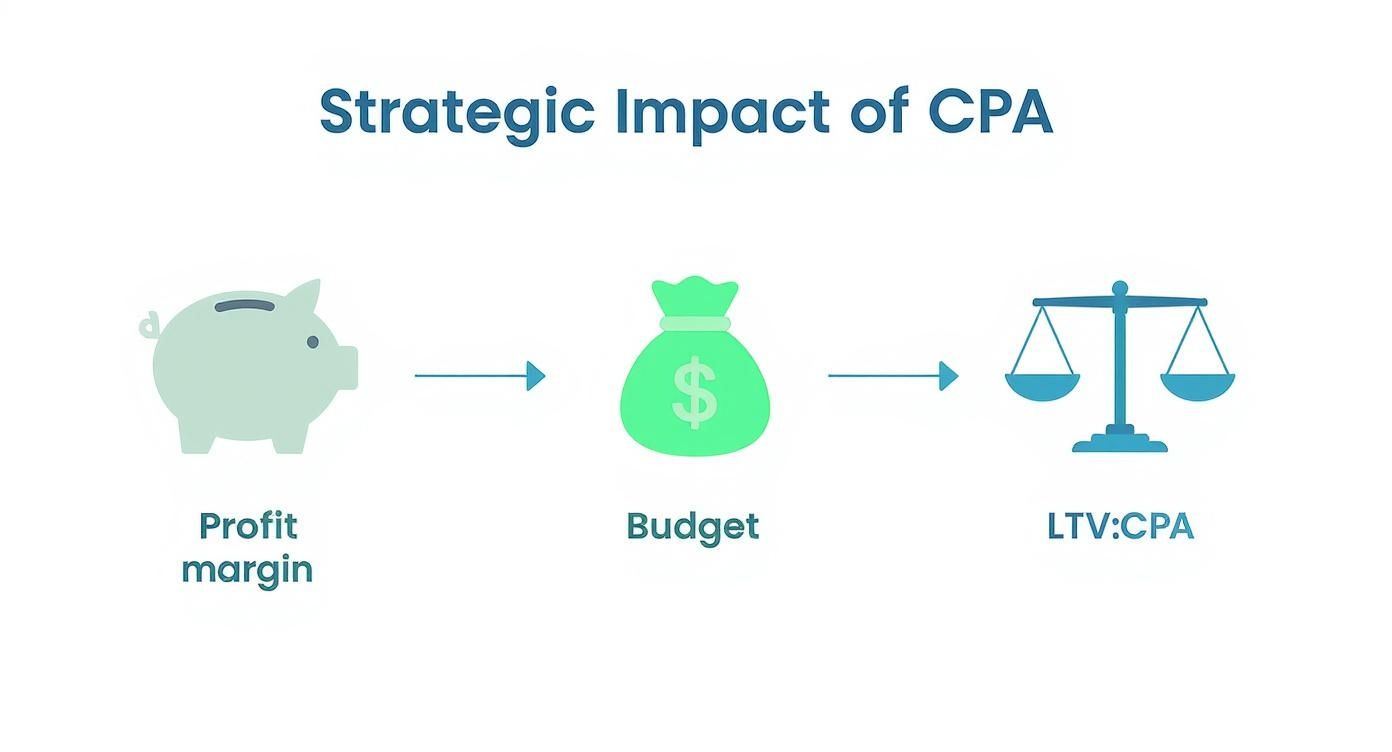
As you can see, a well-managed CPA doesn't just sit on a spreadsheet. It actively fuels healthy profits, lets you allocate your budget with confidence, and ultimately ensures your growth is built to last.
Key Factors That Shape Industry CPAs
Several core dynamics cause CPA benchmarks to swing so wildly from one industry to the next. Understanding these is the key to judging your own performance fairly and setting expectations that make sense for your campaigns.
A few of the biggest influences include:
- Length of the Sales Cycle: How long it takes to convert a lead into a paying customer has a huge impact on cost. B2B industries often face long, complex sales cycles with multiple decision-makers, which naturally pushes CPA higher compared to a quick impulse buy in retail.
- Average Order Value (AOV): If you're selling high-ticket items like enterprise software or bespoke furniture, you can justify a much higher CPA. The immediate return on that acquisition cost is simply that much greater.
- Market Competition: The more players in your field, the more you'll have to pay for attention. Fierce competition on platforms like Google Ads and Meta Ads drives up bid prices, which has a direct knock-on effect on your CPA.
A "good" CPA is not a fixed target but a moving one. It's a figure that is competitive, sustainable, and profitable within the unique economic realities of your specific industry.
CPA Benchmarks in the UK Market
To give you a clearer picture, let's look at some illustrative CPA benchmarks for different sectors in the UK.
Illustrative CPA Benchmarks by UK Industry
| Industry | Average CPA Range (Illustrative) |
|---|---|
| E-commerce (Fashion/Retail) | £45 – £95 |
| B2B SaaS (Software) | £150 – £450+ |
| Finance & Insurance | £100 – £300 |
| Legal Services | £200 – £600+ |
| Travel & Hospitality | £30 – £80 |
| Education | £50 – £150 |
| Healthcare | £70 – £200 |
Please note: These are generalised ranges and can vary significantly based on the specific niche, audience, and marketing channels used.
For example, the UK e-commerce scene has seen acquisition costs shoot up recently. The average CPA for many online retailers now hovers around £68–£78, a significant jump from just a few years ago. You can read more on the rising costs in UK e-commerce to see just how much the market has shifted.
Contrast that with a B2B SaaS company, where a CPA of £200-£400 (or even more) isn't unusual. That figure might seem eye-watering, but it’s perfectly sustainable if the average customer lifetime value runs into the thousands. On the higher end, industries like legal and financial services can see CPAs climbing past £500, driven by intense competition and the massive value each new client represents.
Once you understand these industry-specific quirks, you can stop asking, "What is my CPA?" and start asking the much more powerful question: "Is my CPA optimised for profitable growth in my market?"
Proven Strategies to Lower Your CPA
Knowing your Cost Per Acquisition is a great start, but actively driving it down is where you really get a competitive edge. A high CPA can bleed your budget dry and stunt your growth, while a smart, strategic approach can transform a costly campaign into a profit-making machine. The aim isn't just about spending less money; it’s about spending it smarter—trimming the fat and investing more in what actually delivers results.
Think of lowering your CPA as an ongoing process of fine-tuning, not a one-and-done task. It’s a blend of sharp analysis, creative experimentation, and a genuine understanding of your customer’s journey. By methodically improving every single touchpoint, from the initial ad they see to the final thank-you page, you can make every pound in your marketing budget work that much harder.
Sharpen Your Ad Targeting
One of the fastest ways to slash wasted spend is to stop showing your ads to people who will never buy from you. It’s a simple concept. Casting your net too wide means you end up paying for clicks from users who were never a good fit in the first place. Precision targeting is your best defence against an overinflated CPA.
Start by getting your hands dirty with data. Dive into your analytics and pinpoint the specific demographics, interests, and behaviours of your most profitable customers. Use these insights to build out detailed customer profiles and tighten up your targeting criteria across your ad platforms.
A few key areas to focus on right away include:
- Negative Keywords: Be ruthless in excluding search terms that are irrelevant. For example, if you sell premium leather shoes, you'll want to add negative keywords like “cheap,” “repair,” and “second-hand” to avoid paying for those unqualified clicks.
- Lookalike Audiences: Take your existing customer list and let platforms like Meta and Google work their magic by building lookalike audiences. They’ll find new users who share common traits with your best customers, which can massively improve your ad relevance.
- Geotargeting: Don’t waste your budget advertising in locations you can't serve or where your ideal customers simply don't live. Get specific with your geographical targeting to focus your spend on the most promising areas.
Optimise the Landing Page Experience
You could craft the most compelling ad in history, but if it clicks through to a slow, confusing, or untrustworthy landing page, your CPA will inevitably climb. That transition from ad to page needs to be completely seamless. This is the point where so many potential customers drop off. The page has to instantly deliver on the promise you made in your ad.
A great landing page is crystal clear, compelling, and laser-focused on a single call-to-action (CTA). Anything that pulls attention away from that one goal—like a complicated menu or competing offers—adds friction and kills your conversion rate.
Your landing page isn't just a destination; it's a crucial part of the conversion conversation. It needs to reassure the user they've come to the right place and make it incredibly easy for them to take the next step.
Make a habit of continuously testing different elements. Tweak your headlines, CTA button colours, page layouts, and, crucially, your page speed. A Google study found that when page load time goes from one to three seconds, the probability of someone leaving skyrockets by 32%. A faster, more intuitive page directly leads to better conversion rates and, you guessed it, a lower CPA.
Leverage A/B Testing and Creative Iteration
Never fall into the trap of assuming you know which ad copy or image will perform best. A/B testing (or split testing) is your most reliable tool for making creative decisions based on hard data, not just gut feelings. It’s as simple as running two different versions of an ad at the same time to see which one performs better.
This methodical approach lets you pinpoint exactly what resonates with your audience. You can test almost anything: the headline, the main text, the image or video, and the call-to-action. By constantly testing and refining, you can systematically improve your click-through and conversion rates, which directly pushes your CPA down. Embracing more advanced tech, such as adaptive machine learning for real-time bidding in ads, can also help dynamically optimise your ad placements to grab conversions at the best possible price.
Beyond paid ads, think about how you can nurture leads more efficiently. For instance, exploring the advantages of email marketing can help you build a low-cost channel for turning interested prospects into loyal customers over time, which improves your overall blended CPA even further.
Tying It All Together for Sustainable Growth
We’ve covered a lot of ground in this guide, starting with the basic definition of Cost Per Acquisition, moving on to the calculation, and finally exploring some powerful ways to bring it down. If there’s one thing to remember, it’s this: CPA isn't a metric you can just set and forget. Think of it as a living, breathing indicator of your marketing’s health and your business’s overall efficiency.
When you treat it that way, you naturally start monitoring it continuously and making agile adjustments. By weaving CPA analysis into your regular reporting, you transform it from a simple data point into a genuinely strategic tool. It starts to inform your budgeting, shine a light on your most profitable channels, and prove the value of your growth efforts with cold, hard numbers.
Cost Per Acquisition is the bridge between your marketing spend and your profitability. Master it, and you build a business that is not just growing, but growing smarter, stronger, and more resilient.
This approach elevates your understanding of what is cost per acquisition from a mere calculation into a cornerstone of a scalable business. To see how this fits into a bigger picture, our guide on creating a marketing strategy for small business can help you place your CPA goals within a wider framework for lasting success.
Common Questions About CPA (And Our Answers)
Even after getting the basics down, a few questions always seem to come up when teams start really digging into their Cost Per Acquisition. Getting these sorted will help you use the metric properly and steer clear of common pitfalls.
Let's clear up a few of the big ones.
What's the Difference Between CPA and CAC?
This is a classic. People often throw these terms around as if they're the same thing, but there's a small, crucial difference.
Cost Per Acquisition (CPA) is a bit of a catch-all. It can measure the cost to get someone to take any important action—not just become a customer. Think of things like signing up for a free trial, downloading a guide, or even just becoming a qualified lead. You'll sometimes hear it called Cost Per Action for this reason.
Customer Acquisition Cost (CAC), however, is laser-focused. It only measures the total cost of winning a brand new, paying customer. While it's common to hear people say "CPA" when they really mean "CAC", being precise in your own reporting is vital for accuracy.
How Often Should I Be Calculating My CPA?
Honestly, it depends entirely on the rhythm of your business and your marketing efforts.
If you're in a fast-paced world like e-commerce, with short sales cycles and campaigns that are always running, you'll want to look at your CPA weekly, maybe even daily for specific ads. It gives you that immediate feedback you need. On the flip side, for a B2B business with a six-month sales cycle, a monthly or quarterly check-in makes more sense for a strategic, big-picture view.
The most important thing isn't the schedule itself, but sticking to it. Calculating your CPA consistently is how you spot trends, see if your optimisations are working, and make smarter decisions over time.
Can My CPA Actually Be Too Low?
It sounds strange, but yes, it absolutely can. A rock-bottom CPA isn't automatically a win.
Sometimes, it’s a red flag that your marketing is playing it too safe. You might be targeting such a narrow audience that you’re not spending enough to reach new people and truly scale. You’re essentially just picking off the easy wins, but missing out on the much bigger growth opportunities waiting just beyond.
The goal isn't to hit the lowest possible CPA. It’s to find that sweet spot—a healthy, sustainable CPA that keeps you profitable while fuelling your company's growth plans.
Ready to discover the tools that can help lower your CPA and drive sustainable growth? Explore The Digital Marketing Toolbox to find and compare the best marketing solutions for your business. Find your perfect fit at https://grow-your-biz.com.


