

So, what exactly is customer journey mapping? Think of it as creating a visual story of every interaction a customer has with your business. It tracks everything from the moment they first hear your name to the point they become a loyal, raving fan. Essentially, it’s a diagram that lays out all the steps a customer takes to get what they need from you.
Seeing Your Business Through Your Customer's Eyes
Picture your customer as the hero of a story. Your business is the world they're exploring. A customer journey map is the script that follows this hero's every move, thought, and emotion. It's a powerful tool that forces you to step outside your own perspective and see your company exactly as your customers do.
This map is far more than a simple timeline. It’s a rich illustration that digs into the subtleties of the entire customer experience. Instead of just plotting out what you want the customer to do, it focuses on what the customer is actually doing, thinking, and feeling at every single touchpoint.
It's this shift in viewpoint that really matters. It’s how you uncover those moments of pure delight and, just as importantly, the frustrating sticking points that are costing you business.
The Building Blocks of a Journey Map
To really get to grips with customer journey mapping, it helps to understand its core components. These elements are the foundation of your map, working together to turn raw data into a story that your whole team can get behind. The ultimate goal is to build genuine empathy and get everyone aligned on what your customers truly need.
A customer journey map is built around the customer. It puts their emotions, challenges, and actions front and centre, moving way beyond the traditional, business-first sales funnel.
By laying the journey out visually, you can immediately spot the gaps. Is your online checkout process a bit of a nightmare? Is your follow-up support after a sale a bit lacklustre? These are the golden nuggets of insight that lead to real, meaningful improvements.
To give you a clearer picture, the table below breaks down the fundamental building blocks of any effective customer journey map. Think of it as a quick reference guide to how all the pieces fit together.
Core Components of a Customer Journey Map
| Component | Description | Example |
|---|---|---|
| Customer Persona | A semi-fictional profile of the ideal customer you're mapping. It captures their goals, motivations, and pain points. | "Sarah the Small Business Owner," who is tech-savvy but time-poor and needs efficient solutions. |
| Touchpoints | Any point where the customer interacts with your brand, whether it's online or in the real world. | A social media ad, a visit to a physical store, a call to customer service, or an email newsletter. |
| Customer Actions | The specific things a customer does at each touchpoint as they move through their journey. | Clicking an ad, comparing product prices, adding an item to the basket, or leaving an online review. |
| Emotions & Mindset | The customer's feelings, thoughts, and attitudes during each interaction. This is where the real empathy comes from. | Feeling excited after finding a product, frustrated by a slow website, or satisfied after a helpful support chat. |
With these components in place, you’re not just looking at data points; you’re starting to understand the human experience behind them.
Why Journey Mapping Is a Business Superpower

It’s one thing to know what a customer journey map is, but it's another thing entirely to grasp just how powerful it can be for a business. Think of it less like a chart and more like a universal translator for your entire company. It’s the tool that finally breaks down those invisible walls between marketing, sales, product development, and customer support.
When everyone is looking at the same customer story, the entire dynamic shifts. Marketing stops seeing a "lead" and starts seeing a real person with a problem to solve. The support team no longer deals with a "ticket" but helps a frustrated individual at a make-or-break moment.
This shared perspective is incredibly unifying. It gets everyone pulling in the same direction, focused on one clear goal: making the customer’s experience better.
Uncovering Hidden Friction and Moments of Truth
Every customer’s path has peaks and valleys. A journey map shines a spotlight on all of them, especially the hidden friction points—the little annoyances that quietly kill conversions and chip away at loyalty. It could be a confusing checkout page, an unhelpful FAQ, or a long wait for a support email.
Mapping the journey lets you pinpoint these moments with precision. For instance, a UK-based e-commerce shop might discover that customers are consistently abandoning their carts right after the shipping costs appear on the final screen. This isn’t just a statistic; it's a "moment of truth" where their frustration suddenly overtakes their desire to buy.
A customer journey map forces you to confront the reality of your customer's experience, not the idealised version you think you're providing. It’s an honest look in the mirror that reveals exactly where to focus your resources for maximum impact.
Armed with this insight, the retailer can make a simple but crucial change, like showing delivery estimates much earlier. This small adjustment, directly informed by the map, can dramatically increase completed sales and customer trust. This is a core part of building any effective marketing strategy for a small business, as it puts solving real customer problems first.
Driving Smarter Business Decisions
When you truly understand the customer’s journey, you can put your resources to work much more effectively. Instead of guessing where to invest your time and budget, the map gives you a clear guide based on actual customer behaviour.
In the UK, the move towards data-driven customer insight is gaining serious momentum. A 2024 CX Network report revealed that 41% of UK organisations have increased their use of data analytics and AI for journey analysis in the last year alone. On top of that, 28% boosted their investment in specific journey management platforms, showing a clear appreciation for its strategic value.
This evidence-based approach brings real, tangible benefits:
- Targeted Problem-Solving: You fix the issues that are actually causing customers to leave, not just the ones you assume are problems.
- Improved Customer Retention: By smoothing out the experience and showing you understand their needs, you build the kind of loyalty that keeps people coming back.
- Increased Efficiency: Teams stop wasting energy on projects that don't align with the customer’s real path, which means better productivity all around.
Imagine a UK financial services firm using a journey map and realising new customers feel completely overwhelmed during onboarding. Instead of pumping out more generic marketing, they could invest in a personalised email sequence and a dedicated support chat for new clients. This targeted fix addresses a huge pain point right away, improving retention from day one.
In the end, customer journey mapping is a business superpower because it replaces assumptions with empathy. That leads to smarter decisions, happier customers, and a much healthier bottom line.
Understanding the Five Stages of the Customer Journey
Every relationship with a customer is a story, one that unfolds from a first fleeting interaction into, hopefully, genuine loyalty. To really get your head around what is customer journey mapping is, you need to see this story not as a rigid sales funnel, but as a fluid, distinctly human experience. The journey is typically broken down into five critical phases, each defined by what the customer is thinking, needing, and doing at that moment.
By mapping out these stages, we can get past generic labels and dig into what customers are actually feeling and trying to accomplish. This lets us meet them right where they are with the perfect message and support.
Stage 1: Awareness
This is where it all begins. A potential customer first realises they have a problem to solve or a need to fulfil. They're not looking for you just yet; they're simply becoming aware that a solution might even exist.
Let’s imagine Sarah, a small business owner in Manchester. She’s currently juggling her team’s projects with a chaotic mess of spreadsheets. Her "awareness" moment hits when a crucial deadline is missed. She thinks to herself, "There has to be a better way to keep track of all this."
At this point, her actions are purely exploratory. She might Google "how to manage small team projects" or stumble across a well-targeted ad on social media from a project management tool. The key takeaway is that she's identified a pain point and is now open to discovering a fix.
Stage 2: Consideration
Now that Sarah knows she has a problem, she moves into the consideration phase. She’s actively researching and comparing different options on the market. She’s moved beyond simply being aware of the issue and is now seriously evaluating how to solve it.
Her behaviour sharpens. She might be reading blog posts that compare different software, scanning online reviews on sites like Capterra, or even asking for recommendations in a business networking group. She's weighing up features, pricing, and what other business owners like her are saying.
This is a make-or-break stage where you have to provide real value and build trust. The goal isn’t a hard sell; it’s to educate and guide, helping the customer make an informed decision that feels right for them.
The infographic below helps to visualise this early flow, from a customer first noticing a need all the way through to the point of purchase.
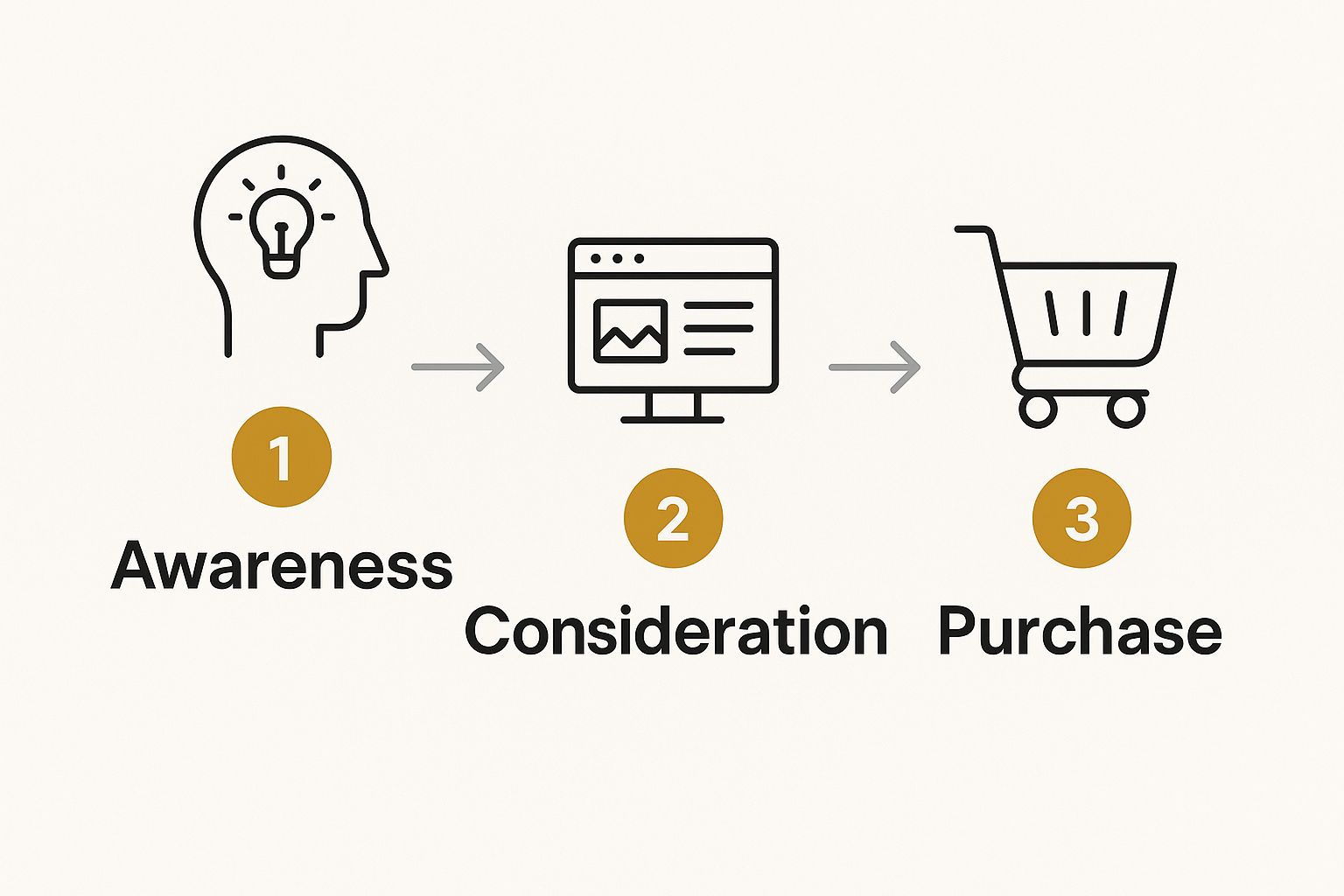
This visual really highlights how each stage builds on the last, guiding someone from a vague problem towards a specific buying decision.
Stage 3: Purchase
The purchase, or conversion, is the moment of truth. After all that research, Sarah has whittled her choices down to one or two tools and is ready to pull the trigger. Her final decision will be shaped by all the information she’s gathered, but also by how easy and confident she feels during the actual buying process.
Her actions are now transactional. She might sign up for a free trial, navigate a checkout page, or chat with a sales rep to finalise the details. A smooth, frictionless experience is absolutely essential here. Any confusion, hidden costs, or technical glitches could make her abandon her cart in a heartbeat. That’s why mapping this specific part of the journey is so vital.
Here in the UK, customer journey mapping is a cornerstone for getting these interactions right. British companies often segment the journey into these distinct phases to better understand what makes their customers tick. In fact, over 81% of customer experience practitioners say that journey mapping is highly effective for showing internal teams how customers behave and what they expect, allowing them to fix friction points before they derail a sale.
Stage 4: Retention
The journey is far from over once the payment goes through. The retention stage is where a customer becomes a user, and their real experience with your product or service begins. This whole phase is about delivering on your promises and making sure the customer actually gets the value they were hoping for.
For Sarah, this means setting up her new project management tool. Is the onboarding process clear? Can she easily find help if she gets stuck? A positive start here reinforces her decision and lays the foundation for a long-term relationship. Journey mapping is especially powerful when focused on critical moments like these, and it's a key part of implementing customer onboarding best practices.
Key activities in the retention stage often include:
- Effective Onboarding: Giving customers tutorials, guides, or welcome emails that set them up for success from day one.
- Proactive Support: Offering accessible and genuinely helpful customer service through live chat, email, or a solid knowledge base.
- Ongoing Communication: Sharing useful tips, product updates, and checking in to make sure everything is going well.
Stage 5: Advocacy
The final and most coveted stage is advocacy. This is where a happy customer transforms into a loyal fan who actively promotes your brand to others. They don't just stay with you; they become a walking, talking source of new business.
If Sarah’s experience is fantastic, she won't think twice about recommending the tool to another business owner she knows. She might leave a glowing online review, share her success on social media, or even agree to be a case study. This kind of word-of-mouth marketing is pure gold because it’s authentic and comes with built-in trust.
Getting to this stage requires you to consistently exceed expectations across the entire journey. By truly understanding and optimising each of these five stages, you can build a repeatable process that turns brand-new customers into your most passionate cheerleaders.
How to Build Your First Customer Journey Map
So, you’re ready to build your first customer journey map. It can sound a bit intimidating, but let’s get one thing straight: this isn't about complex software or technical diagrams. Think of it more like a hands-on workshop, where you piece together a story that reflects what your customers actually experience, not just what your team thinks they do.
It’s a bit like being a detective. You’re collecting clues from all over the place to build a clear picture of your customer’s reality. But before you start looking for evidence, you need to know exactly what case you’re trying to solve.
Step 1: Set Clear and Measurable Goals
Before you even touch a whiteboard, you have to answer one crucial question: why are we doing this? A map without a clear destination is just a nice-looking graphic. Your goal will shape the entire project, ensuring that the insights you uncover can lead to real, tangible improvements for the business.
Get your team together and ask: What specific problem are we trying to solve with this map?
A few common goals might be:
- Fixing a leaky checkout process to reduce the number of abandoned carts.
- Making the onboarding experience smoother to help new customers stick around.
- Figuring out why trial users aren't upgrading to a paid plan.
- Finding gaps in our post-purchase support to build stronger customer loyalty.
Having a specific, measurable goal—like "understand the friction points in our mobile app's sign-up flow"—is what keeps everyone on the same page and focused on getting a useful result.
Step 2: Gather Real Customer Insights
This is the most important part. An effective journey map is built on a foundation of real customer data, not just internal guesswork. Relying only on what you think you know is the fastest way to create a map that's completely useless.
Your mission here is to blend two different types of information: what customers do and what they say.
First, dig into the data you already have. This is your quantitative research—the hard numbers that show you where people are going and what’s happening.
- Website Analytics: Where are people coming from? Where are they dropping off? What paths do they take through your site?
- CRM Data: Look through support tickets, live chat transcripts, and notes from your sales team. What are the common complaints or questions?
- Social Media Metrics: Pay attention to comments, messages, and brand mentions. They’re a goldmine of unfiltered public opinion.
Then, you need to add the human element with qualitative research. This means actually talking to your customers to understand the why behind their actions.
- Customer Interviews: Just a handful of one-on-one chats can give you incredibly rich insights you’d never find in a spreadsheet.
- Surveys and Feedback Forms: Use simple tools like Net Promoter Score (NPS) or feedback pop-ups to get opinions at a larger scale.
- User Testing: There’s nothing quite like watching someone try to use your product or website in real-time to see where they struggle.
When you combine the "what" from your data with the "why" from your customers, you get a map grounded in both evidence and empathy.
Step 3: Identify All Potential Touchpoints
A touchpoint is simply any moment a customer interacts with your brand. These moments are scattered across the entire journey, from the very first time they hear about you to their ongoing relationship with your company.
Get your team in a room and brainstorm every single possible touchpoint. It’s helpful to group them by the stage of the journey (like Awareness, Consideration, Purchase) so you don't miss anything obvious.
Touchpoints are the individual scenes that make up the story of your customer's journey. Mapping them out allows you to see the complete picture, not just isolated moments.
For an online shop, for instance, your touchpoints might look something like this:
- Seeing a sponsored post on Instagram.
- Reading a product review on a blog.
- Visiting a product page on your website.
- Going through the online checkout.
- Receiving a shipping confirmation email.
- Calling the customer support helpline.
Listing all these out creates the skeleton of your map. It shows you exactly where you need to zoom in and analyse the customer’s experience. If you need some inspiration, check out these excellent user journey map examples to see how other companies visualise these interactions.
Step 4: Chart Actions, Thoughts, and Emotions
Now that you have your touchpoints laid out, it’s time to add the colour and bring the map to life. This is where you connect your research to each step, plotting out what the customer is doing, thinking, and feeling along the way.
For every single touchpoint, you’ll want to document these three things:
- Actions: What is the customer actually doing? (e.g., “Clicks a Facebook ad,” “Compares pricing,” “Adds an item to their cart.”)
- Thoughts: What questions or considerations are going through their head? (e.g., “Is this really worth the price?” “I wonder if this will solve my problem,” “I hope the shipping isn’t too expensive.”)
- Emotions: How are they feeling right now? Excited? Confused? Frustrated? A simple visual scale, like a series of smiley faces or a line graph, is perfect for tracking their emotional state.
This final step is what turns a basic flowchart into a powerful empathy map. You can literally see the emotional highs and lows of the journey, revealing the fantastic moments you need to double down on and the painful friction points you urgently need to fix.
Choosing the Right Tools for Journey Mapping
https://www.youtube.com/embed/3iwL2OEeWiw
Once you’ve got your goals locked in and the customer research is done, it's time to bring your map to life. You could absolutely start with a physical whiteboard and a stack of sticky notes—and many great maps begin that way. But the right digital tool will make it much easier to collaborate, share your work, and keep the map updated as things change.
Think of it like this: the tool doesn't make the map, but the right one certainly makes the process a whole lot smoother.
The market for this kind of software is booming. It was valued at $14.2 billion in 2024 and is expected to climb to a massive $34.66 billion by 2029. That incredible growth shows just how vital these tools have become for businesses in the UK and globally that are serious about understanding their customers. You can dig deeper into the numbers by exploring the full research on customer journey mapping software insights.
With so many options, it's easy to feel a bit lost. The good news is that most tools fall into one of a few key categories, so let’s break them down.
Digital Whiteboards and Collaboration Tools
If your team is just starting out or really values free-form brainstorming, a digital whiteboard is a fantastic choice. These platforms give you a limitless digital canvas to drop ideas, images, and notes. They’re perfect for getting everyone together for a creative workshop.
Tools like Miro or Mural are incredibly intuitive. You don’t need any special training to get going, which means people from all departments can jump in and contribute without a steep learning curve. Their real strength is their flexibility.
- Best For: Team brainstorming sessions, creating the first draft of your map, and workshops where creative freedom is the main goal.
- Example Tools: Miro, Mural, FigJam.
Dedicated Journey Mapping Platforms
As your mapping efforts become more sophisticated, you’ll likely find you need something more specialised. This is where dedicated journey mapping platforms come in. They are purpose-built for creating, managing, and analysing every facet of the customer experience.
These tools offer things like pre-built templates, the ability to pull in real customer data, and features that connect your map directly to business results. You can link touchpoints to key performance indicators (KPIs), attach customer feedback, and create a single, reliable source of information for the whole company. For larger organisations aiming to build a truly customer-first culture, this level of detail is a game-changer.
These specialised platforms turn your map from a static image into a living, breathing dashboard. They don’t just show you the journey; they help you measure its impact and pinpoint exactly where you can make improvements.
Project Management and Diagramming Software
There’s a third group of tools that weren’t designed specifically for journey mapping but can do a pretty good job. Many project management tools with timeline or board views, along with general diagramming software, can be easily adapted to visualise your customer’s path.
They might not have the persona-building features or emotional tracking of a dedicated platform, but they are often tools your team already knows and uses. This makes them a practical, cost-effective option, especially if your mapping needs are fairly straightforward. If you're looking at how this fits into your wider strategy, our beginner's guide to digital marketing can provide some useful context.
To help you see the differences at a glance, here’s a quick comparison of the main tool types.
Comparison of Customer Journey Mapping Tool Types
This table breaks down the different categories of tools, helping you decide which type of solution is the right fit for your team's needs and resources.
| Tool Type | Best For | Key Features | Example Tools |
|---|---|---|---|
| Digital Whiteboards | Brainstorming & collaboration | Infinite canvas, templates, real-time collaboration | Miro, Mural |
| Dedicated Platforms | In-depth analysis & management | Persona builders, data integration, KPI tracking | UXPressia, Smaply |
| Diagramming Software | Basic visualisation & flowcharts | Shape libraries, flow diagrams, integrations | Lucidchart, Visio |
Ultimately, the best tool is the one your team will actually use. Don't be afraid to start simple. Prove the value of mapping first, and then you can always invest in more advanced software as your understanding of what is customer journey mapping grows and your strategic needs get more complex.
Common Questions About Customer Journey Mapping
Even with a solid grasp of the basics, some practical questions always pop up when a team first dives into journey mapping. Let's clear the air and tackle some of the most common ones so you can get started with confidence.
Is a Journey Map Just a Fancy User Flow?
This is a really common mix-up, but the difference is massive.
Think of a user flow as a zoomed-in, technical blueprint. It shows the exact, step-by-step clicks someone takes to get one specific thing done on your app or website—like the process for resetting a password. It's all about the 'how'.
A customer journey map, on the other hand, is the big picture. It’s a strategic overview of the entire relationship a customer has with your brand, stretching across all channels and over time. It’s not just about clicks; it's about their feelings, frustrations, and thoughts along the way.
A user flow is like a single chapter detailing one specific scene. The customer journey map is the whole novel, telling the complete story from start to finish.
How Much Data Do We Really Need to Start?
It’s less about quantity and more about quality. You need the right data, not necessarily a mountain of it. The best journey maps are built by blending two types of insight: the 'what' and the 'why'.
Quantitative data (like website analytics) tells you what is happening. But it's the qualitative feedback—from customer interviews, surveys, or support tickets—that tells you why. Even a map based on deep conversations with just five customers is a world away from having no map at all. You can always start with what you have and build on it over time.
How Often Should We Update Our Maps?
Your customer journey map is a living document, not a "one and done" project to be filed away and forgotten. Customer expectations change, technology moves on, and your own business evolves. To stay relevant, your map needs to keep pace.
As a general rule, give your maps a formal review at least once a year. It's also smart to revisit them any time you make a major business change, such as:
- Launching a new product or service.
- Overhauling your website.
- Moving into a new market or targeting a new demographic.
Keeping your maps fresh ensures they remain a powerful tool for your whole organisation.
How Do We Actually Measure the ROI of This?
Measuring the return on investment from journey mapping comes down to connecting your findings to real business numbers. Start by using your map to pinpoint a specific, high-value problem—say, a huge number of customers abandoning their shopping carts when they see the shipping costs.
Once you roll out a fix based on what you learned, track that specific metric to see the improvement. You can also monitor key performance indicators (KPIs) like customer satisfaction scores (CSAT), Net Promoter Score (NPS), or customer churn rate. For example, identifying a communication gap might lead you to explore the advantages of email marketing to close it. By tying your mapping efforts to these concrete outcomes, you can clearly show the financial value of your work.
Ready to build a marketing stack that supports every stage of the customer journey? The The Digital Marketing Toolbox provides curated recommendations on the best tools for analytics, automation, and engagement. Discover solutions that help you act on your journey mapping insights by visiting https://grow-your-biz.com today.


