
Put simply, demand generation is all about creating awareness and, more importantly, a genuine desire for your product or service. It’s a full-funnel marketing approach that aims to educate your audience and build trust long before they’re even thinking about buying something.
Understanding What Demand Generation Really Is

Imagine a new food truck setting up in town. They don't just appear on a street corner one day and hope for the best. Weeks beforehand, they're building a buzz. They're all over social media with mouth-watering photos, they've got local food bloggers writing about them, and maybe they’ve even given out free samples at a local fair.
By the time they officially open for business, there’s already a line of people waiting, eager to try their food. That queue is demand made real. Demand generation does the exact same thing for your business—it gets people interested and positions your brand as the go-to solution when they finally realise they need one.
To boil it down, here’s a quick overview of what demand generation really involves.
Demand Generation At A Glance
| Aspect | Description |
|---|---|
| Core Purpose | To create awareness and desire for your products or services across your entire target market. |
| Primary Focus | Educating audiences, building brand authority, and establishing trust over the long term. |
| Key Activities | Content marketing, social media engagement, SEO, paid media, webinars, and community building. |
As you can see, it's a strategic, long-term approach rather than a quick win.
The Philosophy Behind Building Demand
At its heart, demand generation is about playing the long game. It's a shift away from aggressive, short-term sales tactics and towards building authentic, lasting relationships with potential customers. It’s proactive, not reactive.
This strategy rests on a few core principles:
- Education over the hard sell: The goal is to provide genuinely useful content that helps people understand their problems and the solutions available.
- Building authority: You want to position your brand as a trusted expert and a thought leader in your field.
- Creating brand preference: It’s about nurturing relationships so that when the time comes to buy, your company is the natural first choice.
This is a key idea for any business serious about growth. For more on the basics, have a look at our beginner's guide to digital marketing.
Why Demand Generation Matters in the UK
Demand generation has become a vital part of B2B marketing strategy here in the UK, as more and more businesses see how it drives real, measurable results. A recent benchmark survey showed that marketing leaders are feeling more confident in this approach.
In fact, it revealed that 57% of UK marketers plan to increase their spending on Account-Based Marketing (ABM), and 54% are set to invest more in content marketing—both are central to a solid demand generation plan. You can read more about these demand generation trends and see how other businesses are adapting.
By focusing on creating a well-informed and engaged audience, you're not just finding customers for today; you are building a predictable pipeline of loyal advocates for tomorrow.
Ultimately, the aim is to create a market that seeks you out, already convinced that you offer the best solution.
Demand Generation vs Lead Generation: Let's Clear Things Up
It’s a common mix-up in marketing circles: people use "demand generation" and "lead generation" as if they're the same thing. They’re not. While they work together, they are two very different gears in your marketing machine. Getting this right is the first step towards building a growth strategy that actually works.
So, what's the real difference? It all comes down to scope and timing.
Demand generation is the long game. It’s about creating a genuine appetite for what you offer across your entire market. Think of it as warming up an audience, teaching them something valuable, and building a reputation long before they even think about making a purchase. You're building a brand people know and trust.
Lead generation, on the other hand, is the specific action of collecting contact details from people who’ve raised their hand to say, "I'm interested." It’s the direct result of the awareness and trust you’ve already built.
Think of It Like Throwing a Party
Let's break it down with a simple analogy.
Imagine you're hosting a massive party. Demand generation is all the work you do beforehand to make it the must-attend event of the season. You’re picking a killer theme, curating the perfect playlist, and getting the word out to build some serious buzz. The goal? To make people want to be there because they’ve heard it’s going to be amazing.
Lead generation is what happens at the party when you ask for someone's number. You’ve already created the ideal atmosphere where everyone is having a great time, which makes them far more likely to want to connect. One creates the vibe; the other captures the details.
Demand generation builds the audience. Lead generation converts individuals from that audience into actionable contacts for your sales team.
Trying to ask for numbers without first throwing a great party (demand gen) is just awkward and rarely works.
Key Distinctions in Practice
To give you a clearer picture, here’s a side-by-side look at how these two functions operate. Notice how they target different stages of the buyer's journey and rely on completely different metrics for success.
Demand Generation vs Lead Generation Key Distinctions
| Attribute | Demand Generation | Lead Generation |
|---|---|---|
| Primary Goal | Create broad market awareness and educate potential buyers. | Capture contact details from interested prospects. |
| Audience Focus | The entire target market, including those not yet in a buying cycle. | A smaller segment of the market that has shown buying intent. |
| Core Activities | SEO, content marketing, brand advertising, social media engagement. | Gated content (e-books, webinars), contact forms, free trials. |
| Main KPIs | Website traffic, brand search volume, content engagement. | Cost per lead (CPL), conversion rates, marketing qualified leads (MQLs). |
At the end of the day, these two aren't rivals; they're partners in crime. Strong demand generation lays the groundwork, making your lead generation efforts cheaper and far more effective. It ensures that when you do ask for that contact information, you're talking to people who already know, like, and trust your brand.
For a deeper dive, there's a great resource on Demand Generation vs Lead Generation that explores this further. When you get both working in harmony, you create a powerful system that doesn't just grab attention—it turns that attention into real revenue.
The Pillars Of A Modern Demand Generation Strategy

Knowing the theory behind demand generation is one thing, but actually putting it into practice is a whole different ball game. A truly effective demand programme isn’t just one tactic; it’s a set of interconnected pillars, all working together to create something strong and sustainable.
Think of it like building a house. You need a solid foundation, sturdy walls, and a protective roof. Each part is crucial, and they all have to work in unison.
These pillars aren't separate channels you can just switch on and off. They form a complete ecosystem that guides potential customers on a natural journey. For instance, an insightful blog post you publish (content) gets found through a Google search (SEO), which you then boost to a wider audience using social ads (paid media). Anyone who shows interest is then carefully guided towards a conversation (nurturing).
Let’s break down these core components to see how they all fit together.
Value-Driven Content Marketing
Content is the fuel for your entire demand generation engine. It's the genuine value you offer your audience long before you ever dream of asking for anything in return. Forget sales pitches and product brochures; we're talking about education, problem-solving, and building real trust.
Great demand gen content comes in many forms, with each piece playing a specific role in guiding a buyer.
- Blog Posts and Articles: These are your bread and butter for answering the specific questions your audience is typing into search engines, establishing you as the go-to resource.
- Reports and White Papers: Dive deep with data-backed resources that showcase your expertise and offer unique insights nobody else has.
- Webinars and Virtual Events: Nothing beats an interactive format for connecting directly with your audience, showing off your solution, and answering questions live.
- Case Studies and Success Stories: This is your social proof. It shows potential customers, "Hey, we've helped people just like you solve this exact problem."
The golden rule? Create content that speaks directly to your ideal customer's biggest headaches. When your content genuinely helps them, they start to prefer your brand without you ever having to do a hard sell.
Search Engine Optimisation (SEO)
Creating amazing content is only half the battle. If no one can find it, it might as well not exist. This is where Search Engine Optimisation (SEO) becomes absolutely critical. SEO is all about fine-tuning your website and content so you show up higher in search results for the right keywords.
When someone has a problem, their first port of call is almost always Google. By making sure your content aligns with the phrases they're searching for, you place your brand directly in their path right when they need you most. This isn't about interrupting them; it's about being the solution they were actively looking for.
A strong SEO strategy ensures your valuable content doesn’t just sit on your website collecting dust. It transforms your site into a magnet for inbound interest, attracting qualified prospects 24/7.
This approach builds a sustainable, long-term flow of traffic from an audience that is already looking for what you offer.
Strategic Paid Media
While SEO is a long game that builds organic momentum, paid media gives you speed and precision. It lets you amplify your message and reach a hand-picked audience right now. Channels like social media ads or search engine marketing (SEM) are essential for pushing your best content in front of the right eyeballs.
The UK's digital ad industry is booming, with revenue projected to soar past £40 billion. That kind of investment shows just how vital paid channels have become. What's more, paid social media ad spend in the UK is expected to grow by 14% annually, proving it’s not slowing down anytime soon. You can dig deeper into the UK's digital marketing landscape for more insights.
In the world of demand generation, paid media isn’t just for driving clicks to a sales page. You use it to:
- Promote Your Best Content: Push traffic to your educational blog posts, reports, and webinars to build that initial spark of awareness.
- Retarget Engaged Visitors: Reconnect with people who’ve already shown interest in your content by serving them more tailored offers.
- Test Your Messaging: Quickly find out what headlines, images, and offers resonate most with your audience so you can refine your entire strategy.
Mastering specific tactics like What Is Retargeting in Digital Marketing? can really take your paid approach to the next level.
Intelligent Email Nurturing
So, you've attracted an audience with your brilliant content and sharp paid campaigns. What now? Email marketing is how you start building a real relationship. Email nurturing involves sending a series of automated, personalised emails designed to guide prospects along their journey.
This has nothing to do with spamming inboxes with weekly promotions. It’s a carefully planned sequence that delivers the right information at just the right time. For example, if someone downloads your report on a specific challenge, your nurture sequence could automatically follow up with related blog posts, a relevant case study, and, eventually, an invitation to a demo.
By weaving these four pillars—Content, SEO, Paid Media, and Email—together, you create a cohesive and powerful system. This integrated strategy does more than just generate a list of leads; it builds a loyal audience and a predictable pipeline of customers who genuinely see you as a trusted partner.
Winning With Emerging Channels And Tactics

The marketing playbook you relied on yesterday might not get you the win today. To really cut through the noise, smart brands are looking beyond the usual channels and embracing new tactics to meet their audiences where they’re already paying attention. This isn't about jumping on trends; it's about seeing the creator economy and social commerce as vital parts of a modern strategy.
These newer channels are so effective because they slot right into people's existing habits and preferences. They seamlessly blend content, community, and commerce, letting brands build real trust and inspire action in a way that feels natural, not like a disruptive ad.
By weaving these fresh strategies into your marketing mix, you stay relevant and connect with potential customers where they're already spending their time. It's a proactive mindset that's crucial for any business trying to understand what demand generation really means in today's world.
Harnessing The Power Of Influencer Marketing
Influencer marketing has grown up. It's no longer a niche experiment but a serious channel for generating demand, especially when it comes to building authentic trust at scale. Forget just celebrity endorsements; this is about partnering with credible experts and voices who have a real, established connection with your target audience.
Think about it: when an industry influencer gives your product their seal of approval, they’re essentially lending you their hard-earned credibility. This kind of endorsement is powerful social proof. It introduces your brand to a perfectly aligned audience with a layer of trust already baked in—something that could take you years to build from scratch.
The secret is to prioritise relevance over sheer reach. A micro-influencer with a smaller, highly engaged following can often deliver far better results than a mega-influencer with millions of passive followers. It all comes down to finding the perfect match for your brand and the audience you want to reach.
The influencer marketing sector has become a cornerstone of many demand generation strategies in the UK, showing exceptional growth. The UK market reached USD 2.36 billion and is projected to grow at a compound annual rate of 29.5%.
Consumer behaviour backs this up, with studies showing that somewhere between 69% and 75% of UK consumers make buying decisions based on influencer posts. You can discover more insights about the UK influencer market and its growing impact.
Capitalising On Social Commerce
Social commerce fundamentally changes the path to purchase. It collapses the customer journey, allowing people to discover and buy products right from their social media feeds. This captures their buying intent the very moment it sparks, removing friction and making the whole process incredibly smooth.
Platforms like Instagram Shopping, Facebook Shops, and TikTok Shop have turned social media from a place of discovery into a direct point of sale. For demand generation, this is a game-changer because it connects the top of the funnel (awareness) directly to the bottom (the sale).
To make social commerce work for you, your content needs to be both engaging and shoppable. Here’s how to do it:
- Create High-Quality Visuals: Use compelling images and videos that show your products in a way that’s both authentic and aspirational.
- Leverage User-Generated Content: Encourage your customers to share photos of themselves with your products, then feature that content to build powerful social proof.
- Use Shoppable Tags: Make it dead simple for users to tap a product in a post, see the price, and click through to buy.
- Run Live Shopping Events: Host live streams to demonstrate products, answer questions in real time, and offer exclusive deals to viewers.
Of course, these new channels don't replace the classics like email. In fact, they work best when they're all integrated. For example, you can use a social commerce campaign to win over a new customer, then add them to your email list for long-term nurturing. Exploring the advantages of email marketing will help you see how it all fits together. By blending new and established channels, you build a resilient strategy that not only grabs attention but also builds lasting customer relationships.
Here's the rewritten section, designed to sound like it was written by an experienced human expert.
How Do You Actually Know If Your Demand Generation Is Working?
Creating a buzz is one thing, but if you can’t tie that buzz back to business results, you’re just making noise. Measuring demand generation properly means looking past the easy-to-track "vanity metrics" like social media likes or impressions. Instead, you need to focus on the numbers that tell a clear story about revenue and growth.
This is how you prove your demand engine isn't just a cost centre, but a serious revenue driver. When you track the right KPIs, you can build a performance dashboard that connects every single marketing activity directly to the bottom line. It’s all about showing undeniable business impact.
The most important KPI for demand generation will always be qualified pipeline. The whole point is to measure how well you're guiding accounts through their journey, from just hearing about you to becoming a genuine sales opportunity.
Let’s dig into the metrics that really matter and what they tell you about the health of your strategy.
The Core Metrics for Your Demand Dashboard
To get a complete picture, you need a balanced set of metrics that cover the entire journey, from someone's first click to a signed contract. These KPIs don't just show you what's happening; they help you understand why.
Here are the essentials every demand generation marketer should have their eyes on:
- Marketing-Sourced Revenue: This is the big one—the ultimate proof of your value. It tracks the total revenue from deals that started with a marketing touchpoint, directly linking your campaigns to the company's bank account.
- Marketing Qualified Leads (MQLs): I know what you’re thinking—MQLs can feel a bit old-school. But they're still a useful signal of interest. Think of an MQL as someone who has raised their hand, showing they're more likely to become a customer than your average website visitor.
- Sales Qualified Leads (SQLs): This number tells you how many of your MQLs the sales team has looked at and agreed are worth their time. A healthy MQL-to-SQL conversion rate is a great sign that marketing and sales are on the same page.
- Pipeline Velocity: How fast are leads moving from that initial MQL stage to a closed deal? That's your pipeline velocity. A faster velocity often means your sales cycle is tight and your leads are high quality.
Keeping a close watch on these figures helps you see how efficient and effective your entire demand generation machine really is.
Getting a Grip on Your Unit Economics
Beyond tracking leads and revenue, you have to understand the financial efficiency of your efforts. Are you actually making money on each new customer? This is where unit economics come in, helping you make sure your growth is profitable and sustainable.
First up is your Customer Acquisition Cost (CAC). This is the total cost of everything you spent on sales and marketing to land a single new customer over a set period. It includes ad spend, content creation, event costs, and even salaries.
The other side of the coin is Customer Lifetime Value (CLV). This is the total revenue you can realistically expect to make from a single customer over the entire time they do business with you.
The real insight comes when you compare the two. A healthy, scalable business model typically has a CLV to CAC ratio of 3:1 or higher. In simple terms, for every pound you spend to get a customer, you should be getting at least three pounds back over their lifetime. If your CAC is creeping up too close to your CLV, it’s a red flag that your acquisition strategy might not be built to last.
Your First Demand Generation Campaign Playbook
All the theory in the world doesn't mean much until you put it into practice. So, let’s make demand generation real. We're going to walk through a simple, step-by-step playbook, following a fictional B2B tech company as they build their first campaign from scratch.
This isn't just an abstract exercise. It’s a concrete plan you can lift, adapt, and use for your own business, whether you're a small business owner, an agency marketer, or an e-commerce manager.
Step 1: Define Your Ideal Customer Profile
Before you even think about writing a blog post or designing an ad, you have to know exactly who you're talking to. A vague idea of your customer just won't cut it. You need a razor-sharp Ideal Customer Profile (ICP).
This means digging deeper than basic demographics to understand their real-world challenges, what motivates them, and what their day-to-day work life actually looks like.
For our B2B tech company—let's say they sell project management software—their ICP isn't "marketing managers." It's "Marketing Managers at UK-based SaaS companies with 50-200 employees who are struggling to manage cross-functional content campaigns and are currently juggling spreadsheets and generic task apps."
See the difference? That level of detail is your compass. It guides every decision you make from here on out, from the topics you choose to the channels you focus on.
Step 2: Create a High-Value Content Offer
Now that you know what keeps your ICP up at night, you can create something that genuinely helps them. This isn't a sales brochure in disguise; it's a genuinely useful resource they'd happily trade an email for. An industry benchmark report is a perfect example.
Our tech company decides to create "The 2024 UK SaaS Content Operations Benchmark Report." They'll survey 100 marketing managers who fit their ICP, collecting data on team structures, common bottlenecks, and the tools they use. Then, they’ll package all those juicy insights into a beautifully designed report.
This single asset does two things brilliantly: it positions them as an authority and gives their audience something of real value.
A powerful content offer is the cornerstone of your campaign. It acts as the magnet that pulls your ideal audience into your world by offering solutions, not just products.
This report is now the centrepiece of the entire campaign. It gives you a compelling reason to start a conversation with your target audience across different platforms.
Step 3: Develop a Multi-Channel Distribution Plan
An amazing report is worthless if it's just sitting on your server. Next, you need a plan to get it in front of your ICP. Using multiple channels is key to reaching people where they already are. A solid marketing strategy for a small business will almost always blend organic and paid tactics to get the best results.
Here’s the plan our tech company puts into action:
-
SEO-Driven Blog Content: They’ll write a series of blog posts on topics like "How to Streamline Your Content Workflow" and "Top Project Management Challenges for SaaS Marketers." Each article will solve a specific problem and point to the benchmark report as the next logical step.
-
LinkedIn Promotion: They’ll run targeted ads on LinkedIn, showing a summary of the report's key findings directly to users whose job titles and company profiles match their ICP. This makes sure every penny of their ad spend is hitting the right audience.
-
Email Nurturing: As soon as someone downloads the report, they're entered into an automated email sequence. The first email delivers the report, but the follow-ups will share specific insights, link to relevant case studies, and eventually, invite them to a live webinar to discuss the findings.
This diagram helps visualise how all that effort connects directly to business outcomes, from creating initial interest to driving actual revenue.
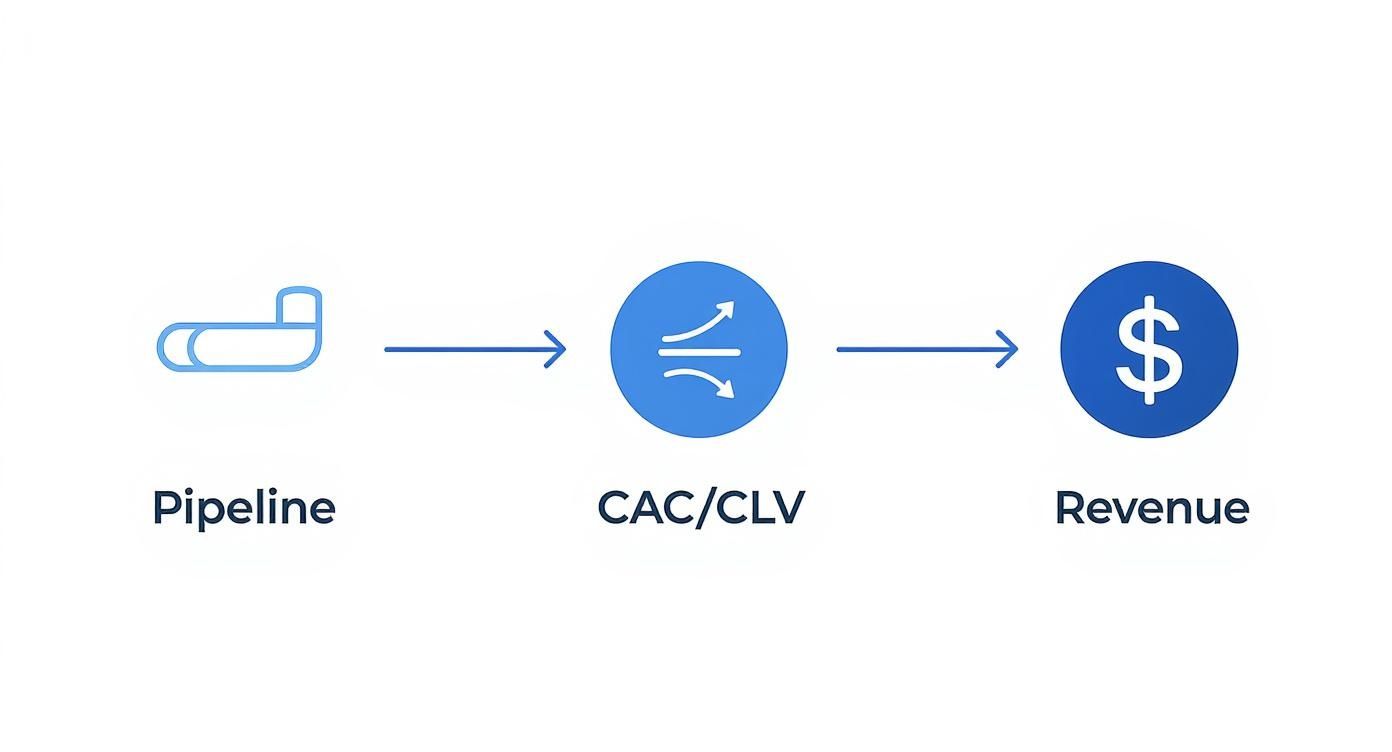
The flow from pipeline to revenue highlights why it's so important to measure the entire journey, not just that first lead.
By weaving these channels together, you create a cohesive experience that builds awareness, captures interest, and gently guides prospects toward a sales conversation. This playbook gives you a repeatable framework for turning the knowledge of what is demand generation into a powerful, revenue-driving machine.
Your Demand Generation Questions Answered
Let's wrap things up by tackling some of the questions that always pop up when marketers first start digging into demand generation. Think of it as a quick-fire round to clear up any lingering confusion before you dive in.
These are the practical, "how does this actually work?" questions that surface once you move past the theory and start thinking about putting it all into practice.
How Long Does It Take To See Results From Demand Generation?
I’m going to be straight with you: demand generation is a marathon, not a sprint. While you might see some encouraging early signs—like more website traffic or people actually engaging with your content—within the first one to three months, the real impact on your sales pipeline takes a bit longer to show.
Realistically, you should expect to see significant, bottom-line results after about 6 to 12 months of consistent, focused effort. The whole point is to build genuine brand equity and trust over the long haul.
The goal here is to create a sustainable, predictable flow of high-quality opportunities over time, rather than just chasing a short-term spike in leads who aren't even ready to talk.
It’s this long-term approach that builds a much stronger and more reliable foundation for your business.
What Is The Most Important Part Of A Demand Generation Strategy?
While every piece of the puzzle we've discussed is important, if I had to pick one thing, it would be this: genuinely valuable, audience-focused content. Content is the heart of any successful demand generation programme; it’s the fuel that powers everything else.
Think about it this way:
- For SEO: Your content is the very thing that gets you found on Google.
- For Paid Ads: It’s the valuable asset you’re promoting to grab someone's attention.
- For Email Nurturing: It's the reason people stay on your list and keep opening your emails.
Without content that truly educates, entertains, or solves a problem for your ideal customer, every other part of your strategy will fall flat. It's impossible to build that all-important trust without it.
Can A Small Business With A Limited Budget Do Demand Generation?
Absolutely. Demand generation is a philosophy first, a budget item second. Small businesses can get brilliant results by focusing on high-impact, organic activities that don't need a massive cash injection.
The key is to be clever and consistent. A small business could start by creating super-targeted blog content that solves very specific, niche problems for their ideal customer—a fantastic SEO play.
On top of that, you could get active in relevant online communities, start building an email list from day one, or host small, educational webinars. The focus should always be on providing immense value. That builds brand loyalty far more effectively than a big advertising budget ever could.
Ready to build your own high-impact marketing machine? The Digital Marketing Toolbox gives you access to a curated catalogue of the best tools for SEO, content, email, and more, all in one place. Find the right solutions to kick-start your demand generation strategy today at https://grow-your-biz.com.


