
Picture this: a good friend tells you about a new coffee shop they love. You'd probably check it out, right? Now, compare that to seeing a random billboard for the same place. The friend's recommendation just carries more weight.
That's influencer marketing in a nutshell. It’s the digital version of word-of-mouth, powered by people who have built real trust with their online communities.
What is Influencer Marketing, Really?

At its core, influencer marketing is all about collaboration. A brand teams up with an individual—an "influencer" or "creator"—who has a loyal following in a particular niche. These aren't just random celebrities; they're experts, hobbyists, and entertainers who have earned the respect and attention of their audience through consistent, authentic content.
Instead of creating a traditional ad that interrupts what people are watching, a brand works with these creators to weave their product or service into their content in a way that feels natural. The idea isn't to just flash a product on screen; it's to have a trusted voice share it genuinely. It's a powerful piece of the puzzle, something we explore more in our beginner's guide to digital marketing.
It's All About Authentic Connections
Think of a classic TV commercial as a brand shouting its message from a rooftop, hoping someone below is listening. Influencer marketing, on the other hand, is more like a quiet conversation between friends. It works because it taps into a simple human truth: we trust people we know and admire.
Influencer marketing cuts through the noise and consumer cynicism. It uses the power of genuine relationships to build a brand's credibility in a way that old-school advertising just can't match.
This whole approach hinges on the creator’s authenticity. The best partnerships aren't scripted. They happen when a brand trusts the influencer enough to let them talk about a product in their own voice, in a style their audience knows and loves.
What does this look like in the real world?
- A fitness influencer might share how a specific protein powder genuinely fits into their post-workout routine.
- A tech creator could give an honest, detailed review of a new laptop, pointing out both the pros and the cons.
- A travel vlogger might create a whole video around their stay at a boutique hotel, showing off what made the experience special.
Ultimately, it’s about finding the right people who are already talking to your ideal customers and letting them tell your story for you. It turns someone scrolling passively into an engaged, potential customer.
The Journey From TV Ads to TikTok Creators
Let’s be honest, influencer marketing isn't some brand-new phenomenon. It’s actually a classic idea that’s been given a powerful, modern makeover. Long before we had social media, brands were already leaning on celebrity endorsements. Just picture a famous footballer on your cereal box or a Hollywood starlet in a perfume ad on TV.
That was the original playbook. You'd take a well-known face, have them lend their credibility to a product, and hope their star power would rub off. The thinking was pretty straightforward: if someone you admire uses something, maybe you should too. It was a broad, one-to-many broadcast that relied on mass media and the allure of aspiration.
The Rise of Digital Authenticity
Then the internet came along and completely rewrote the rules. Early bloggers were among the first to challenge the old guard. These were just ordinary people writing passionately about their interests—from home cooking to the latest tech gadgets—and they slowly built small, loyal communities who trusted their unfiltered opinions.
This was the turning point. People started looking to these relatable, "everyday experts" for real advice, turning away from the distant, airbrushed celebrities. This new wave of influencers brought something to the table that was far more valuable than fame: authenticity. They weren't just reading from a script; they were sharing their actual experiences.
The real power dynamic shifted when consumers realised they could trust a recommendation from a creator with 5,000 followers more than a superstar with millions. This was the birth of niche influence.
This fundamental move away from aspiration and towards genuine connection is what modern influencer marketing is built on today.
From Static Posts to Video Stories
As platforms and technology got more sophisticated, so did the ways influencers could connect with their audiences. The evolution happened in clear stages:
- Early Days (The Bloggers): It all started with detailed product reviews and personal stories, which laid the groundwork for everything that followed.
- The Instagram Era: Suddenly, it was all about highly stylised images and "picture perfect" lifestyles, making products look irresistible.
- The YouTube Boom: In-depth vlogs, tutorials, and "unboxing" videos gave creators a space for long-form, personality-driven content that built deep connections.
- The TikTok Revolution: Short-form, snappy videos made content creation more democratic and viral than ever, cementing the creator economy as a major force.
So, what we call "influencer marketing" today is the direct descendant of those old celebrity ads. The difference is that now it’s more democratic, incredibly targeted, and built on a foundation of genuine trust. The journey from a static TV commercial to an interactive TikTok video shows just how much the way we build trust—and make buying decisions—has changed.
Decoding the Different Types of Influencers
To really get your head around influencer marketing, you need to understand that not all influencers are cut from the same cloth. Follower count is just one part of the story; the real magic happens when you match the right creator to your campaign goals. The influencer world is usually categorised into different tiers based on audience size, and each one brings something unique to the table.
This infographic gives a great visual breakdown of the influencer hierarchy, from the super-niche nano-influencers right up to the celebrity-status mega-influencers.
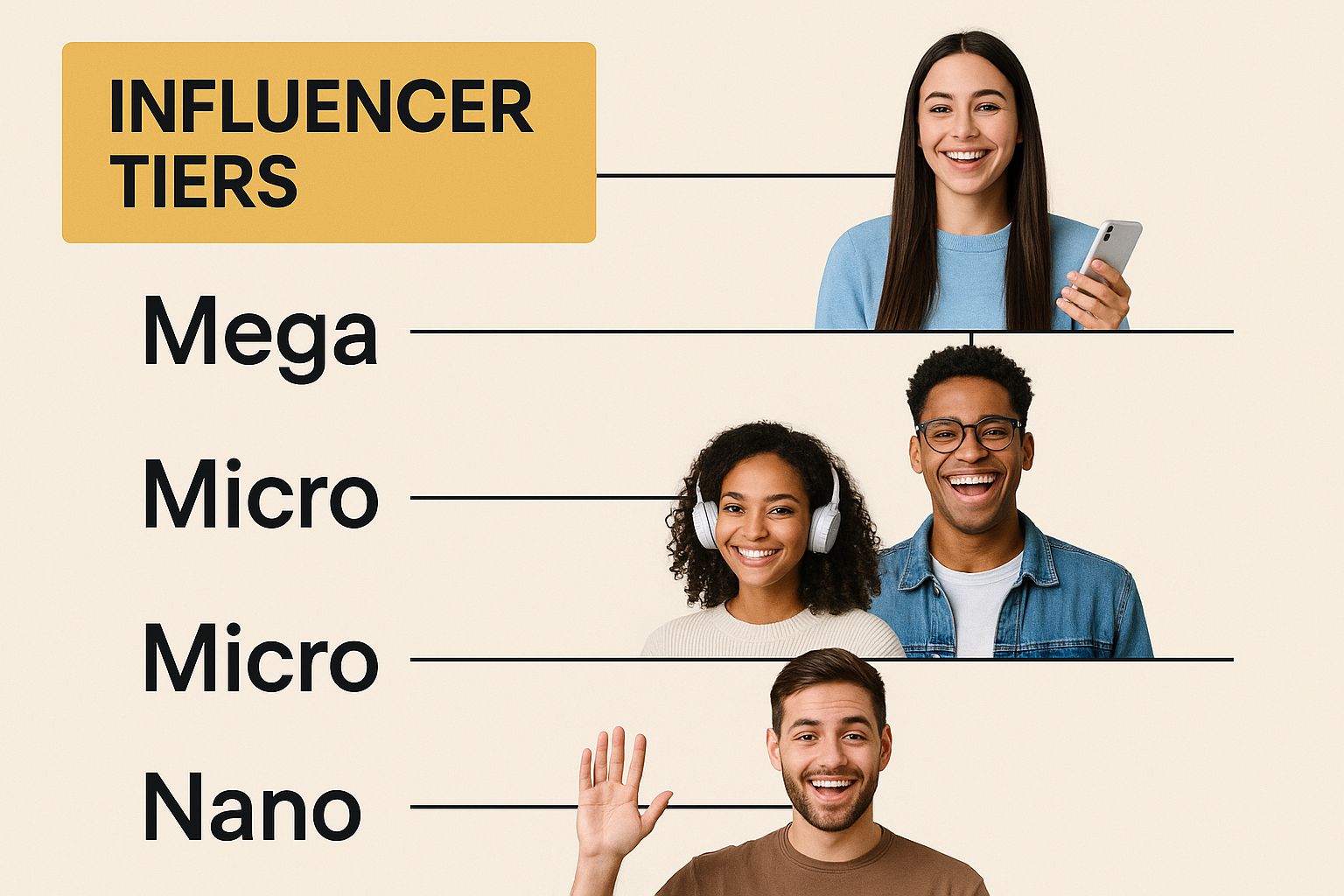
As you can see, while the big names at the top offer massive reach, the industry's foundation is really built on a huge number of smaller creators who have incredibly engaged communities.
Nano and Micro-Influencers: The Community Builders
Nano-influencers (1,000–10,000 followers) and micro-influencers (10,000–100,000 followers) are the heart and soul of authentic engagement. These creators tend to focus on very specific niches, from sustainable fashion to local vegan food, and they’ve built real, trust-based relationships with their followers.
When they recommend something, it doesn’t feel like an advert. It feels more like getting a tip from a friend who genuinely knows their stuff. Because their audience is smaller and more focused, their engagement rates often blow larger accounts out of the water. For brands keeping an eye on the budget or selling a niche product, working with these creators can deliver a fantastic return.
A partnership with a micro-influencer is a strategic move to tap into a pre-built community of trust. It prioritises the quality of engagement over the sheer quantity of impressions, often leading to stronger conversion rates.
Here in the UK, the influencer market has grown into a massive £896 million industry, and it's these smaller creators who are driving a lot of that growth. In fact, micro-influencers make up about 47.3% of all influencers in the UK because they have such a strong connection with their audience.
Take TikTok, for instance. UK-based micro-influencers on the platform can hit engagement rates as high as 18%—a figure that absolutely dwarfs the typical rates you see on other platforms. This is a big reason why a staggering 78% of UK TikTok users say they’ve bought something after seeing a creator promote it.
Macro and Mega-Influencers: The Awareness Machines
Moving up the ladder, we have macro-influencers (100,000–1 million followers) and mega-influencers (1+ million followers). These are your established online personalities, celebrities, and public figures who have enormous followings. Their superpower? Unmatched reach.
If your goal is to generate widespread brand awareness—say, for a major product launch or a big seasonal campaign—then working with a macro or mega-influencer makes perfect sense. A single post can put your brand in front of millions of people almost instantly.
But this kind of reach comes with a few trade-offs. Engagement rates are usually lower, and the price tag for a collaboration is significantly higher. The connection they have with their audience can also feel a bit less personal compared to smaller creators. To get a feel for how these top-tier influencers pitch their value to brands, it’s worth checking out some influencer media kit examples. It gives you a real insight into the professional side of the industry.
To help you decide, here’s a quick comparison of the different influencer tiers.
Comparing Influencer Tiers by Audience Size and Impact
The table below breaks down the main influencer categories, highlighting their typical follower counts, engagement levels, and where they fit best in a marketing strategy.
| Influencer Tier | Follower Count | Typical Engagement Rate | Best For |
|---|---|---|---|
| Nano-Influencer | 1,000 – 10,000 | 5% – 10% (Very High) | Hyper-targeted niche campaigns, building local buzz, user-generated content. |
| Micro-Influencer | 10,000 – 100,000 | 2% – 5% (High) | Driving high-quality engagement, niche product promotions, building trust. |
| Macro-Influencer | 100,000 – 1 Million | 1% – 3% (Moderate) | Broad brand awareness, major product launches, reaching a large audience. |
| Mega-Influencer | 1 Million+ | <1% (Low) | Maximum reach, celebrity endorsements, large-scale awareness campaigns. |
Ultimately, choosing the right tier boils down to your campaign objectives. Are you after widespread visibility, or do you need a deep, trusted endorsement within a tight-knit community? Answering that question is the first and most important step in building an influencer strategy that actually works.
So, Why Does Influencer Marketing Actually Work?
What’s really going on when a brand partners with an influencer? Forget the buzzwords for a moment. Influencer marketing delivers tangible results because it taps into something fundamentally human: trust. It’s not about flashy ads interrupting a user's feed; it’s about a genuine connection that can drive real business growth.
Think about it. Traditional advertising can feel a bit like an uninvited guest at a dinner party – loud, out of place, and easily ignored. Influencer content, on the other hand, is the complete opposite. It’s a welcome part of the conversation. When a creator your audience already follows and respects recommends a product, it lands like a tip from a trusted friend, cutting through the usual consumer cynicism.
At its core, this entire strategy is built on a powerful psychological principle: social proof. We are all wired to look to others for clues on what to buy, where to eat, or what to believe. Influencers provide that social proof on a massive scale, showing their followers that a product isn't just good, it's been vetted by someone they admire.
Building Real Trust and Credibility
If there’s one standout benefit of influencer marketing, it's the ability to build authentic trust. An influencer has likely spent years nurturing a relationship with their audience, sharing valuable and honest content day in, day out. When they team up with a brand that genuinely fits their personal style and values, that hard-earned trust naturally extends to the brand itself.
This transfer of credibility is incredibly powerful. Instead of your company shouting from the rooftops about how great your product is, you have a respected third party saying it for you. This builds a kind of brand loyalty and emotional connection that's incredibly difficult to replicate with other marketing methods.
An influencer partnership isn't just a paid placement; it’s an endorsement built on a pre-existing foundation of trust. That authenticity is the currency that fuels genuine engagement and sales.
Reaching Hyper-Targeted Niche Audiences
Influencers are the undisputed champions of the niche. Whether your ideal customer is an urban gardener in Manchester or a sustainable fashion enthusiast in London, you can bet there's an influencer who speaks their language. This gives you a direct line to a highly concentrated group of potential customers, avoiding the scattergun approach of broader advertising.
The UK market is a perfect example of this in action. Influencer marketing has become a serious business here, with spending hitting around £896 million in recent years. This huge investment makes sense when you consider there are roughly 63.5 million people in the UK active on social media.
While not everyone is instantly convinced, about 22% of UK consumers say they trust influencer recommendations – a significant figure in today's crowded digital space. If you'd like to dive deeper, you can discover more insights about influencer marketing statistics. This kind of precise targeting means your marketing budget is working smarter, not just harder, to reach the people most likely to become your next loyal customers.
How to Build Your First Influencer Campaign
https://www.youtube.com/embed/QCZngQdOnpo
Moving from theory to practice is where the real work begins. Launching your first influencer campaign might feel like a huge undertaking, but if you break it down into a simple, step-by-step process, it becomes far more approachable.
Success isn't about finding someone with a million followers. It’s about building a genuine partnership that clicks with your brand’s goals.
The first step is always the most critical: decide what success actually looks like for you. Are you trying to get your name out there? Drive more traffic to your website? Or maybe boost sales for a new product? Your objectives will dictate every other decision you make.
A campaign without clear, measurable goals is like a ship without a rudder. Knowing your destination from the start means you can accurately measure your return on investment and prove the campaign was worth it.
Once your goals are crystal clear, you can start the search for the right partner. This part is less about follower counts and more about finding the right fit. Look for creators whose values, audience, and content style genuinely reflect your brand. A perfect match means their endorsement will feel natural and authentic, not like a clunky, paid-for ad.
Crafting a Winning Outreach Strategy
When you’ve pinpointed a few potential partners, your outreach needs to stand out from the crowd. Generic, copy-and-paste messages are a one-way ticket to the bin.
Personalise your approach. Mention a specific post or video of theirs that you loved, and explain exactly why you think a collaboration would bring real value to their audience.
If you get a positive response, the next step is talking terms. Be ready to discuss compensation, which could be anything from a flat fee to a commission on sales, or even a mix of both.
To keep everything smooth and ensure you’re both on the same page, put together a clear, concise creative brief. This should outline the campaign's goals, key messages, and what you need from them. Just remember to leave room for their creative freedom—that’s what their audience loves them for. To keep everything organised and monitor performance, it’s worth using dedicated influencer tracking tools.
Focusing on Long-Term Partnerships
Recent trends in the UK show a big move away from one-off posts and towards more meaningful, long-term collaborations. British brands are starting to treat influencers more like brand ambassadors, building lasting relationships that create deeper trust with consumers.
This approach delivers far more value over time through repeated, authentic exposure. In fact, data for 2025 shows that 63.8% of UK brands plan to focus on these kinds of genuine partnerships. This shift signals a more mature, strategic view of influencer marketing. Building these relationships should be a core part of your wider marketing strategy for a small business.
Measuring Success Beyond Likes and Comments

So, you’ve run a campaign. How do you actually prove it delivered real value? While a flood of likes and comments feels good, that’s only scratching the surface. It doesn't tell the whole story.
To grasp the true impact of your influencer marketing, you have to look beyond these surface-level ‘vanity metrics’. The real trick is to focus on the numbers that tie directly back to your core business goals.
Effective measurement isn’t about chasing every single number you can get your hands on. It’s about being smart and organising your Key Performance Indicators (KPIs) into categories. This approach creates a clear map, showing you the path from initial audience attention right through to business results. It helps you understand not just what happened, but why.
The ultimate goal is to connect influencer activity to a tangible Return on Investment (ROI). This means moving beyond simple engagement and proving how the campaign contributed to your bottom line.
Key Metrics for Every Campaign Stage
For a complete picture, it’s best to break down your measurement into three core areas. Each one shines a light on a different part of the customer journey, from the first moment they see your brand to the point where they make a purchase.
1. Awareness Metrics
Think of these as your 'eyeballs' metrics. They tell you how many people saw your brand thanks to the influencer’s content and measure the campaign's overall reach.
- Impressions: The total number of times the content was simply displayed on a screen.
- Reach: The number of unique accounts that saw the content. One person seeing it five times is still a reach of one.
- Audience Growth: A straightforward look at how many new followers your own social media accounts gained during the campaign.
2. Engagement Metrics
This is where things get interesting. This group of metrics shows you how people actually interacted with the content. High engagement is a fantastic sign of genuine connection and interest.
- Shares and Saves: These are gold. They show the content was valuable enough for people to keep for later or pass on to their own network.
- Comments: Look past the number and at the quality of the comments. Are people having real conversations about your brand?
- Clicks: A simple but powerful metric showing how many people were intrigued enough to click a link in the post, usually sending them to your website.
3. Conversion Metrics
And here’s the bottom line. This is where you see the direct business impact, tracking the valuable actions people took after seeing the content.
- Referral Traffic: How many visitors landed on your website directly from the influencer’s unique link?
- Discount Code Usage: A clear-cut way to track sales. How many times was that influencer-specific promo code used at the checkout?
- Lead Generation: This could be new sign-ups for a webinar or your newsletter. This also opens up a great chance to explore the advantages of email marketing to nurture those fresh leads.
- Sales: The total revenue generated directly from the campaign, tracked precisely using affiliate links or unique codes. This is your ROI, plain and simple.
Got Questions About Influencer Marketing? We’ve Got Answers.
As you start wrapping your head around influencer marketing, it's completely normal for a bunch of practical questions to pop up. Let's tackle some of the most common ones right now, helping you move from simply understanding the idea to actually building a solid strategy.
How Much Does Influencer Marketing Actually Cost?
This is usually the first question on everyone's mind. The honest answer? It varies wildly. There's no one-size-fits-all price list. An influencer campaign could cost you nothing more than a free product sent to a nano-influencer, or it could be a six-figure deal with a household name.
So, what determines the price? It really boils down to a few key things:
- Follower Count: It's simple maths, really. An influencer with a million followers has a much larger audience and will charge significantly more than someone with ten thousand.
- Engagement Rate: Don't just look at follower numbers. A creator with a smaller but fiercely loyal and active community can be incredibly valuable, and their rates often reflect that deep connection.
- The "Ask": What are you actually asking them to do? The price for a single, fleeting Instagram story will be very different from that of a dedicated, in-depth YouTube video.
- Your Niche: Some industries are just more expensive than others. Influencers in specialised fields like finance or B2B tech can command higher fees because their expertise is in high demand.
What Are the Legal Rules for Sponsored Posts?
This is a big one, and getting it wrong can land you in hot water. In the UK, the Advertising Standards Authority (ASA) sets the rules, and they're pretty clear: if you've paid for a post in any way (money or a freebie), it has to be declared as an ad.
It's a legal must for both the brand and the influencer to make it crystal clear that content is an advertisement. This means using prominent labels like #ad, #sponsored, or #gifted.
This isn't just about avoiding a slap on the wrist from the ASA. It's about being transparent and maintaining trust. When an audience feels misled, it damages the credibility of both the creator and your brand.
How Can a Small Business Find the Right Influencers?
If you're a small business, you might think this is all out of your league, but that's not true at all. The trick is to stop chasing massive follower counts and start focusing on genuine relevance.
Look for micro- and nano-influencers who are already creating content in your niche and clearly love what they do. A great starting point is to search for relevant hashtags on Instagram and TikTok. You can also use influencer marketing platforms to find creators whose audience is a perfect match for your ideal customer. For a small business, authenticity is your superpower.
Ready to put these insights into action? Discover the perfect tools to manage your campaigns, track your results, and grow your brand with The Digital Marketing Toolbox. Visit us at https://grow-your-biz.com to explore a curated selection of top-tier marketing solutions.


