
Keyword research is all about discovering the exact words and phrases your ideal customers are typing into search engines like Google. It’s far more than a technical SEO task; it's a deep dive into how your audience thinks and speaks, giving you a direct line into their needs, wants, and problems.
Think of it as the market research for your digital presence. It’s the foundation that connects your business with people who are actively looking for what you offer.
Why Keyword Research Is the Bedrock of Good SEO

Imagine opening a new shop on the high street. You've filled it with products you're passionate about, but you never stopped to ask what the local community actually wants or needs. You might have the best products in the world, but if no one is looking for them, your doors will stay closed.
Building a website without keyword research is the digital equivalent of that empty shop. You end up creating content that feels right to you but completely misses the mark with your audience, leaving you invisible to the very people you’re trying to help.
At its heart, what is keyword research in SEO is the art of understanding your customer's language. It bridges the gap between the industry jargon you use to describe your services and the everyday words people use when they have a problem you can solve.
Moving Beyond Guesswork
Without solid keyword research, your entire SEO strategy is just a shot in the dark. You might pour hours into a brilliant article on "bespoke artisanal footwear," but if your target audience is actually searching for "handmade leather shoes UK," you'll never cross paths.
This process replaces guesswork with hard data. It gives you the confidence to make strategic decisions that lead to real, measurable growth. It's your window into the mind of your market, revealing everything from emerging trends to the most urgent questions your customers are asking.
Keyword research is the market research of the digital age. It tells you not only what people are searching for, but also how popular those topics are and how difficult it will be to compete for their attention.
The importance of this process isn't a secret. In the UK, a staggering 84% of digital marketing professionals view keyword research as a fundamental part of their SEO strategies. This makes perfect sense when you realise it uncovers what your audience is actually typing into Google UK, which absolutely dominates the search market here.
The Strategic Business Impact
Ultimately, great keyword research brings focus and purpose to your entire digital marketing effort. It ensures that every blog post, product page, and video you create is designed to meet a genuine audience need. This alignment doesn't just improve your SEO; it drives your business forward.
Here’s a quick overview of the key components and their importance.
Keyword Research at a Glance
This table summarises the core components of keyword research and why each one is crucial for your SEO success.
| Component | Why It's Important |
|---|---|
| Discovering Keywords | Uncovers the language your customers use, revealing topics you might not have considered. |
| Analysing User Intent | Helps you understand the “why” behind a search, so you can create content that truly helps. |
| Evaluating Search Volume | Shows how many people are searching for a term, helping you gauge potential traffic. |
| Assessing Competition | Reveals how difficult it will be to rank, allowing you to pick your battles wisely. |
| Mapping to Content | Connects each keyword to a specific page, ensuring a clear and organised site structure. |
By getting this right, you unlock tangible benefits that ripple across your business.
- Increased Organic Traffic: You'll attract more of the right kind of visitors—people actively searching for your expertise.
- Improved Conversion Rates: When your content directly answers someone's query, they are far more likely to buy, sign up, or get in touch.
- Enhanced Brand Authority: By consistently providing valuable answers, you build trust and establish yourself as the go-to expert in your field.
For a foundational understanding, you can delve deeper into what is keyword research in SEO. Mastering this skill transforms your website from a simple online brochure into a powerful, predictable engine for growth.
Understanding Keyword Types and Search Intent
Not every search is the same. Just like a conversation can range from a quick question to a deep discussion, keywords come in all shapes and sizes. Each one tells you something different about what the searcher really wants, and getting a feel for these differences is at the heart of smart SEO.
Think of it as a spectrum. On one end, you have the big, flashy, one-word wonders. On the other, you have the specific, conversational phrases that people type when they know exactly what they’re looking for.
-
Head Terms: These are the short, punchy queries, usually just one or two words like "accountants" or "leather shoes." They get a huge amount of traffic, but they're incredibly competitive and the intent behind them is often a complete mystery.
-
Long-Tail Keywords: Now we're talking. These are the longer, more detailed phrases people use when they're further down the rabbit hole, like "small business tax accountant in Manchester" or "best waterproof walking shoes for women." The search volume is much lower, but that's a good thing—it signals a user who is much closer to making a decision.
For most businesses, the real gold is hidden in that long tail.
The Hidden Power of Long-Tail Keywords
Trying to rank for broad head terms often feels like shouting into a hurricane. You’re up against established giants with eye-watering marketing budgets, and it’s a tough, expensive fight.
Long-tail keywords let you sidestep that battle entirely. Instead of fighting for everyone, you can focus on connecting with the right people.
Someone searching for "accountants" could be anyone—even a student doing homework. But the person searching for "small business tax accountant in Manchester"? That’s almost certainly a potential client with a real, urgent need. By going after these super-specific phrases, you attract visitors who aren't just window shopping; they're actively looking for the exact solution you provide.
This approach is especially powerful for anyone trying to get noticed online. The goal isn't to chase the vanity metrics but to target the 94.74% of queries that get ten or fewer searches a month. These are the low-competition, high-intent phrases that actually lead to business. While the top result on Google UK might hoover up a massive 39.8% click-through rate, the real opportunity for growing businesses lies in the vast ocean of other searches—the 70-92% that are classified as long-tail. You can dig deeper into these UK-specific numbers and learn more about these SEO statistics.
Getting to the "Why" Behind the Search
Even more important than how long a keyword is, is the why behind it. We call this search intent. It’s the user’s underlying goal, the real reason they’re searching in the first place. Nailing this is arguably the single most important part of modern SEO. If your content perfectly matches what someone is trying to accomplish, you create a genuinely helpful experience, and that’s exactly what Google wants to reward.
Search intent generally falls into one of four main camps:
-
Informational: The user has a question and wants an answer. They're looking for knowledge. Think "how to register a new business" or "sourdough bread recipe." They aren't looking to buy anything just yet; they're in learning mode.
-
Commercial: The user is kicking the tyres before making a purchase. They're weighing up their options, comparing products, and looking for reviews to find the best fit. Queries like "best CRM for small business" or "Samsung vs iPhone camera review" are classic examples.
-
Transactional: The user has their wallet out and is ready to act. Their intent is crystal clear and they want to make a purchase, book a service, or sign up now. You’ll see this in searches like "buy Nike Air Max size 9," "Squarespace discount code," or "emergency plumber near me."
-
Navigational: The user already knows exactly where they're going and is just using Google as a fast-track. They're looking for a specific website or login page. Think "Facebook login," "BBC News," or "The Digital Marketing Toolbox."
When you map your content to the right search intent, you give people what they actually want at the moment they want it.
Matching Content to Search Intent
This table breaks down how to align your content creation with the four primary types of search intent for maximum impact.
| Search Intent | User Goal | Ideal Content Type |
|---|---|---|
| Informational | To learn something or find an answer to a specific question. | Blog posts, how-to guides, tutorials, articles, infographics. |
| Commercial | To research and compare products or services before buying. | Product comparisons, in-depth reviews, “best of” lists, case studies. |
| Transactional | To make a purchase, book a service, or complete another action. | Product pages, service pages, pricing tables, free trial sign-ups. |
| Navigational | To find a specific website or page they already know. | Your homepage, login page, or a specific brand feature page. |
By thinking this way, you can create a far more effective content strategy that meets users exactly where they are in their journey.
When you align your content with search intent, you stop trying to sell to people who just want to learn and start providing solutions to those ready to buy. This simple shift can dramatically improve your website's performance and conversion rates.
A Four-Step Keyword Research Framework
Knowing the theory behind keyword types and search intent is one thing, but putting it into practice is a different game entirely. To turn these concepts into a repeatable process that actually drives results, you need a structured workflow.
Think of this as your recipe for SEO success. A chef follows precise steps to create a perfect dish, and a smart marketer follows a framework to build a powerful keyword strategy. This four-step plan breaks down the entire journey, from brainstorming initial ideas to creating a content plan that gets you found on Google.
Each stage builds on the last, giving you a logical, effective, and organised approach that any UK business owner can follow. It’s how you move beyond scattered ideas and create a cohesive plan that lines up perfectly with your business goals.
Step 1: Discovery And Brainstorming
The first stage is all about gathering your raw ingredients. Your goal here is to create a massive, unfiltered list of potential keywords your ideal customers might be typing into Google. Don't worry about analysing or judging them just yet; this is a creative, expansive phase.
Start by getting inside your customer's head. What problems are they trying to solve? What questions do they have? Jot down every phrase and query that comes to mind.
Next, have a peek at your competitors. What topics are they covering on their blogs? What keywords are their most successful pages targeting? SEO tools can automate this, but even a simple Google search will reveal what your rivals are ranking for.
Finally, listen to the real world. Pay attention to the language your customers use in emails, on sales calls, and in reviews. These conversations are a goldmine of genuine, high-intent keywords that your competitors have likely overlooked.
- Brainstorm "seed" keywords: List broad topics related to your business, like "small business accounting" or "handmade jewellery".
- Analyse competitors: Find the keywords that are already sending traffic to your rivals.
- Listen to your audience: Mine customer support tickets, online forums, and social media for the exact language people use.
This initial list will be messy and broad, but that's the point. You're casting a wide net to make sure you don't miss any valuable opportunities before you start refining.
Step 2: Evaluation And Analysis
With your master list of potential keywords in hand, it's time to put on your detective hat. This is where you sift through all those brainstormed ideas to find the true gems. You'll be using data to figure out which keywords are worth pursuing and which ones are best left alone.
The goal is to qualify each keyword against a few key metrics. This process turns your raw list into a strategic asset, separating the high-potential opportunities from the vanity metrics.
A keyword with massive search volume is useless if it's irrelevant to your business or completely impossible to rank for. The evaluation phase is about finding that strategic sweet spot where opportunity meets your ability to compete.
You’ll want to look at three main factors for each term:
- Search Volume: On average, how many people are searching for this keyword each month? This gives you a sense of the potential traffic you could attract.
- Keyword Difficulty: How hard will it be to rank on the first page of Google for this term? This metric helps you pick battles you can actually win.
- Relevance and Intent: How closely does this keyword align with your products or services? Does it match the informational, commercial, or transactional intent you want to target?
This critical analysis ensures you focus your energy where it will have the most impact. You'll end up with a list of keywords that are not only popular but also achievable and relevant to your bottom line.
The diagram below shows the journey a user takes, which your keyword evaluation should mirror.
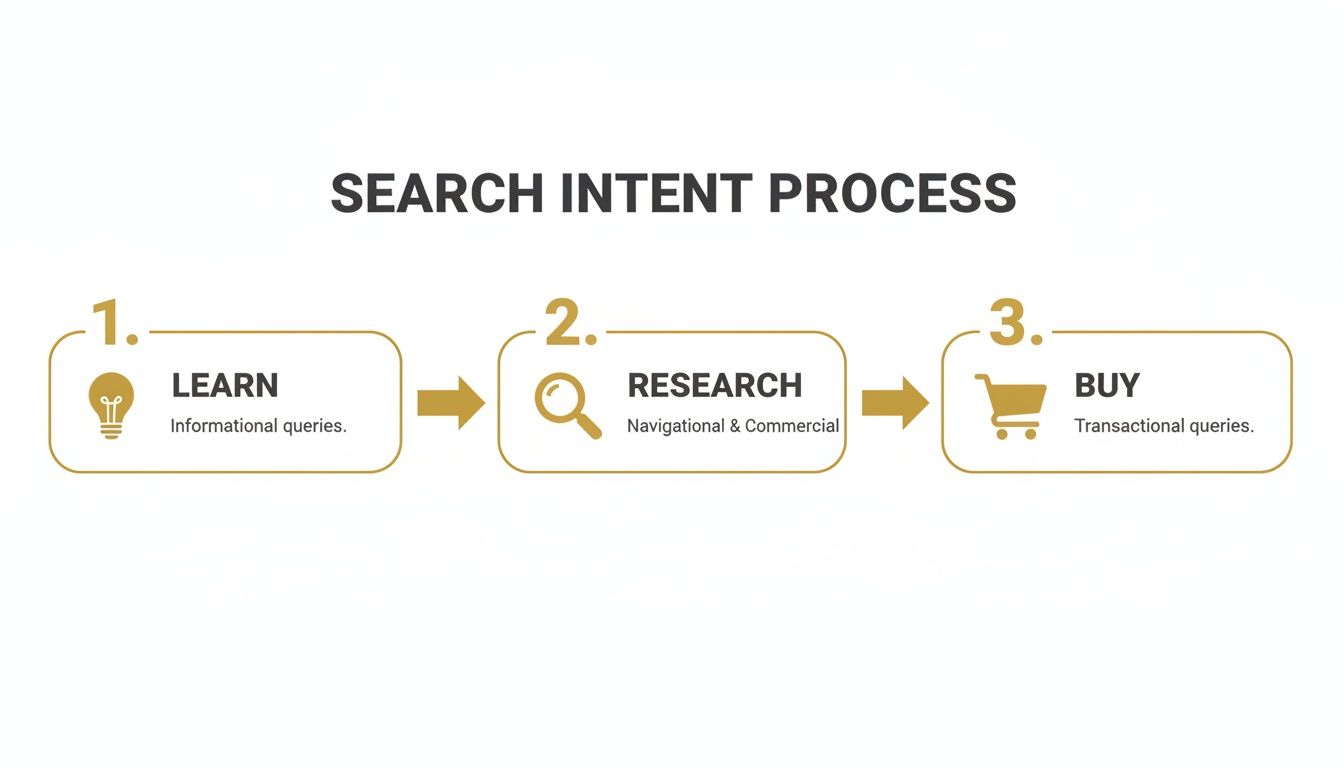
This shows how a searcher moves from learning about a topic, to researching solutions, and finally to making a purchase—a core concept for understanding keyword relevance.
Step 3: Prioritisation And Goal Alignment
Okay, so now you have a refined list of relevant, achievable keywords. But which ones should you go after first? This is where you strategically decide where to focus your efforts for the best immediate and long-term return.
Not all keywords are created equal when it comes to business value. A keyword that leads to a high-value sale is far more important than one that just brings in casual readers. This is where your SEO strategy must connect directly with your bigger business goals.
Ask yourself these critical questions for each keyword:
- Does this keyword attract visitors who are likely to become customers?
- Does it align with a new product launch or a key service we're promoting?
- Does it represent a "quick win"—low difficulty, high relevance—that can build early momentum?
By scoring your keywords based on their business potential, you can create a clear roadmap. This stops you from randomly picking terms and makes sure your content creation is always aimed at activities that will actually grow your business.
Step 4: Mapping Keywords To Content
The final step is where your strategy becomes a real, actionable content plan. Keyword mapping is simply the process of assigning a primary target keyword (and a group of related secondary keywords) to a specific page on your website.
Every important page—from your homepage to your blog posts and service pages—should have a unique keyword target. This simple practice prevents "keyword cannibalisation," a common problem where multiple pages on your own site compete with each other for the same search term, diluting your authority and confusing Google.
For example:
- "Best CRM for small business UK" might be mapped to a detailed comparison guide on your blog.
- "Small business accounting services" would be assigned to your main service page.
- "How to send an invoice" could be the target for a helpful, top-of-funnel blog post.
This organisational step provides incredible clarity for you and your team. It ensures every piece of content has a clear purpose and is optimised to rank for a specific, valuable query. It’s how you turn all that research into a tangible asset that consistently attracts the right audience.
Essential Tools and Techniques for Finding Keywords
Right, you’ve got the framework down. Now for the fun part: finding the actual words and phrases your customers are plugging into Google every day. The good news is you don’t need a massive budget or a complicated suite of software to get started. In fact, some of the most powerful insights are hiding in plain sight, and they’re completely free.
Think of these free methods as your foundational toolkit. They help you get a feel for the genuine language of your audience, straight from the source. These techniques are fantastic for unearthing long-tail keywords and figuring out the real questions people need answers to.
Start with Zero-Budget Methods
Before you even think about paying for a tool, you can build an incredibly solid list of initial keywords just by tapping into free, everyday resources. This approach grounds your strategy in real human behaviour, not just numbers on a spreadsheet. It’s all about listening first and analysing second.
And one of the best places to start listening is where your audience is already talking.
-
Online Communities (Reddit & Quora): These platforms are absolute goldmines for unfiltered customer language. Hunt down subreddits or Quora topics related to your industry and just observe. Pay attention to the questions, the problems, and the exact terminology people use. A thread titled "What's the best way to…" is basically a ready-made keyword staring you in the face.
-
Google's Built-in Features: Google itself leaves a trail of powerful clues. Start typing a broad keyword into the search bar and see what Autocomplete suggests – these are all real, popular queries. Once you hit search, scroll down to the "People Also Ask" box and the "Related searches" section at the bottom for even more ideas.
By exploring these free avenues, you’re gathering authentic, intent-driven phrases directly from the people you want to reach. This groundwork is invaluable, setting a strong foundation for everything that comes next.
Ethically Analyse Your Competitors
Guess what? Your competitors have already done a lot of the heavy lifting for you. By ethically analysing their content, you can figure out which keywords are already bringing them traffic and results. This isn't about copying them; it's about spotting opportunities they might have overlooked.
Start by simply looking at their best-performing blog posts or service pages. What topics are they covering in depth? Take note of the titles, headings, and key phrases they repeat. This manual review can quickly reveal their core keyword strategy and highlight gaps you can fill with better, more detailed content.
Understanding which keywords your competitors successfully rank for provides a strategic benchmark. It shows you what's achievable in your market and helps you find underserved topics where you can build authority more quickly.
For instance, if a rival has a popular article on "small business accounting tips," you could create a more specific, targeted guide on "quarterly VAT return tips for UK freelancers." This lets you go after a more focused, high-intent audience without fighting them head-on for a broader term. You can find our detailed guide on the best keyword research tools to help with this process.
Accelerate Your Research with Premium Tools
While free methods are vital for understanding your audience’s mindset, premium SEO tools are absolute game-changers for speed and scale. Platforms like Ahrefs and Semrush are industry standards for a reason—they let you scale up your research, analyse data efficiently, and track your progress over time.
Think of these tools as a high-powered microscope. They take the raw insights you've gathered and enrich them with crucial data points like search volume, keyword difficulty, and even estimated click-through rates. This data turns your qualitative hunches into a quantitative, actionable strategy.
To really get the most out of your time, leveraging the best keyword research tools is a must for any serious SEO work. These platforms let you:
- Uncover Competitor Keywords: Just pop in a competitor's domain and instantly get a list of almost every keyword they rank for.
- Find Keyword Gaps: Compare your site against several competitors to find valuable keywords they all rank for, but you don't.
- Scale Your Ideation: Turn one single "seed" keyword into thousands of relevant suggestions, complete with all the data you need to prioritise them.
When you combine these manual, human-centric techniques with the power of premium tools, you get a complete, well-rounded approach. You start with genuine human insight and then use technology to validate and scale your strategy for maximum impact.
Common Keyword Research Mistakes to Avoid
Even the most well-thought-out keyword strategy can go off the rails if you stumble into a few common traps. Knowing the theory is one thing, but sidestepping these frequent blunders is what turns a strategy that looks good on paper into one that actually drives traffic and revenue. Think of this as your pre-flight checklist.
Chasing "Ego Keywords"
Lots of businesses fall into this trap right at the start. They build a list of "ego keywords"—those big, impressive-sounding terms like "marketing software" or "business coaching." Sure, they might get tens of thousands of searches, but trying to rank for them is usually a losing battle against established industry giants with massive budgets.
The real goal of keyword research isn't to chase the biggest search volumes; it's to find the most valuable conversations. Focusing on highly competitive 'ego keywords' often leads to spending significant resources with little to no return on investment.
Instead of fighting a war you can't win, hunt for more specific long-tail keywords. This is where you have a genuine chance to compete and connect with an audience that's much closer to buying.
Forgetting About Search Intent
This is easily the biggest mistake you can make in modern SEO. You might discover a keyword with great volume and low competition, but if you don't grasp the why behind the search, your content will completely miss the mark. It’s like showing up to a job interview in your swimming trunks; you’re in the right place, but you've totally misjudged the situation.
For instance, someone searching for "best CRM for small business" is in a commercial, comparison-focused mindset. They're looking for reviews, pricing, and detailed feature breakdowns. If you target that phrase with a top-level blog post called "What is a CRM?," you’ve failed to match their intent. Your page will never satisfy them, and it will never rank.
Always ask yourself: what is the searcher trying to do? Then, create the exact piece of content that helps them do it.
Treating Research as a One-Off Task
The digital world moves at a dizzying pace. Customer behaviour changes, new competitors pop up, and search trends are always shifting. A keyword list you built a year ago could already be missing huge opportunities or, even worse, targeting phrases that are now completely outdated.
Proper keyword research isn't a "set it and forget it" job. It’s a continuous cycle of discovery, analysis, and fine-tuning. A good rhythm to get into is:
- Perform a major audit annually: This is your chance to step back and re-evaluate your entire strategy, making sure it still aligns with your business goals.
- Conduct quarterly check-ins: Use these to spot emerging trends, find new long-tail opportunities, and see if the intent behind your keywords has changed.
- Monitor your performance constantly: Keep a close watch on your rankings for target keywords. This will help you spot pages that need a content refresh before they start to slip.
By treating what is keyword research in SEO as an ongoing process, you ensure your strategy stays agile, relevant, and consistently effective at driving real growth.
From Keywords to Content: A Practical Workflow

Having a finalised list of keywords is a great start, but it’s just that—a start. The real magic happens when you turn that spreadsheet of terms into a living, breathing content plan. This is where we bridge the gap between raw data and content that actually gets results.
The trick is to stop thinking about individual keywords and start thinking in topic clusters. Imagine you’re organising a library. You wouldn't just scatter books randomly across the floor. You’d group all the books on a single subject together on one shelf, making it simple for people to find exactly what they need.
That’s what we’re doing with our keywords. By grouping related terms, we signal to search engines that we’re a comprehensive resource on a topic, which helps build our authority in their eyes.
Building Your Content Clusters
First things first, look for the main themes running through your keyword list. Start grouping keywords with similar search intent into clusters, with each cluster focused on a broad "pillar" topic.
For instance, keywords like "how to send an invoice," "invoice template for freelancers," and "small business invoicing software" all clearly belong together. They form a natural cluster around the broader topic of "business invoicing."
This lets you create a central, in-depth piece of content (your pillar page) and then surround it with more specific articles that all link back to it. This creates a really strong internal linking structure that Google loves. If you need a hand with the writing itself, our guide on SEO content writing tips has you covered.
With your clusters defined, it's time to assign those keywords to actual pieces of content.
Your keyword list isn't just a collection of terms; it's a series of content prompts. Each keyword represents a question your audience is asking or a problem they need solved, giving you a clear mandate for what to create next.
For every new blog post, service page, or product description you plan to write, make sure you assign:
- A Primary Keyword: This is the main focus of the page. It’s the term you want this specific page to rank for, and it should feature in your title, headings, and throughout the copy.
- Secondary Keywords: These are closely related variations and long-tail phrases. They add depth and context, helping your content feel more natural and rank for a wider range of queries.
Following this structured process means every single piece of content you create has a clear, strategic purpose. It's how you turn your research into a real asset that consistently brings in the right kind of traffic and customers.
Frequently Asked Questions About Keyword Research
Even when you've got the basics down, a few nagging questions always seem to pop up once you start doing the actual work. Let's tackle some of the most common ones so you can get on with your keyword research with confidence.
Think of this as your quick-reference cheat sheet for those "what if" moments.
How Often Should I Do Keyword Research?
Keyword research isn't a one-and-done task; it's more like tending a garden. You can't just plant the seeds and walk away. You should plan for a major deep-dive at least once a year, or whenever you're launching a new product line or service.
On top of that, it's smart to schedule quarterly check-ins. These are your moments to see what's working, spot emerging trends, and find older content that could use a refresh. This rhythm keeps your SEO strategy tuned in to what people are actually searching for right now.
Keyword research is a cycle, not a straight line. The market is always changing, and your strategy must adapt to keep pace. Consistent effort is what separates successful SEO from stagnant websites.
What Is a Good Keyword Difficulty Score?
Honestly, there's no magic number here. A "good" score is completely relative to your own website's strength. If you're running a brand-new site with very little authority, going after keywords with a difficulty score under 30 (on most SEO tools) is a great place to start.
As your website earns more backlinks and builds its reputation over time, you can start aiming for more competitive terms. The real skill is finding that sweet spot between a keyword that gets a decent amount of traffic and one you can realistically rank for.
Can One Page Rank for Multiple Keywords?
Absolutely! In fact, that's exactly what you should be aiming for. A single, well-crafted page will naturally rank for its main target keyword plus a whole cluster of related secondary terms and long-tail variations. You might be surprised at what you find in your analytics. Digging into the challenge of "keywords not provided" in Google Analytics can help you uncover these hidden gems.
When this happens, it sends a powerful signal to Google that your page is a genuinely comprehensive resource, which in turn helps it show up for an even wider range of searches.


