

Marketing attribution is all about figuring out which of your efforts are actually bringing in the customers. It’s the science of assigning credit to the different ads, clicks, and pieces of content that someone interacts with on their journey to becoming a customer. In short, it helps you move from just guessing what works to knowing what drives results.
Understanding the Core Concept of Attribution

At its heart, marketing attribution is about connecting the dots. Think about a typical customer journey: someone might see your ad on social media, read a blog post a week later, get an email newsletter, and then finally click a paid search ad to make a purchase.
Without attribution, it's easy to give 100% of the credit to that final search ad. But that ignores all the other crucial steps that built awareness and trust along the way. Attribution helps you see the whole picture.
This process lets you answer fundamental business questions with hard data, not just gut feelings. You can finally understand the true value of each marketing channel and, just as importantly, see how they all work together to nudge a customer towards a decision. By analysing these pathways, you can stop pouring money into campaigns that aren't pulling their weight and double down on what truly works.
Why It Matters More Than Ever
Let's face it, the modern customer journey is anything but a straight line. People bounce between channels, and research shows that e-commerce customers almost always use multiple touchpoints before they buy. This complexity makes attribution a must-have for a few key reasons:
- Smarter Spending: It shines a light on which channels deliver the best return on investment (ROI), so you can allocate your budget where it will have the biggest impact.
- Better Campaigns: When you know which messages and creative work best at each stage of the journey, you can fine-tune your campaigns for much better performance.
- Proving Marketing’s Value: Attribution gives you the cold, hard data you need to show the rest of the business how marketing directly contributes to sales and growth.
Essentially, it’s the difference between flying blind and navigating with a precise GPS. A great real-world example of this is for sellers on major platforms; you can find out more in a comprehensive guide to Amazon Attribution, which explains how they can track the performance of their off-site ads.
Marketing attribution transforms your budget from an expense into a strategic investment. It ensures every pound spent is accountable and directed towards activities that demonstrably move the needle.
Ultimately, getting to grips with marketing attribution is the first step toward building a predictable growth engine for your business. It gives you the confidence to make smarter decisions, ensuring your marketing efforts are not just busywork but are actively building your bottom line.
Why Attribution Is a Game-Changer for UK Businesses

It’s one thing to get your head around the theory of marketing attribution, but it’s another thing entirely to see it transform a business. For UK companies trying to stand out in a crowded market, attribution isn't just a clever metric; it's a genuine tool for growth. It’s what shifts you from simply spending money on marketing to strategically investing it for a predictable return.
Let’s imagine a growing e-commerce brand based in Manchester selling artisanal coffee. They're putting their budget into Google Ads, Instagram campaigns, and a weekly email newsletter. Without attribution, they might see a sale come through from a Google Ad and assume that’s their star player. So, they pour more money into it.
This is such a common—and costly—mistake. What they can't see is that the customer first found their brand through an engaging Instagram Reel, then signed up for their newsletter to get a discount. They only searched on Google after a promotional email landed in their inbox. In this journey, Instagram and email did all the heavy lifting, but that final click got all the glory.
Optimise Your Marketing Spend with Precision
Proper attribution fixes this massive blind spot. By giving credit to each of these touchpoints, our Manchester coffee brand can finally see the complete, true customer journey. They suddenly realise their Instagram content is brilliant for building that initial spark of awareness, while their email marketing is absolutely vital for nudging people towards a purchase.
This clarity changes everything. Instead of just blindly boosting their Google Ads budget, they can now make much smarter decisions.
- They could allocate more funds to creating high-quality Instagram Reels that pull in new audiences.
- They could invest in their email strategy to make it more personal and convert more subscribers.
- They could refine their Google Ads to target people who are already familiar with them, making every pound spent far more efficient.
This approach makes sure every bit of the budget is working as hard as possible, directly feeding the bottom line. It’s all about making your entire marketing strategy for small business more joined-up and effective.
Prove the Value of Your Marketing Efforts
Beyond smarter spending, attribution gives you the hard data you need to prove marketing’s worth. It helps you answer that critical question from the leadership team: "What are we actually getting for our marketing spend?" Instead of pointing to vague metrics like clicks or impressions, you can show them a clear report linking specific campaigns directly to sales.
Attribution provides the evidence that turns marketing from a perceived cost centre into a proven revenue driver. It connects your team's daily activities directly to business growth.
This is becoming more and more crucial for businesses up and down the country. The focus on measurement is a clear trend, with 22% of UK marketers now saying sales is their most valuable performance metric. This is followed closely by social media engagement at 20% and website traffic at 18%. These figures highlight a growing demand to connect marketing actions to real business results—which is exactly what attribution delivers.
By getting to grips with marketing attribution, UK businesses can stop guessing and start building a predictable growth engine. You get a crystal-clear picture of how customers find you and what makes them tick, empowering you to turn those valuable insights directly into profit.
Choosing The Right Attribution Model
Picking an attribution model is a bit like choosing the right tool for a job. There’s no single ‘best’ one; the right choice really depends on your business, how long it takes a customer to decide to buy from you, and what you’re trying to learn.
It’s easy to fall into the trap of looking for a one-size-fits-all answer. But the reality is far more nuanced. A model that works perfectly for a fast-paced online shop could paint a completely misleading picture for a B2B business with a six-month sales cycle. The real goal is to find a model that reflects how your customers actually interact with your brand on their way to making a purchase.
This diagram highlights how picking the right model is central to attribution, which in turn leads to a better return on investment, sharper channel insights, and smarter budget decisions.
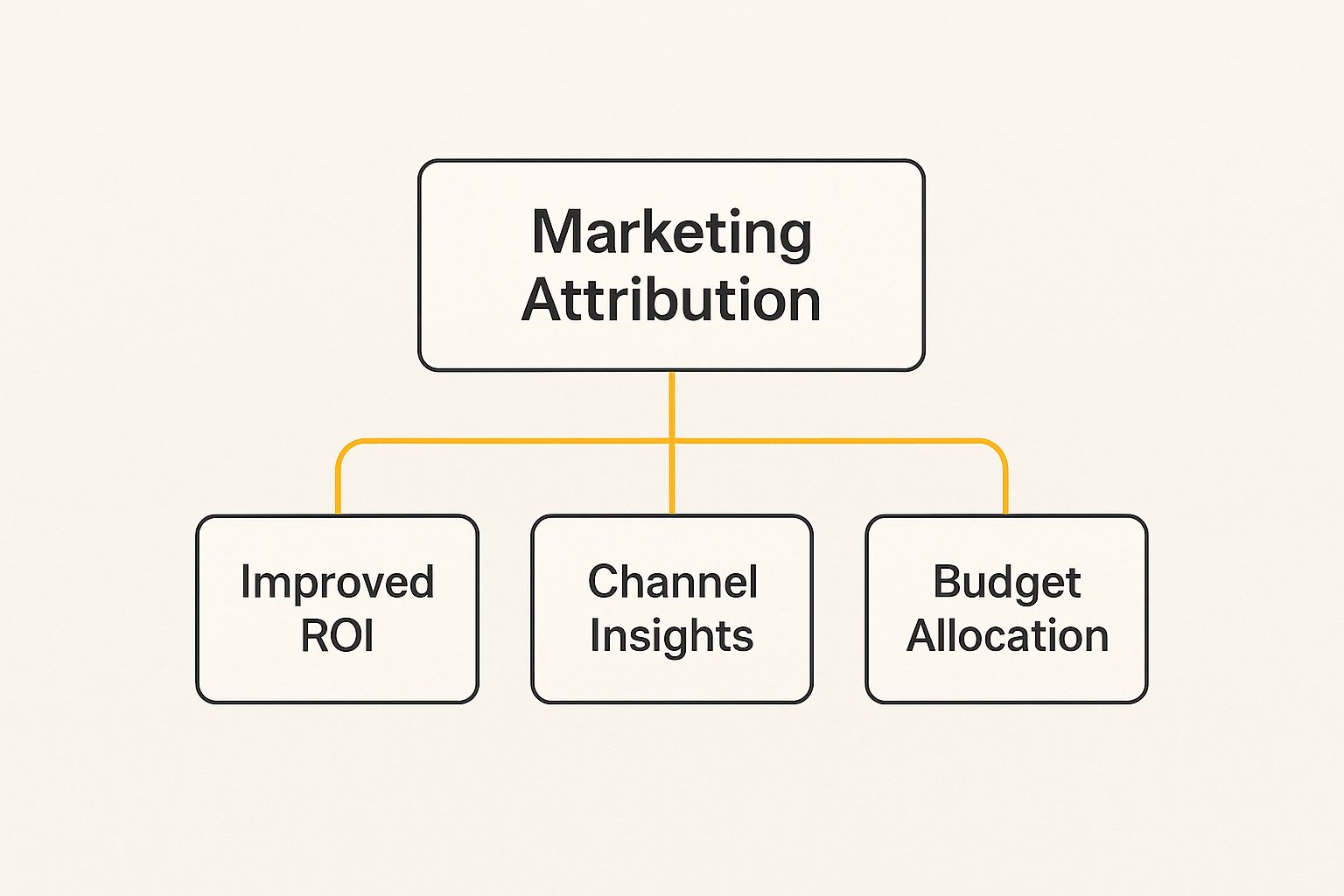
As you can see, the path from effective attribution to business growth is clear. It all starts with a model that gives you an honest, unfiltered view of your marketing performance.
Single-Touch Models: The Simple Starting Point
The most straightforward way to get started is with a single-touch model. These are simple because they give 100% of the credit for a sale to just one marketing touchpoint. While they’re easy to set up, they often oversimplify what is usually a much more complex customer journey.
Think of it like a football team scoring a goal. Does all the credit go to the striker who kicked the ball into the net? Or does it also belong to the midfielder who made the crucial pass? Single-touch models are like giving all the glory to the striker, completely ignoring the teamwork that led to the opportunity.
There are two main types:
- First-Click Attribution: This model gives all the credit to the very first interaction a customer has with your business. It's really useful for understanding which of your channels are best at creating initial awareness and bringing new people into your world. The downside? It ignores everything that happens afterwards to nurture that early interest.
- Last-Click Attribution: As you might guess, this is the complete opposite. It gives all the credit to the final touchpoint right before the customer converted. It’s often the default setting in analytics platforms like Google Analytics, and it’s great for pinpointing which channels are effective at closing the deal. Its major flaw, however, is that it completely devalues all the marketing efforts that built the initial trust and interest in the first place.
Multi-Touch Models: Seeing The Whole Picture
While single-touch models provide a narrow snapshot, multi-touch models offer a far more balanced and realistic perspective. They work by spreading the credit across multiple touchpoints in the customer's journey, recognising that it usually takes several interactions to lead to a final sale.
Going back to our football analogy, a multi-touch model is like giving credit to the whole team. The defender who won the ball back, the midfielder who passed it forward, and the striker who scored all get recognised for their contribution. It paints a much more complete and fair picture of how success was achieved. This mindset is vital for anyone building a cohesive marketing plan, and our beginner's guide to digital marketing explores how different channels can work together.
Multi-touch attribution shifts your perspective from asking, "What was the one thing that worked?" to "How did all our marketing efforts work together to drive this result?"
Let’s have a look at the most common multi-touch models.
- Linear Model: This is the most democratic multi-touch model. It simply gives equal credit to every single touchpoint along the customer’s path. If a customer saw a social media ad, clicked an email, read a blog post, and then used a search ad to buy, each of those four touchpoints would receive 25% of the credit. It’s a simple, fair approach that values every interaction equally.
- Time-Decay Model: This model is built on the idea that the touchpoints closer to the sale are more influential. It gives more credit to interactions that happened recently and less to those from weeks or months earlier. So, the first touchpoint gets the least credit, while the last one gets the most.
- U-Shaped (Position-Based) Model: This popular model gives special importance to two key moments: the very first touch that introduced the customer to your brand and the very last touch that sealed the deal. It typically assigns 40% of the credit to the first interaction, 40% to the last, and splits the remaining 20% evenly among all the touchpoints in between. This is a fantastic choice for businesses that value both lead generation and conversion-driving activities.
Comparing Common Marketing Attribution Models
To make it easier to decide, here’s a quick summary of the models we've covered, how they work, and where they shine.
| Model | How It Works | Pros | Cons | Best For |
|---|---|---|---|---|
| First-Click | Gives 100% credit to the first touchpoint. | Simple to implement; highlights top-of-funnel channels. | Ignores all other interactions; oversimplifies the journey. | Businesses focused purely on generating new leads and brand awareness. |
| Last-Click | Gives 100% credit to the last touchpoint. | Easy to measure; shows what closes deals. | Devalues upper and mid-funnel marketing efforts. | Companies with short sales cycles and a focus on direct-response campaigns. |
| Linear | Distributes credit equally across all touchpoints. | Fair and balanced; acknowledges every interaction. | Can undervalue more influential touchpoints. | Marketers who want a simple, holistic view of the entire customer journey. |
| Time-Decay | Gives more credit to touchpoints closer to conversion. | Reflects that recent interactions can be more influential. | Can devalue important early-stage awareness-building. | Businesses with longer consideration phases, like B2B or high-value sales. |
| U-Shaped | Gives 40% credit to the first touch, 40% to the last, and 20% to the middle. | Values both the "opener" and the "closer" touchpoints. | Can undervalue the nurturing that happens in the middle. | Companies with a balanced focus on both lead generation and conversion. |
Choosing a model isn't a one-time decision. The best approach is often to start with a simpler model that aligns with your primary business goals, and then test more sophisticated models as your understanding and data capabilities grow.
Putting Your Attribution Strategy into Action
Getting started with attribution can feel a bit overwhelming, but it's really just a matter of breaking it down into manageable steps. The goal isn't to build some flawless, overly complex system from day one. It's about laying a solid foundation and then tweaking it as you gather more data and get a better feel for how your customers actually behave.
The whole process starts with a simple question: what are we trying to achieve? You can't measure what you haven't defined. Are you hunting for brand new leads, pushing for immediate sales, or trying to build long-term customer loyalty? Your answer here will shape every decision you make, from the data you collect to the model you choose.
Define Your Goals and Key Conversions
First things first, you need to decide what a "win" looks like for your business. What are the most important actions someone can take on your website? These are your key conversions.
While a final sale is often the ultimate goal, don't forget all the smaller steps that get a customer there. These 'micro-conversions' are gold, especially if you have a longer sales cycle. They help you understand the entire journey, not just the final destination.
Your list of conversions might look something like this:
- Macro-conversions: The big wins, like completing a purchase or requesting a demo.
- Micro-conversions: Smaller but valuable actions, like signing up for a newsletter, downloading a whitepaper, or even just adding an item to the basket.
Pinpointing these actions gives your attribution work a clear purpose. It helps you focus on the touchpoints that genuinely nudge people closer to your most important business objectives.
Map Your Customer Touchpoints
Next, it’s time to play detective. You need to identify every single place a customer might bump into your brand. This means mapping out every possible point of contact, both online and offline, to build a complete picture.
Get ready to audit all your current marketing channels.
A classic mistake is to fixate on the obvious digital channels like search ads and social media, completely forgetting other interactions that might be influencing a customer’s decision.
Pull together a comprehensive list of all your touchpoints. This could include:
- Organic Search (SEO)
- Paid Search (PPC)
- Social Media (both organic posts and paid ads)
- Email Marketing Campaigns
- Referral Traffic from other websites
- Direct Traffic (people typing your URL straight in)
- Offline Events (like trade shows or in-person meetings)
Once you have this map, you can make sure you’ve got tracking in place for each touchpoint. This is often done using UTM parameters in your URLs to tag traffic from specific campaigns. Getting this step right is fundamental; it’s what gives your attribution model the clean data it needs to work properly.
Select Your Tools and Technology
With your goals set and your touchpoints mapped out, it's time to pick the tech to pull it all together. The good news is you don't need a huge budget to get going. Many businesses can start this journey with tools they're probably already using.
For most small to medium-sized businesses, Google Analytics is the perfect place to start. It's free, incredibly powerful, and its Model Comparison Tool lets you analyse your conversion paths using different attribution models. You can easily switch between Last-Click, First-Click, Linear, and others to see just how differently the credit gets assigned.
As your business grows, you might find you need something more specialised. Dedicated attribution platforms can offer much deeper insights, especially for businesses with complicated, multi-channel customer journeys. They can help stitch together data from all over the place—like your CRM and ad platforms—into one single, cohesive view.
The final, and arguably most important, step is to actually start analysing the data. Pick a model to begin with, run your reports, and look for patterns. Over time, you'll gain an invaluable understanding of how your marketing channels truly work together. Of course, once you've chosen your model, the next step is to accurately measure performance. A great resource on this is a guide to accurately tracking the ROI of your advertising campaigns. This whole process is about turning raw data into smarter, more profitable marketing decisions.
Overcoming Common Attribution Hurdles in the UK

While the dream is to perfectly track every penny of your marketing spend, the reality is often a lot messier. Getting marketing attribution right isn't just a case of flicking a switch, especially for UK businesses trying to make sense of things amidst strict privacy laws and the "walled gardens" of major ad platforms.
But don't let that put you off. Understanding these challenges is the first step towards building a measurement strategy that's both realistic and genuinely useful. The goal isn't impossible perfection; it's about getting a clearer, more honest picture than you had before.
One of the biggest headaches is that customer data is all over the place. It's not sitting in one neat spreadsheet; it's fragmented across your CRM, your website analytics, and various ad networks like Google and Meta. And each one is telling a slightly different story.
Navigating Data Silos and Platform Discrepancies
Ever pulled a report from Google Ads and another from Meta for the same campaign, only to find the conversion numbers don't match? It’s not an error. It’s the classic symptom of data silos. Each platform tracks users and assigns credit based on its own rules, entirely within its own ecosystem.
Meta might take credit for a sale because someone saw an ad on Instagram, while Google gives the credit to a search ad they clicked later that day. Naturally, both platforms want to prove their value, which leaves you with conflicting reports and no single source of truth.
The real challenge isn't a lack of data, but a lack of connection between the data points. Good attribution is all about bridging these gaps to create one unified view of the customer journey from all the scattered pieces.
This problem is made worse by inconsistent tracking windows. Privacy regulations like GDPR have made old-school cross-platform tracking much harder, leading platforms to use their own attribution windows. For example, Facebook might use a 7-day click window, while Google Ads defaults to a 30-day one.
The Perils of Outdated Models
Another huge hurdle is relying on overly simplistic models. We've touched on this, but the classic example is last-click attribution. This model gives 100% of the credit to the final touchpoint before a conversion, completely ignoring everything that came before.
Think about a typical customer journey:
- Awareness: They first heard about your brand from a LinkedIn post.
- Consideration: They signed up for your newsletter and read three of your emails.
- Conversion: A retargeting ad finally prompted them to buy.
A last-click model gives all the glory to that final retargeting ad. This is a dangerously narrow view. It could easily lead you to slash the budget for your brilliant LinkedIn and email campaigns, without realising you're gutting the very channels that fill the top of your funnel. Recognising the full journey is vital, and the advantages of email marketing are a perfect example of why those middle touchpoints can't be ignored.
Getting past these hurdles really starts with a shift in mindset. It’s about accepting that no single platform holds all the answers and that you need a blended, multi-touch approach to get closer to the truth. By embracing these complexities, you can set realistic expectations and build a much more resilient and insightful attribution strategy.
Attribution Success Stories You Can Learn From
The theory is great, but seeing marketing attribution deliver real-world results is what truly brings its power to life. The proof is always in the numbers, and several brands have completely turned their strategies around by adopting a smarter way to measure what works. These stories show just how much growth is possible when you move beyond simplistic last-click thinking.
These businesses all shared a common headache: their customer journeys were messy, and they couldn't confidently connect marketing spend to sales. They were essentially flying blind, guessing which channels were pulling their weight and which were just draining the budget. The fix was to implement a data-driven attribution model that could finally show them the whole picture.
Bose and the Power of Multi-Touch Insights
Global audio giant Bose is a perfect case study. By switching to a more sophisticated attribution model, they gained a much deeper understanding of how their various channels collaborated to guide customers towards a purchase. This wasn't just a trivial data exercise; the impact was huge.
Bose achieved an incredible 81% increase in e-commerce sales and a 35% rise in overall revenue. This really highlights the modern reality of online shopping, where research shows that 73% of customers now use multiple channels before making a decision. You can discover more insights about attribution uplift and see why a multi-touch view is no longer optional for UK businesses.
When you can assign fair credit to every touchpoint, from that first blog post a customer reads to the final ad they click, you can finally make budget decisions based on evidence, not guesswork. That shift is the secret to unlocking sustainable, predictable growth.
Driving Efficiency at HelloFresh and Beyond
It’s not just the big tech brands winning here. Meal-kit company HelloFresh used data-driven attribution to fine-tune its marketing and make some serious efficiency gains.
By getting a clear view of the entire customer path, they managed to secure:
- A 10% increase in conversions.
- An 18% reduction in their Cost Per Acquisition (CPA).
In the same vein, tour operator Walks of Italy used a better attribution approach to increase its revenue by 33% while improving marketing ROI by a massive 25%. These examples prove that whatever your industry, getting a handle on what marketing attribution is and putting it to work leads directly to smarter spending and a healthier bottom line. They simply stopped guessing and started measuring what actually mattered.
Frequently Asked Questions About Marketing Attribution
Even after getting your head around the basics, you probably still have a few practical questions about how marketing attribution actually works in the real world. That’s perfectly normal. Let's tackle some of the most common queries I hear from marketers, so you can move from theory to practice with confidence.
Think of this as your quick-reference guide for what comes next. We’ll look at where to start if you’re a smaller business, how things are changing, and how you can get going without a massive budget.
What Is the Best Attribution Model for a Small Business?
If you're running a small business, my advice is always to start simple. It’s easy to get bogged down in complex models, but you don't need to. A U-Shaped (or Position-Based) model is a fantastic starting point because it strikes a great balance between useful insight and simplicity.
Here’s how it works: it gives 40% of the credit to the very first touchpoint that brought a customer to your brand, and another 40% to the final touchpoint right before they converted. That remaining 20% gets distributed across all the interactions in between. This way, you’re properly valuing both the channels that create initial awareness and the ones that close the deal, without getting lost in the weeds.
How Much Does It Cost to Implement Attribution?
This is a big one, and the good news is, you can get started with marketing attribution for free. Many businesses already have the tools they need right at their fingertips.
For most people, the best place to begin is Google Analytics. It's free, incredibly powerful, and comes with a Model Comparison Tool. This lets you switch between different views of your data—like Last-Click, First-Click, and Linear models—to see how credit shifts.
As your business scales and your marketing gets more sophisticated, you might want to look into dedicated attribution platforms. These paid tools offer much deeper analysis and more integrations, but they're definitely not a day-one requirement. The most important thing is just to start tracking with the tools you already have.
How Is Attribution Evolving with Privacy Changes?
It's no secret the marketing world is changing. With the phasing out of third-party cookies thanks to new privacy laws and browser updates, the old ways of tracking are becoming less reliable. But this doesn't mean attribution is dead—far from it. It’s just getting smarter.
The future of attribution is adapting, and it’s leaning heavily on a few key areas:
- First-Party Data: This means focusing more on the data you collect directly from your audience via your website, CRM, or email list. It's information you own and can trust.
- Unified Analytics: We’re seeing a greater need for platforms that can pull together data from all your different channels into one clear, unified picture of the customer journey.
- AI and Modelling: Predictive models are becoming essential. They can cleverly fill in the tracking gaps left by the absence of cookies, giving you an estimated but highly accurate view of conversion paths based on the data you do have.
Ready to build a smarter, more efficient marketing strategy? The Digital Marketing Toolbox is your go-to resource for discovering and comparing the best tools for analytics, SEO, and automation. Streamline your workflow and drive real growth. Explore the best tools for your business today at https://grow-your-biz.com.


