
At its heart, marketing automation is all about using clever software to handle the repetitive, time-consuming parts of your marketing. Think of it as the ultimate assistant for your team—one that works tirelessly around the clock to send the right email at the right time, keep customer details up to date, and get your social media posts out on schedule.
It’s the technology that takes the grunt work off your plate, freeing up your team’s valuable time to focus on the things humans do best: strategy, creative thinking, and building genuine relationships with customers.
So, What Is Marketing Automation, Really?
Imagine you’re running a popular local bookshop. Trying to personally greet every person who walks in, remember their favourite author, and send them a handwritten note when a new book in their preferred genre arrives would be completely overwhelming.
Now, picture a system that automatically sends a welcome discount to someone who just signed up for your newsletter, emails a special offer on mystery novels to customers who’ve bought them before, and gently reminds someone they left a book in their online shopping basket. That’s exactly what marketing automation does, but for your digital presence.
It’s not about replacing marketers with robots. It’s about giving them a powerful tool that executes tasks with speed and precision, allowing your team to step back from the manual grind and focus on the bigger picture.
It's More Than Just Sending Emails
A lot of people hear "marketing automation" and immediately think of basic email newsletters, but that’s only a tiny piece of the puzzle. While an email tool can send a message to a list, true automation software is the central nervous system connecting all your marketing efforts.
The real magic lies in how it links different channels and customer behaviours together into one seamless flow.
- It watches what people do: The software can see how users interact with your website, what emails they open, and which ads they click on.
- It figures out who's interested: Based on their actions, it can automatically score leads to identify who is most likely to buy.
- It reacts in real-time: When someone takes a specific action, like downloading a guide from your site, it can instantly trigger a pre-planned series of follow-up messages.
By putting these processes on autopilot, businesses can create a far more personal and timely experience for every single person, whether they have a hundred customers or a hundred thousand. It ensures no one gets forgotten and every customer feels seen.
Manual vs Automated Marketing: A Quick Comparison
To really see the difference automation makes, it helps to compare common marketing tasks side-by-side. The table below highlights the incredible gains you can achieve in efficiency, scale, and the ability to personalise experiences for your audience.
| Marketing Task | The Manual Way | The Automated Way |
|---|---|---|
| Welcoming New Subscribers | Manually sending an email to each new person who signs up. Prone to delays and inconsistency. | An instant, personalised welcome email is triggered the moment someone subscribes. |
| Nurturing Leads | A salesperson tries to remember to follow up with dozens of leads via individual emails or calls. | A pre-built sequence of emails and content is automatically sent based on the lead's interests and behaviour. |
| Social Media Posting | Logging into each platform daily to post content in real-time. Difficult to maintain a consistent schedule. | Posts are scheduled weeks in advance across all channels and published automatically at optimal times. |
| Identifying Sales-Ready Leads | Sales and marketing teams rely on guesswork or time-consuming meetings to decide who to contact. | A lead scoring system automatically flags the hottest leads based on their engagement, and notifies sales instantly. |
| Personalising Offers | Sending the same generic discount or promotion to the entire email list. | Tailored offers are sent to specific customer segments based on their past purchase history or browsing behaviour. |
As you can see, the shift from manual to automated isn’t just about saving time—it’s about creating a smarter, more responsive marketing engine that can grow with your business.
How Marketing Automation Works Its Magic
To really get your head around marketing automation, it helps to look under the bonnet and see how all the pieces fit together. At its heart, the technology runs on a simple but incredibly powerful idea: triggers and actions. A specific customer behaviour (the trigger) sets off a pre-planned, automated response (the action).
Think of it as a smart production line for your marketing. Each station is set up to perform a specific task based on signals it receives, guiding a potential customer smoothly along the path to becoming a loyal fan of your brand. This whole process is built on a few essential pillars working in harmony.
The Core Components of Automation
The real power of marketing automation software is how it pulls several key functions into one central hub. This integration is what creates that seamless flow of data and actions, delivering a joined-up customer experience that would be a nightmare to manage by hand.
These core components usually include:
- Lead Management and Scoring: This is where the system keeps tabs on every single interaction someone has with your business. It watches which pages they visit, what emails they open, and which guides they download, then assigns points to each action.
- Workflows and Campaign Builders: These are the brains of the operation. A workflow is simply a sequence of automated steps you create, like, "If a user visits the pricing page twice, then send them an email with a case study."
- Analytics and Reporting: Every single action is tracked, giving you crystal-clear data on what’s hitting the mark and what isn’t. This lets you measure your return on investment (ROI) and fine-tune your strategy as you go.
This image shows how these parts come together, with a marketer analysing the data to boost the overall ROI.
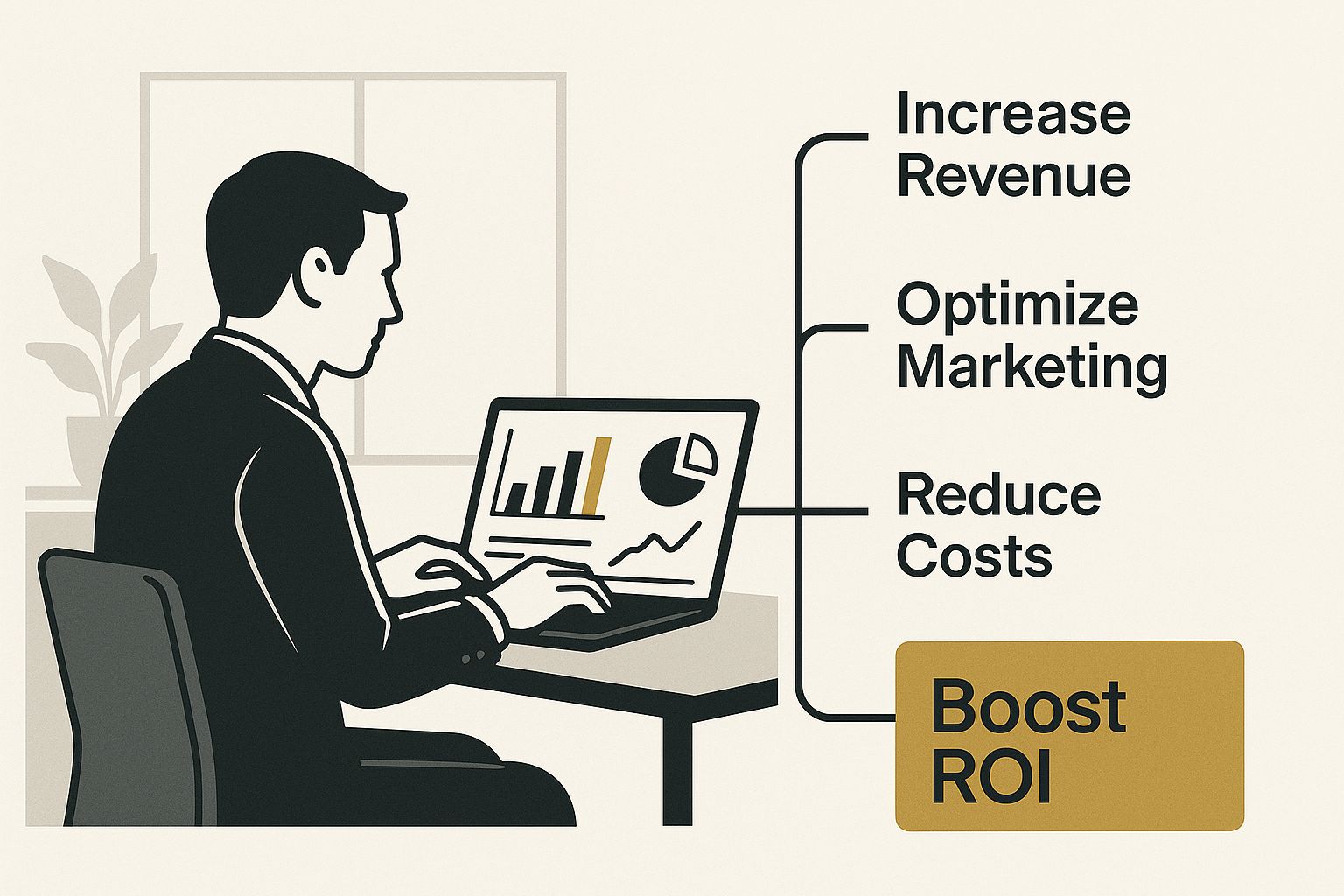
As the visual suggests, automation isn't a one-and-done task. It's a continuous cycle of engaging customers, gathering data, and using those insights to make your next campaigns even better.
An E-commerce Example in Action
Let’s bring this to life with an online clothing store. A new visitor, Sarah, browses a few product pages for summer dresses but leaves without buying anything. Without automation, she's just another anonymous visitor who got away. With automation, a completely different story unfolds.
An automated system doesn’t just see a visitor; it recognises potential. It connects the dots between browsing behaviour, past purchases, and expressed interests to deliver a perfectly timed and relevant experience.
The system tags Sarah's profile with an interest in "summer dresses." A day later, an automated workflow triggers an email to her, showcasing the very dresses she was looking at, maybe with a small "first-time buyer" discount thrown in. If she clicks the link but still doesn't buy, the system could wait another two days before sending a follow-up email featuring glowing customer reviews for those specific dresses.
This entire sequence happens automatically, nurturing Sarah's interest without a single person on the marketing team lifting a finger. It’s this ability to deliver a personal journey at scale that truly defines marketing automation and makes it such a vital tool for growing a business.
The Real-World Benefits for Your Business
It’s one thing to understand the mechanics of marketing automation, but it’s another to see the real impact it can have on your bottom line. Theory is great, but the true value comes from the tangible, measurable advantages it brings to the table, especially for businesses trying to get ahead in a crowded market.
These aren't just small tweaks for efficiency; we're talking about a fundamental shift in how you can attract, engage, and keep your customers coming back. For UK sectors like e-commerce, SaaS, and digital services, automation is no longer a 'nice-to-have'—it's fast becoming essential for survival and growth.
More Time and Better Leads
Probably the first thing you'll notice is the huge amount of time your team gets back. Think about all those repetitive tasks: sending follow-up emails, scheduling social media posts, or sorting contact lists. Automating them frees up your talented marketers to do what they do best—think strategically.
This reclaimed time feeds directly into more creative campaigns, better long-term planning, and deeper analysis of what’s actually working. Meanwhile, your automation platform is busy in the background, sifting through data to improve the quality of your leads. By tracking what people click on and how they interact with your brand, the system can automatically score prospects and flag the ones who are most engaged.
The upshot? Your sales team can stop chasing dead ends. They can put their energy into conversations with prospects who are already warmed up and genuinely interested in what you have to offer.
Automation ensures that your team's effort is always directed where it will have the most impact, turning your marketing function into a highly efficient and targeted growth engine.
Deeper Personalisation and Customer Loyalty
In today's market, generic, one-size-fits-all messages are just noise. Marketing automation gives you the power to create highly personalised experiences for every customer, at a scale that would be completely impossible to manage by hand. Using the data collected by your system, you can tailor every touchpoint to a customer's specific interests, behaviour, and history with your brand.
This opens up some fantastic opportunities:
- Targeted Content: You can send someone an article or an offer directly related to a product they were just looking at on your website.
- Behaviour-Based Triggers: A customer abandons their shopping cart? The system can automatically send them a follow-up email with a small discount to nudge them over the finish line.
- Dynamic Messaging: Why show everyone the same thing? Customise your website or emails based on a visitor's location or their past purchases.
This level of personal attention makes customers feel seen and valued, which is the absolute bedrock of building long-term loyalty. When you consistently deliver relevant, timely communication, you're not just selling; you're building a relationship that encourages repeat business. A well-designed marketing strategy for small business can use this capability to gain a significant competitive edge.
The numbers back this up. The UK marketing automation market is set for a projected annual growth rate of 13.9% between 2025 and 2030, largely driven by this demand for more personalised campaigns. Even in 2024, email marketing alone made up 26.12% of this growing industry, proving just how central it remains.
Putting Automation into Practice
Knowing the theory is one thing, but seeing marketing automation in action is where it all clicks. So, let’s move past the concepts and look at some real-world examples of how businesses are using automated workflows to connect with customers and grow their sales.
These scenarios track a customer's journey, revealing how simple triggers can launch powerful, perfectly timed marketing sequences. The best part? You can adapt these same strategies for your own business.
Example 1: The Engaging Welcome Series
A user named Alex discovers a new online gardening blog and signs up for its weekly newsletter to get planting tips. Without automation, he'd probably get a generic confirmation and then silence until the next newsletter. With automation, his journey is far more personal and engaging from the very beginning.
- Immediate Trigger: The moment Alex hits ‘subscribe’, an automated workflow springs into action.
- Email 1 (Instantly): A warm welcome email lands in his inbox, thanking him for signing up and delivering the promised planting guide.
- Email 2 (2 Days Later): The system follows up with an email showcasing the blog’s most popular articles, helping Alex find great content straight away.
- Email 3 (4 Days Later): A final email in the series asks about his specific interests (e.g., vegetable gardening, indoor plants) using clickable links. His choice automatically updates his profile, making sure future emails are even more relevant to him.
This simple sequence makes a fantastic first impression and segments Alex for future personalisation, all without anyone lifting a finger.
Example 2: The Lead Nurturing Campaign
Imagine Maria, a small business owner, is looking for new accounting software. She visits a provider's website and downloads their free eBook, "A Guide to Financial Management for SMEs." This single action flags her as a potential lead and kicks off a nurturing campaign.
- Initial Action: Maria's download puts her into a specific "SME Lead" segment.
- Follow-Up 1 (1 Day Later): She receives an email with a link to a case study, showing how a business just like hers benefited from the software.
- Follow-Up 2 (3 Days Later): If she clicked the link in the last email, the system sends an invitation to a free webinar on streamlining business finances.
- Final Step: If Maria registers for the webinar, her lead score jumps up, and the system automatically alerts a sales rep to give her a personal call.
This multi-step process gently guides Maria from initial curiosity towards being ready for a sales conversation, educating her at every step.
By delivering relevant content at each stage, the automated workflow builds trust and qualifies the lead effectively. This ensures the sales team invests its time talking to the most promising prospects.
Example 3: The Abandoned Cart Recovery
For any online shop, abandoned carts are a massive source of lost revenue. A shopper, Ben, adds a pair of trainers to his cart but gets distracted and leaves the site. Automation can turn this near-miss into a definite sale.
The system is programmed to trigger a workflow one hour after a cart is abandoned.
- Reminder Email (1 Hour Later): Ben gets a friendly, low-pressure email: "Did you forget something?" It includes a picture of the very trainers he left in his cart.
- Incentive Email (24 Hours Later): If he still hasn't checked out, a second email arrives offering a 10% discount to nudge him towards completing the purchase.
- Urgency Email (48 Hours Later): A final email creates a little urgency, letting him know his discount code is about to expire.
These automated sequences are incredibly effective at clawing back sales that would otherwise be lost for good. For a deeper dive, you can learn more about setting up marketing automation effectively for your online store.
Choosing the Right Automation Tools

So, you’re sold on the idea of marketing automation. Fantastic. The next step is a big one: picking the right software to bring it all to life. Think of it like buying a car. A solo entrepreneur running a side hustle needs a completely different vehicle to a global enterprise, and the best choice always comes down to the journey you’re planning to take.
Before you dive headfirst into comparing features and pricing tables, take a moment to look inwards. It's crucial to assess your own needs first. A platform built for a multinational corporation will likely be a clunky, expensive nightmare for a small business. On the flip side, a basic tool might hold back a company that’s ready to scale up.
Start with the simple questions. What’s your budget? How many people are on your team? And, perhaps most importantly, how will this new platform play with the systems you already rely on, like your CRM?
Key Factors to Consider
Making a smart decision means looking past the flashy marketing promises and digging into what will actually work for your business day-to-day. A bit of due diligence now will save you a world of pain down the line.
To help you focus your search, here are the three most critical areas to investigate:
- Business Size and Scalability: Are you a small team that needs something simple and effective right out of the box? Or are you a larger organisation that needs advanced features and the capacity to handle serious growth? Find a tool that fits you today but won't hold you back tomorrow.
- Budget and Pricing Model: The costs can be all over the place. Some platforms charge you based on the number of contacts you have, while others offer tiered plans based on features. Get crystal clear on your budget and keep an eye out for any hidden fees.
- Integrations with Existing Systems: Your automation tool can't operate in a silo. It needs to talk to your other software, especially your CRM. Check for native, easy-to-set-up integrations with the tools you use every day to keep your data flowing smoothly.
Choosing the right platform isn't about finding the 'best' tool on the market. It's about finding the best fit for your specific business goals, team, and tech stack.
A Look at Popular Platforms in the UK
The UK market is packed with excellent marketing automation tools, each with its own personality and strengths. HubSpot, for instance, is famous for its all-in-one platform that bundles marketing, sales, and service tools together. It's a solid choice for businesses that want a single, unified system.
ActiveCampaign really shines with its incredibly powerful yet intuitive automation builder, making it a favourite for marketers who want to craft intricate, highly personalised customer journeys. And Mailchimp, which started life as a simple email tool, has evolved into a robust platform perfect for small businesses looking for user-friendly automation without the complexity. Our beginner's guide to digital marketing can give you more context on how these tools fit into a wider strategy.
The move towards smarter, more efficient tools is undeniable. As of 2025, an estimated 67% of UK digital agencies have already adopted AI-powered automation for tasks like email sequences and lead scoring. This isn't just a trend; it's a competitive edge, allowing them to launch campaigns up to 40% faster. You can learn more about why UK agencies are turning to automation.
Getting Started and Avoiding Common Pitfalls
Jumping into marketing automation is exciting, but a little bit of planning goes a long way. The biggest mistake I see people make is trying to boil the ocean—automating everything all at once. The trick is to start small, get a quick win, and build from there. Think of it as laying down a solid foundation before you start building the rest of the house.
The very first thing you need to do is get crystal clear on your goals. What are you actually trying to accomplish? Maybe you want to improve the quality of your leads, win back customers who abandon their shopping carts, or create a smoother onboarding experience. Whatever it is, having a specific, measurable objective is your North Star. It will guide every decision you make.
Your First Steps to Automation
Ready to get your hands dirty? Taking it one step at a time is the best way to avoid feeling overwhelmed and allows you to learn as you go. Focus on launching a single, straightforward campaign that can make a real difference.
Here’s a simple game plan:
- Define a Clear Business Goal: Start with one objective. For example, "I want to reduce cart abandonment by 15% in the next three months."
- Map the Relevant Customer Journey: Sketch out the exact steps a customer takes before they leave their cart behind. Where are the friction points?
- Choose a Simple Workflow: You don't need a 10-step masterpiece. Just build a basic two-email sequence to remind them about their cart.
- Launch and Measure: Set it live, then keep a close eye on the results. See what works and what doesn't.
This measured approach builds confidence and gives you real-world data you can use to build bigger, better campaigns down the line.
Common Mistakes to Sidestep
Even with the best intentions, it’s easy to stumble. Knowing the common pitfalls is half the battle. One of the biggest blunders is over-automating and forgetting there’s a real person on the other side of the screen. Automation should feel personal and helpful, not robotic.
Another classic mistake is trying to run your automation on messy or incomplete data. Your system is only as smart as the information you give it. Bad data leads to sending the wrong message at the wrong time, which is a surefire way to annoy your customers. For a deeper dive into the dos and don'ts, it's worth exploring these marketing automation best practices.
Don't let perfect be the enemy of good. So many businesses get stuck in analysis paralysis, trying to create a flawless, all-encompassing strategy from day one. It's far better to launch a simple, effective workflow and improve it over time.
Finally, remember that automation isn't a silver bullet. Setting unrealistic expectations will only lead to disappointment. Instead, focus on making steady, incremental improvements, especially in areas like email engagement. Understanding the fundamental advantages of email marketing can help you set a realistic baseline for what your automated campaigns can achieve.
It's interesting to note that a 2025 UK report found only 15% of businesses listed improving marketing automation as a key priority. This shows just how many companies are still at the very beginning of their journey. You can read more about these digital marketing statistics.
Frequently Asked Questions
Even after getting your head around the basics, a few questions always seem to pop up. That’s completely normal. Let's dig into some of the most common things people ask when they're figuring out how marketing automation could work for their business.
How Much Does It Cost to Get Started?
This is the million-dollar question, isn't it? The good news is that you don’t need a massive budget to get going. Many platforms have starter plans designed for small businesses, often ranging from £15-£50 per month, usually priced according to how many contacts you have.
Of course, more advanced systems with all the bells and whistles can run into hundreds or even thousands. The real trick is to find a plan that fits what you need right now but has room for you to grow later.
Is This the Same as Email Marketing?
Not quite, though email is a massive piece of the puzzle. Think of it this way: your email marketing tool is a specialist, an expert at doing one job incredibly well. Marketing automation, on the other hand, is the general manager of your entire marketing operation.
It doesn’t just handle email. It brings together what’s happening on your website, your lead scoring, social media activity, and all the rich data in your CRM to create a single, unified strategy.
Essentially, while all marketing automation platforms can send emails, not all email marketing tools can manage the complex, multi-channel workflows of a true automation system. It's a significant step up in strategic power.
Ready to find the perfect tools to power your growth? At The Digital Marketing Toolbox, we bring together the best solutions for automation, SEO, content creation, and more, all in one place. Explore our curated selection and start building your ideal marketing stack today.


