
At its heart, programmatic advertising is simply the automated buying and selling of digital ad space. Forget the old-school way of negotiating ad placements over phone calls and drawn-out email chains. Instead, sophisticated software handles the entire transaction in the time it takes to blink.
Think of it like a high-speed stock market, but for online ads. It’s a fast, efficient, and incredibly smart way to get your message in front of the right people.
What Is Programmatic Advertising Anyway?
Let's cut through the jargon. Imagine you wanted to rent a billboard on a busy motorway. Traditionally, that meant finding the billboard owner, haggling over the price, signing contracts, and then just hoping the right kind of people drove past. Programmatic advertising takes that entire manual process and completely reinvents it for the digital age.
It uses clever algorithms to automatically purchase ad space and display your ads to very specific people across websites, apps, and social media. The whole point is to show the right ad, to the right person, at the right time—and do it all with unparalleled efficiency. It’s not just automation for automation’s sake; it’s about making advertising genuinely smarter and more relevant.
This approach is a perfect example of how marketing is evolving, often plugging directly into advanced marketing automation workflows.
The Core Idea: Precision and Speed
The real magic of programmatic lies in its ability to make data-driven decisions in real-time. Every single time you load a webpage that has ad space, a lightning-fast auction kicks off behind the scenes.
The entire process—from a user loading a page to a winning ad being displayed—happens in about 200 milliseconds. That's literally faster than you can blink.
This auction system instantly assesses anonymous data about you: your interests, your location, and your recent browsing habits. Advertisers who think you're their ideal customer then place a bid to show you their ad. The highest bidder wins, and their ad pops up on your screen.
This data-first approach allows for incredible precision. Instead of broadly advertising on a "sports website," a brand can get much more granular and target:
- Users who have previously visited their website (retargeting).
- People who live in a specific postcode and have recently searched for running shoes.
- Individuals who have been reading articles about marathon training.
Why It Matters for Modern Marketing
This switch from manual to automated ad buying is a game-changer for any modern business. It frees up marketing teams from tedious admin, allowing them to focus on what really moves the needle: strategy, creative thinking, and analysing performance. It's a foundational concept in today's marketing world, which you can learn more about in our guide at https://grow-your-biz.com/beginners-guide-to-digital-marketing/.
The impact is massive and only getting bigger. In the UK, the programmatic advertising market is expected to grow by roughly 27% each year between 2025 and 2035. This huge growth is being driven by industries like retail and consumer goods, which rely on programmatic to fine-tune their targeting and measure results with pinpoint accuracy.
Meet the Key Players in the Programmatic World

The programmatic advertising ecosystem might seem like a complex machine at first glance, but it really boils down to a handful of key platforms working in perfect sync. Each one has a specific job to do, and their seamless collaboration is what makes this automated process tick.
To really get our heads around it, let's think of the whole system as a dynamic marketplace, almost like a financial stock exchange, where buyers and sellers meet to trade.
The Demand-Side Platform (DSP): The Buyer’s Command Centre
First, we have the advertiser's best friend: the Demand-Side Platform (DSP). This is the software that brands and agencies use to actually buy ad space. It’s their single, unified dashboard for managing entire campaigns across a vast ocean of websites and apps.
An advertiser logs into their DSP to set up a campaign, defining everything from who they want to target and how much they're willing to pay, to uploading their actual ad creative. The DSP then acts as their automated agent, going out into the marketplace to bid on ad placements that precisely match their criteria.
Among the various components, the Demand-Side Platform (DSP) is what gives advertisers the power to programmatically purchase ad impressions from countless exchanges. It's the mission control for the entire buying side of the equation.
The Supply-Side Platform (SSP): The Seller’s Advocate
On the flip side, we have the publisher's tool: the Supply-Side Platform (SSP). If a DSP is for buying ad space, an SSP is for selling it. Publishers—like news sites, popular blogs, or mobile app developers—use an SSP to manage and monetise their available ad inventory.
The SSP’s main goal is to help the publisher get the best possible price for their ad space. It does this by connecting their inventory to a massive pool of potential buyers from multiple ad exchanges and DSPs simultaneously. Whenever a user lands on their site, the SSP is what fires the starting gun, sending out an ad request that kicks off the whole real-time bidding auction.
The Ad Exchange: The Central Marketplace
So, you have advertisers looking to buy and publishers ready to sell. Where do they actually meet? That's where the Ad Exchange comes in. Think of it as the central trading floor.
An Ad Exchange is a neutral, technology-driven marketplace that facilitates the real-time buying and selling of ad inventory. SSPs plug in to offer their supply, and DSPs connect to bid on it. The exchange is the auctioneer, managing the entire transaction in the blink of an eye.
It really is like a stock exchange for ads. The SSP lists the 'shares' (the ad space), the DSPs place 'buy orders' (the bids) on behalf of investors (the advertisers), and the exchange instantly facilitates the trade.
This centralised hub is what makes programmatic advertising possible at such a massive scale, connecting an enormous amount of supply with an equally huge amount of demand.
The Data Management Platform (DMP): The Intelligence Hub
Finally, there’s one more crucial player that works mostly behind the scenes: the Data Management Platform (DMP). This is the brain of the operation, the central warehouse for all the valuable audience data.
A DMP is a piece of software that collects, sorts, and organises large sets of first-, second-, and third-party data. It then creates detailed (but always anonymous) audience segments, such as "London-based professionals interested in eco-friendly cars" or "users who have recently searched for flights to Spain."
This rich audience intelligence is then passed to the DSP, giving the advertiser the insight needed for incredibly precise targeting. In short, the DMP tells the DSP who to target, and the DSP then goes out and finds them.
Key Players in the Programmatic Advertising Ecosystem
To help visualise how these platforms work together, here’s a simple breakdown of their roles in a typical programmatic transaction.
| Component | Primary User | Core Function |
|---|---|---|
| Demand-Side Platform (DSP) | Advertisers & Agencies | Buys ad space and manages ad campaigns automatically. |
| Supply-Side Platform (SSP) | Publishers & App Developers | Manages and sells ad inventory to maximise revenue. |
| Ad Exchange | Intermediary Platform | A neutral marketplace connecting DSPs and SSPs for real-time auctions. |
| Data Management Platform (DMP) | Advertisers & Publishers | Collects and organises audience data to create targetable segments. |
Together, these four platforms create a powerful and efficient system. They transform what could be a chaotic and manual process into a slick, data-driven operation designed to deliver the right message to the right person at the perfect moment.
How a Real-Time Ad Auction Actually Works
Ever wondered what’s happening in that split second between you clicking on a webpage and a perfectly placed ad popping up? It isn't magic; it’s an incredibly fast auction. This entire process is called Real-Time Bidding (RTB), and it's the engine that drives most programmatic advertising. It’s a lightning-fast story that unfolds every single time an ad space becomes available.
Let's follow one ad opportunity from the moment it's created to the final display. This journey reveals how technology makes decisions at speeds the human brain can't even process, all to connect advertisers with the right audience at just the right moment.
The Spark: A User Visits a Page
It all kicks off with something you do a dozen times a day: you visit a website. The instant you land on a page with ad space—whether it’s a news blog or a recipe site—the publisher's website sends out a signal that it has an ad impression up for grabs.
This signal comes from the publisher’s Supply-Side Platform (SSP). It instantly tells the digital marketplace that an auction is about to kick off. The SSP bundles up key details about the ad slot (like its size and position on the page) and, crucially, anonymised data about you (your general location, device type, and browsing interests). This whole package is known as a bid request.
The Blazing-Fast Bidding War
Once that bid request hits the ad exchange, it’s broadcast to a multitude of Demand-Side Platforms (DSPs). Think of each DSP as an agent representing different advertisers who might want to reach a user just like you.
This is where the real-time thinking happens. Each DSP analyses the bid request against its advertisers' campaign rules, asking a few key questions in a fraction of a second:
- Does this user fit our target demographic?
- Is the website's content right for our brand?
- Based on our goals, how much is this ad impression really worth to us?
If it's a good match, the DSP submits a bid for the advertiser. Dozens of DSPs might all throw their hats in the ring for that single ad impression, all within milliseconds. It’s a silent, instantaneous bidding war fought entirely by algorithms.
The core of programmatic is this rapid-fire auction. The ad exchange receives all the bids, picks the highest one, and declares a winner. From the initial ad request to selecting the winning bid, the whole thing usually takes less than 200 milliseconds.
The Winner Is Chosen and the Ad Is Served
The ad exchange immediately notifies the winning DSP. The winner’s ad creative is then fetched from its server and sent back through the SSP to the publisher’s website. Finally, the winning ad appears on your screen, filling the exact space that was just auctioned off.
And the most amazing part? It all happens invisibly while the rest of the page is still loading. You, the user, are completely unaware that a sophisticated, hyper-competitive auction just took place for your attention. This process repeats itself millions of times every second across the internet.
This infographic gives you a simplified look at the flow, highlighting the sheer scale and speed of it all.
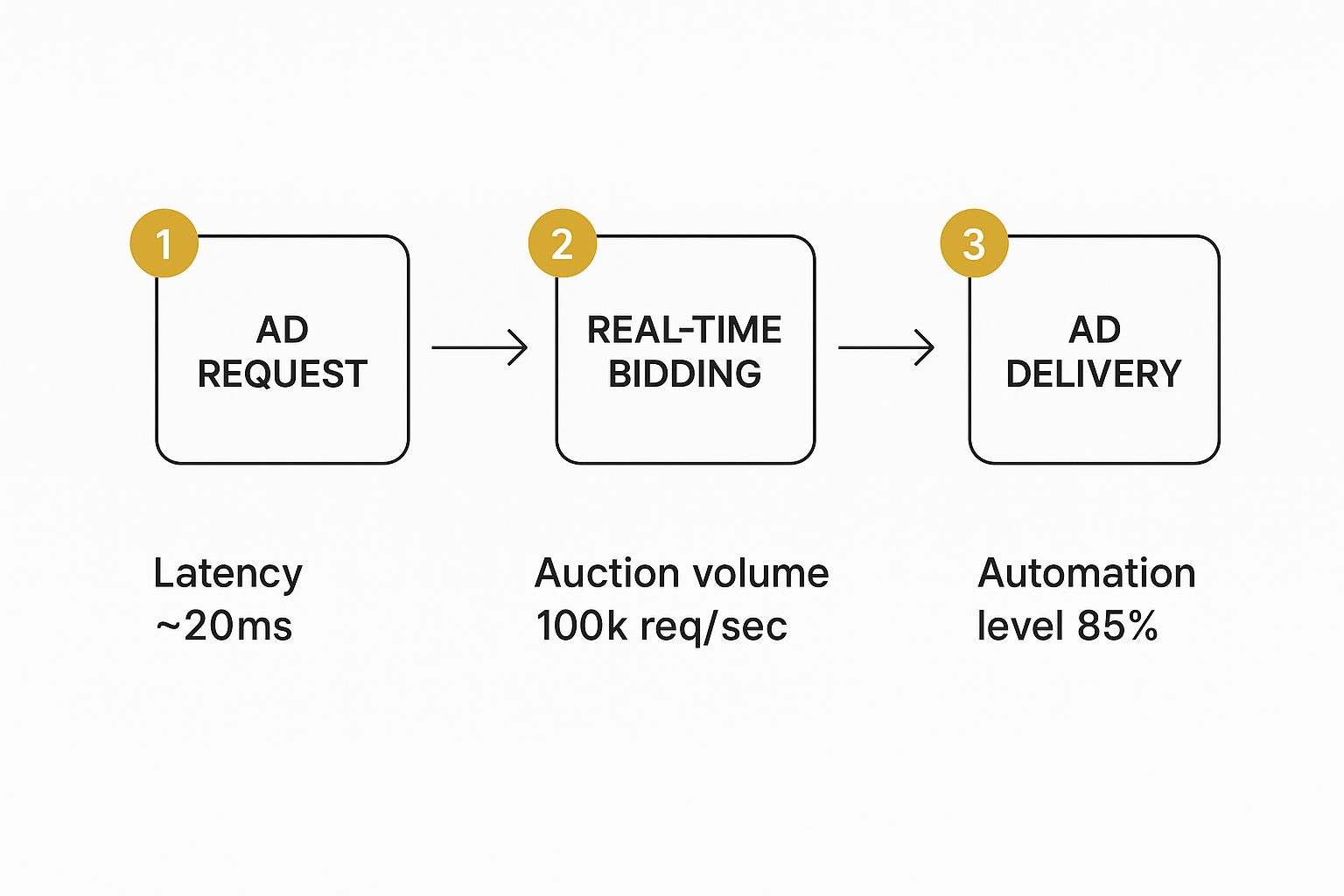
This really captures the incredible efficiency of the system. Auctions are handled at immense volumes with nearly instant response times, all driven by automation.
Why Programmatic Advertising Is a Game Changer
It’s one thing to understand the mechanics of real-time bidding, but it’s another to see how it can completely overhaul your marketing results. Programmatic advertising isn’t just another way to buy ad space; it’s a total mindset shift. It trades guesswork for data, manual grunt work for smart automation, and shouting into the void for precision conversations.
For any business, big or small, this change unlocks some serious advantages that were once only available to those with the deepest pockets. The real benefits boil down to efficiency, intelligence, and a much healthier return on your ad spend, making it an essential part of any modern marketing plan.
Unmatched Efficiency Through Automation
The most immediate win is a huge gain in efficiency. Cast your mind back to the old way of buying ads: endless phone calls, drawn-out negotiations, and stacks of paperwork. Programmatic simply automates that entire process, freeing your team to focus on what actually moves the needle—strategy and creative thinking.
Instead of spending weeks trying to lock down a few ad placements, your team can launch and manage sophisticated campaigns across thousands of websites in just a few hours. This isn't just about saving time. It's about shifting your team's focus from tedious admin to high-value tasks like analysing performance data and polishing your messaging.
The Power of Hyper-Specific Targeting
This is where programmatic really shines. It lets you move past broad, clumsy demographic buckets and connect with people based on their genuine interests and online behaviour.
Let's say you sell high-performance hiking boots. With a programmatic approach, you can stop targeting "men aged 25-45" and get much smarter. You could instead target:
- Behavioural Data: Users who have recently been browsing websites that review hiking trails in the Peak District.
- Contextual Data: People currently reading an online article about the "best waterproof hiking gear".
- Retargeting: Individuals who visited your hiking boot product page but left without buying.
This level of precision means your budget is spent only on the people most likely to be interested, which drastically improves your chances of getting a click and a conversion. For smaller companies, this focus is a core part of building an effective marketing strategy for small business.
Real-Time Insights and Optimisation
Traditional advertising often felt like you were flying blind. You’d launch a campaign and have to wait weeks, sometimes months, to find out if it even worked. Programmatic, on the other hand, gives you a live dashboard of rich data, allowing for instant tweaks and improvements.
You can see in real-time which ads, audiences, and websites are delivering the goods—and which ones are falling flat. If a particular creative isn't landing, you can pause it instantly. If one audience segment is converting like crazy, you can immediately push more of your budget in that direction.
This dynamic feedback loop lets you constantly refine your campaigns on the fly. To truly grasp how these automated strategies can boost performance, it's worth exploring a guide to Google Ads campaign optimization. This approach turns your advertising budget from a static expense into a nimble, performance-driven investment.
The UK's digital market is a perfect illustration of this technology's dominance. In fact, programmatic ad spending in the UK is forecast to reach a staggering $23.19 billion by 2025. To put that in perspective, that's nearly double the combined spend of Germany and France, showing just how essential this data-first approach has become. You can dig into these market trends further at https://www.emarketer.com/content/uk-germany-and-france-programmatic-ad-spend-2025. It’s clear that programmatic isn't just a trend; it's the engine of modern digital marketing.
Navigating the Common Risks and Challenges
While programmatic advertising gives you incredible reach and precision, it's not a set-and-forget solution. It comes with its own unique set of headaches, and if you’re not careful, they can quietly eat away at your budget and damage your brand. Being aware of these challenges from the outset is the key to running successful, and safe, campaigns.
Think of it this way: you wouldn't drive a high-performance car without understanding how the brakes work. The same logic applies here. Let's look at the main bumps in the road you need to watch out for.
The Problem of Ad Fraud
One of the biggest spectres haunting the programmatic world is ad fraud. At its core, this is a scam where criminals use bots—automated computer programs—to pretend they're real people. These bots visit websites, generate fake ad impressions, and even "click" on ads, all to trick you into paying for engagement that never actually happened.
The result? Your performance data gets completely skewed, making a failing campaign look like a winner. More importantly, your budget is being siphoned away from reaching genuine customers and put straight into the pockets of fraudsters.
Protecting Your Brand Safety
Just as critical is the issue of brand safety. This is all about where your ads end up. The last thing you want is your carefully crafted advert appearing next to an article about a tragedy, or on a website that promotes hate speech or conspiracy theories.
Brand safety isn't just about avoiding an embarrassing screenshot. It's about safeguarding the reputation you’ve worked so hard to build. A single misplaced ad can seriously undermine consumer trust and devalue your brand.
This is where you need to be proactive. Smart advertisers use detailed exclusion lists (often called blocklists) to specify which sites, apps, and content categories are strictly off-limits. It's a non-negotiable step for any responsible media buyer.
The Hidden Costs and Complexities
The programmatic ecosystem has a lot of moving parts—DSPs, SSPs, ad exchanges—and every platform in the chain takes a slice of your ad spend. This is sometimes referred to as the "ad tech tax." While these fees are a necessary part of the process, a lack of transparency can make it tough to figure out how much of your money is actually paying for the ad space versus how much is going to the middlemen.
On top of that, the UK programmatic market has become fiercely competitive. Advertisers are often bidding more to reach the same groups of people. To get a decent return, you need to be smarter with your data. For instance, one analysis found that certain in-market audiences have a 15% higher propensity to spend online compared to the average user. Targeting these premium segments is essential to stay ahead. You can find out more about winning programmatic strategies on iabuk.com.
Finally, regulations like GDPR have added another layer of complexity. You have to be absolutely sure your data practices are compliant. While this presents a challenge, it's also a chance to build stronger, trust-based relationships directly with your customers. You can explore this further by reading about the advantages of email marketing. Getting a handle on these issues is what truly separates a great programmatic campaign from a merely average one.
Your Questions About Programmatic Answered
As you start to get your head around programmatic advertising, a few common questions always seem to pop up. It’s a huge, complex system, so it's completely normal to wonder how it all connects with the tools you already know or even where to begin. Let's clear up some of that confusion with straightforward answers.
Is Programmatic Advertising the Same as Google Ads?
That's a great question, and the short answer is no, though they are related.
Think of Google Ads as its own self-contained universe, what we often call a "walled garden." When you use it, you're buying ad space specifically on Google's own turf—like Google Search, YouTube, and Gmail. It's powerful, but it keeps you within its walls.
Programmatic advertising is the bigger picture. It’s the method for buying ad space across the enormous, open internet. We're talking millions of different websites, apps, and digital platforms that aren't owned by Google. While Google has its own set of programmatic tools (like Display & Video 360), the standard Google Ads platform most businesses use is a separate beast from the wider programmatic world.
The key difference is scope. Google Ads keeps you within Google’s ecosystem. Programmatic advertising gives you access to pretty much the entire web.
What Is the Difference Between RTB and Programmatic Direct?
This gets right to the heart of how programmatic deals actually happen.
Real-Time Bidding (RTB) is the lightning-fast auction we’ve been talking about. Impressions are sold one by one to the highest bidder in the blink of an eye. It’s incredibly flexible and fantastic for reaching massive audiences efficiently.
Programmatic Direct is a different beast altogether. This is more like a traditional handshake deal, but with a modern, automated twist. An advertiser and a publisher agree on a deal upfront—a fixed price for a guaranteed amount of ad space. The "programmatic" part simply means the technology handles the execution automatically. You get the predictability of a direct buy with the efficiency of automation.
How Can a Small Business Get Started with Programmatic?
You might think programmatic is just for the big players, but it’s more accessible than ever. For a small business, the trick is finding the right entry point.
Your best bet is to look for a self-service Demand-Side Platform (DSP). When you're vetting them, look for a few specific things:
- No high minimum spending requirements: This is crucial. You want to be able to test the waters without having to commit a huge chunk of your budget.
- A user-friendly interface: The last thing you need is a platform that requires an engineering degree to operate. It should feel intuitive enough for you to set up campaigns on your own.
- Clear reporting dashboards: You have to know what’s working. Good reporting makes it easy to see your results and figure out your next move.
The smart way to start is small. Launch a single, tightly focused test campaign with one clear goal, like driving traffic to a new product page. From there, you can watch the data roll in, learn what your audience responds to, and optimise your campaigns as you go.
Ready to discover the perfect tools to power your marketing efforts? At The Digital Marketing Toolbox, we bring together the best solutions for analytics, SEO, advertising, and more, helping you grow your business with confidence. Explore our curated platform today.


