
Ever had that weird feeling an advert is following you around the internet? You look at a pair of trainers on one site, and for the next few days, those exact trainers pop up everywhere you go. That’s not a coincidence; it's retargeting at work.
It’s a smart marketing approach designed to reconnect with people who have already visited your website or interacted with your brand in some way. Think of it less as advertising and more as a friendly, digital tap on the shoulder—a reminder about something they’ve already shown interest in.
Your Second Chance to Make a First Impression
Instead of throwing a huge net out into the ocean hoping to catch new customers, retargeting focuses on a much warmer audience: people who are already familiar with you. The idea is simple but powerful. Someone who has browsed your products is far more likely to become a customer than a complete stranger.
By showing them relevant ads on other websites, social media feeds, and apps they use daily, you stay fresh in their minds. It's a gentle nudge to bring those "window shoppers" back to your site, giving you a valuable second chance to turn their initial curiosity into a sale.
How Does Retargeting Actually Work?
The whole process is triggered by a user's initial visit. A small, anonymous piece of code (often called a pixel or cookie) is placed on their browser. This doesn't store any personal information, but it does act like a marker.
Later, when that same person visits another site that's part of your chosen ad network (like Google or Facebook), the network spots that marker. It then knows to show them your specific advert, reminding them of the product they were looking at earlier.
This diagram breaks it down visually.
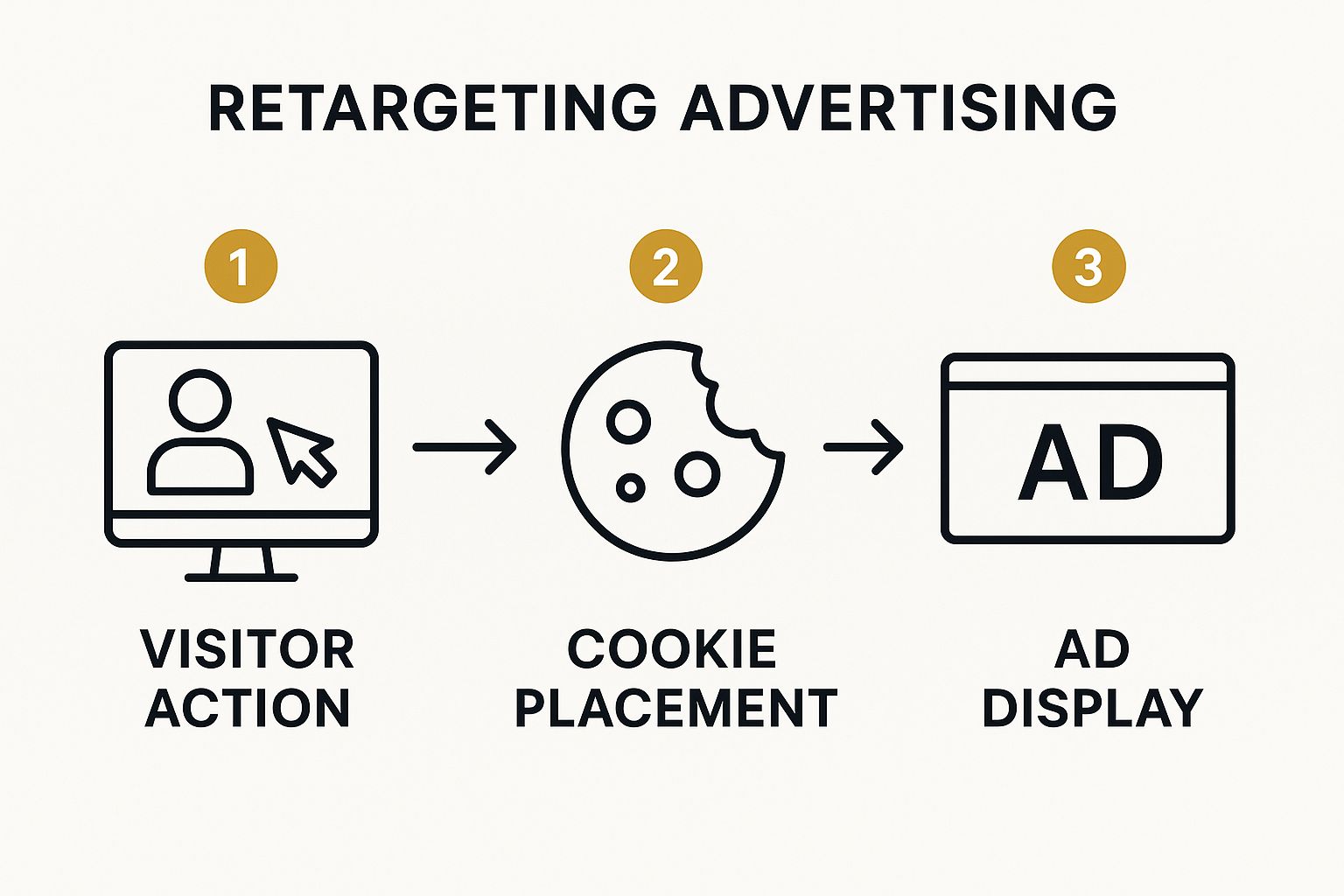
As you can see, a simple website visit starts a chain reaction that allows ad networks to find that user again and serve them a relevant ad.
To put this into perspective, let's look at the simple steps involved.
The Retargeting Process At A Glance
This table breaks down the three core stages of a typical retargeting campaign, showing how a simple visit is turned into a conversion opportunity.
| Stage | What Happens | Example |
|---|---|---|
| 1. The Visit | A potential customer visits your website and browses. A cookie is placed on their browser. | Someone looks at a product page for a blue winter coat but leaves without buying. |
| 2. Ad Network Tracking | The user leaves your site and browses other websites or social media platforms. | The person later scrolls through their Facebook feed or reads a news article online. |
| 3. Ad Delivery | The ad network recognises the cookie and serves your targeted ad to that specific user. | An advert for the same blue winter coat—maybe with a "10% off" offer—appears in their feed. |
This simple loop is incredibly effective at bringing people back into your sales funnel.
And the results speak for themselves. In the UK's competitive online market, this strategy is a game-changer. Research has shown that retargeting can boost conversion rates by up to 150% and slash cart abandonment by 26%. You can explore more stats on the power of retargeting at Cropink.com.
At its heart, retargeting is about continuing a conversation that has already started. It’s not about shouting at strangers but rather whispering a helpful reminder to interested friends.
This shifts the whole focus from chasing cold leads to nurturing warm ones. It's a more efficient, cost-effective way to drive sales and turn those missed opportunities into loyal customers.
How Retargeting Works Behind the Scenes

Ever wondered how an ad for a pair of shoes you just looked at suddenly follows you around the internet? It’s not magic, but it is clever. The whole process relies on a tiny, simple piece of code.
This technology is usually a tracking pixel or a cookie—think of it as a digital breadcrumb. When someone lands on your website, a small, completely invisible snippet of code is placed on their web browser.
This breadcrumb is entirely anonymous. It doesn’t grab personal information like a name or email address. Instead, it just tags that user's browser with a unique, anonymous ID. As they continue to browse other sites, ad networks recognise this ID and know to show them your ads. It's a simple, but powerful, way to stay top-of-mind.
This is a fundamental concept in modern marketing. If you're building your strategy from the ground up, you can learn more in our beginner's guide to digital marketing. Getting a handle on how these tracking tools work is the first step to running truly effective campaigns.
The Two Core Types of Retargeting
While the end goal is always to bring people back, retargeting isn't a one-size-fits-all game. Your approach will change depending on who you're trying to reach and the information you have on hand. Generally, it all boils down to two main categories.
- Pixel-Based Retargeting: This is the classic method we’ve just described. It’s all about showing ads to anonymous website visitors based on what they did on your site, like viewing a specific product or reading a blog post.
- List-Based Retargeting: This approach uses customer data you already own, like an email list from your CRM. You simply upload your list of contacts to an ad platform (like Facebook or Google). The platform then matches those emails to its user profiles and shows your ads directly to them.
Pixel-based retargeting is brilliant for reaching a wide net of recent visitors, while list-based targeting lets you get super-specific with your messaging for existing leads or loyal customers.
Understanding Pixels and Cookies
So, what exactly are these digital breadcrumbs? They’re the little engines that make almost all retargeting advertising possible.
A cookie is just a small text file that a website stores on a user’s computer via their web browser. Its job is to remember things, like what’s in a shopping cart or that a user has visited your site before.
A tracking pixel (sometimes called a web beacon) is a tiny, often 1×1 pixel, transparent image embedded on a webpage or in an email. When the page loads, so does the invisible pixel, which then tells a server to place the cookie on the user’s browser.
Essentially, the pixel is the trigger, and the cookie is the long-term marker that follows the user around, telling ad networks, "Hey, this person was here!"
Navigating Privacy and Consent in the UK
In today's world, you can't just drop cookies on someone's browser without asking. It's a matter of privacy and law. Regulations like GDPR and the UK’s PECR (Privacy and Electronic Communications Regulations) mean you have to be completely transparent about tracking.
This means you must get clear, explicit consent from your visitors before placing any non-essential cookies on their device. You'll recognise this as the "cookie banner" that pops up on most websites you visit for the first time.
Ignoring these rules can lead to some hefty fines. It's vital to make sure your website clearly explains what cookies you’re using and gives people a genuine choice to accept or reject them. Many businesses use marketing automation to manage this, like using platforms for Shopify abandoned cart email automation that also respect user consent choices. By being upfront and compliant, you build trust and still get to run brilliant campaigns.
Exploring Different Types of Retargeting Campaigns

Retargeting isn't a one-size-fits-all strategy. Think of it less as a single tool and more like a complete toolkit. Just as a carpenter wouldn't use a hammer to saw wood, a savvy marketer needs to pick the right retargeting campaign for the job at hand.
Getting to grips with the different approaches is how you move from just showing generic ads to creating campaigns that actually connect with people. Some methods are brilliant for keeping your brand in the public eye, while others are finely tuned to rescue abandoned shopping carts. Let's break them down.
Static and Contextual Retargeting
The most straightforward approach is static retargeting. Here, you create a handful of ads and show them to anyone who has visited your website. It’s simple to get up and running and does a solid job of general brand recall, gently reminding past visitors that you’re still around.
For example, a local plumber could show a simple ad with their logo and phone number to anyone who recently visited their "emergency services" page. The message is always the same, but it keeps their business at the front of the queue when a pipe eventually bursts.
Contextual retargeting adds another layer of intelligence. It places your ads on websites related to the content your visitor was just looking at. If someone was reading an article about DIY home renovations, your ad for plumbing services appearing on that page suddenly feels much more relevant and helpful.
Dynamic Retargeting
This is where things get really personal and, frankly, incredibly effective. Dynamic retargeting automatically builds ads tailored to each individual user, based on exactly what they did on your website. It’s like having a personal shopper who remembers every item you looked at.
Ever browsed for a specific pair of trainers on ASOS, only to see an ad for those exact trainers pop up in your social media feed an hour later? That’s dynamic retargeting in action. It plugs into your product catalogue to pull the right images, prices, and details directly into the ad.
This approach is so powerful because it shifts from a generic reminder to a highly specific, relevant suggestion. It closes the gap between 'just looking' and 'buying' by putting the very item they wanted right back in front of them.
For e-commerce, travel sites, or any business with a large inventory, this method is a game-changer. It’s well-known for boosting conversion rates because the ads align perfectly with what the user has already shown an interest in.
Search and Video Retargeting
What if you could reach people based on what they're looking for, even if they’ve never heard of you? That's the power of search retargeting. This tactic shows your ads to people based on the keywords they’ve recently used on search engines like Google or Bing.
Imagine someone searches for "best running shoes for marathon training." A sports retailer can use that signal to retarget them with ads for their top-of-the-line trainers, capturing their intent at the perfect moment.
Video retargeting, on the other hand, focuses on how people have engaged with your video content. On platforms like YouTube and Facebook, you can create audiences of people who have:
- Watched a certain percentage of one of your videos.
- Subscribed to your channel.
- Liked or commented on your content.
You can then serve follow-up ads to this already-warm audience, guiding them smoothly along their journey to becoming a customer.
Email Retargeting
Often confused with standard email marketing, email retargeting is a specific tactic that targets website visitors who are already on your mailing list. It links their browsing behaviour on your site to their email address, unlocking some seriously personalised follow-up opportunities.
If a subscriber on your list browses your new collection of winter coats but leaves without buying, you can send them a targeted email a day later featuring those exact coats. This method is incredibly effective for re-engaging existing customers and leads. You can explore more about the overall advantages of email marketing in our dedicated guide.
Choosing The Right Retargeting Tactic
With several options available, picking the right one depends entirely on your goals. Some are built for speed and simplicity, while others offer deep personalisation.
This table breaks down the most common types to help you decide which approach best fits your needs.
| Retargeting Type | Best For | Common Platform |
|---|---|---|
| Static | General brand awareness and top-of-mind recall. | Google Display Network, Facebook |
| Dynamic | E-commerce, recovering abandoned carts, and showing specific products. | Google Ads, Criteo, Facebook |
| Search | Reaching new audiences based on high-intent keywords. | Google Ads |
| Video | Nurturing audiences who have engaged with your video content. | YouTube, Facebook, Instagram |
| Re-engaging existing subscribers with personalised content. | Mailchimp, HubSpot, Klaviyo |
Ultimately, the best strategy often involves a mix of these tactics. You might use static ads for general brand building while running a highly-focused dynamic campaign to win back high-value shoppers.
For some real-world inspiration on how businesses are putting these ideas into practice, check out these 7 Remarketing Ads Examples. They provide a fantastic look at how to use these tactics to re-engage customers and drive sales.
The Business Benefits of Strategic Retargeting
Understanding the mechanics of retargeting is one thing, but what really counts is the impact it has on your bottom line. Investing in retargeting isn't just about showing more ads; it’s about making every single pound in your marketing budget work harder for you.
Think about it: you're focusing your efforts on a warm audience—people who have already visited your website and shown some interest. This means you're not starting a conversation from scratch; you're picking up where you left off. These individuals are far more likely to convert than someone who has never heard of you, making retargeting one of the most efficient ways to drive sales.
Maximise Your Conversion Rates
The most obvious and immediate benefit of retargeting is a significant jump in conversions. It’s simple, really. Someone who sees a retargeted ad is much more likely to come back and finish what they started than a brand-new visitor. You're just giving them a gentle nudge, reminding them of something they already wanted.
Picture a small online clothing boutique based in the UK. A visitor spends a few minutes looking at a specific summer dress but then gets a phone call and leaves the site. A couple of days later, a beautiful ad for that exact dress pops up in their social media feed. That timely reminder is often all it takes to bring them back to complete the purchase. A near-miss becomes a sale.
This isn't just for e-commerce, either. It works for pretty much any business, from software companies to local services. By reconnecting with interested prospects, you're systematically recovering revenue that would have otherwise slipped through your fingers.
Enhance Brand Recall and Trust
In the noisy online world, out of sight is truly out of mind. Retargeting makes sure your brand stays visible, keeping it fresh in a potential customer's memory. So when they're finally ready to make a buying decision, your business is the first one that comes to mind.
This repeated exposure does more than just remind people you exist; it builds a sense of familiarity and trust. When people see your brand on well-known websites and social platforms, it gives you a stamp of credibility. Over time, that consistent presence helps turn a one-time visitor into a loyal customer who knows and trusts your name.
Retargeting is a powerful tool for building brand equity. It keeps your business top-of-mind, ensuring that when the need arises, your brand is the immediate and trusted solution.
This sustained visibility is a crucial part of any solid marketing strategy for small business, helping you stand shoulder-to-shoulder with larger competitors.
Achieve a Superior Return on Ad Spend
When you stack it up against campaigns that target cold audiences, retargeting almost always delivers a higher Return on Ad Spend (ROAS). You’re not spending money trying to convince complete strangers; you’re investing in people who have already raised their hands. This sharp focus on a high-intent audience makes your ad spend far more effective.
The numbers back this up. In 2025, social media advertising in the UK is projected to bring in an average return of £5.28 for every pound spent. By using retargeting on platforms like Facebook or Instagram, businesses can tap directly into this high-return environment. You can find more on these trends in the UK media spend projections at Marketing Week.
This incredible efficiency means that even companies with smaller budgets can see real, meaningful results. It's an essential tactic for any business looking to grow sustainably.
Best Practices for Effective Retargeting

A great retargeting campaign isn't just about switching on the ads; it demands a bit of finesse and a smart plan. Without one, you risk your ads becoming unwelcome noise rather than a helpful nudge.
The real goal is to make your campaigns feel less like an interruption and more like a genuinely useful reminder. It’s all about getting the right message in front of the right person at the right time. Let's walk through the practices that separate the good campaigns from the truly great ones.
Segment Your Audiences for Relevance
Think about it: not everyone who visits your website is looking for the same thing, so why would you show them all the same ad? This is where audience segmentation comes in. It’s simply the process of grouping your visitors based on what they did on your site, which lets you serve up ads that are far more personal and relevant.
This single step can completely change the game. Someone who just glanced at your homepage needs a very different message from someone who was moments away from buying before getting distracted.
Here are a few classic segments to get you started:
- Homepage Visitors: This is your broadest audience. They've shown a flicker of interest, so think brand awareness ads to keep your name top of mind.
- Product Page Viewers: These people have looked at a specific item. Show them ads featuring that exact product, perhaps with a different image or highlighting a key benefit.
- Cart Abandoners: This is your highest-intent group. They were this close to converting, so a gentle reminder, maybe with a small incentive like free delivery, can often get them over the line.
When your creative matches what the user was actually doing, your ads suddenly become a lot more powerful.
Set Frequency Caps to Avoid Ad Fatigue
We've all been there—haunted by the same ad, relentlessly following us from one website to the next. That feeling is called ad fatigue, and it’s one of the fastest ways to annoy potential customers and tarnish your brand's image.
The fix is simple: use frequency capping. This is a standard feature in nearly every ad platform that lets you limit how many times one person sees your ad in a given timeframe (for example, no more than five times in 24 hours).
Setting a sensible frequency cap is vital. It shows respect for the user's experience, keeping your brand visible without becoming a nuisance. This simple tweak protects your brand's reputation and improves how your campaign performs.
A well-judged cap ensures you get enough exposure to make an impact, but not so much that you become part of the background noise. It's a small adjustment that saves your budget and protects your brand.
Use Ad Sequencing to Tell a Story
Instead of hammering home the same message over and over, what if you could guide your audience on a journey? Ad sequencing lets you do exactly that. You can create a series of ads that appear in a specific order over time, telling a story that builds interest and nurtures the relationship.
A simple sequence might look something like this:
- Ad 1 (Days 1-3): Start with a gentle reminder of your brand, something that reinforces what you're all about.
- Ad 2 (Days 4-7): Follow up with social proof. An ad showing a glowing customer testimonial or a five-star review can build trust.
- Ad 3 (Days 8-10): Now it's time for the offer. A small discount or a free trial can be the final push someone needs to make a decision.
This narrative style is far more engaging than a single, repetitive ad. It warms up your audience, builds a connection, and makes the final ask feel much more natural.
Exclude Converters with a Burn Pixel
There's almost nothing more irritating for a customer than seeing ads for a product they've just bought. It’s a complete waste of your advertising spend and a surefire way to create a bad user experience. The solution is the burn pixel.
A burn pixel is a snippet of code you place on your "thank you" or confirmation page. When someone lands there after making a purchase, the pixel signals your ad platform to take them out of that ad campaign. It's a clean and simple way to stop advertising to people who have already done what you wanted them to do.
Putting a burn pixel in place is one of the smartest optimisations you can make. It refines your targeting, stretches your budget further, and shows your customers that you're paying attention.
This kind of fine-tuning is becoming standard practice. In the UK, for instance, many businesses are weaving their retargeting into broader programmatic advertising strategies to get more efficient results. Programmatic ad spend in the UK is set to continue growing through to 2028, showing just how central it's become. To learn more, you can check out the latest digital advertising trends in the UK on Statista.com. Tools like burn pixels are essential for getting the best possible return from these sophisticated systems.
Got Questions About Retargeting? We've Got Answers
Once you start exploring retargeting, a few questions always pop up. It's a seriously effective strategy, but it comes with its own lingo, costs, and things to keep in mind. Let's walk through some of the most common queries so you can get started with confidence.
Is Retargeting the Same Thing as Remarketing?
This is easily the biggest point of confusion, and for good reason—the terms are thrown around interchangeably all the time. But if we're getting technical, there is a subtle difference.
-
Retargeting has always been about serving paid ads to anonymous website visitors. It’s all powered by cookies and tracking pixels that follow a user’s journey, letting you show them ads on other websites or social media feeds after they’ve left your site.
-
Remarketing, in its classic sense, was more about reaching out to known contacts, usually via email. Think of an abandoned cart email—that’s classic remarketing, using your own data (like a CRM list) to get back in touch.
In reality, the lines have blurred. Platforms like Google often use the term "remarketing" to describe what is essentially ad-based retargeting. For all intents and purposes today, it's safe to think of them as two sides of the same coin, both focused on reconnecting with people who already know you.
What's the Real Cost of Retargeting?
There's no one-size-fits-all answer here. Your costs will depend on your industry, the size of the audience you’re trying to reach, and where you're running your ads. That said, the pricing usually breaks down into two models:
-
Cost Per Mille (CPM): With CPM, you pay a flat rate for every 1,000 times your ad is shown (an "impression"). This is brilliant if your goal is pure brand awareness and just getting your name out there.
-
Cost Per Click (CPC): Here, you only pay when someone actually clicks your ad. It’s the go-to model for campaigns where you want action, like making a sale or signing up, because you're paying for genuine engagement.
Things like where your ad appears, how many other advertisers are chasing the same audience, and how good your ad is will all nudge the price up or down. The great news? Retargeting almost always delivers a better return on your ad spend because you’re talking to a warm audience that’s already shown interest.
Does Retargeting Come Across as Creepy?
It's a fair question. We've all been followed around the internet by that one ad. Done badly, retargeting can feel intrusive and just plain annoying. But when it's done thoughtfully, it can be genuinely helpful.
The secret is to think of it less as an interruption and more as a gentle, helpful nudge. A well-timed ad for a pair of shoes you were just looking at isn't creepy; it's a useful reminder.
To keep your ads on the right side of the line, just stick to a few best practices:
- Set Frequency Caps: Don't bombard people. Control how many times one person sees your ad in a day or week.
- Use a Burn Pixel: This is a must. It's a piece of code that stops showing ads to someone once they've bought the product.
- Stay Relevant: Make sure the ad you show is directly related to what they were looking at. Don't show them ads for lawnmowers if they were browsing laptops.
Stick to these simple rules, and your retargeting campaigns will feel helpful, not harassing.
Ready to build a smarter marketing stack? The Digital Marketing Toolbox offers a curated selection of the best tools for SEO, email, social media, and more. Explore and compare top solutions to drive real growth for your business today at https://grow-your-biz.com.


