
Let's get straight to the point. A value proposition is the promise you make to your customers. It’s a crystal-clear answer to the one question on every potential buyer's mind: ‘Why should I buy from you and not from someone else?’ This isn't just a catchy slogan; it's a powerful statement that spells out the exact benefits someone gets by choosing your product or service.
What Is a Value Proposition, Really?

Think of it as your entire business boiled down into a single, compelling idea—the ultimate elevator pitch. It’s the very foundation that your marketing, product development, and customer service should be built on.
Without a strong value proposition, you're just another face in the crowd. With one, it becomes the compass that guides your brand. It ensures every decision you make reinforces the unique value you deliver to the people who matter most: your customers.
The Three Pillars of a Strong Proposition
For a value proposition to truly land, it needs to be built on three crucial pillars. Get these right, and you'll create a message that doesn't just get heard, but gets felt by your audience.
- Relevance: It must clearly show how your product solves a real problem or improves a customer's situation.
- Tangible Value: It needs to communicate the specific benefits in a way that feels real and measurable.
- Unique Differentiation: It has to make it obvious why you're the better choice over all the alternatives out there.
Your value proposition is the bridge connecting what your business offers with what your customer genuinely needs. It’s the simple, guiding principle that ensures your hard work translates into real, tangible benefits for them.
If you're looking to dive even deeper into this concept, this guide on What Is a Value Proposition is a fantastic resource.
Why This Matters in the UK Market
The UK’s digital marketing scene is incredibly crowded. The market size hit a staggering USD 19.6 billion recently, and with projections showing it could reach USD 47.1 billion by 2033, the competition is only getting fiercer. For small business owners and e-commerce managers, a clear, compelling promise isn't just nice to have—it's essential for survival. It's how you cut through the noise and grab attention.
To make sure your message is effective, it helps to break it down into its core components. Here's a quick summary of the three pillars every great value proposition must have.
The Three Pillars of a Powerful Value Proposition
| Pillar | What It Means | Key Question It Answers |
|---|---|---|
| Relevance | How your product connects to a customer's specific need or desire. | "Do you understand my problem?" |
| Value | The concrete benefits and outcomes the customer will experience. | "What specific benefits will I get?" |
| Uniqueness | What makes your solution superior to all other available options. | "Why should I choose you over anyone else?" |
Nailing these three elements is the secret to creating a promise that not only attracts customers but keeps them coming back.
The Building Blocks of a Winning Value Proposition

A powerful value proposition doesn't just happen by accident. It's carefully assembled from four core components, each one locking into the next to create a clear and compelling promise. Think of it like building with LEGOs – every brick needs to connect perfectly for the final model to be strong and instantly recognisable.
If you skimp on any one of these elements, your entire message becomes wobbly and unconvincing. But get them right, and you'll have something that doesn't just grab attention; it builds real trust with the people you most want to reach.
Let's break down what these four essential pieces are.
Your Target Customer
Everything begins and ends here. You simply can't promise value if you don't know who you're promising it to. This isn't about vague demographics like age or location, either. It's about getting under their skin and understanding their motivations, their ambitions, and what makes a day genuinely good for them.
A fuzzy customer profile only leads to a fuzzy promise. Instead of trying to be everything to everyone, you need to laser-focus on your ideal buyer. That kind of clarity ensures every word of your value proposition lands with impact because it speaks directly to their world.
Ask yourself a few hard questions:
- Who is the one person who gets the most out of what we do?
- What are their day-to-day professional challenges or personal goals?
- Where do they hang out online, and whose advice do they actually listen to?
The Customer Problem
Once you know who you’re talking to, the next job is to nail down the specific problem you solve for them. Forget about your product's features for a moment; this is all about the customer's frustration. What's that nagging annoyance, that costly bottleneck, or that unmet need that keeps them awake at night?
A great value proposition zooms in on a real, tangible pain point. It proves to the customer that you don't just see them as another sale – you actually get what they're struggling with.
By putting the customer's problem front and centre, you shift the entire conversation from what you sell to what they stand to gain. That simple reframe is the secret to crafting a message that truly connects on an emotional level.
This customer-first mindset is crucial not just for your value proposition but for your entire presence in the market. To dig deeper into how this shapes your brand’s perception, you might find our guide on what is brand positioning helpful.
The Unique Benefits
This is where your solution finally takes the stage. But again, this isn't a list of your product specs. It’s the direct answer to the customer's unspoken question: "So what? What's in it for me?" Benefits are the positive outcomes and real-world results someone gets from using your product or service.
For every problem you've identified, you need to offer a clear, desirable benefit. You're essentially painting the "after" picture for your customer, showing them a vision of their better, easier, or more successful reality once they choose you.
For example, if their problem is "wasting hours on manual data entry," your benefit isn't "automated software." It's "Get back 10 hours a week to focus on what really matters—growing your business." See the difference? The benefit is the outcome, not the tool.
The Proof of Your Promise
The final, crucial piece is credibility. Anyone can make a bold claim, but a winning value proposition has the receipts to back it up. Proof is what transforms a hopeful promise into a believable one. Without it, your message is just marketing hot air.
You can deliver proof in a few different ways, each adding another layer of trust.
- Data and Statistics: Use hard numbers like, "Trusted by 50,000+ happy customers."
- Testimonials and Reviews: Let your existing clients do the talking for you.
- Case Studies: Show a detailed before-and-after journey of a client's success.
- Awards and Certifications: Use third-party validation to underline your expertise.
In the UK, a recent survey of over 500 businesses showed exactly where priorities lie for 2025: 54% are focused on boosting sales revenue, while 42% are aiming for better brand awareness and customer engagement. As the UK's digital agency sector, with its 8,509 agencies, grows towards £20.4 billion in revenue, proving your value has never been more critical. You can explore more findings in the UK digital marketing report.
How to Craft Your Value Proposition Step by Step
Alright, theory is one thing, but now it’s time to roll up your sleeves and actually build this thing. Nailing your value proposition isn't about waiting for a sudden flash of inspiration; it's a methodical process. Think of it as building with LEGOs—you need the right pieces in the right order.
This five-stage guide is your instruction manual. Follow it, and you'll move from vague ideas to a concrete statement that actually gets results. You won't be guessing what customers want; you'll be building your promise on real insight.
Stage 1: Define Your Ideal Customer
Before you can talk about value, you have to know who you’re talking to. Seriously. This first step is the foundation for everything else. If you try to appeal to everyone, you’ll end up resonating with no one.
Go beyond basic demographics. You need to get inside their heads. What’s their job title? What keeps them up at night? What are they trying to achieve in their career? Your goal is to paint a crystal-clear picture of the person who stands to gain the most from what you offer. For a deep dive, our guide on how to create buyer personas is the perfect next step. This clarity is what makes the rest of the process work.
Stage 2: Uncover Their Pains and Desired Gains
Now that you know who you're talking to, it's time to step into their shoes. What are the daily frustrations—the "pains"—that get in their way? This could be anything from clunky software and wasted money to simply not having enough hours in the day.
Just as important are their "gains"—the results they're dreaming of. What does a 'win' look like for them? Maybe it’s hitting a revenue target, freeing up their weekend, or getting a promotion. The best way to find out? Ask them. Use customer interviews, surveys, and feedback forms to get these insights straight from the source.
- Pain Points: What are the biggest headaches or roadblocks they face right now?
- Desired Gains: What specific outcomes would make their life or work noticeably better?
The magic happens when you understand the gap between their current reality and their desired future.
Stage 3: Map Your Features to Customer Benefits
Time to look at your own product or service, but always through your customer's eyes. Start by listing its key features, but don't stop there. This is where so many businesses stumble.
For every single feature, you have to translate it into a tangible benefit that solves one of the pains or delivers one of the gains you just identified.
A feature is what your product does. A benefit is what the customer can do with it. Always lead with the benefit.
For instance, a feature might be "AI-powered scheduling." The benefit? "Stop wasting hours coordinating meetings and win back 5 hours every week." See the difference? That simple shift makes your value infinitely more appealing.
Stage 4: Identify Your True Differentiation
Let's be honest: you’re not the only one trying to solve this problem. Your competitors are out there making their own promises. So, what makes your solution genuinely different or better? This is where you have to pinpoint what truly sets you apart.
Take a hard look at your main competitors. What are they great at? Where do they fall short? The gaps in their offering are your opportunities. Your differentiator might not even be a feature—it could be your outstanding customer service, your flexible pricing model, or your company’s mission.
You're looking for that one thing you do better than anyone else for your specific customer. In the UK's crowded digital advertising space, this is crucial. The sector's own value is clear from its projected 15.4% compound annual growth rate from 2025-2030. With smartphones driving 58.54% of revenue, a mobile-first differentiator is more powerful than ever.
Stage 5: Weave It All into a Compelling Statement
You’ve got all the pieces. Now, let's put them together into a clear, concise statement. There are plenty of templates out there, but a simple, proven formula is a great place to start. Try this one on for size:
For [your target customer] who [is struggling with a specific problem], our
provides [the key benefit] unlike [your main competitor].
This structure forces you to be brutally specific about your audience, their problem, the value you deliver, and what makes you unique. Use it as a starting point, then polish the language until it sounds powerful and authentic. To get more hands-on advice, check out this guide on how to create a value proposition that truly wins customers. By following this process, your final statement won't just be a catchy slogan—it will be a genuine promise of value.
UK Value Proposition Examples That Inspire
Theory is one thing, but seeing a powerful value proposition in action is what really makes the concept click. To bring it all to life, let’s look at some brilliant examples from successful UK brands. These companies have absolutely nailed the art of telling customers exactly why they should choose them over anyone else.
As we break down their approach, you’ll see how all the core components we’ve discussed—the audience, their problem, the benefits, and the proof—all slot together perfectly to create a message that’s both crystal clear and incredibly persuasive.
Fintech For The People: Monzo
Monzo exploded onto the UK banking scene because they spotted a massive gap in the market: traditional banks were completely ignoring the frustration and lack of transparency people felt about their own money. Their whole value proposition is built around simplicity, control, and putting the customer first.
- Headline: "Banking that makes life easier."
- Target Audience: Digitally-native millennials and Gen Z. They're fed up with clunky, old-school banking and demand instant control over their finances from their phone.
- Problem Solved: They tackle the anxiety and confusion that comes with managing money, from surprise fees and slow international payments to useless budgeting tools.
- Key Differentiator: Their app is incredibly intuitive. You get instant spending notifications, can set up savings "Pots" in seconds, and spend abroad without fees. It's not just a bank account; it's a tool designed for financial wellness.
Monzo's meteoric rise comes down to this relentless focus on the customer's problem. They’ve made their app feel less like a bank and more like a genuinely helpful financial sidekick.
Fashion For The Individual: ASOS
ASOS became an e-commerce giant by understanding that modern fashion is about more than just clothes—it’s about self-expression and inclusivity. Their value proposition is aimed squarely at a generation that prizes choice, authenticity, and convenience above everything else.
- Headline: "ASOS DESIGN and 850+ brands."
- Target Audience: Young adults (roughly 16-34) who see fashion as a core part of their identity. They want the latest trends but also the freedom to forge their own unique style.
- Problem Solved: The classic limitations of high-street shopping—narrow size ranges, a lack of variety, and the sheer hassle of finding everything in one place.
- Key Differentiator: A massive, expertly curated collection of brands sits alongside their own in-house label, all available in an extensive range of sizes (ASOS Curve, Tall, Petite). Pair that with a seamless user experience and flexible delivery, and you have the ultimate destination for fashion discovery.
ASOS doesn’t just promise a new dress or a pair of trainers. It promises a world of endless fashion possibilities, delivered right to your door, where everyone can find something that makes them feel like themselves.
Value Proposition Analysis of UK Market Leaders
The examples above show a clear pattern: successful brands don't just sell a product, they sell a solution. The table below breaks down how these leaders connect their messaging directly to the core components of a strong value proposition.
| Brand | Core Message (Headline) | Target Audience | Pain Point Solved | Key Differentiator |
|---|---|---|---|---|
| Monzo | "Banking that makes life easier." | Digitally-savvy young adults | Financial anxiety & lack of control | An intuitive, all-in-one financial wellness app |
| ASOS | "ASOS DESIGN and 850+ brands." | Style-conscious 16-34 year olds | Limited choice & poor size inclusivity | Unmatched variety and inclusive sizing |
| Deliveroo | "Your favourite restaurants, delivered." | Urban professionals & families | Poor quality of traditional takeaways | Restaurant-quality food at home |
This analysis highlights how a single, powerful headline can encapsulate a deep understanding of who the customer is, what they struggle with, and why your solution is uniquely equipped to help.
The infographic below neatly summarises the five key steps involved in crafting a value proposition just as compelling as these standout brands.
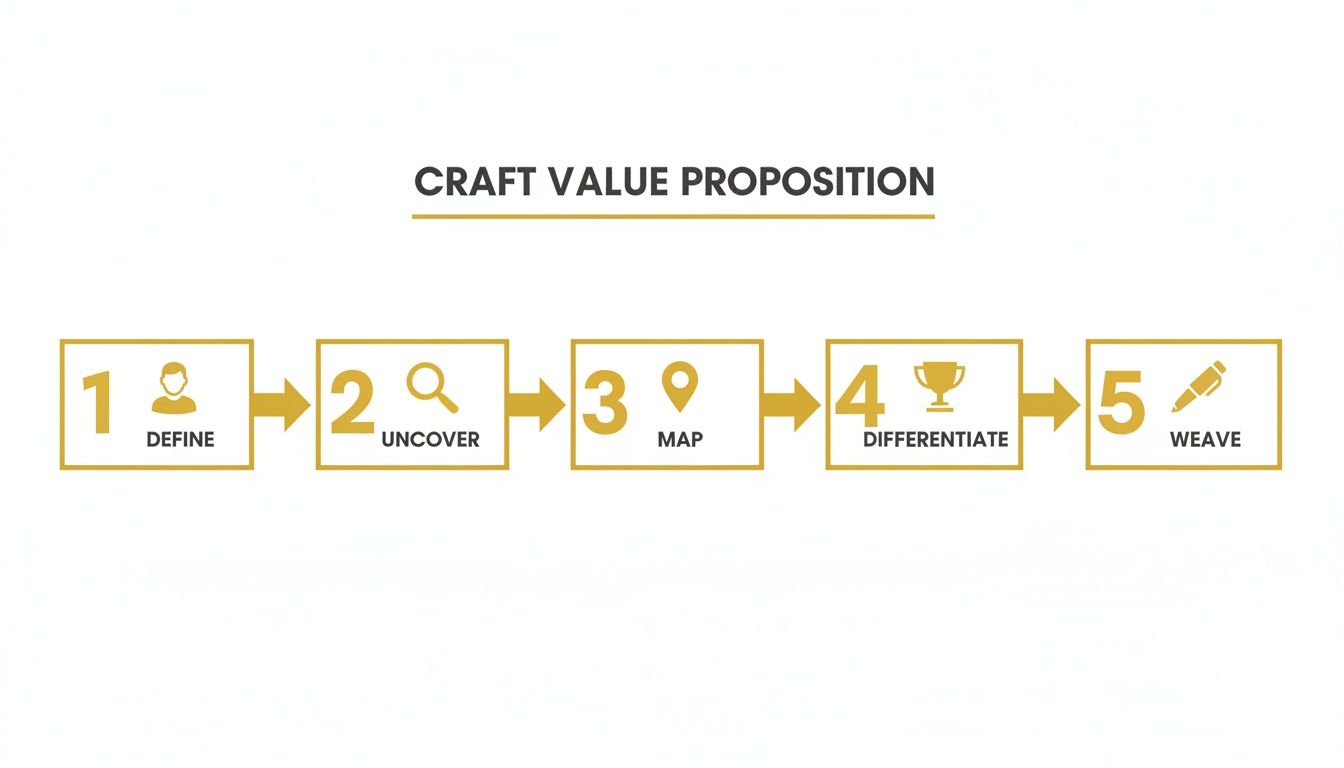
This process isn't about guesswork. It shows that creating a powerful message is a structured journey, starting with deep customer understanding and ending with a unique, persuasive statement that sets you apart.
Food Delivery Redefined: Deliveroo
Deliveroo didn't just offer another takeaway service; it completely revolutionised the experience by bringing high-quality restaurant food directly to people's homes. Its value proposition is anchored in three simple pillars: speed, choice, and quality. In doing so, it solved a problem many of us didn't even realise we had.
- Headline: "Your favourite restaurants, delivered."
- Target Audience: Urban professionals and families who love the quality of restaurant dining but crave the convenience of staying in.
- Problem Solved: The limited and often low-quality options available from traditional food delivery services. Before Deliveroo, takeaway was mostly restricted to a handful of cuisines.
- Key Differentiator: Their logistics tech and rider network allowed them to partner with premium, local restaurants that had never offered delivery before. They didn't just promise food; they promised a restaurant-quality experience at home. This move fundamentally shifted customer expectations and created an entirely new market.
Common Mistakes That Weaken Your Value Proposition
Crafting a powerful value proposition is as much about avoiding the classic traps as it is about following the right steps. Even with a solid understanding of your customer, a few simple missteps can cause your message to fall completely flat, leaving potential buyers confused, unimpressed, or simply scrolling on by.
Knowing what these errors look like is the first step to making sure your own promise lands with the clarity and impact it deserves. Often, these mistakes come from a good place—like trying to sound impressive or appeal to everyone at once—but they almost always lead to a weak, forgettable statement.
Using Vague Buzzwords and Jargon
One of the quickest ways to kill a value proposition is to stuff it with corporate-speak. Phrases like “world-class solutions,” “synergistic paradigms,” or “innovative frameworks” might sound important in a boardroom, but they mean absolutely nothing to your customer. They're just filler words that scream, "We can't explain what we actually do."
Your customers aren’t looking for clever buzzwords; they’re looking for straightforward answers to their problems. Stick to simple, direct language that spells out the real-world outcome they’ll get.
- Before: We offer world-class, streamlined solutions to maximise your workflow efficiency.
- After: Our software cuts your project admin time in half so you can focus on creative work.
See the difference? The second example hits home because it’s specific, benefit-driven, and you get it in seconds.
Focusing on Features Instead of Benefits
This one is a classic. It’s the trap of listing what your product is instead of what it does for the customer. A feature is a technical detail, like "128-bit encryption." A benefit is the real-world outcome, like "Complete peace of mind that your data is secure."
People don't buy features; they buy a better version of themselves. Your job is to translate your product’s cool capabilities into a clear, desirable benefit that solves a real headache for them.
A feature is what your product has. A benefit is what your customer gets. Always lead with what they get.
Forgetting this simple rule is why so many value propositions read like a dry technical manual instead of a compelling promise.
Making Unproven Claims
Anyone can call themselves the "best," "fastest," or "easiest." But without a shred of proof, these words are just empty boasts. A strong value proposition has to be believable, and that credibility comes from specific, verifiable evidence.
You need something to back up what you're saying—be it data, customer testimonials, case studies, or social proof.
- Weak Claim: We are the leading provider of marketing automation tools.
- Proven Claim: Trusted by over 10,000 UK businesses to automate their marketing and boost sales.
The second statement swaps a vague boast for a concrete number, making it instantly more credible and persuasive.
Trying to Appeal to Everyone
When you write a message for everyone, you end up connecting with no one. A value proposition that’s too broad and generic just gets lost in the noise. The goal isn’t to attract every single person on the planet; it’s to resonate deeply with your ideal customer.
A sharp, focused value proposition might even put some people off, and that's okay. In fact, it's a good thing. It means you are speaking directly to the audience that will truly benefit from what you offer, making your message far more potent for the people who actually matter. Your promise should feel like it was written just for them.
Testing and Refining Your Value Proposition

Getting that first version of your value proposition down on paper is a massive step, but the job isn't finished. A truly great promise isn’t static. It’s a living statement that you need to test, measure, and tweak over time. Think of it less like a carving set in stone and more like a garden that needs regular attention to flourish.
The aim here is to stop guessing and start using real data to figure out what actually clicks with your audience. This process turns your value proposition from a hopeful theory into a powerful, data-backed tool for growth. It keeps your message sharp, relevant, and effective, even as your market and customers evolve.
Data-Driven Testing Methods
So, how do you find out what's really working? You have to put your message to the test. There are a few straightforward methods that will give you clear, actionable insights into how people perceive your value. This is where you get to see how tiny changes in wording can lead to huge shifts in customer behaviour.
One of the most powerful ways to do this is with controlled experiments. For a deep dive into setting these up, our guide to A/B testing for marketing walks you through the entire framework. It's the perfect way to compare different versions of your message and see which one performs best.
Here are three practical ways to get started:
-
A/B Testing Your Headline: Use simple tools to show different versions of your main homepage headline to different visitors. Does a headline about saving time get more engagement than one about saving money? Let the data decide for you.
-
Simple Customer Surveys: Send a quick survey to recent customers or your email list. Ask them point-blank: what problem did we solve for you? What do you value most about what we offer? The language they use is often pure gold for refining your own messaging.
-
Analysing Website Metrics: Jump into your website analytics. Keep a close eye on the bounce rate and conversion rate for your key landing pages. If lots of people are leaving immediately (high bounce rate), your value proposition might not be grabbing their attention. If they stick around but don't take action (low conversion rate), the promise might not be persuasive enough.
Interpreting the Results
Collecting the data is just step one. The real magic happens when you interpret it correctly. Try not to get fixated on finding a single "winner." Instead, look for patterns across all the feedback and metrics you've gathered.
The most valuable insights often come not from confirming what you already believed, but from discovering what you didn't expect. This feedback loop is the engine of continuous improvement for your brand's core message.
This ongoing cycle of testing and refining ensures your answer to "what is a value proposition" stays potent and true. It guarantees the promise you make to your customers is always in sync with the value you deliver, which is the key to building trust and achieving sustainable growth.
A Few Lingering Questions About Value Propositions
Even with a solid draft in hand, some questions tend to linger. Let's tackle a few common ones to make sure your understanding is crystal clear and you're ready to put your value proposition to work in the real world. Getting these details straight helps keep your core message sharp.
Here are some straightforward answers to the questions we hear most often.
How Is a Value Proposition Different from a Slogan?
Think of it this way: a slogan is a catchy, memorable phrase designed for brand recognition. Nike’s “Just Do It” is a classic example. Its job is to stick in your head and build an emotional connection to the brand.
A value proposition, on the other hand, is a much more practical statement. It clearly explains the specific, tangible benefits a customer gets by choosing you. It makes a direct promise and answers the crucial question: why should I buy from you specifically?
A slogan is built to be catchy and memorable. A value proposition is built to be persuasive and solve a problem.
They serve different purposes, but you'll often find that the most powerful slogans are distilled from a really strong value proposition.
Can My Business Have More Than One Value Proposition?
Yes, absolutely. While your company will have one overarching value proposition that defines its core promise, it's smart to create different versions for specific products or customer groups. This is how you make your message incredibly relevant.
A software company, for example, might have one value proposition for small businesses that centres on affordability and ease of use. But for its big corporate clients, it might have a completely separate one that talks about enterprise-grade security, scalability, and 24/7 dedicated support.
The key is that each value proposition must speak directly and uniquely to the audience it’s intended for.
How Often Should I Revisit My Value Proposition?
Your value proposition should never be set in stone. As a general rule, it's a good idea to review it at least once a year to make sure it still holds true.
More importantly, though, you need to revisit it any time something significant changes in your business or your market. Triggers for a review could be things like:
- Launching a major new product: The value you're offering has changed in a big way.
- Moving into a new market: A new audience will have different needs and pain points.
- A new competitor arrives on the scene: You might need to sharpen what makes you different.
- Customer needs evolve: What mattered to your customers last year might not be their top priority anymore.
To stay effective, your value proposition has to grow and adapt right alongside your business and the people you serve.
Ready to discover the perfect tools to build and test your value proposition? The Digital Marketing Toolbox offers a curated catalogue of top solutions for SEO, analytics, and A/B testing, all in one place. Find, compare, and implement the resources you need for sustainable growth.
Explore the tools at grow-your-biz.com


