
A marketing funnel is the journey you guide a potential customer on, starting from the moment they first hear about you, all the way to becoming a loyal, paying fan. It’s called a funnel for a simple reason: you start with a wide audience at the top, and as people move through the stages, the group gets smaller and more focused, just like a real funnel guiding liquid into a bottle.
Think of it as the roadmap for turning strangers into customers.
What Is a Marketing Funnel Really
Let’s imagine you've just opened a new local bookshop. On any given day, hundreds of people might walk past. That's the top of your funnel. A smaller group notices your window display and becomes aware that your shop exists. An even smaller group pops in to browse the shelves—they're now considering a purchase.
A handful of those browsers find a book they can't resist and take it to the counter. That's a conversion. And if they love the experience, the curated selection, and the friendly chat, a few will come back again and again, even telling their friends about their new favourite spot.
That entire process, from a random passerby to a devoted regular, is a marketing funnel in action. It's not just some abstract concept; it’s a practical framework for understanding how people interact with your business and how you can nudge them along at each step.
Why This Concept Matters for Growth
If you don't have a clear marketing funnel, your marketing can feel a bit like throwing spaghetti at the wall and hoping something sticks. A blog post here, a social media ad there—it’s all disconnected from what actually makes you money. A properly mapped-out funnel changes everything.
It helps you:
- Find the Leaks: You can see exactly where potential customers are dropping off. Are you getting lots of website traffic but no one signs up for your newsletter? The problem is likely in your consideration stage.
- Spend Smarter: Instead of guessing where to put your budget, you can invest in the parts of the journey that need the most attention, giving you a much better return on your investment.
- Build Better Relationships: When you understand what a customer needs at each stage, you can give them exactly the right information or offer at the right time. This builds trust and makes them feel understood.
This simple diagram shows the classic three stages—Awareness, Consideration, and Conversion—that are the backbone of almost every funnel.
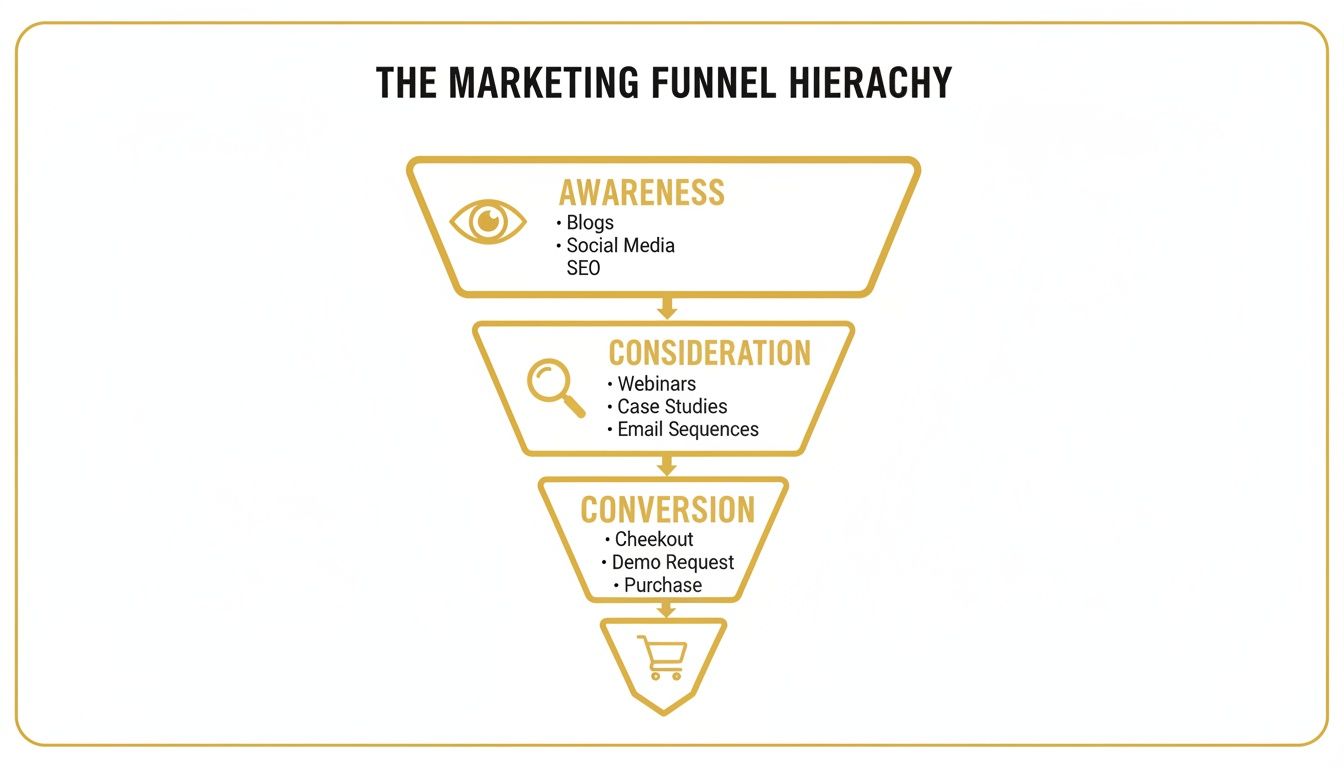
As you can see, your tactics shift from casting a wide net to using highly targeted actions as your audience becomes more serious about buying. To get a feel for how different businesses apply these ideas, it's worth checking out these real-world marketing funnel examples.
And if you're ready to really dig in and map out every touchpoint, this practical guide to full-funnel marketing is a fantastic resource. Think of it as your blueprint for building a system that doesn't just attract eyeballs but consistently turns them into your brand’s biggest supporters.
The Awareness Stage: Making a Great First Impression
Welcome to the very top of the marketing funnel, what we often call TOFU (Top of Funnel). This is your brand's big debut, the moment you pop up on a potential customer’s radar for the first time. The goal here isn't to make a sale—not yet, anyway. It's all about grabbing the attention of the right people and educating them with genuinely useful content.
Think of it like casting a wide, but smart, net. You’re not trying to catch every fish in the sea, just the ones most likely to be interested in what you have to offer. It's your one shot at a memorable first impression, positioning your brand as a knowledgeable and helpful resource from the get-go.
At this point, your audience isn't looking for a hard sell. They're usually just searching for answers, exploring solutions to a problem, or satisfying their curiosity about a topic. Your job is to meet them right where they are with content that helps, no strings attached.

Proven Strategies for Attracting Your Audience
To really nail the top of the funnel, your content needs to be easy to find and impossible not to share. The focus is on broad-reach tactics that answer common questions and speak to your audience's pain points, often before they even realise your product is the answer.
Here are a few of the most effective strategies I've seen work time and again:
- SEO-Optimised Blog Content: Writing articles that answer the "what is," "how to," and "why" questions your ideal customers are typing into Google is a game-changer. It positions you as an expert and brings in a steady stream of organic traffic.
- Engaging Social Media Campaigns: Get active on platforms like Instagram, LinkedIn, or Facebook. Share valuable tips, industry news, and a peek behind the scenes. The real aim is to build a community and spark conversations.
- Shareable Infographics and Videos: People love visuals. A sharp infographic or a short, educational video can explain complex ideas in a flash, racking up shares and massively expanding your reach.
- Educational Webinars or Podcasts: Hosting free sessions on topics your audience cares about is a brilliant way to build credibility and introduce your brand to people who are actively looking to learn.
These tactics are so effective because they put the user’s needs first. When you provide value upfront, you start building the trust you'll need to guide them further down the funnel.
Key Insight: The Awareness stage is about being a helpful guide, not a salesperson. Your content should feel like a generous offer of expertise, solving a small piece of your audience's problem for free. This generosity is what makes your brand memorable.
Example in Action: A Local Bakery
Let's look at a real-world example. Picture a local bakery that specialises in stunning, custom wedding cakes. Their target audience? Newly engaged couples who are just dipping their toes into the overwhelming world of wedding planning.
Instead of running ads that scream "Buy Our Cakes!", they take a smarter, TOFU approach. The bakery's team crafts a detailed blog post titled "How to Choose the Perfect Wedding Cake Flavour Combination." This article isn't a sales pitch; it's packed with genuine advice on pairing flavours, considering seasonal ingredients, and handling dietary needs.
They then promote this post using targeted Instagram and Pinterest ads aimed at users whose online activity suggests they’ve recently got engaged. The campaign showcases gorgeous cake photos with captions like, "Struggling to pick a flavour? Our latest guide can help!" It’s a brilliant strategy that captures the attention of their ideal customers by solving a real problem they're facing at that exact moment.
How to Measure Success at This Stage
Since sales aren't the objective, how do you know if your awareness efforts are actually working? You need to track metrics that show you're reaching and engaging the right people.
These are the key performance indicators (KPIs) to keep a close eye on:
- Website Traffic: Are you seeing an increase in overall visitors, especially to your blog and other informational pages?
- Social Media Reach and Impressions: This tells you the number of unique people who are seeing your content.
- Follower Growth: A steady climb in your social media following is a great sign that your content is hitting the mark.
- Keyword Rankings: Are you moving up in search engine results for your target informational keywords?
- Brand Mentions: How often are people talking about your brand online?
These signals confirm that you're casting your net effectively and stirring up that crucial initial interest. A healthy top of the funnel is the foundation for everything that comes next.
The Consideration Stage: Building Trust and Nurturing Leads
So, you’ve grabbed someone’s attention. They know you exist. What now? They’ve just stepped into the all-important middle of the marketing funnel, often called the Consideration stage or MOFU (Middle of the Funnel).
At this point, your job shifts dramatically. It’s no longer about casting a wide net. Now, it's about proving you're the right choice. People here are actively researching, comparing you against your competitors, and digging deeper to see if you can really solve their problem. Your mission is to educate them, build trust, and show them you’re the expert they’ve been looking for.
Think of this stage as the bridge between casual curiosity and a real commitment to buy. Without a solid bridge, all those people you attracted in the awareness stage will simply fall away.

Key Nurturing Tactics to Build Confidence
Guiding someone through the consideration phase isn’t about the hard sell. It’s about being the most helpful resource they can find. You need to offer content that helps them evaluate their options intelligently and makes their decision easier.
Here are some of the most effective tools for the job:
- Detailed Case Studies: Nothing shouts "we get results" louder than a good case study. They tell a relatable story: here’s the problem our client had, this is how we tackled it, and here are the impressive, measurable outcomes.
- Expert Guides and E-books: This is your chance to really show off your expertise. In-depth guides on topics your audience truly cares about position you as an authority and are incredibly valuable—often valuable enough for someone to trade their email address for.
- Comparison Checklists or Pages: Don’t be afraid to compare your solution to others. An honest, transparent comparison shows confidence in your own offering and helps your prospects feel like they’re making a well-informed choice.
- Webinars and Product Demos: A live webinar or a recorded demo brings your solution to life. It’s a fantastic way to connect on a more personal level, answer questions directly, and demonstrate exactly how you can help.
By providing these resources, you’re not just educating; you’re also learning more about what your audience needs, which allows for much more effective follow-ups.
A Critical Transition: This stage is where your brand connection is truly tested. Even huge, well-known brands can see a massive drop-off here if they don’t engage properly. It’s the make-or-break moment where a passive audience must be nurtured into an active, interested community.
Turning Awareness into Actionable Interest
Failing to nurture leads at this point is one of the most common—and costly—leaks in any marketing funnel. A 2023 YouGov analysis of top UK snack food brands tells this story perfectly. A brand like Pringles enjoyed massive awareness (over 90%), but only 24% of those people actually moved on to considering a purchase. For Tyrrells crisps, the drop was even more severe, from 77% awareness to just 16% consideration, with purchase intent plummeting to 3%. These numbers prove that just being known isn't enough; you have to actively convert that recognition into genuine interest. You can learn more about how brands perform in the consumer journey on yougov.com.
This is where things like automated email sequences and social proof become your best friends. Once someone downloads your e-book or signs up for a webinar, you can kick off a series of helpful emails that offer more value, tackle common objections, and share glowing customer testimonials. Little things, like showing social proof pop-ups on your website ("Jane from London just signed up!"), also work wonders for building trust and a sense of momentum.
Of course, for any of this to work, it has to be relevant to your audience. You need to know who you’re talking to. If you haven’t already, now is the time to sit down and figure out how to create buyer personas. This foundational work ensures your messaging hits the mark, guiding your leads confidently toward the final purchase decision.
The Conversion Stage: Inspiring Action and Closing the Sale
We’ve now reached the sharp end of the marketing funnel, what’s often called the BOFU (Bottom of the Funnel). This is where all your hard work pays off. The leads you’ve so carefully guided and nurtured are standing at the edge of a decision, and it’s your job to give them the final, confident push they need.
The goal here is deceptively simple: make saying "yes" the easiest and most obvious choice. Your prospect has weighed their options and done their homework. Now, it's about turning that strong interest into actual revenue by creating a seamless, persuasive path to the finish line.
Every little detail counts, from the words on your buttons to the transparency of your pricing.
Crafting an Irresistible Path to Purchase
At this critical point, friction is your greatest enemy. Any hint of confusion, a moment of doubt, or one too many clicks can send a potential customer packing, abandoning their cart forever. Your mission is to anticipate every possible roadblock and clear it out of their way.
Here are the tactics that make the biggest difference:
- Powerful Calls-to-Action (CTAs): Be direct and command action. Vague phrases like "Learn More" just don't cut it anymore. Use strong, benefit-driven commands like "Get Your Free Trial Now" or "Complete My Order."
- High-Converting Landing Pages: A BOFU landing page should have one job and one job only: securing the conversion. Strip away all distractions. That means no navigation menu, no links to blog posts, nothing to pull their attention away.
- Frictionless Checkout Process: Only ask for the essential information. The more fields you make someone fill out, the lower your conversion rate will be. Offer multiple payment options, display security badges to build trust, and be upfront about all costs, especially shipping.
- Compelling Offers and Scarcity: A little urgency goes a long way. A limited-time discount, a bonus for the first 10 buyers, or a "low stock" warning can be just the thing to overcome last-minute hesitation.
These elements work in concert to create a smooth runway from consideration straight through to conversion.
The Power of Automation and Social Proof
Let’s be realistic—even with a perfect checkout flow, people get distracted. Life happens. This is where automated email flows become your most important safety net. Tools like Klaviyo are brilliant for this, letting you set up automatic reminders for people who leave items in their cart.
But these aren't just gentle nudges; they're conversion powerhouses. Just look at the UK data.
Here's a quick breakdown of how standard campaigns stack up against automated flows, based on Klaviyo's recent UK benchmarks.
Email Marketing Funnel Performance UK Benchmarks
| Industry | Average Campaign Conversion Rate | Average Automated Flow Conversion Rate |
|---|---|---|
| Apparel & Accessories | 0.08% | 1.83% |
| Food & Beverage | 0.17% | 1.93% |
| Health & Beauty | 0.11% | 1.48% |
| Home & Garden | 0.09% | 1.46% |
| Electronics | 0.05% | 0.94% |
Source: Klaviyo 2025 Benchmarks, Great Britain
The numbers speak for themselves. Automated flows, like abandoned cart sequences, consistently outperform standard campaigns by a massive margin. For any UK marketer, ignoring automation at the bottom of the funnel is like leaving money on the table. You can dive deeper into these UK email performance stats on Klaviyo's blog.
Expert Tip: Don't forget the immense power of social proof right at the point of sale. Showing customer testimonials, star ratings, or even real-time notifications ("Sarah from Manchester just bought this!") on your product and checkout pages can provide that final bit of validation a hesitant buyer needs.
Measuring Success at the Bottom of the Funnel
Unlike the earlier, fuzzier stages of the funnel, success here is crystal clear. It’s measured in pounds and pence. Your metrics should give you a direct, unfiltered view of how well you're turning prospects into paying customers.
Keep a close eye on these key performance indicators:
- Conversion Rate: This is your headline number. It’s the percentage of visitors who actually complete the action you want them to take (e.g., make a purchase).
- Shopping Cart Abandonment Rate: What percentage of people add items to their cart but don’t finish the checkout? A high rate is a red flag that something in your process is causing friction.
- Cost Per Acquisition (CPA): Simply put, how much does it cost you in marketing spend to get one new customer?
- Average Order Value (AOV): How much does the average customer spend in a single transaction? Finding ways to bump this number up is a core part of optimisation.
By obsessively tracking these metrics, you can A/B test everything—from your CTA button colour to your page layout—to systematically improve your results. This data-first approach is what transforms a simple funnel into a predictable, revenue-generating machine.
Beyond the Sale: Turning Customers into Lifelong Fans
It’s a classic mistake to think the marketing funnel’s job is done the moment a customer clicks ‘buy’. In reality, that's just the end of the beginning. The most valuable, and often most profitable, part of the customer journey is what happens after the sale. This is where you turn one-time buyers into loyal repeat customers and, eventually, your most powerful marketers.
Think about it: acquiring a new customer can cost anywhere from five to 25 times more than keeping an existing one. A smart post-purchase strategy isn't just about boosting future revenue; it’s about building a rock-solid, self-fuelling growth engine for your entire business.
The focus fundamentally shifts from persuasion to reinforcement. You’re no longer trying to convince someone to make a purchase—you're proving they made the right call and giving them every reason to stay.
From Customer to Repeat Customer: The Loyalty Loop
The first mission after a sale is all about retention. The goal is to create such a brilliant experience that coming back for a second, third, or fourth purchase feels like the most natural thing in the world. This is about building a genuine relationship, not just closing a deal.
Here are a few proven ways to nail retention:
- A Masterclass in Onboarding: Don’t just fire off a generic receipt. Craft a welcome email series that helps customers get instant value from their purchase. Think helpful tips, quick video tutorials, or exclusive content that makes them feel like an insider from day one.
- Create an Exclusive Club: Loyalty programmes are a no-brainer. Reward repeat business with points, early access to new products, or members-only discounts. It makes customers feel valued and gives them a compelling reason to stick with you over a competitor.
- Proactive, Human Support: Don’t wait for problems to arise. A simple, personal follow-up email asking for feedback or offering help can show you genuinely care about their experience. It’s a small touch that leaves a huge impression.
When you get this right, you transform the old-school linear funnel into a powerful "loyalty loop." Satisfied customers are immediately ready to jump back into the consideration stage for their next purchase.
Key Takeaway: The moments immediately following a purchase are your single greatest opportunity to make a lasting impression. A thoughtful post-purchase experience is the bedrock of a long-term customer relationship.
From Fan to Marketer: The Advocacy Stage
Once you've earned that loyalty, you unlock the final, most potent stage of the funnel: advocacy. This is where your happiest, most loyal customers become a volunteer marketing army, spreading the word about your brand simply because they want to. Their genuine enthusiasm is far more convincing than any ad you could ever run.
But advocacy rarely happens by accident. You need to give your fans the right tools and a little nudge to share their positive experiences.
Here’s how you can activate your advocates:
- Make it Easy to Leave Reviews: After a great customer service chat or a few weeks after they’ve received their product, send a simple, direct request for a review on Google, Trustpilot, or your own site.
- Launch a Killer Referral Programme: Give customers a real reward—like a discount, store credit, or a small gift—when they successfully refer friends and family. This formalises word-of-mouth and makes it a win-win.
- Champion User-Generated Content (UGC): Encourage customers to post photos or videos of them using your product on social media with a unique hashtag. When you feature their content on your official channels, it provides incredible social proof and makes them feel celebrated.
By focusing on loyalty and advocacy, you create a beautiful, self-sustaining cycle. These new brand champions feed highly-qualified prospects—who already trust your brand—right back into the top of your marketing funnel.
How to Analyse and Optimise Your Funnel Performance
Building a marketing funnel is a massive first step, but it’s definitely not a ‘set it and forget it’ job. The real magic happens when you stop seeing your funnel as a static blueprint and start treating it like a living, breathing engine that needs constant tuning. It's this commitment to continuous analysis and optimisation that separates the good funnels from the truly great ones.
Think of yourself as a detective sifting through clues. All that data tells a story—it shows you where people are moving along smoothly, but more importantly, it flags exactly where they’re getting stuck. These sticking points are what we call bottlenecks, and finding them is the secret to unlocking serious growth.
The whole process is a simple, repeating cycle: track the right numbers at each stage, diagnose the leaks where you're losing people, and then test changes methodically to see what actually works. Measure, test, repeat.
Identifying Your Funnel Bottlenecks
So, what is a bottleneck? It's any point in your funnel where the number of people moving to the next stage drops off a cliff. Think of a high bounce rate on a key landing page, a depressingly low open rate on an important email, or a huge wave of abandoned carts at the checkout. These are all classic examples.
To find them, you've got to be tracking the right metrics for each part of the journey. Here are the essentials:
-
Top of Funnel (Awareness): Keep a close eye on Website Traffic, Bounce Rate, and Time on Page. If you're getting loads of traffic but your bounce rate is sky-high, it's a strong hint that your ads or content aren't quite matching what visitors expected to find.
-
Middle of Funnel (Consideration): Here, you’re looking at Lead Magnet Downloads, Email Open/Click-Through Rates, and Webinar Attendance. If these numbers are low, it suggests the content you're using to nurture leads just isn't hitting the mark.
-
Bottom of Funnel (Conversion): This is where it gets serious. Your most critical numbers are Conversion Rate, Shopping Cart Abandonment Rate, and Cost Per Acquisition (CPA).
Data from UK digital agencies really brings these vulnerabilities to life. One firm, Mr Digital, reported 2,900 monthly visits but was struggling with a 47.62% bounce rate. Another, Conversion Rate Experts, was handling 42,100 visits but saw a 50.38% bounce rate and an average visit of just 42 seconds. A session that short is a massive red flag for weak engagement right at the top of the funnel—a clear bottleneck. You can discover more insights about funnel optimisation for UK businesses on t.uk.
A Practical Framework for A/B Testing
Once you’ve found a bottleneck, it’s time to roll up your sleeves and start testing solutions. A/B testing, also known as split testing, is your best friend here. The idea is simple: you create two versions of a single element—a headline, a button, an image—and show each version to different segments of your audience to see which one performs better.
Key Insight: The golden rule of A/B testing is to only ever test one thing at a time. If you change both the headline and the button colour in one test, you’ll have no idea which change actually made the difference.
Start by testing the things that are likely to have the biggest impact. Focus your A/B tests on these areas first:
- Headlines: Try out different angles. You could test a headline that focuses on the benefits against one designed to spark curiosity.
- Calls-to-Action (CTAs): Play around with the button text ("Get My Free Guide" vs. "Download Now"), its colour, and even where it’s placed on the page.
- Offers: Pit a 10% discount against a free shipping promotion to find out what truly motivates your customers to buy.
- Landing Page Layouts: Sometimes a simple change, like moving an image or reordering the sections, can make a huge difference.
By methodically digging into your data and testing your assumptions, you can turn your marketing funnel from a rough guide into a finely-tuned, data-driven system built for continuous growth. Of course, measuring all of this accurately is essential, which is where a solid grasp of what is marketing attribution becomes incredibly valuable.
Your Top Marketing Funnel Questions Answered
When you first start exploring funnels, a few common questions always pop up. Let's tackle some of the big ones so you can move forward with a clear strategy.
What's the Real Difference Between a Marketing Funnel and a Sales Funnel?
It's easy to see why people use these terms interchangeably, but they really do have different jobs. Think of the marketing funnel as the big picture – everything you do to get on someone's radar and keep them interested. Its main goal is to attract a wide audience and warm them up.
The sales funnel, on the other hand, is a much tighter, more focused part of the process. It really comes into play when a lead is ready to talk business. This is where your sales team takes over with demos, quotes, and contract talks to get the deal signed. They’re two sides of the same coin, working together to bring customers in.
Your marketing funnel casts a wide net to find potential customers; the sales funnel is what guides those hooked fish right into the boat. They’re a team, but their tactics and scope are different.
How Long Does It Actually Take to Build a Funnel?
That's the million-dollar question, and the honest answer is: it depends. You could get a simple, solid funnel up and running in less than a week. We're talking about a focused landing page that captures leads and triggers a basic automated email series. It's a great way to get started and see results quickly.
But if you're picturing something more complex – a multi-channel funnel with loads of blog content, a video series, and intricate email workflows – you're looking at a project that could take several weeks or even a couple of months to build, test, and properly launch. My advice? Start with a simple version first, get some real-world data, and then build it out from there.
Do I Really Need a Different Funnel for Every Product?
In a word: yes. If you want the best results, creating tailored funnels is the way to go. Your different products or services likely solve different problems for different types of people, right? A generic, one-size-fits-all funnel just won't speak to any of them effectively.
When you build a dedicated funnel for each main offering, you can nail the messaging, create content that hits home, and design offers that feel like they were made just for that specific audience. That kind of personalisation is what separates funnels that just work from funnels that absolutely smash their targets.
Ready to start building and optimising your own powerful funnels? The Digital Marketing Toolbox puts all the essential tools in one place, helping you turn marketing activity into measurable growth. Find the perfect solutions for every stage of your customer's journey at https://grow-your-biz.com.


