
Why Email Marketing Software Still Matters in 2026
Is email marketing dead in 2026? Hardly. The best email marketing software still gives businesses a direct line to their audience while every social platform keeps changing the rules. The inbox remains one of the few places where you can build repeatable, measurable growth.
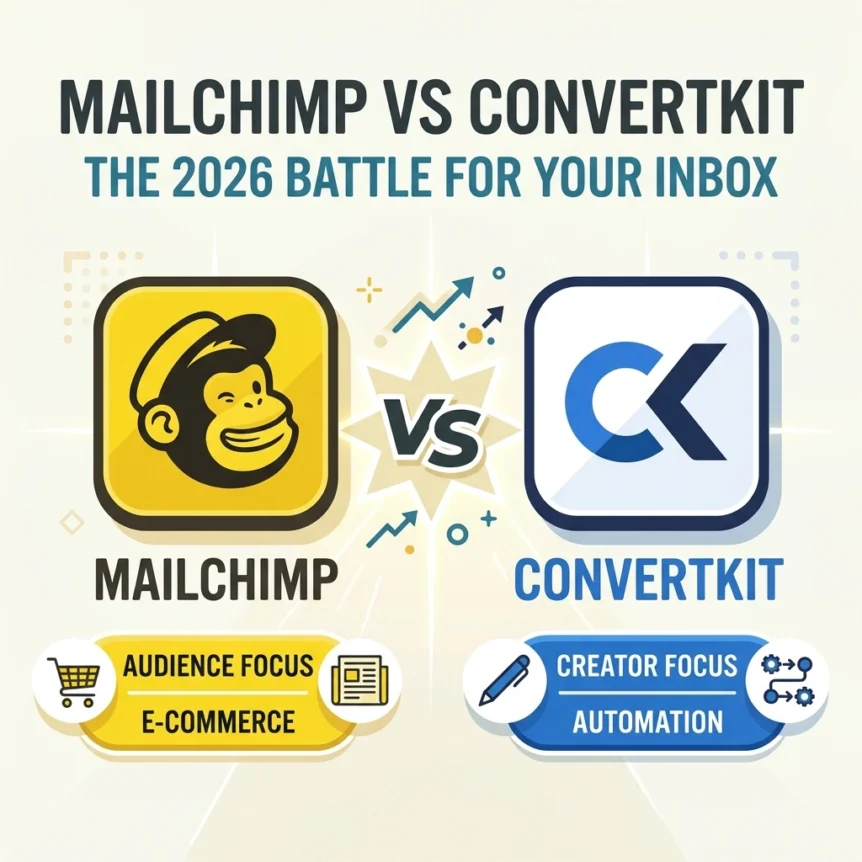
If you’re reading this, you’re likely stuck between two titans: Mailchimp, the friendly monkey that’s grown into a marketing behemoth, and ConvertKit (recently rebranded as Kit), the creator-first darling that promises to turn your newsletter into a full-blown business. Both are heavyweights in the best digital marketing tools arena, but they aren't interchangeable.
So, how do you choose? Are you a creator building a personal brand, or a small business owner trying to scale an e-commerce empire? Let’s crack the hood and see which email marketing software engine is worth your monthly investment.
The Elephant in the Room: You Don’t Own the Keys
Before we dive into the features, we need a reality check. Both Mailchimp and ConvertKit are SaaS (Software as a Service) platforms. This means you are operating on “rented land.”
Straight talk: you don’t own the underlying code, the platform architecture, or the servers. If Mailchimp decides to change its terms of service or ConvertKit goes offline, you can't just take your “installation” and host it elsewhere. You own your email list (the data), but the “cockpit” you use to fly the plane belongs to them. If you’re looking for complete platform ownership, you’d be looking at open-source self-hosted solutions, but for 99% of businesses, the convenience of SaaS far outweighs the risk of not owning the source code. Just keep your backups handy.
Email Marketing Software Pricing: The “Hidden” Growth Tax
Every business owner hates the feeling of burning cash as they grow. Both email marketing software platforms use subscriber-based pricing, but they approach the “Free Plan” very differently.
Mailchimp used to be the king of free, but in 2026, their free tier is more of a “look but don't touch” experience. With a limit of 250 contacts, you’ll hit the ceiling before you’ve even finished your first cup of coffee. Their paid plans start around $13/month, but the price scales aggressively as your list grows.
ConvertKit, on the other hand, has leaned hard into the creator economy. Their free plan currently supports up to 10,000 subscribers, which is absolutely massive. However, there’s a catch: you don’t get the visual automation builder on the free tier.
You can send broadcasts, but you can't build those “set it and forget it” funnels that actually make you money while you sleep. That matters because pricing only tells part of the story when you’re comparing email marketing software for long-term ROI.
Golden Nugget: Don't choose based on the free plan alone. Look at what you’ll be paying when you hit 5,000 subscribers. That’s usually where the “pricing pain” starts to kick in.
Email Marketing Software Automation: The Brains of the Operation
Why are you even using email marketing? If it’s just to send a “Happy Friday” blast once a week, you're doing it wrong. The real ROI in email marketing software lives in automation.
ConvertKit was built for creators who want to automate their sales funnels. Their visual automation builder is incredibly intuitive. It looks like a clean flowchart, making it easy to see exactly what happens when someone clicks a link or buys a product.
It’s perfect for marketing tools for agencies that need to show clients clear, logical pathways for their leads.
Mailchimp has improved its “Customer Journey Builder,” and for most e-commerce businesses, it’s a powerhouse. It integrates deeply with platforms like Shopify to send “Abandoned Cart” emails and personalized product recommendations.
However, it can feel a bit more “clunky” if you’re trying to build complex, multi-branch sequences that aren't tied to a physical product. If automation is your deciding factor, this is where email marketing software starts to separate the hobby tools from the serious revenue drivers.

For the Solo Creator: Why ConvertKit Often Wins
Are you a blogger, podcaster, or YouTuber? If your “product” is your knowledge, ConvertKit is your sweet spot. For creator-led email marketing software, that focus really matters.
Their Creator Network is a game-changer in 2026. It allows you to partner with other creators to recommend each other’s newsletters. Imagine someone signs up for a newsletter about fitness, and on the “Thank You” page, they see a recommendation for your newsletter about healthy meal prep.
It’s built-in viral growth without spending a dime on ads.
They also have built-in commerce. You can sell digital downloads or subscriptions directly through ConvertKit without needing a separate online html form builder free or a complex Shopify setup.
For creators flying solo, this kind of email marketing software keeps the stack lean and the day-to-day workflow simple.
For the E-commerce Hustler: Why Mailchimp Holds the Crown
If you have a warehouse full of physical products, Mailchimp is still the heavyweight champion. Their integrations are endless. Whether you need to connect to your CRM, your POS system, or specialized analytics tools, Mailchimp probably has a native integration for it.
Mailchimp also offers superior A/B testing and multivariate testing. If you want to know if a blue “Buy Now” button beats a red one across 10,000 subscribers, Mailchimp gives you the data to back it up.
For businesses where a 1% increase in conversion equals thousands of dollars, this level of granularity is essential. If your store depends on segmentation, product triggers, and measurable lift, this is the kind of email marketing software that earns its keep.

Email Marketing Software Design and Deliverability in 2026
In 2026, an ugly email is a deleted email.
Mailchimp offers two different editors: a classic drag-and-drop builder and a new AI-assisted editor. Their templates are polished, professional, and very “brandable.” If you want your email to look like a high-end digital magazine, Mailchimp is the tool for the job.
You can even use their free landing page templates to ensure your branding is consistent from click to conversion. For visual-first email marketing software, that polished design experience is a real selling point.
ConvertKit takes a different approach. They believe that plain-text emails (or emails that look like personal notes) have better deliverability and higher engagement. Their editor is minimalist: think Notion or Google Docs.
It’s fast and effective, but if you love fancy layouts and complex columns, you might find it frustrating.
Speaking of deliverability, both platforms are excellent. However, Mailchimp often boasts slightly higher industry benchmarks (around 91%) compared to ConvertKit’s 87-89%. In the battle for the inbox, every percentage point counts.
For many teams, deliverability is the non-negotiable metric when choosing email marketing software.
Comparison Summary Table
| Feature | Mailchimp | ConvertKit (Kit) |
|---|---|---|
| Best For | E-commerce & Small Biz | Creators & Bloggers |
| Free Tier | 250 contacts (Limited) | 10,000 subscribers (Generous) |
| Entry Price | ~$13/month | ~$39/month |
| Ownership | SaaS (Rented) | SaaS (Rented) |
| Key Strength | 300+ Integrations | Creator Growth Network |
| Automation | Robust / E-commerce focused | Visual / Funnel focused |
| Ease of Use | Moderate | High (Intuitive) |
The “Agency” Perspective: Managing Multiple Clients
If you’re running a marketing agency, the choice becomes even more nuanced. You need a platform that allows for easy switching between accounts and robust reporting.
Mailchimp has long been the gold standard for best marketing automation software in the agency world. Their multi-account management is seamless.
On the flip side, ConvertKit is quickly catching up with better team collaboration tools, but it still feels more tailored to the “individual” than the “firm.” If your team manages client campaigns every day, the right email marketing software should save time, not create admin drag.
Making the Switch: Is it Worth the Headache?
Thinking about moving from one email marketing software platform to the other? It’s not as scary as it used to be. ConvertKit offers a “concierge migration” for paid users, meaning they’ll move your tags, sequences, and subscribers for you.
Mailchimp is a bit more “DIY,” but their import tools are fairly straightforward.
Just remember: migrating your list often triggers a temporary dip in deliverability as ISPs (like Gmail and Outlook) “re-learn” that your new sending IP is trustworthy. Don't migrate right before a big product launch.
The Moment of Truth: Which One Should You Pick?
So, which tool should you choose? Is it worth the money?
Choose ConvertKit if:
You are the face of your brand. You sell digital products, courses, or coaching. You want a tool that feels like a partner in your growth and don't mind paying a bit more for a platform that is actually designed for the way you work.
Choose Mailchimp if:
You sell physical goods and rely on a platform like Shopify or WooCommerce. You need deep data, broad integrations, and the most affordable starting price. You want your emails to look like high-production marketing assets.
The “Battle for Your Inbox” isn't about which tool has more features: it's about which email marketing software fits your daily workflow. Are you a designer or a data scientist? A writer or a retailer? Answer that, and you'll find your winner.
For official feature details and pricing, check out Mailchimp and ConvertKit. When you're comparing email marketing software, going straight to the source is always the smart move.


